
Researching the family of our ancestor Barbara Blair, wife of John Drummond, 8th of Colquhalzie, initially proved to be a challenge. Information suggested that she and her brother were the children of Sir Alexander Blair of Balthayock and his wife, Dame Elizabeth Fotheringham. However, as detailed in Part 1, Sir Alexander turned out to be their first cousin once removed, and while we cannot be certain, it seems likely that Barbara Blair was the daughter of William Blair, 1st Baron of Tarsappie and his first wife, Margaret Olipher, rather than of his second wife, Catherine Blair.
We had not expected to be able to trace Barbara Blair’s ancestry back any further, but having identified the correct father, in time, we were able to trace Barbara Blair’s paternal ancestry through a number of lines, and this will be discussed in Part 3.
The biggest surprise was that Barbara Blair, who initially appeared to be of more humble birth than her Drummond husband, turned out to be the great (x6) granddaughter of the second Stewart monarch, King Robert III and his wife Annabella Drummond.
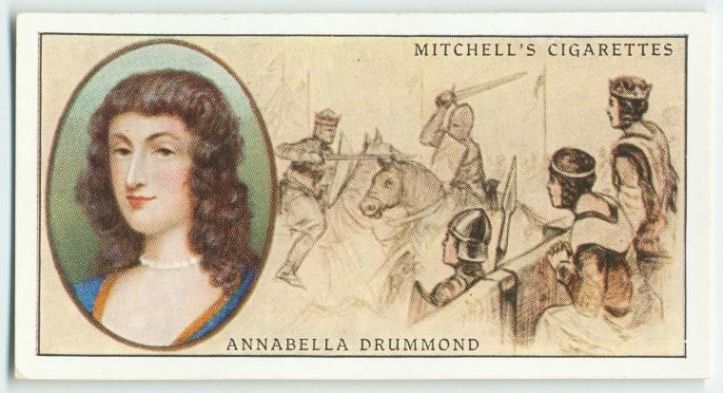
Photo credit: The New York Public Library.
Annabella Drummond was also the great (x8) aunt of Barbara Blair’s husband, John Drummond, 8th of Colquhalzie.
This meant that while John Drummond, 8th of Colquhalzie was a descendant of King Robert II, his wife Barbara Blair, as a descendant of King Robert III, was a generation closer to the Royal House of Stewart.
Generation 1: William Blair of Tarsappie, 1st Baron of Tarsappie and his wife Margaret Olipher
As noted in Part 1, it seems likely that Barbara Blair was the daughter of William Blair, 1st Baron of Tarsappie and his first wife, Margaret Olipher, rather than of his second wife, Catherine Blair.
It seems possible that William Blair, 1st Baron of Tarsappie may have matriculated arms with the Lyon Court, but as yet we have found no trace of this.
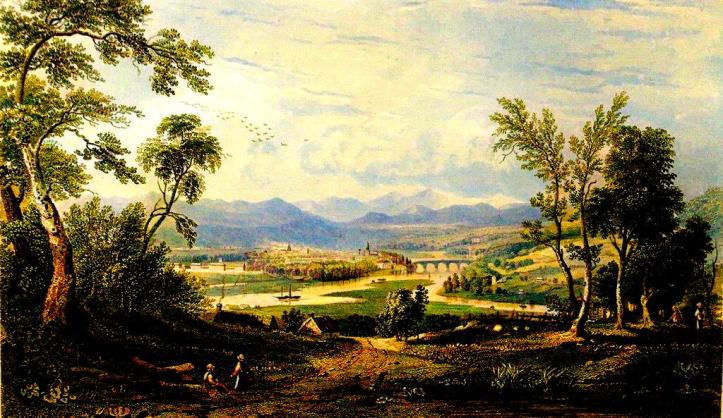
From the author’s collection.
Generation 2: Alexander Blair, 5th of Balgray and his wife Christian Blair
William Blair’s father, Alexander Blair, was the 5th laird of Balgray, while his mother was Christian, daughter of Thomas Blair 6th laird of Balthayock and 1st Baron of Balthayock.
The couple were fourth cousins, both being descended from Sir John Oliphant of Abergalgie and his wife Margaret Ogilvie.
There were two, seemingly unrelated families named Blair in Scotland, both of whith claimed to be the senior. According to an article entitled Blair Surname History, by William Campbell Blair, MD and Bryce Dixon Blair on The Blair Society for Genealogical Research:
"There are two well-documented, ancient Scottish Blair families, the Blairs of that Ilk (also called the Blairs of Blair) in Ayrshire, and the Blairs of Balthayock in Perthshire. It has long been a matter of debate as to whether they arose separately, or both had a common origin with the Barony of Blair in Ayrshire. Recent research by Jack Blair, of Perthshire, Scotland, suggests they did not share a common ancestor (Ref. 1). On the other hand, Jack Richard Blair, of Sydney, Australia has presented a case that the two early Blair families do share a common origin (Ref. 4).

"Ref. 1)The Blairs of Balthayock and their Cadets 1150-1180, by Jack Blair, Anne Groome, et al. published in 2001 by Gateway Press, Baltimore, MD. Detailed Genealogical and Historical account of this family and their branches. Available through the Clan Blair Society, WWW.CLANBLAIR.ORG.

"Ref. 4) The Blair Surname. Its ancient Scottish Origins and the Genealogies of Three Blair Families, (The Blairs of Blair, Ayrshire ca.1135-1878, The Blairs of Balthayock, Perthshire c1205-1862, and the Blairs of Ladymuir, Renfrewshire ca.1597-1997), by Jack Richard Blair, Sydney Australia, 1999. Available through BSGR (On-Line Sales) or CBS (Book Store).'
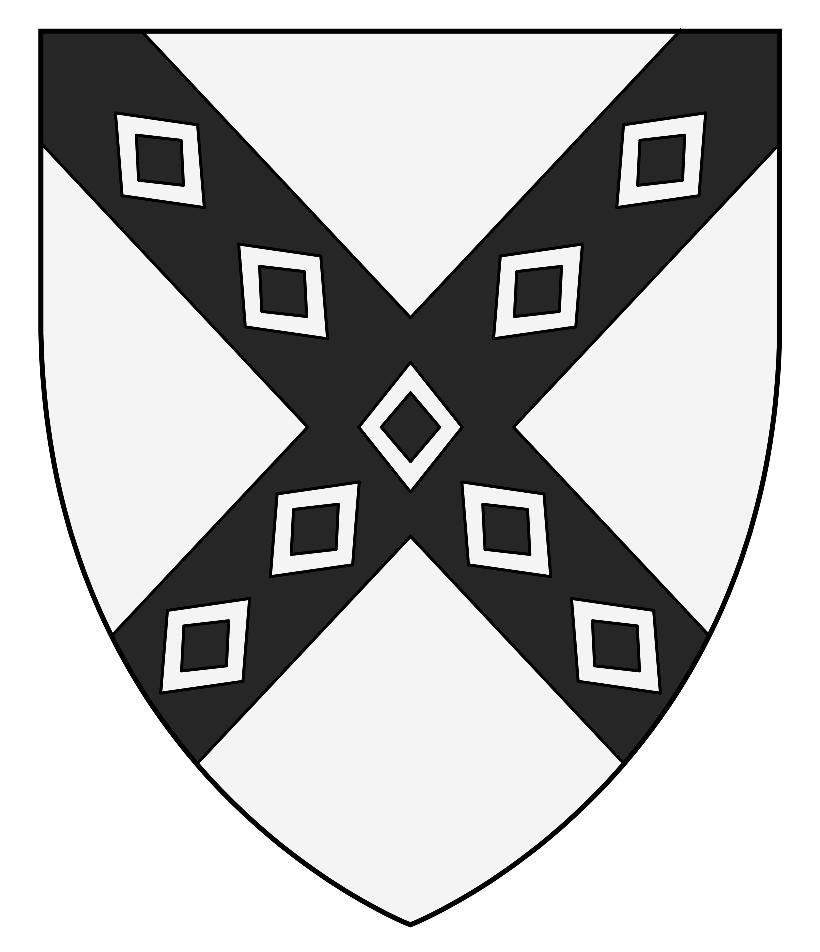
Image copyright Wappen Wiki.
The Blairs of Balgray were a junior branch of the Blairs of Melginch, whose founder was Patrick de Blair. Little is known of him other than that he was named in a 1467 charter in which his son, another Patrick Blair, was granted a charter for the lands of Melginch.
Patrick Blair, 1st of Melginch is known to have had two sons, the elder, Thomas who succeeded as the 2nd of Melginch, and the younger, James, who in 1471 was infeft in the lands of Balgray and Pitskellie.
James Blair, 1st of Balgray, was the great (x2) grandfather of Alexander Blair, 5th of Balgray.
The latter was infeft in the lands Pitskilly and the Mill of Bograw, in the barony of Melginch, as heir to his deceased father on 26th August 1577.
As noted above, Alexander Blair, 5th of Balgray married his fourth cousin, Christian, daughter of Thomas Blair, 6th of Balthayock and 1st Baron of Balthayock.
The couple left at least five children:
- Alexander Blair, 6th of Balgray, the eldest son, who succeeded his father.
- William Blair, 1st of Tarsappie, 1st Baron of Tarsappie, and father of our ancestor Barbara Blair.
- Patrick Blair, a Burgess of Perth.
- Elizabeth Blair, who married John Stewart, younger of Carse.
- Janet Blair, who married Patrick Gray of Lynedoch.
It seems likely that the Blairs of Balgray may have matriculated arms with the Lyon Court, but as yet we have found no trace of this.
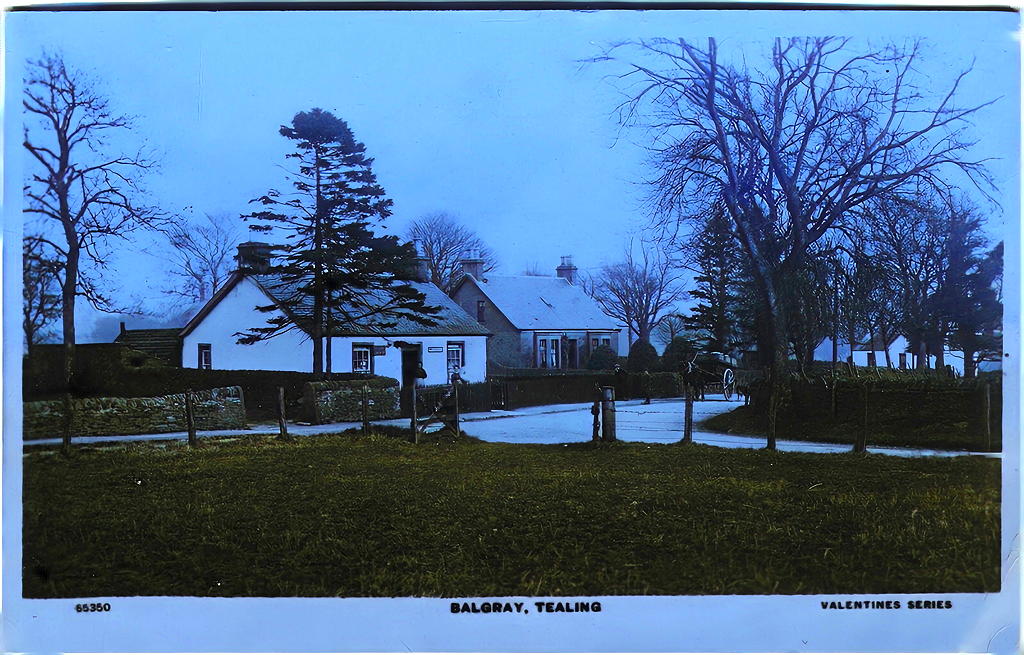
Generation 3: Thomas Blair, 6th of Balthayock, 1st Baron of Balthayock and his wife Katherine Ayton
Thomas Blair was the head of the Balthayock branch of the Blairs, which disputed seniority with the Blairs of that ilk.
He was the son of Alexander Blair, 5th of Balthayock and his wife Janet Gray. He was her first husband.
After Alexander Blair’s death, Janet Gray went on to marry Hugh Fraser, 3rd Lord Lovat, and surviving him, she married thirdly Sir David Lindsay, Lord Edzell.
In 1509, Thomas succeeded his late father and grandfather and was infeft in the barony of Kinnoul as their heir.
In 1534, for a yearly payment of 24 merks, Alexander obtained a Tack from his mother, Janet Gray, for her terce of the lands of Cults.
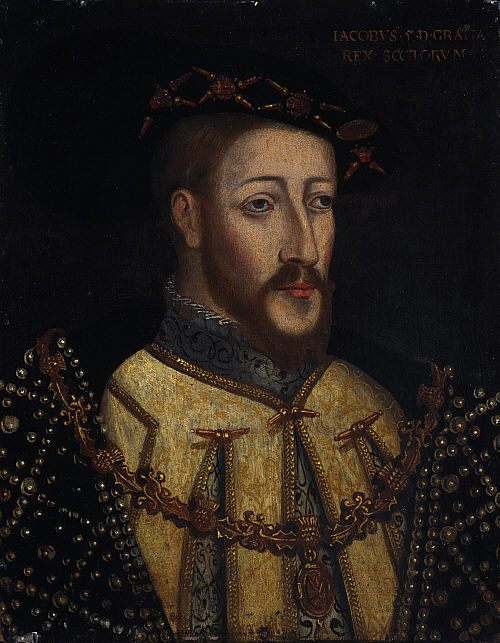
By 1542, Thomas Blair was a “personal servant” to King James V of Scots.
It was no doubt thanks to his closeness to the monarch that on 10th June 1542, the King erected the lands of Ardler and Baldowrie into a free barony of Balthayock, with remainder to Thomas, Alexander, his eldest son and heir, and the heirs of their bodies, which failing, successively and in turn to William, his second son, Patrick, also his son, Patrick Blair of Balmyle, Alexander, brother of Patrick Blair of Balmyle, Alexander Blair, Burgess of Perth, John Blair of Melginch, William Blair of Balgillo, John Blair of Ardblair, Mr. George Blair of Bendochy, George Blair, Burgess of Dundee, Gilbert Blair in Auchteralyth, David Blair of Balgray, George Blair in Pety, which failing, to his nearest heir descended of the family of Balthayock.
(Registrum magni sigilli regum Scotorum : The register of the Great seal of Scotland, A.D. 1306-1668. Vol. 3, no. 2683.)
This made Thomas Blair, 6th laird of Balthayock and 1st Baron of Balthayock. The advancement was an important one as it raised Thomas from the ranks of the gentry (i.e. a Laird) to that of nobility (i.e. a Baron), and just one step below that of a peer of the realm (the lowest rank being Lord of Parliament).
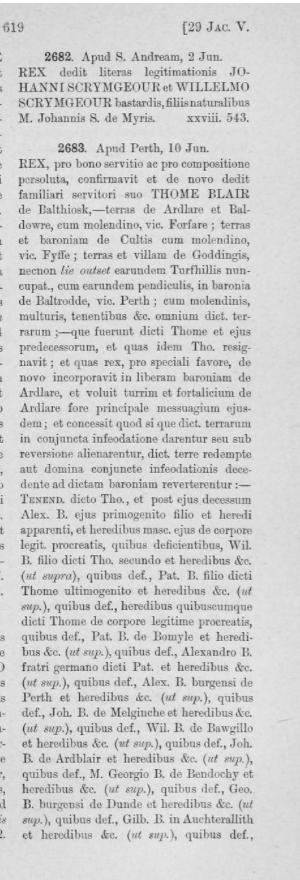
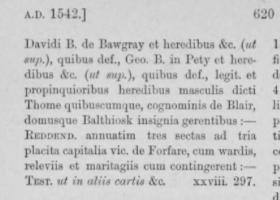
However, the fall of Thomas Blair was as rapid as his rise.
On 24th November 1542, the Scots army suffered at catastrophic defeat by the English at the Battle of Solway Moss. The effect on the king appeared to be dramatic. He fell victim to a complete mental and physical collapse and on 14th December 1542, King James V died.
He was aged just thirty and was succeeded by his five or six day old daughter, who became Mary, Queen of Scots.
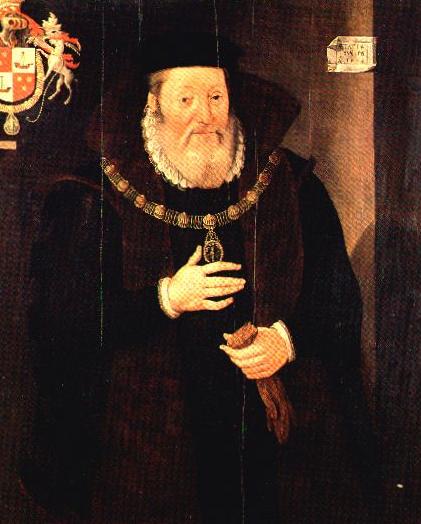
From a painting at Lennoxlove House, Haddingon, East Lothian, home of the Duke of Hamilton.
After the death of King James V, the second in line to the kingdom of the Scots was his second cousin, James Hamilton, 2nd Earl of Arran. Arran was the grandson of James Hamilton, 1st Lord Hamilton and Princess Mary, daughter of King James II, and he was appointed as Regent on 3rd January 1543.
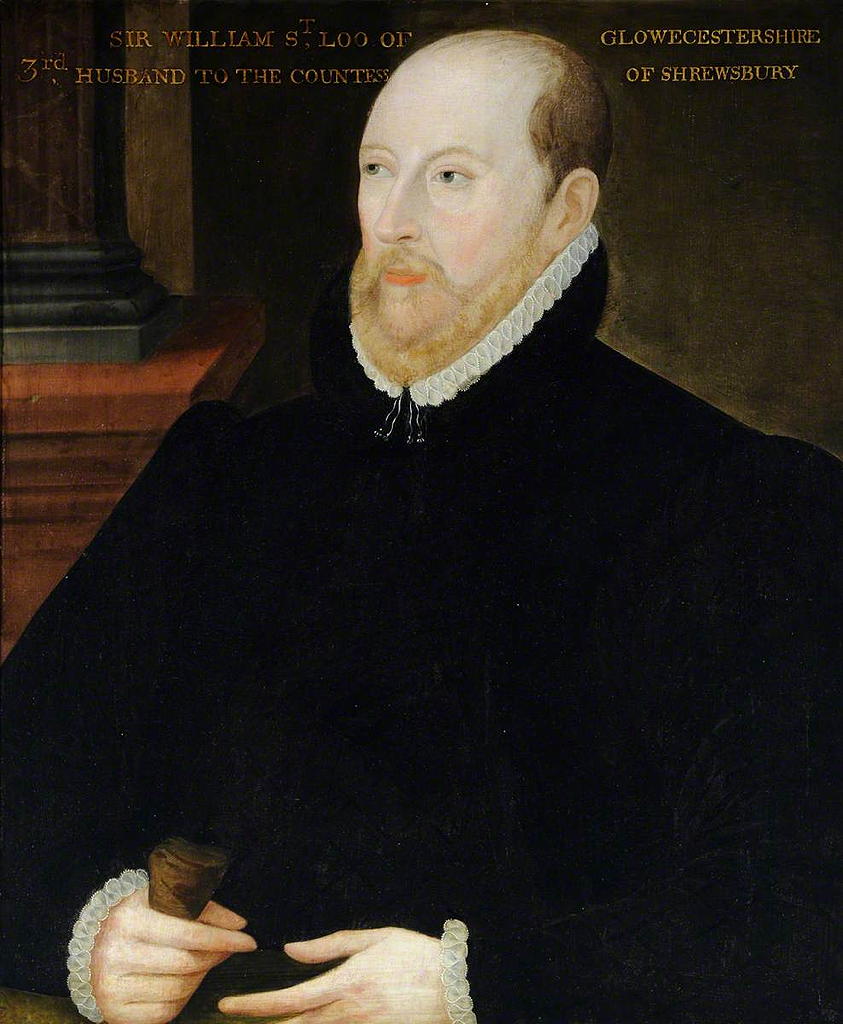
From a painting at Hardwick Hall, now owned by the National Trust.
However, Arran’s right to govern Scotland was challenged by Matthew Stewart, 4th Earl of Lennox, and his supporters. Lennox’s eldest son, Henry, Lord Darnley (1546-1567) would go on to marry Mary Queen of Scots and be the father of the future King James VI of Scotland and I of England.
Lennox was also in the line of succession to the throne of Scotland, being the great grandson of James Hamilton, 1st Lord Hamilton and Princess Mary, daughter of King James II. Lennox’s grandmother was the sister of James Hamilton, 1st Earl of Arran. James 2nd, Earl of Arran was the son of the 1st Earl of Lennox, by his second marriage. Matthew Stewart, 4th Earl of Lennox claimed that the 1st Earl of Arran’s divorce and second marriage were invalid, thus implying that the Regent was illegitimate.
Thomas Blair may have been a member of the Lennox faction. On 22nd April 1544, he entered into a Bond of Maintenance and Friendship with John Ross of Craigie and William Moncrieff of that Ilk.
Thomas Blair and John Ross of Craigie were ordered by the Regent Arran to leave Perth and as they had not complied, on 8th November 1544, he and Ross were “put to the horn“. Under the Privy Seal on that date, the Regent Arran made a gift of all the moveable possessions of the two outlaws to David Charteris, brother of Thomas Charteris of Kinfauns. (For more information on the Charteris Barons of Kinfauns, see Part 1).
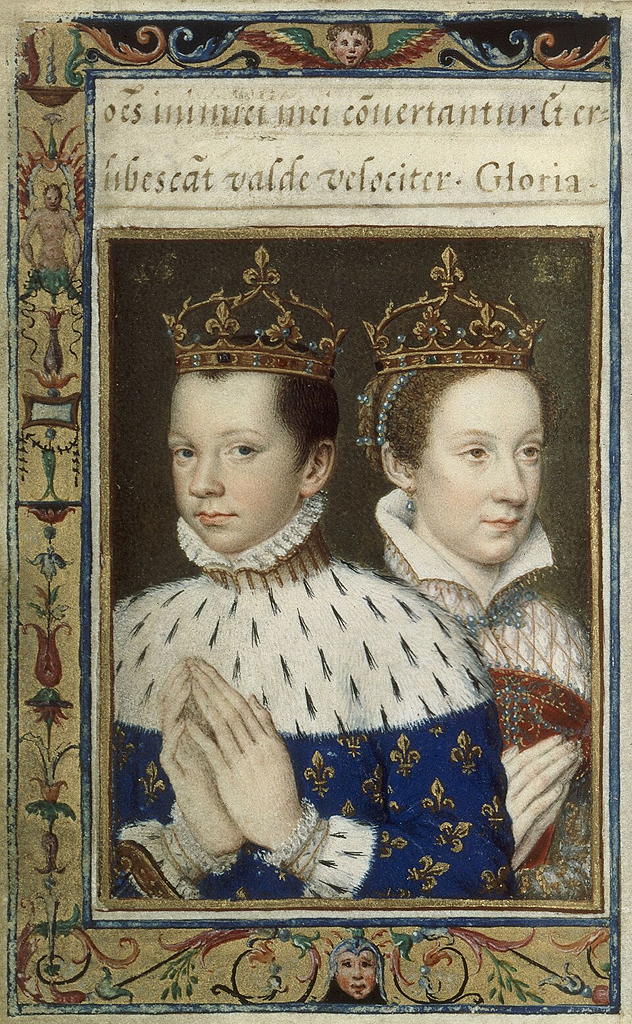
Image credit: Bibliothèque nationale de France, NAL 83, folio 154 v.
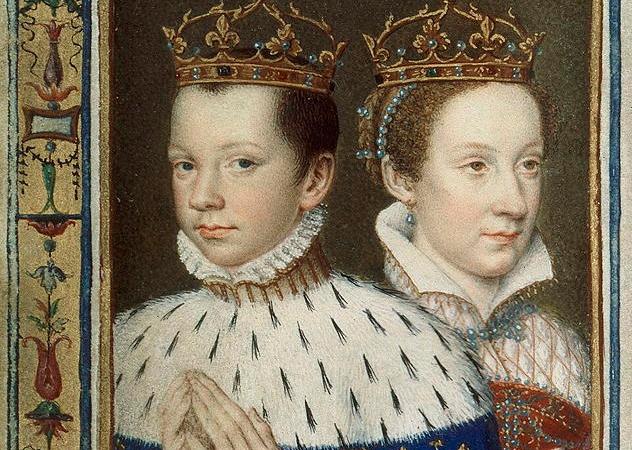
On 7th July 1548, the Treaty of Haddington was signed between France and Scotland. Mary, Queen of Scots was betrothed to the Dauphin François, eldest son of Henri II of France and Caterina de’ Medici. In return, the French sent military aid to raise the Siege of Haddington. The five-year old Mary, went to live in France, and on 25th March 1558, she married the dauphin, who later, albeit briefly, became King François II of France, with Mary as his Queen consort.
Following the Treaty of Haddington, the dauphin’s father, King Henri II of France described himself as “Protector of Scotland” and as a sweetener, on 8th February 1549, the French King appointed James, 2nd Earl of Arran to be Duke of Châtellerault in France and a knight of the Order of Saint Michael.
It was not until 11th February 1550, that the outlawed Thomas Blair of Balthayock came in from the cold and was allowed a gift of the ward of the lands of Kynnell following the death of his mother, Janet Gray.
Finally, on 3rd February 1552, Thomas Blair received a gift of the ward of his own lands, which had fallen to the crown on the death of the superior, William, Lord Crichton of Sanquhar.
He did not enjoy his reinstatement for long, dying some time between 23rd August 1553 and 1568.
Thomas Blair married a Katherine Ayton. We have yet to research her ancestry, but she may have been the daughter of Andrew Ayton of that Ilk and Isabel Kincragie.
Thomas Blair and Katherine Ayton are known to have had the following children:
- Alexander Blair, the eldest son, who succeeded his father to become 7th laird of Balthayock and 2nd Baron of Balthayock.
- William Blair, is styled the second son in the remainder of father’s charter the lands of Balthayock in 1542.
- Patrick Blair, is styled “filius ultimogenito” in the remainder of his father’s charter for Balthayock in 1542.
- Katherine Blair, who married Thomas Chalmer of North-Leys and Seggieden.
- Isabella Blair, who married John Lindsay of Evelick.
- Christian Blair, married Alexander Blair of Balgray.
- Euphemia Blair, who married firstly, Andrew Scott at Kirkcroft, and secondly, James Monorgund of that Ilk.
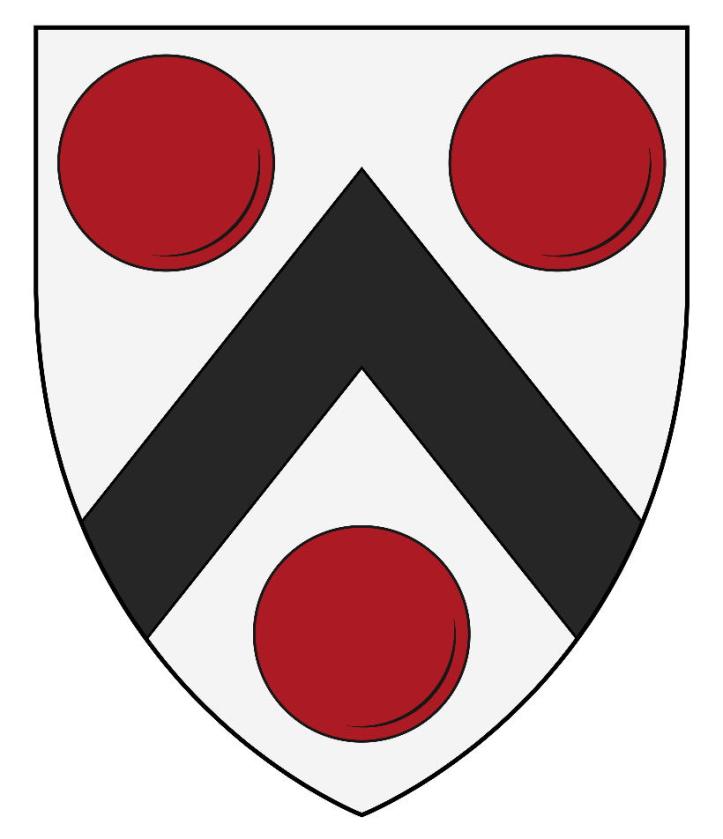
Image copyright Wappen Wiki.
Generation 4: Alexander Blair, 5th of Balthayock and his wife Janet Gray
It should be noted that there can be confusion in the numbering of the lairds of Balthayock as some histories have counted Patrick Blair, Younger of Balthayock, as the 3rd laird. However, Patrick Blair, eldest son of Thomas Blair, 2nd of Balthayock died in the lifetime of his father. This meant that Thomas Blair, 2nd of Balthayock was succeeded by his grandson, Alexander, who became 3rd of Balthayock, and he in turn was succeeded by his eldest son, Thomas Blair, 4th of Balthayock.
Alexander Blair, 5th laird of Balthayock was the son of Thomas Blair, 4th laird of Balthayock and his wife, Marjory Ogilvy, daughter of Sir David Ogilvy of Inchmartine and his wife Mariota Hay.
Alexander Blair married Janet Gray. She was the daughter of Sir Patrick Gray of Kineff, Master of Gray and his wife Annabella Forbes, Mistress of Gray, daughter of Alexander Forbes, Baron of Forbes and 1st Lord Forbes and his wife Lady Elizabeth Douglas.
According to the “Letters and papers of the Fothringhams of Powrie, the 4th Earl of Perth, and the Blairs of Balthayock“, held in the National Archives of Scotland, on 1st April 1505 Alexander Blair succeeded his father, Thomas Blair, 4th of Balthayock and was served heir in the lands of Balthayock, and others.
Alexander was only laird of Balthayock for a short time, dying sometime between his succession on 1st April 1505 and 2nd May 1508.
Following Alexander Blairs’s death, Janet Gray married again, before 6th May 1509, to Hugh Fraser, 3rd Lord Lovat.
Janet Gray also survived her second husband and was married for a third time, before 1st December 1534, to Sir David Lindsay, Lord Edzell.
Alexander Blair, 5th laird of Balthayock and Janet Gray are known to have had the following children:
- Thomas Blair, 6th laird of Balthayock and 1st Baron of Balthayock
Image copyright Wappen Wiki.
Generation 5: Sir Patrick Gray of Kineff, Master of Gray and his wife Annabella Forbes, Mistress of Gray
Patrick Gray, Master of Gray (also known as Sir Patrick Gray of Kineff) was the son of Andrew Gray, 1st Lord Gray and Elizabeth Wemyss, the daughter of Sir John Wemyss and Isabel Erskine.
Sir Patrick’s father Sir Andrew Gray was held hostage in England for the good conduct of King James I of Scots from 1424 to 1427. He was also one of those who accompanied King James I’s daughter, the Lady Margaret, to France for her marriage to the Dauphin of France in 1436. Sir Andrew was created a Lord of Parliament as Lord Gray around July 1445 by King James II.
Lord of Parliament is the lowest rank within the Peerage of Scotland which also included Viscount (from 1606), Earl, Marquis (from 1488) and Duke (from 1398). Lords of Parliament are distinct from Scottish barons, who were nobility, but not peers. The title Lord of Parliament became popular during the reign of King James II, with nine Lordships being created in 1445 (those of Hamilton, Maxwell, Glamis, Graham, Leslie, Lindsay, Saltoun, Campbell and Gray).
As the eldest son and heir of a Lord of Parliament, Sir Patrick Gray of Kineff held the title “Master of Gray“. The title of Master was not, as often assumed, a courtesy title, but a noble dignity in its own right. Like that of Baron, it conferred rights of attendance to the Scottish Parliament.
Sir Patrick, Master of Gray, married, firstly, Margaret Fleming, daughter of Sir Malcolm Fleming of Biggar & Cumbernauld and Lady Elizabeth Stewart, before 7th February 1440. (1439 Old Style).
Sir Patrick married, secondly, Annabella Forbes, daughter of Alexander Forbes, 1st Lord Forbes and Lady Elizabeth Douglas, before 1445.
He died between 23 August 1463 and September 1464.
As Patrick Gray predeceased his father, Andrew Gray, 1st Lord Gray, the Lordship was inherited by Patrick’s son, Andrew, who became 2nd Lord Gray.
Sir Patrick Gray of Kineff, Master of Gray and Annabella Forbes are known to have had the following children:
- Andrew Gray, 2nd Lord Gray.
- Janet Gray who married firstly, Alexander Blair, 5th laird of Balthayock, secondly Hugh Fraser, 3rd Lord Lovat, and thirdly, Sir David Lindsay, Lord Edzell.
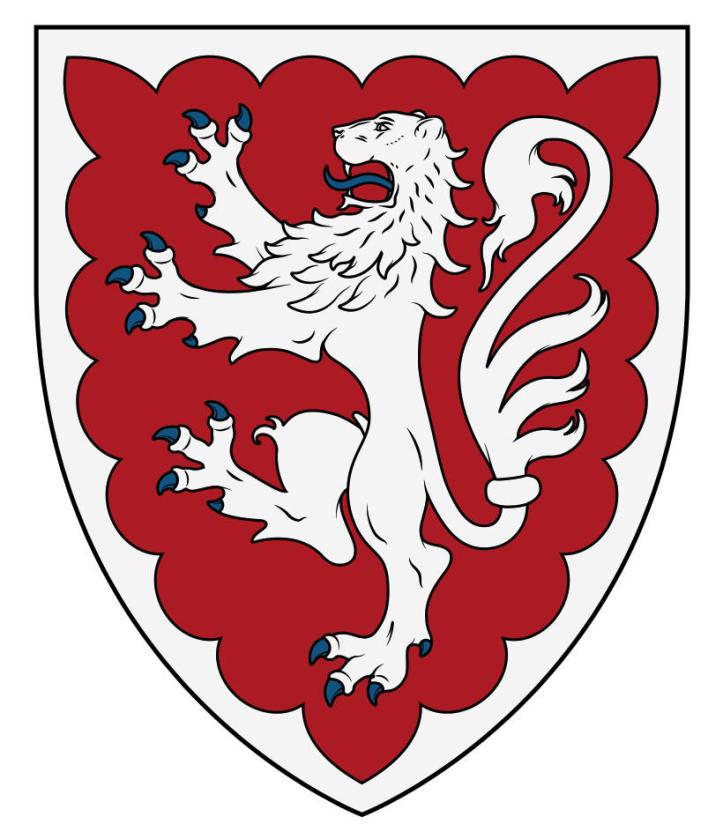
Image copyright Wappen Wiki.
Generation 6: Alexander Forbes, Baron of Forbes, 1st Lord Forbes and his wife, Lady Elizabeth Douglas
Lord Forbes is the senior Lordship of Parliament in the Peerage of Scotland. There were Lordship titles created prior to that of Lord Forbes, but these either became extinct (such as Lord Abernethy, created 1233, extinct 1325) or became subsidiary titles to higher ranks of peerages (such as Lord Strathnaver, created 1235, but became a subsidiary title of the Earl of Sutherland).
The Lordship of Forbes is believed to have been created sometime after 1436 in the reign of King James II for Alexander de Forbes, the Baron of Forbes. The precise date of the Lordship’s creation is unknown. Brown’s 1834 Peerage of Scotland states a creation year of 1440. The title must have been created before 12th July 1442, as in a Precept of that date, Alexander Forbes was styled as Lord Forbes.
Alexander Forbes, 1st Lord Forbes was the eldest son of Sir John de Forbes (who died in 1405), Sheriff-depute of Aberdeen, and Coroner of that shire, and his wife, Margaret Kennedy. She was a daughter of Sir John Kennedy of Dunure and Mary de Montgomery of Stair & Cassillis.
Alexander Forbes was one of those who fought under the banner of the Earl of Mar against the forces of Donald, Lord of the Isles at the bloody Battle of Harlaw on 24th July 1411. Although Mar’s force suffered heavy losses and believed they had been defeated, the Islesmen withdrew during the night, heading firstly to Ross and then back to the Isles, making Harlaw a tactical victory for the Earl of Mar.

Illustration from the manuscript of Martial d’Auvergne, Les Vigiles de Charles VII, c. 1484.
Alexander Forbes was also among the Scottish forces sent to the assistance of Charles, Dauphin of France, afterwards crowned as King Charles VII of France, and he had a share in the victory obtained over the English at Beaugé, in Anjou, on 22th March 1421. This little-known battle is considered to be Scotland’s third most important victory over an English army, rating only behind Bannockburn and Stirling Bridge. The joint army of Scots and French was led by John Stewart, Earl of Buchan, and Gilbert Motier de La Fayette, the Marshal of France, and was believed to number around 5,000. Facing them was an English army of about 4,000, led by Thomas of Lancaster, Duke of Clarence, who was killed in the action. The Duke of Clarence was the second son of Henry IV of England and the younger brother of Henry V. He was heir presumptive to the throne and if Henry V had died without an heir, Clarence would have succeeded him as King of England.
Alexander Forbes, 1st Lord Forbes married the Lady Elizabeth Douglas (sometimes referred to as Mary), who was only daughter of George Douglas, 1st Earl of Angus and his wife Lady Mary Stewart, daughter of King Robert III and his Queen consort Annabella Drummond.
Lady Elizabeth (or Mary) Stewart was married twice, firstly to Alexander Forbes, 1st Lord Forbes, son of Sir John Forbes of that Ilk and Elizabeth Kennedy, between 6th October 1423 and 16th October 1423.
After the death of Alexander Forbes, 1st Lord Forbes in 1448, Lady Elizabeth Stewart married, secondly, Sir David Hay of Lochorwart & Yester, the son of Sir William Hay of Lochorwart & Yester and Alice de la Haye.
Alexander Forbes, 1st Lord Forbes and Lady Elizabeth Stewart are known to have had the following children:
- Annabella Forbes, who married Sir Patrick Gray of Kineff, Master of Gray
- James Forbes, 2nd Lord Forbes
- William Forbes
- Margaret Forbes
- Elizabeth Forbes
- Susanna Forbes
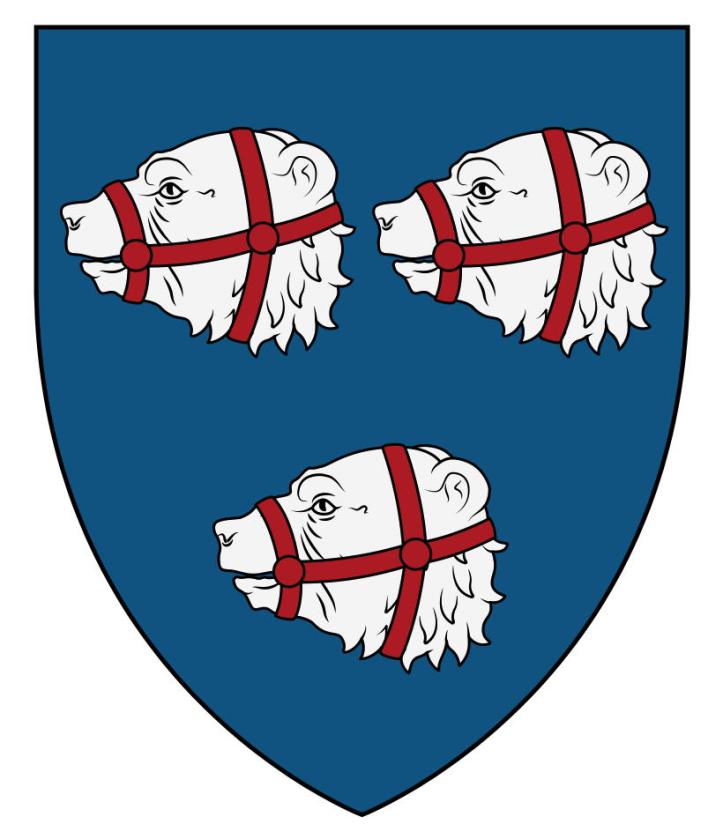
Image copyright Wappen Wiki.
Generation 7: George Douglas, 1st Earl of Angus and his wife, Lady Mary Stewart, Princess of Scots
The Stewarts, Douglases and Drummonds were three of the most prominent families in Scotland at the death of King David II, second king of the House of Bruce, on 22nd February 1371. David Bruce was succeeded by his half- nephew, Robert Stewart, son of Marjory Bruce and her husband, Walter Stewart, 6th High Steward of Scotland. Robert Stewart thus became King Robert II and the first of the Stewart dynasty that would rule Scotland, and then England until the death of Queen Anne in 1714.(1)
(1) With the exception of between 1652 (1649 in England) and 1660, when the Three Kingdoms became a republic known as “The Commonwealth“.
As detailed in Lords of Misrule and the Barons of Brechin, the Stewart family was as dis-functional as it was numerous. George Douglas, 1st Earl of Angus, was the founder of the Red Douglas line and he was a crucial player in the struggles for power between the Stewarts and the Black Douglases. Some of the complicated relationships involved are noted below.
Alexander, Earl of Mar, was the illegitimate son of Alexander Stewart, Earl of Buchan and grandson of Robert II, the first Stewart King. Alexander was the second husband Isabel Douglas (circa 1360 – 1408), Countess of Mar suo jure (in her own right).
Countess Isabella of Mar’s first husband was Sir Malcolm Drummond, who became Earl of Mar jure uxoris (in right of his wife). Sir Malcolm was born in 1351, and was he was the brother-in-law of King Robert III, with his sister Annabella Drummond being the Queen consort. Sir Malcolm had acquired Cargill, Stobhall, Kinloch and other lands from his aunt, Queen Margaret Drummond, the second wife of King David II (Bruce).
Countess Isabel of Mar was the sister of the famous warrior, James Douglas, 2nd Earl of Douglas & Earl of Mar, who had died while leading the Scots to a famous victory at the Battle of Otterburn on 5th August 1388. Upon his death without legitimate issue, Isabel had succeeded her brother to become Countess of Mar suo jure (in her own right)
Isabel, Countess of Mar and James Douglas, Earl of Douglas & Mar were the children of William Douglas, 1st Earl of Douglas, and wife Margaret, Countess of Mar, suo jure. Margaret became Countess of Mar in her own right after the death of her brother Thomas, 9th Earl of Mar, without any children. Thomas was the last male heir of the old Celtic line of the Mormaers of Mar and was 9th, 10th or 13th Earl, depending on the numbering system used.
Upon the death of James, 2nd Earl of Douglas, the Earldom was inherited by his cousin (and that of Isabel of Mar) Archibald “the Grim“, Lord of Galloway, an illegitimate son of Sir James Douglas, known as “The Black Douglas” who was a trusted lieutenant of Scotland’s hero king, Robert the Bruce. Archibald had been appointed Lord of Galloway by King David II in 1369.
To add to an already complicated story, James Douglas, 2nd Earl of Douglas & Earl of Mar had an illegitimate son, George Douglas, with Margaret Stewart, widow of Thomas, 9th (or 10th or 13th) Earl of Mar. Margaret was the daughter of Thomas Stewart, 2nd Earl of Angus and was Countess of Angus and Lady of Abernethy in her own right. It their son, George Douglas, 1st Earl of Angus who is the subject of our biography here and the ancestor of Barbara Blair.
Margaret Stewart, Countess of Angus relinquished her title in favour of her son, George Douglas, who thus became the first Douglas to hold the title of Earl of Angus. George Douglas married Princess Mary Stewart, daughter of King Robert III, who, in 1397, confirmed him as George Douglas, 1st (or 4th) Earl of Angus. This new Douglas line later became known, as the Red Douglases.
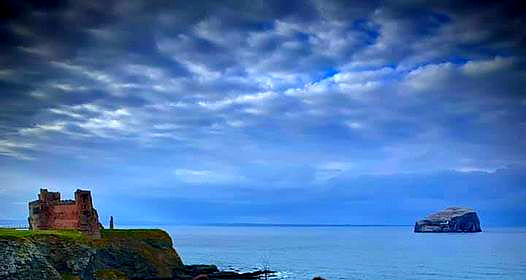
The Red Douglases remained loyal to the Stewarts, in contrast to the mighty Black Douglases, who became by far the most powerful nobles in the South of Scotland and a thorn in the side of the royal house. So many female Stewarts were married to Douglases that there was a real possibility that a Douglas might, either by inheritance or battle, become Kings of Scots. There were years of feuds and murders, some of which became inspiration for George R. R. Martin’s Game of Thrones.
The Black Douglases finally entered into open rebellion against the Stewarts but on 1st May 1455, a small but decisive battle at Arkinholm near Langholm ended the civil war. The royal army was led by George Douglas, Earl of Angus. The head of the Black Douglases, James Douglas, 9th Earl of Douglas, had headed to England to seek support, but his three younger brothers were present at the battle. Of these three, Archibald Douglas, Earl of Moray was killed in the battle and his head presented to King James II; Hugh Douglas, Earl of Ormonde was captured and executed shortly afterwards; while John Douglas, Lord of Balvenie escaped to join his brother James in England.
Shortly after the battle the Black Douglases were attainted, the last few castles held by them fell, and they ceased to be a serious force in Scotland. As a reward for his loyalty, George Douglas, Earl of Angus was awarded the earldom of Douglas, that had previously been held by his third cousin, James Douglas, 9th Earl of Douglas.
George Douglas, 1st Earl of Angus and Lady Mary Stewart are know to have had the following children;
- William Douglas, 2nd Earl of Angus (1398–1437).
- Lady Elizabeth Douglas, married firstly to Sir Alexander Forbes Baron of Forbes, later 1st Lord Forbes and married secondly to Sir David Hay of Yester.
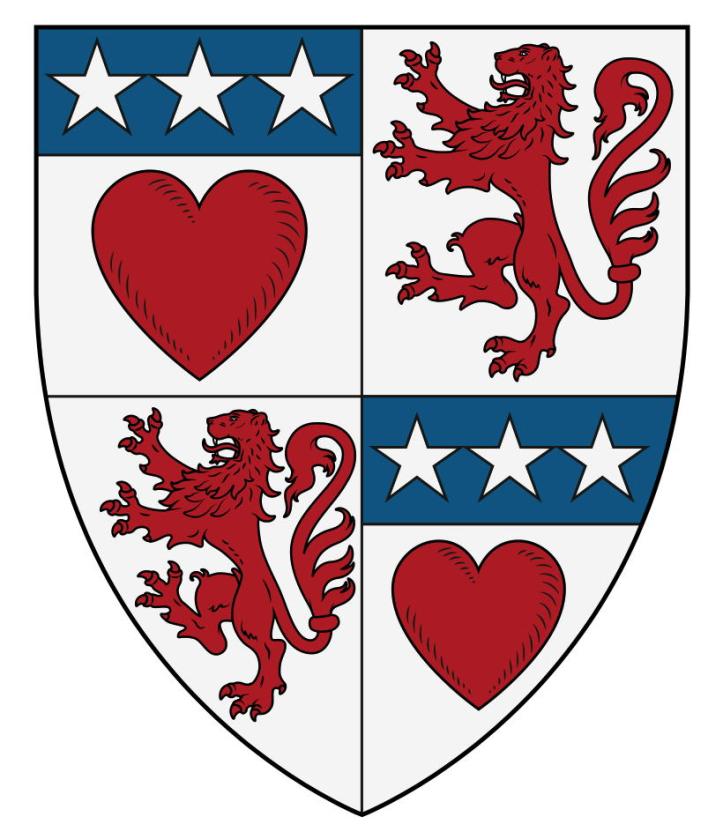
Image copyright Wappen Wiki.
Generation 8: John Stewart, who reigned as King Robert III of Scots and his Queen consort, Annabella Drummond
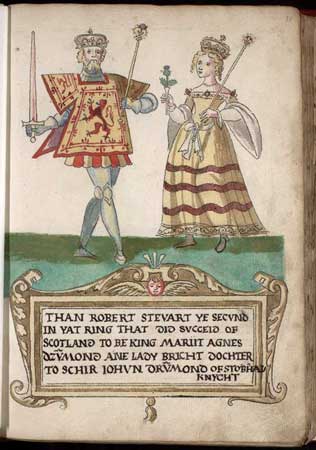
Used with the permission of the National Library of Scotland.
And finally, we arrive at Barbara Blair’s royal ancestors, King Robert III of Scots and his Queen consort, Annabella Drummond.
We have already written in detail about them in articles such as Lords of Misrule and the Barons of Brechin and The Drummonds of Colquhalzie, so they need no further introduction here.
Suffice to say that when we set out to research the ancestry of Barbara Blair, we had little hope of getting very far, let alone to the Royal House of Stewart.
So, as Eve Pryde-Roberts wrote in Fife Coal Mining Ancestors – At Last!:
“Never stop trying – there is hope for everyone with their brick walls!“
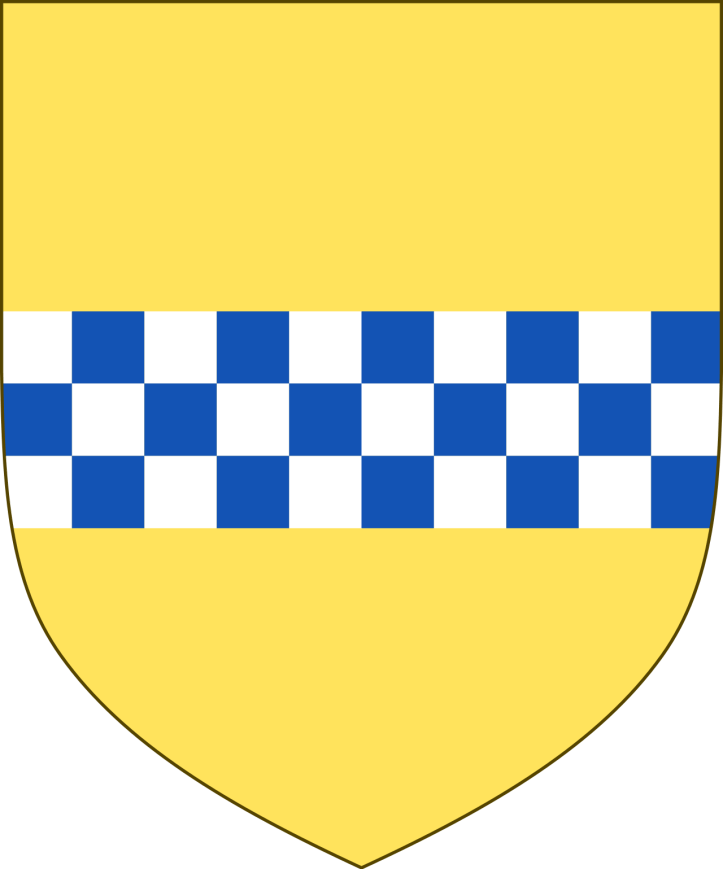
Image credit: Julie Anya Guthrie.
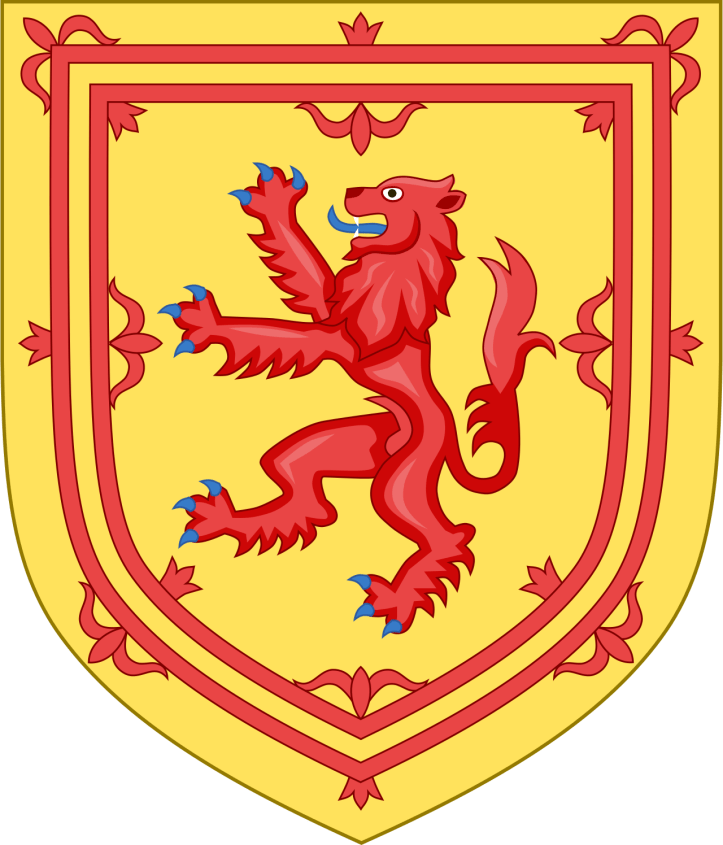
Image credit: Julie Anya Guthrie.
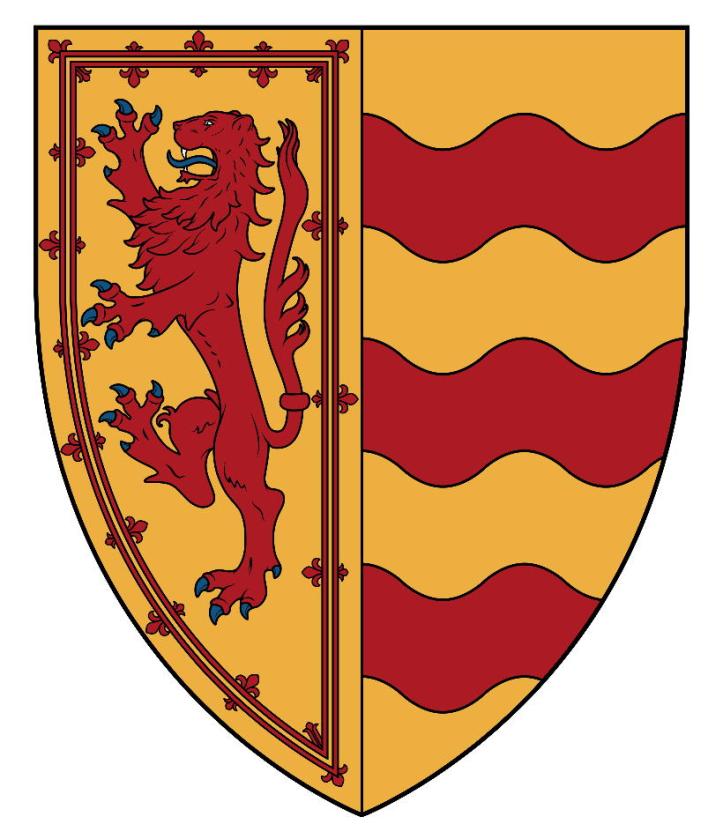
Image copyright Wappen Wiki.


[…] The Blairs have been discussed in detail in The Royal Stewart ancestry of Barbara Blair, wife of John Drummond, 8th of Colquhalzie: Part 2 The R…. […]
LikeLike
[…] Robert III has been discussed in previous articles including The Royal Stewart ancestry of Barbara Blair, wife of John Drummond, 8th of Colquhalzie: Part 2 The R… and Lords of Misrule and the Barons of […]
LikeLike