

“Blair as a place name is found in over two hundred localities throughout Scotland. Blair as a surname in Scotland is first recorded in the early 1200s with two main families – Blair of Blair (also known as Blair of that Ilk) from Ayrshire, and Blair of Balthayock from Perthshire, with no known evidence of a common ancestor.”
“The Clan Blair Society – Celebrating Blair and Scottish Heritage”. Clan Blair Society.
This is the first in a series of articles on the ancestry of Barbara Blair, wife of John Drummond, 8th of Colquhalzie and mother of our gateway ancestor Thomas Drummond.
In it we take a light-hearted look at the use of photographs, portraits and avatars in family history profiles and attempt to determine the identity of the parents of Barbara Blair.
While we cannot be certain, it seems likely that Barbara was the daughter of William Blair, 1st Baron of Tarsappie and his first wife, Margaret Olipher, rather than of his second wife, Catherine Blair.
Barbara Blair, wife of John Drummond, 8th of Colquhalzie
As detailed in a previous post, David Freer recently broke down a brick wall in our Drummond line when he proposed that our Thomas Drummond, great-grandfather of Colin Drummond of Auchterarder, was a son of John Drummond, 8th laird of Colquhalzie and Barbara Blair.
The Register of Sasines records that John’s father, John Drummond, 7th of Colquhalzie, resigned his lands in favour of his son, John and his wife, Barbara Blair on 21st November 1631, indicating that the couple had married before this date.
RS50: Particular Register of Sasines (Perthshire).
Volume 6. Folio 9.
Sasine in favour of John Drummond, younger of Colquhalzie, eldest son and heir of John Drummond of Colquhalzie, for the lands of Colquhalzie to be held by John younger, and Barbara Blair, his wife.
Dated 21 November 1631.
However, John’s father, the 7th laird, appears to have reserved a life-rent of Colqualzie as on 15th May 1641, at the baptism of their daughter, Isobell, John (8th of Colquhalzie) is recorded as “fiar” of Colquhalzie, rather than “laird“.
In Scots law, a fiar was the person who held the fee-simple (ultimate ownership) of a property, often the heir apparent, while someone else (usually a parent) might retain the “life-rent” (the right to use the property during their lifetime).
Viscount Strathallan’s 1691 work was an excellent place to start to research the Drummonds of Colquhalzie. However the ancestry of John Drummond’s wife Barbara Blair proved to be more of a challenge.
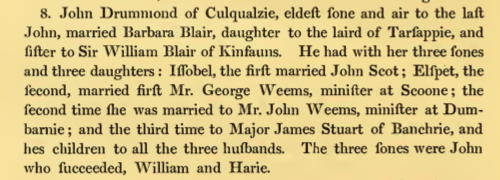
Viscount Strathallan noted that Barbara Blair was “daughter to the laird of Tarsappie and sister to Sir William Blair of Kinfauns“, but he did not report the names of her parents.
Therefore, we initiated a search to attempt to discover their identities.
The “Lords of Kinfauns” website
Claudius: “Excuse me. The book you want, it’s on the t-t-top shelf, fourth from the window at the back. I had it out the other day. Only the t-t-title is Dissertation on Tactics and it’s by P-P-Polemocrates, not Polemocles, and he was a J-J-Jew, not a Greek.“
Livy: “You’d better be right, boy! I don’t take kindly to that many corrections in one day!“
Claudius: “Have I upset him?“
Pollio: “Yes! It’ll do him good!“
I, Claudius (1976) Episode 4. What Shall We Do About Claudius?
Photo credit: Strawmoddie Theatre Company.
A beautifully-presented website dedicated to the “Lords of Kinfauns” appeared to be an excellent resource regarding the Blairs. It is hosted by the current Baron of Kinfauns, Fergus Commane, who states that he purchased the baronial title in 2011 from the 20th Earl of Moray.
The colourful site listed the “Lords” of Kinfauns from 1330 starting with the “Red Reaver, Sir Thomas Charteris. The site notes that Charteris family held Kinfauns for almost 300 years until it passed to an adoptive son, the Earl of Crawford in 1608. From then Kinfauns passed rapidly through several different families. In 1621 it passed to the Hays, and in 1647 to the Blairs. In 1695 Kinfauns was inherited by a member of Carnegie family, who adopted the surname of Blair. Then, in 1741, the last Blair heiress married John, Lord Gray and the Kinfauns title was held by the Gray family until 1878. Kinfauns was then inherited by Edmund Stuart, who in 1895 also become Earl of Moray. The Kinfauns title remained with the Earls of Moray for five generations until it was finally purchased by Fergus Commane in 2011.
The entry of interest to us on the Kinfauns site states: “Sir Alexander (Blair of Balthayock) played a pivotal role in the transfer and consolidation of the barony of Kinfauns, a significant estate in Perthshire. In 1647, Sir Alexander and his wife, Dame Elizabeth Fotheringham, formally granted the lands and lordship of Kinfauns, along with associated rights and properties, to their son, William Blair of Kinfauns through a Crown-backed disposition. This included hereditary rights such as the office of Baillie of the Tay, teind sheaves, and salmon fishings on the River Tay.“

Charles Gray as “The Criminologist – An Expert” in The Rocky Horror Picture Show (1975).
And, so, thanks to the Lords of Kinfauns site, it seemed that fortune had smiled upon us and that we had discovered the identity of the parents of Barbara Blair and her brother Sir William Blair of Kinfauns.
Or had we?

Warning bells soon began to sound. The site presents a biography of the “23rd Lord Kinfauns, 19th Earl of Moray, Archibald John Morton“. However, his surname was Stuart, not Morton. He is then described in the entry’s text as “Morton Gray Stuart“, who was the 17th Earl of Moray, not the 19th Earl. In addition, I was lucky to be familiar with the associated image and recognised it immediately as James Gray Stuart, 1st Viscount Findhorn (1897 – 1971). James Gray Stuart was the third and youngest son of Morton Gray Stuart, 17th Earl of Moray and younger brother of the 18th and 19th Earls. He was joint-Parliamentary Secretary to the Treasury in Winston Churchill’s war-time coalition government and later served as Secretary of State for Scotland, firstly under Churchill and then under Sir Anthony Eden, from 1951 to 1957. In 1959, he was elevated to the peerage as the 1st Viscount Stuart of Findhorn.
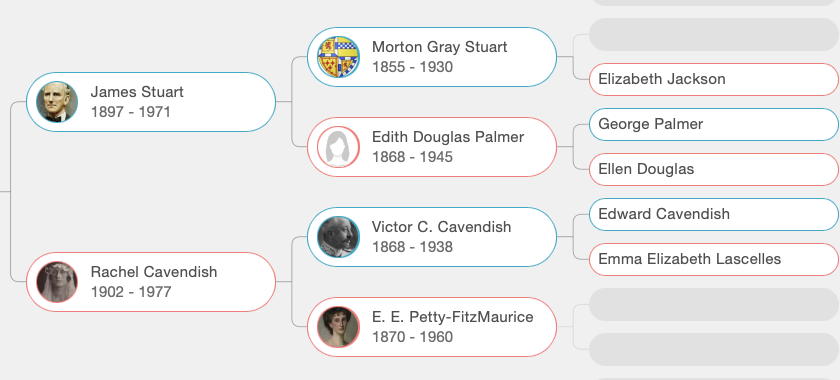
A great-grandchild of James Stuart, 1st Viscount Findhorn is a DNA match, sharing a 20.4 cM fragment on chromosome one. Note that Viscount Findhorn’s portrait is the same as that used for his brother, the 19th Earl of Moray on the Lords of Kinfauns site.
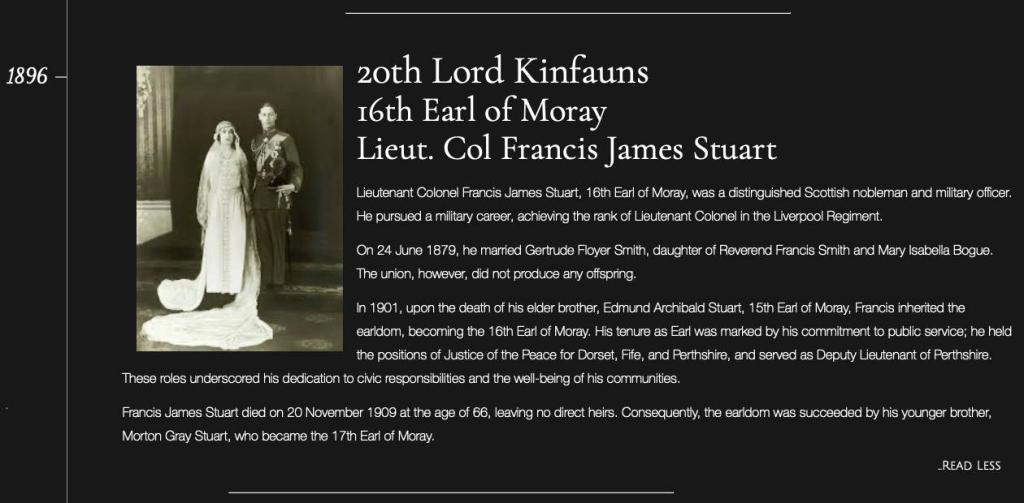
Meanwhile, a photo that appears in the biography of the “20th Lord Kinfauns, 16th Earl of Moray, Lieut. Col Francis James Stuart” is unmistakably one of the then Duke of York, later King George VI, and the then Lady Elizabeth Bowes-Lyon, later Queen Elizabeth and subsequently Queen Elizabeth the Queen Mother.

The image in the biography of the “8th Lord Kinfauns, Sir Alexander Blair of Balthayock” is actually a portrait of British Prime Minister Thomas Pelham-Holles, 1st Duke of Newcastle (1693–1768).
The image presented as the “9th Lord Kinfauns, Sir William Blair of Kinfauns, 1st Baronet” is actually of Thomas Howard, 8th Duke of Norfolk, and was painted around 1725 by Richard van Bleeck.
But does this “artistic licence” really matter?
Or is it simply misleading?
The Use Of Avatars in Family History
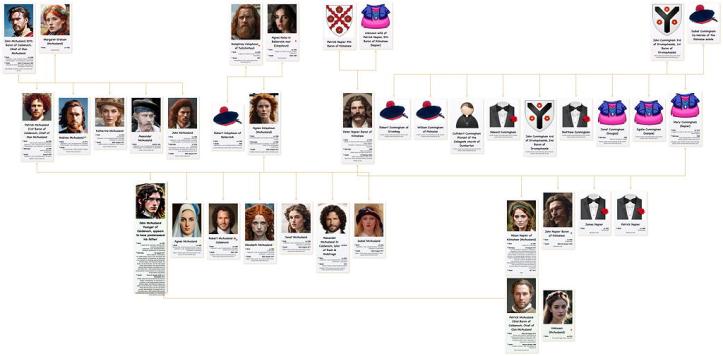
Avatars Copyright Playgroup.
The use of avatars is not unusual in family history, as they can often brighten up an otherwise rather dull-looking tree.
I first noticed the use of avatars in a fascinating presentation concerning an East Lothian family at one of the excellent Scottish Indexes conferences.
However, caution is advised when attaching photographs or portraits to a different person unless the identity of the person used in the image is clearly stated, especially if the tree is not a private one.
Sadly, worldwide community family trees such as those on Family Search are now riddled with countless profiles containing misleading images that are of a different individual to the person indicated. Unsuspecting users then copy those images to their own trees, both private and public, without realising that what they are adding is not a representation of their person of interest, but of someone completely different. And in our digital age, in next to no time, the misleading images can become viral.
Some of these rogue images are fairly simple to detect e.g. due to a fashion that is clearly from a different period in history.
But some can be more difficult to root out.
One example is an image which appears in many trees as a portrayal of Archibald Douglas, 4th Earl of Douglas and 1st Duke of Touraine, who was the head of Scotland’s most powerful family, the Black Douglases, a dynasty that rivalled and threatened even the Royal House of Stewart itself. Archibald was the cousin of James, 2nd Earl of Douglas & Earl of Mar, who died at the 1388 Battle of Otterburn. He was also the son of Archibald Douglas “the Grim“, 3rd Earl of Douglas and grandson of “the good” Sir James Douglas, friend and companion of King Robert I (“the Bruce“).

As a test, I uploaded an image (below) that was supposedly Archibald, 4th Earl of Douglas to Google reverse image search and was informed that it was indeed, the 4th Earl of Douglas. So far, seemingly, so good.
I also sent the image to a distant relative who, unlike me, is an enormous fan of AI. He informed me that his extensive AI searches indicated that the portrait was not of Archibald Douglas, but of his grandfather, Sir James Douglas. (See tree above.)
I then instigated my own mini “Fake or Fortune?” investigation, and was able to trace the provenance of the portrait.
The image was believed to be a portrait of a member of the Douglas family until 1909 when it was correctly identified.
The portrait is, in reality, a copy of a painting of Charles d’Amboise, by Bernardino de Conti.
The original is currently held by the Seattle Art Museum in Washington state, USA.

Bernardino de’ Conti Italian, Milan, ca. 1470 – ca. 1522.
The French nobleman Charles d’Amboise became the governor of the Duchy of Milan after it was conquered by France. The collar of scallop shells and knots denotes the Order of Saint Michael, granted to him about 1505, perhaps the occasion for commissioning this portrait. D’Amboise was a friend and patron of Leonardo da Vinci, but he hired a more conservative artist for his portrait and chose to be portrayed in a classic profile view, which records his features but provides no psychological insight. He most likely wanted to link his image with the great rulers of the ancient past, depicted in side views on coins and medals like those shown in the case nearby. D’Amboise himself was an avid coin collector, as he proudly demonstrates here.
Oil on panel, 13 3/4 x 12 1/2 in. (34.9 x 31.8 cm), Samuel H. Kress Collection, 61.150
Provenance: King Henry VIII of England (1491-1547), by 1542 (as listed in Westminster Palace wardrobe accounts); by inheritance to King Edward VI of England (1537-1553); by inheritance to Mary I, Queen of England (1516-1558); by inheritance to Elizabeth I, Queen of England (1533-1603); by inheritance to James I, King of England (1566-1625), by inheritance to Charles I, King of England (1600-1649) (mentioned in the Inventory of the Collection of Charles I, published by Vertue, 1757, thought to represent the valiant Scottish Earl Douglas, called Black Dudley); [probably Charles I (Commonwealth) sale, 1649-1651]; John Sholto Douglas, 9th Marquess of Queensberry (1844-1900) (exhibited National Portrait exhibition, South Kensington Museum, London, 1866, no. 12, as portrait of James, Earl of Douglas, by an unknown artist); [Dumfries and Galloway, Scotland, by 1866 (exhibited, National Portrait exhibition, South Kensington Museum, London, 1866, no. 12, as “portrait of James, Earl of Douglas, by an unknown artist); Charles Alexander Douglas-Home, 12th Earl of Home (1834-1918), the Hirsel, Borders, Scotland, by 1909 (exhibited, Burlington Fine Arts Club, London, 1909, no. 47, as “An Italian Nobleman” by Bernardino de’Conti); [Frank T. Sabin (d. 1915), London]; [Paul Drey, New York]; purchased from Drey’s by Samuel H. Kress Foundation, New York, 1948 (exhibited Themes and Variations, Baltimore Museum of Art , Apr 15-May 23 1948, p. 12 of catalogue; Leonarda da Vinci, Los Angeles Country Museum , Los Angeles, CA, June 3- July 17 1949, no. 45 of catalogue by W.E. Suida); Seattle Art Museum, since 1952, accessioned 1961
Photo: Paul Macapia.
So, if you care about having accurate images in your tree, beware of using images from public trees without verifying whether they are indeed the person that the profile claims them to be and not a misidentified portrait, an avatar, or even a random image.
The Barony of Kinfauns

The Kinfauns title was not that of a Lord of Parliament, or of a laird, but that of a Scottish Baron (see https://lammermoor.org/2023/12/31/scottish-feudal-baronies/). The differences are subtle but important. Lairds were gentry, Barons were nobles and Lords were Peers of the Realm.
In reward for his services at the capture of Perth in 1313, Thomas de Longueville was granted land east of Perth by Robert the Bruce. Thomas married the heiress of Charteris of Kinfauns and changed his name to Charteris. Kinfauns passed from the Charteris family to the Carnegies and from there to the Blairs. Charteris’ sword is rumoured to still be somewhere in Kinfauns castle.
Four previous members of the Charteris family appear to have been associated with of Kilfauns. These would have been lairds of Kinfauns, as that the lands were not raised into a Barony until 1487 when the Barony of Kilfauns was granted under the Great Seal of Scotland to Sir Thomas Charteris by King James III, a year before the King was murdered after the Battle of Sauchieburn, fighting against rebels, including his son, who became King James IV.
This suggests that Sir Thomas Charteris was 5th Laird of Kinfauns & 1st Baron of Kinfauns.
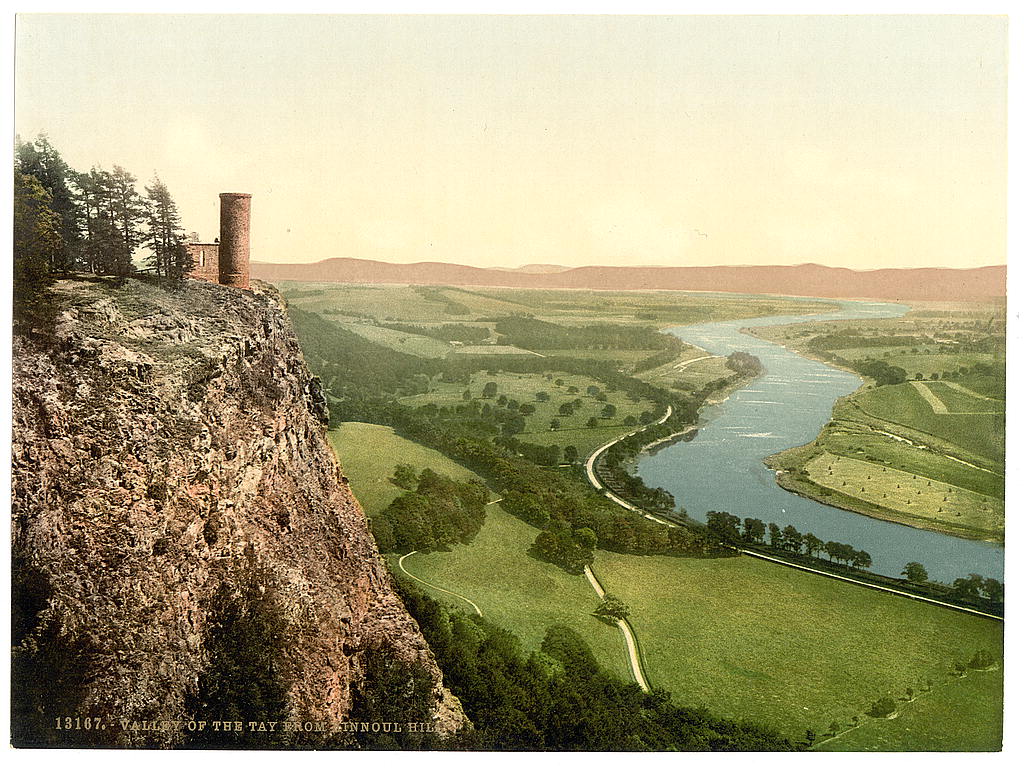
We climbed to the folly when I was young.
Photo credit: Library of Congress.
Thomas de Longueville married the heiress of Charteris of Kinfauns and changed his name to Charteris. He built a castle named Kinfauns Castle on the lands granted to him. The modern Kinfauns Castle is a 19th-century mansion located in the Scottish village of Kinfauns, Perth and Kinross. It is in the Castellated Gothic style, with a slight asymmetry typical of Scottish Georgian. It stands on a raised terrace facing south over the River Tay.
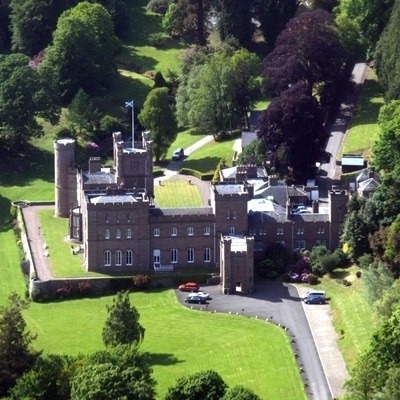
Kinfauns features in Sir Walter Scott’s 1828 novel “The Fair Maid of Perth“, one of the Waverley novels and inspired by the staged Battle of North Inch between Clan Chattan and “Clan Quhele” in September 1396. In Scott’s novel, a deputation of citizens converge at the East Port of Perth. They cross the bridge over the river Tay and then head around the foot of Kinnoul Hill to Kinfauns Castle, where they claim the protection of the Provost of Perth, Sir Patrick Charteris, Baron of Kinfauns.

Image Credit: Bibliothèque Nationale de France.
Who Were the Parents of Barbara Blair and Sir William Blair of Kinfauns?
Sir William Blair of Kinfauns
Let us return to the Blairs, and the identity of the parents of Barbara and Sir William Blair of Kinfauns. Our own research into the Blair family revealed William Blair had indeed succeeded Sir Alexander Blair of Balthayock as Baron of Kinfauns. However, the Barony of Kinfauns had been purchased, rather than inherited. As the two Barons had the same surname this had led to the misconception that they were father and son.
In a charter dated 14th February 1654, Sir Alexander Blair of Balthayock and his wife, Dame Elizabeth Fotheringham, formally granted the lands and lordship of Kinfauns, along with associated rights and properties, to William Blair through a Crown-backed disposition. This included hereditary rights such as the office of Baillie of the Tay, teind sheaves, and salmon fishings on the River Tay.
Sir William Blair of Kinfauns was not, as suggested on the Lord Kinfauns site, the son of Alexander Blair, 10th of Balthayock, but his second cousin. Sir William Blair of Kinfauns was, in fact, the son of William Blair, 1st Baron of Tarsappie.
Our research agreed with the earlier account by Viscount Strathallan, who in his 1681 manuscript noted that Barbara Blair was “daughter to the laird of Tarsappie and sister to Sir William Blair of Kinfauns“.
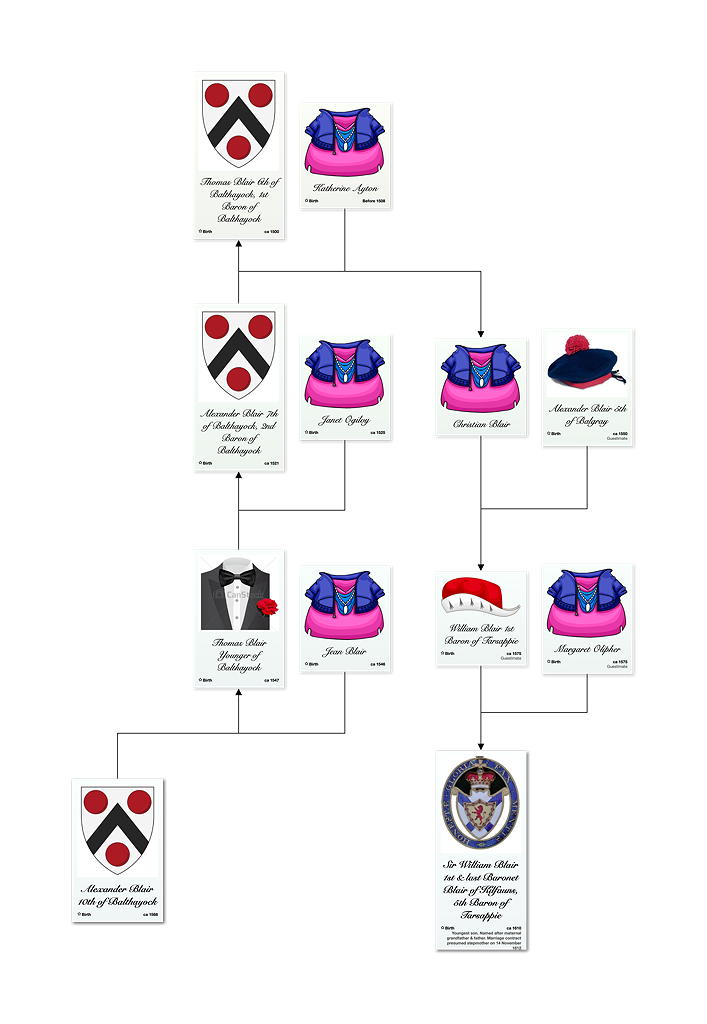
As can be seen in the tree above, Sir William Blair was the son of William Blair, 1st Baron of Tarsappie.
They were both named in a charter, dated 5th July 1628, to them for the quarter-part lands of Williamston from Patrick Murray of Williamston and Katherine Boswell, his wife, in which William Blair is styled the “youngest son“.
On 11th June 1652, William Blair disponed the quarter-part lands of Williamston along with three-quarters of Souterton and Wester Dubheads to Laurence Oliphant of Gask, his fifth cousin.
By a charter dated 14th February 1654, William acquired the Barony of Kinfauns from his second cousin, Sir Alexander Blair, 10th of Balthayock.
Then, on 31st July 1655, William purchased the Barony of Tarsappie from his nephew, Alexander Blair.
Finally, on 18th September 1666, William was created a Baronet of Nova Scotia by King Charles II and became Sir William Blair, 1st Baronet of Kinfauns. However, William was also the last Baronet. As the “remainder” of the title was “to the heirs male of his body” and he left only daughters, the Baronetcy of Kinfauns became extinct at his death.
William’s eldest daughter, Anna Blair, succeeded to the ancient Barony (but not the 1666 Baronetcy) of Kinfauns and on 8th August 1671, she married Alexander Carnegie, fourth son of David Carnegie, 2nd Earl of Northesk. Their third, but eldest surviving son, Alexander, was served heir to his mother in the barony of Kinfauns on 17th April 1695.
William Blair, 1st Baron of Tarsappie
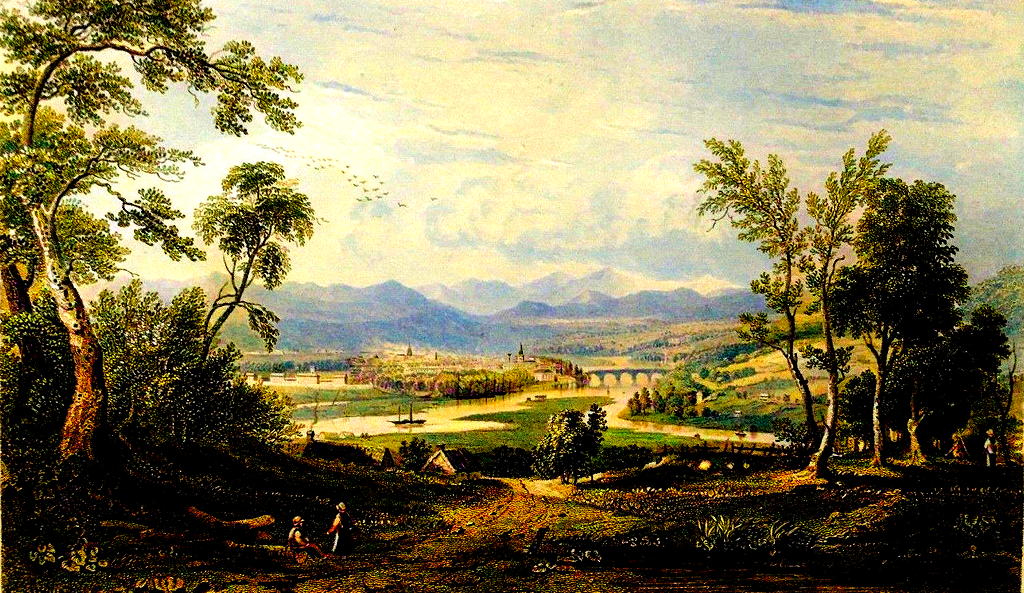
From the author’s collection.
William Blair, 1st Baron of Tarsappie was the father of Barbara Blair and her brother, Sir William Blair of Kinfauns.
In addition to Barbara and William, he was the father of at least two further children.
Firstly there was Thomas Blair, who succeeded his father to become 2nd Baron of Tarsappie and married his second cousin once removed, Margaret Blair, daughter of Alexander Blair, 10th of Balthayock.
Secondly there was Katherine, who married William Bonar, 6th (laird) of Keltie & 5th Baron of Keltie.
On 6th September 1596, William Blair (senior) was admitted as a Burgess of Perth and was styled “son of the deceased Alexander Blair of Balgray.”
On 3rd March 1609, William Blair purchased the middle-parts of the lands of Tarsappie from his second cousin, James Bonar, 7th of Rossie, whose estate had become overcome by debt.
On 18th December 1630, the lands of Tarsappie were raised into a Barony in favour of William Blair, and his eldest son Thomas.
It is not obvious exactly who was the mother of the children of William Blair, 1st Baron of Tarsappie as he was twice married.
On 13th April 1604 he entered into a marriage contract with Margaret Olipher, daughter of William Olipher in Laystoun (wife unknown). Margaret Olipher was a widow, having previously been married to Alexander Smith, son of Patrick Smith in Scone, with whom she had children.
Following Margaret’s death, William entered into a second marriage contract, dated 14th November 1612, with Catherine (or Katherine) Blair, daughter of Alexander Blair of Rossie Ochill and Marion Rollo. Alexander Blair of Rossie Ochill was a younger son of Alexander Blair 7th (laird) of Balthayock and 2nd Baron of Balthayock. This meant that Catherine Blair was William Blair’s first cousin once removed.
It is unclear which wife was the mother of Barbara and William Blair and of their siblings, Catherine, and Thomas.
Thomas and Barbara both had daughters named Elspeth. They may have been named after their paternal aunt, Elspeth Drummond, but another possibility is that they were named after their unknown maternal grandmother, the wife of William Olipher in Laystoun.
Barbara Blair had six known sons with John Drummond of Colquhalzie. The eldest was named John after his paternal grandfather and father and the second, William was named after his maternal grandfather, William Blair. The other sons were named Harry (named after his paternal uncle), David (named after his paternal uncle), Thomas (named after his maternal uncle), and George (probably named after Sir George Hay, who was a witness to the baptism of George and his elder brother Thomas, our ancestor).
Conclusions
Previously, we knew that Barbara Blair had married John Drummond, 8th of Colquhalzie.
We since discovered that she was the daughter of William Blair, 1st Baron of Tarsappie, which agreed with Viscount Strathallan’s statement that she was the daughter of “the laird of Tarsappie“.
Barbara Blair’s mother was probably Margaret Olipher, daughter of Willian Olipher in Layston.
Margaret Olipher was previously married to Alexander Smith, son of Patrick Smith in Scone, and she is said to have had children with him. Therefore, Barbara Blair appears to have an unknown number of half-siblings with the surname Smith.
It cannot entirely be excluded that Barbara’s mother was her father’s second wife, Catherine Blair, daughter of Alexander Blair of Rossie Ochill and his wife Marion Rollo. However, none of Barbara’s six sons were named Alexander and neither of her two known daughters were named Marion, suggesting that Catherine Blair was probably not the mother of Barbara Blair.
Barbara Blair’s brother, William Blair purchased the Barony of Kinfauns from his second cousin, Sir Alexander Blair, 10th of Balthayock, and also the Barony of Tarsappie from his nephew, Alexander Blair. He was created a Baronet of Nova Scotia by King Charles but left only daughters, therefore the Baronetcy of Kinfauns (but not the ancient Barony) became extinct upon his death.
Through her brother, Sir William Blair, Barbara Blair would become related to the Lords Gray, the Carnegie Earls of Northesk and the Stuart Earls of Moray.
In Part 2, we will investigate Barbara Blair’s descent from King Robert III and his Queen, Annabella Drummond – a relative of Barbara’s husband, John Drummond, 8th of Colquhalzie.
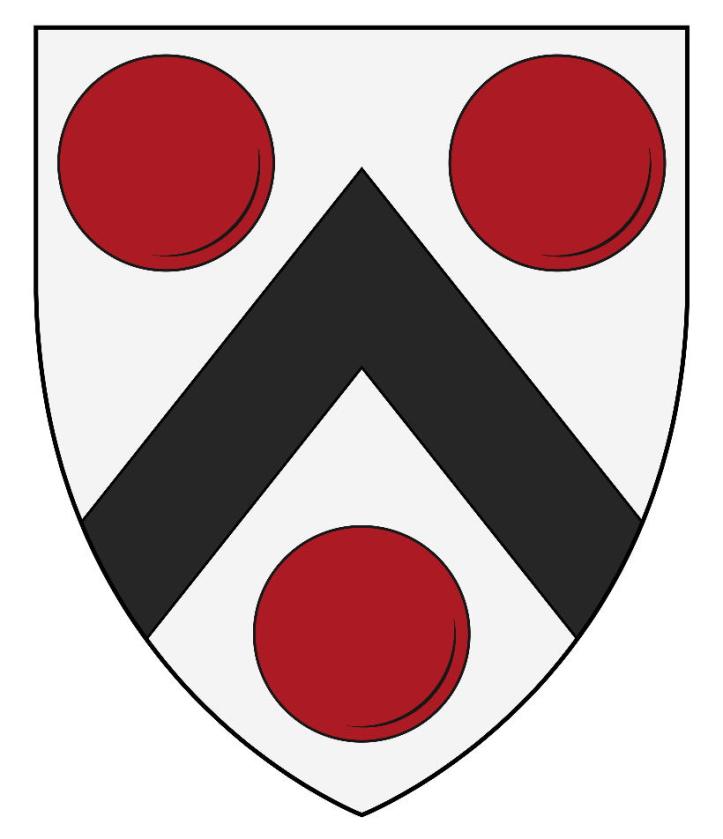
Image copyright Wappen Wiki.


[…] noted in Part 1, it seems likely that Barbara Blair was the daughter of William Blair, 1st Baron of Tarsappie and […]
LikeLike