
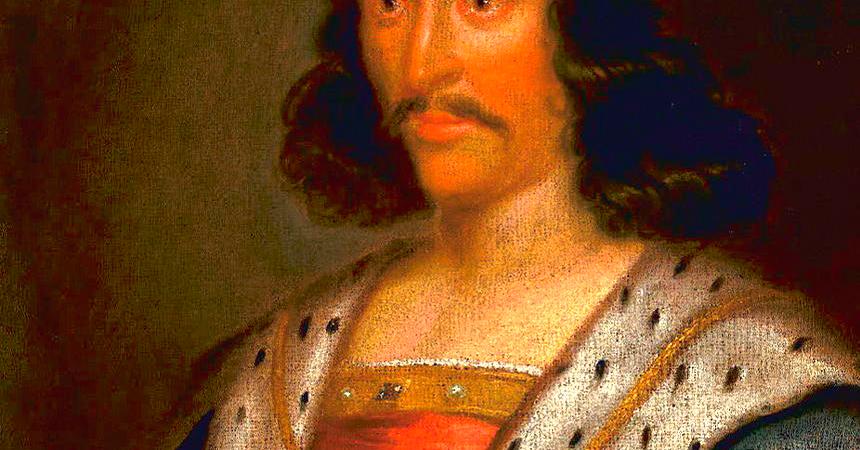
In our examination of the ancestors of Thomas Drummond in Auchterarder, son of John Drummond, 8th of Colquhalzie and his wife Barbara Blair, we look in detail at King Robert II, the first of the Stewart Kings.
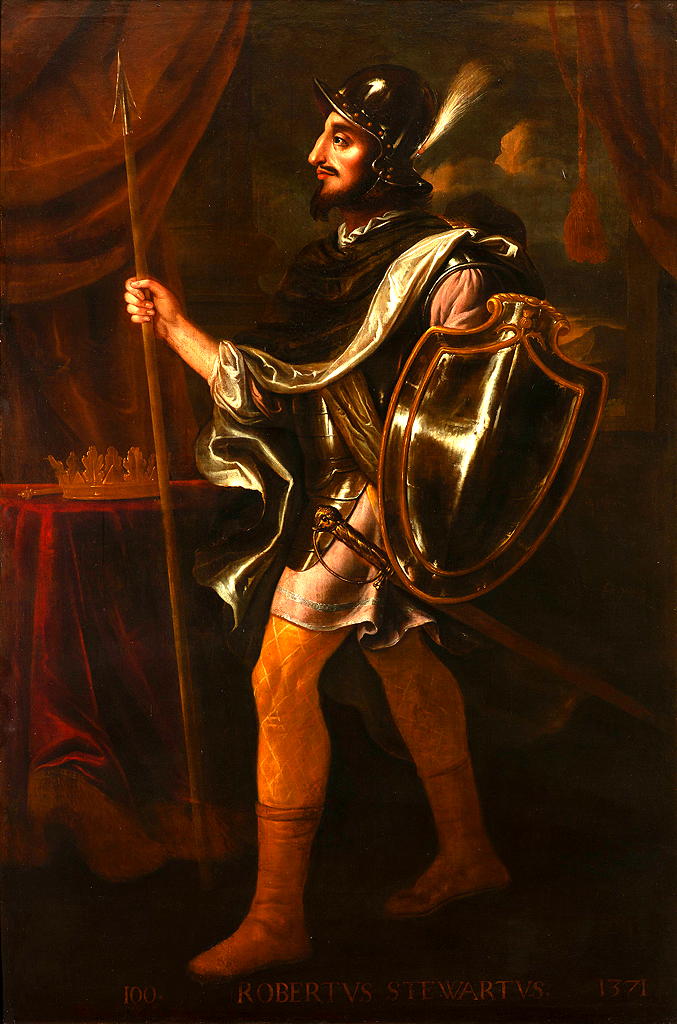
King Robert II of Scots
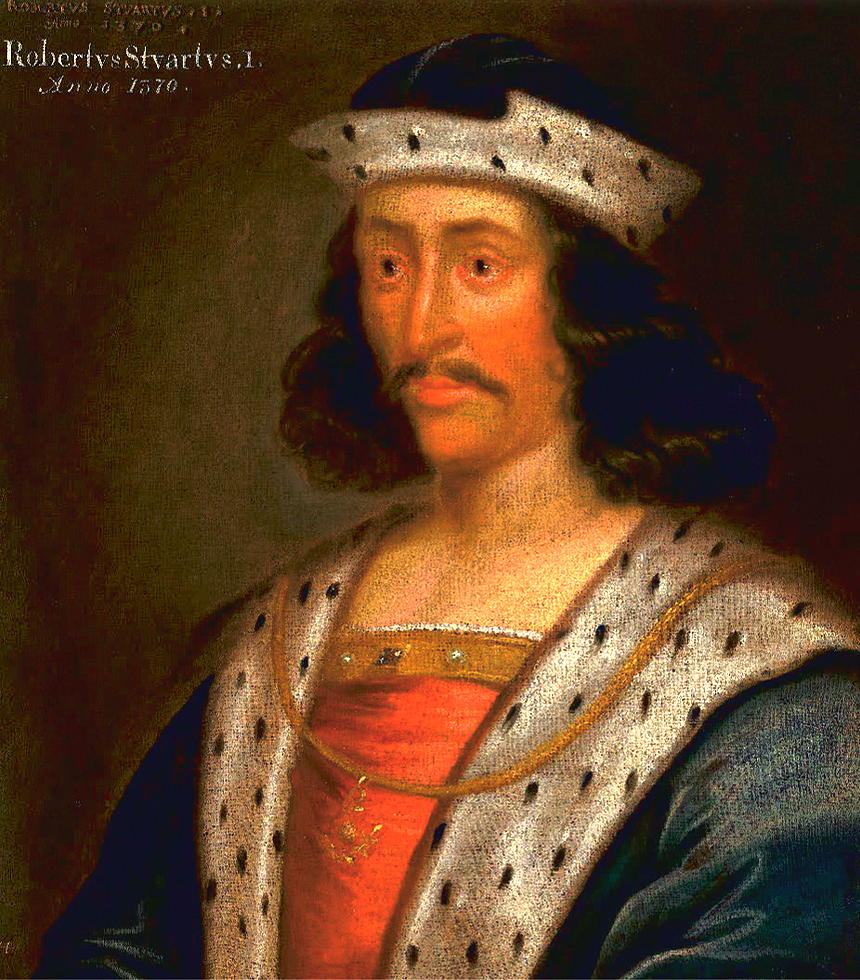
Courtesy of The Fine Art Society Ltd.
The first Stewart King, Robert II (2nd March 1316 – 19th April 1390) was King of Scots from 1371 to his death in 1390.
Family
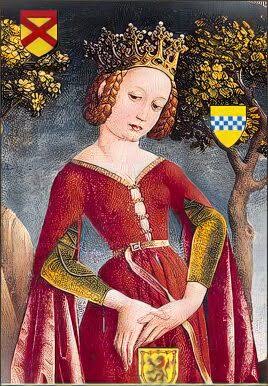
Robert was the son of Marjory Bruce, and her husband Walter Stewart, 6th High Stewart of Scotland. Marjory was the daughter of Robert the Bruce and his first wife, Isabella of Mar, and was named after her paternal grandmother, Marjory, Countess of Carrick suo jure (in her own right). After years of imprisonment in England, Marjory Bruce was released in a prisoner exchange after the Battle of Bannockburn, only to die in a riding accident less than two years later, on 7th February 1316. Marjory was just 20 years old, but left behind a son, Robert, who would go on to become King Robert II.
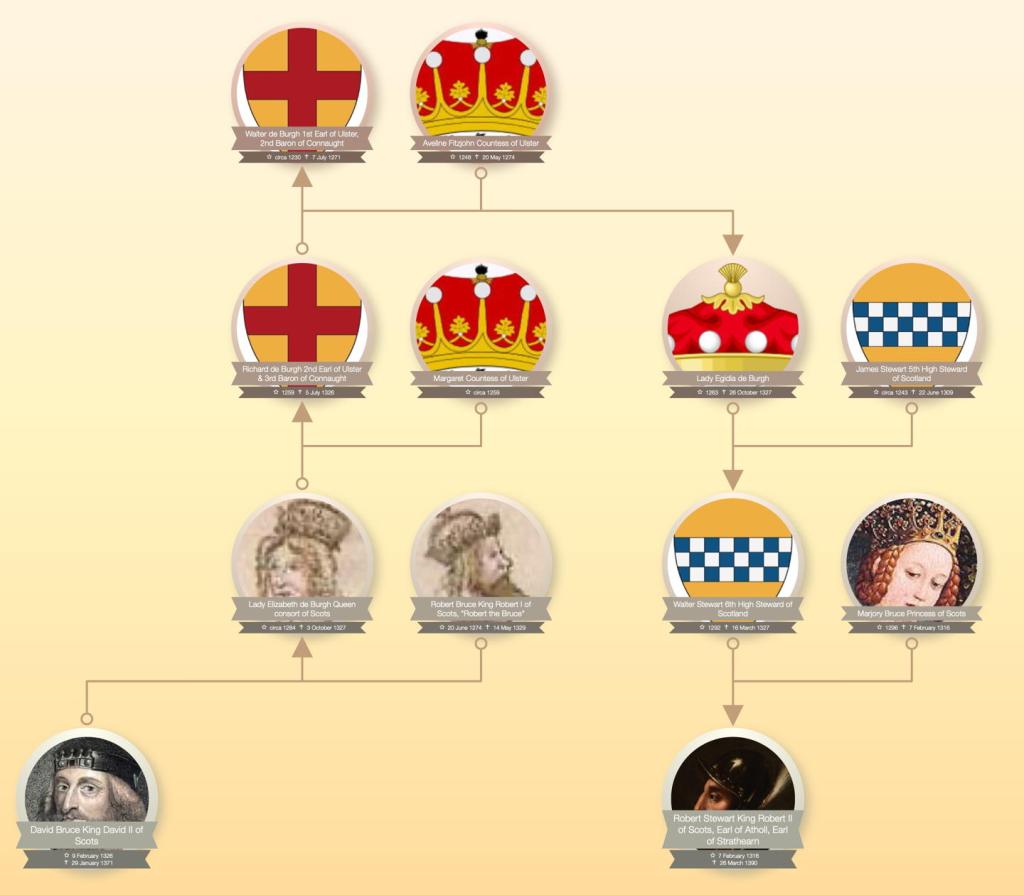
As well as being King David II’s half-nephew, King Robert II was his second cousin via the de Burghs. Robert the Bruce’s second wife, Elizabeth de Burgh, the mother of King David II, was the daughter of Richard de Burgh, 2nd Earl of Ulster. The 2nd Earl sister, Lady Egidia de Burgh had married James Stewart, 5th High Steward of Scotland, and their son Walter, 6th High Steward of Scotland married Princess Marjorie, King David II’s elder half-sister.
On 9th April 1327, Robert’s father, Walter Stewart died a Bathgate Castle in West Lothian and so, at the age of eleven, Robert became the 7th High Steward of Scotland.
Robert Stewart was the grandson of the hero King Robert the Bruce. However he was older than King David II, his half-nephew, who was a late-born son of Robert the Bruce and his second wife, Elizabeth de Burgh.
The importance of Robert Stewart’s mother, Marjory Bruce’s was acknowledged more than 200 years after her death by her great (x5) grandson, King James V. Following the defeat of the Scots by the English at the Battle of Solway Moss, on 24th November 1542, King James V suffered a nervous collapse. He retired to Falkland Palace in Fife and took to his bed with a high fever. When a messenger arrived to tell him that his pregnant queen had given birth to a daughter instead of the hoped-for son, he believed that the Stewart dynasty was at an end. He is said to have “turned his head to the wall” and six days later, he was dead. His famous last words were reputedly:
“It cam wi’ a lass and it will gang wi’ a lass!“
Heir to the Throne
In 1315, the Scottish parliament, seemingly with Marjory Bruce’s approval, revoked her rights as heir presumptive to her father in favour of the King’s only surviving brother, Edward Bruce. However, Edward Bruce wanted a throne for himself and the Irish were happy to oblige. In 1315, Edward Bruce was proclaimed High King of Ireland, the first since Brian O’Neill (High King from 1258 to 1260) and Edward was crowned in 1316 on the Hill of Tara. However, the English King believed that Ireland, like Scotland and Wales, belonged to him and Edward Bruce, last High King of Ireland, was defeated and killed by English forces at the Battle of Faughart, near Dundalk on 14th October 1318.
The death of Edward Bruce, High King of Ireland led to a Parliament in December 1318 which enacted a new tailzie that named Marjory’s son, Robert Stewart as heir presumptive. However, after years of separation, captivity and the birth of daughters, on 5th March 1324, Queen Elizabeth de Burgh finally delivered Robert Bruce his long awaited son and heir. The son was named David, presumably after his illustrious great (x5) King David I. Wth Prince David as the new heir apparent, Robert Stewart was no longer the heir presumptive. However, Robert the Bruce, himself the only survivor of five Bruce brothers, knew to his cost just how fickle fate could be. He wished to secure the Scottish succession without the terrible dynastic chaos and civil wars of previous decades. Therefore, in July 1326 a Parliament at Cambuskenneth officially restored Robert Stewart to the Scottish line of succession as heir presumptive to David Bruce, then aged just two years old, should he die childless.
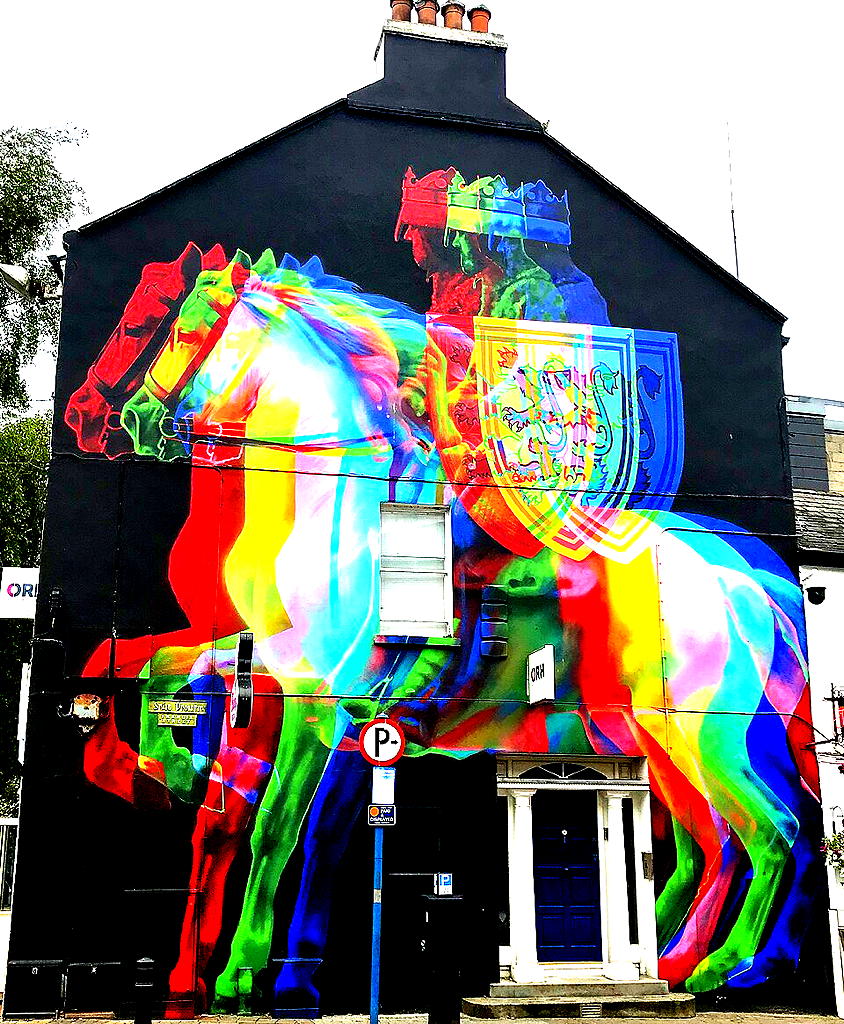
Image credit: D. Sexton.
The Second Wars of Independence
King Robert the Bruce himself died on 7th June 1329, aged 54, at his favourite Manor of Cardross in Dunbartonshire leaving his now three year-old son David Bruce to succeed as King David II. Despite his young age, David had been married the previous year to Princess Joanna Plantagenet, daughter of King Edward II of England and sister of King Edward III. This marriage was intended to bind England as Scotland’s ally following the years of conflict. However, having David II as his brother-in-law did not prevent the English King Edward III from supporting Edward Balliol, son of King John in his attempts to secure the throne of Scotland. On the condition that Balliol acknowledged he was the vassal of King Edward III of England.
Thus began the Second War of Independence, which would start disastrously for the Scots. Sir James Douglas had left on a crusade to Spain with the Bruce’s heart and he was killed at the Battle of Tebu on 1st August 1330. Sir Thomas Randolph, Earl of Moray had been appointed Guardian of the Realm as arranged in the Act of Settlement of 1318. However he died at Musselburgh on 26th June 1332. Edward Bruce had been killed in 1318, Walter Stewart, Princess Marjory’s husband had died in 1327, while Angus Og MacDonald, Lord of the Isles had died around 1330 and Gilbert Hay, Constable of Scotland died in April 1333. Thus, King Robert the Bruce and all his senior commanders at Bannockburn had passed on, and their experience would be sorely missed in the Second War of Independence.
Thomas Randolph, Earl of Moray was succeeded as Guardian of the Realm by Donald, Earl of Mar. Donald was the brother of Isabella of Mar, Marjory Bruce’s mother, and so a close connection of the new King. But within ten days of being appointed Guardian of the Realm, the Earl of Mar was dead, killed on 11th August 1332 at the Battle of Dupplin Moor, near Perth, along with Robert Bruce, Lord of Liddesdale, an illegitimate son of King Robert I (the Bruce).
On 24th September 1332, Edward Balliol was crowned as King of Scots at Scone. It must have seemed almost as if Robert the Bruce had never existed and the Battle of Bannockburn had never been fought and won by the Scots.
But the Scots fought on for their independence against Edward Balliol and his supporters, the Disinherited and the English. King David II and Queen Joanna were evacuated to France for safety and Sir Andrew Moray of Bothwell became Guardian of the Realm. Sir Andrew had married Christian Bruce, and so was King David II’s uncle by marriage. However, Sir Andrew was captured in April 1333 while attacking Edward Balliol and so Scotland once more required a new Guardian.
The next Guardian of the Realm was Sir Archibald Douglas, the half-brother of Robert the Bruce’s friend and loyal lieutenant, Sir James Douglas. Sir Archibald was appointed Guardian in April 1333, but like his predecessors did not last long, being killed at the disastrous Battle of Halidon Hill on 19th July 1333.
Sir Andrew Moray, who had been released from captivity was reappointed as Guardian of the Realm and continued to lead the fight against Balliol. But Sir Andrew fell ill at the siege of Edinburgh castle in early 1338 and he retired to Ormond Castle in the lands of his lordship of Avoch, where he died around Lent in 1338.
The next Guardian of the Realm was Robert Stewart, the half-nephew of King David II and future King Robert II. He was guardian on four occasions, sometimes jointly, and more latterly twice during the eleven years of King David II’s captivity in England after the 1346 Battle of Neville’s Cross.
At the Battle of Neville’s Cross, Amongst those killed at the Battle of Neville’s Cross were Sir Malcolm Drummond, father of King David II’s future wife, Margaret Drummond.
Robert Stewart used his years as Guardian of the Realm to secure a power base for the Stewarts, something which did not go unnoticed and did not endear him to his half-uncle, the captive King David II. In fact, Robert Stewart might not have become King of Scots, as the captive King David II came to an agreement with his brother-in-law, King Edward III of England that Edward’s son, John of Gaunt, Duke of Lancaster should, upon his death, succeed him as King of Scots. However, these terms were rejected by the Scottish parliament.
Robert II, King of Scots
King Robert II was aged almost 55 by the time he inherited the throne from his half- nephew in 1371. He had been extremely active during the Second Wars of Independence, but by 1371, he was, for the time, elderly and past his prime. David Bruce had died at the age of 44, while Robert the Bruce had been 54 when he died. However, despite his relatively advanced age, Robert II reigned as King of Scots for nineteen years.
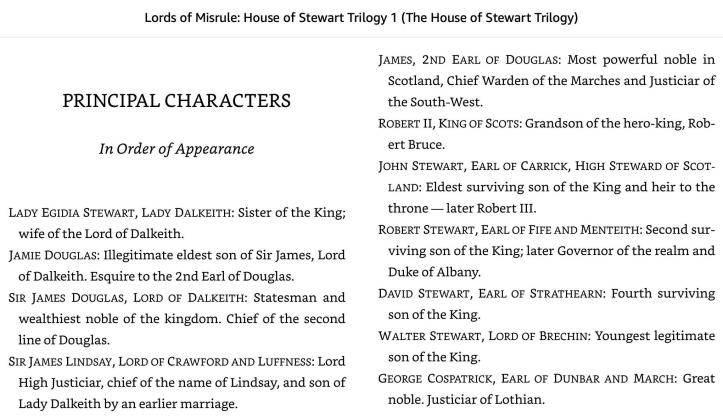
Nigel Tranter’s 1976 novel, “The Lords of Misrule” covers the end of King Robert II’s reign, from around 1388 to 1390 and depicts the the elderly “King Blearie” as “feeble, weary and half-blind“, with his sons, daughters and other nobles squabbling for power and Scotland being ravaged by their conflicts.
Marriages
Robert II had fathered many children, both with his two wives and with his several mistresses. In 1336, Robert Stewart first married Elizabeth Mure of Rowallan. She was the daughter of Sir Adam Mure of Rowallan and died in 1355. However, it was said by some that their marriage had been “uncanonical“. The couple therefore obtained a papal dispensation in 1347 and remarried in 1349. By Scots law, even if their children had been illegitimate (and this was disputed) their marriage would have legitimised them.
Consanguinity and Dispensations
The early canon law of the Roman Catholic Church followed Roman civil law, which decreed that couples were not permitted to marry if they were related within four degrees of consanguinity. The number of degrees was calculated by counting each generational link up to the common ancestor and then down again to the proposed spouse.
However, around the ninth century, the number of prohibited degrees were increased to seven. In addition, the new method by which they were calculated counted back only the number of generations to the common ancestor.
These new rules meant that intermarriage was prohibited to anyone who was more closely related than seventh cousins. They posed significant problems for royal and noble families whose genealogies tended to be well documented.
The way around the rules was to seek a dispensation. Depending on how close the relationship was, these might be granted at parish, diocesan (bishop) or papal level. The new rules also increased church revenues as the granting of a dispensation required paying the church a significant sum.
Degree of Consanguinity Common Ancestor Relationship Marriage 1st degree Parents Siblings Forbidden 2nd degree Grandparents First cousins Forbidden 3rd degree Great grandparents Second cousins Forbidden 4th degree Great (x2) grandparents Third cousins Forbidden 5th degree Great (x3) grandparents Fourth cousins Forbidden 6th degree Great (x4) grandparents Fifth cousins Forbidden 7th degree Great (x5) grandparents Sixth cousins Forbidden 8th degree Great (x6) grandparents Seventh cousins Permitted
As can be seen from the petition to Pope Clement VI in 1347, Robert Stewart and Elizabeth Muir (or Mor) of Rowallan were related in the fourth degree, i.e. were third cousins. As marriage between third cousins was forbidden they should have requested a dispensation before they married. However as this had not been done, their marriage was considered to be “uncanonical“. Hence the 1347 request to the Pope Clement VI in Avignon by King David II of Scots, King Philippe VI of France,
It can be seen that their request was granted, and that their children were to be considered as legitimate. The price of the dispensation was to be, at the discretion of the local bishop, that one or more chapels should be founded by Robert Stewart.
Petition to Pope Clement VI in 1347
(f. 59.)
The kings of France and Scotland, bishops William of St. Andrews, William of Glasgow, William of Aberdeen, Richard of Dunkeld, Martin of Argyle, Adam of Brechin, and Maurice of Dunblane. Signification that although Elizabeth Mor and Isabella Boutellier, noble damsels of the diocese of Glasgow, are related in the third and fourth degrees of kindred, Robert Steward of Scotland, lord of Stragrifis, in the diocese of Glasgow, the king’s nephew, carnally knew first Isabella, and afterwards, in ignorance of their kindred, Elizabeth, who was herself related to Robert in the fourth degree of kindred, living with her for some time and having many children of both sexes by her; the above king and bishops therefore pray the pope that for the sake of the said offspring, who are fair to behold (aspectibus gratiose), to grant a dispensation to Robert and Elizabeth to intermarry, and to declare their offspring legitimate.
To be granted by the diocesan, at whose discretion one or more chapelries are to be founded by Robert. Avignon, 10 Kal. Dec.
‘Volume XIII: 6 Clement VI’, in Petitions to the Pope 1342-1419, ed. W H Bliss (Eyre and Spottiswoode, London, 1896) Page 124.
Children
The Royal House of Stewart was as dis-functional as it was large. Elizabeth Mure of Rowallan died in 1355 after giving birth to at least ten children who survived to adulthood. Robert Stewart then married, by dispensation, Euphemia, daughter of Hugh, 4th Earl of Ross and widow of John Randolph, 3rd Earl of Moray. The latter had been killed on 17th October 1346 at the Battle of Neville’s Cross, where King David II had been taken prisoner by the English. By Euphemia Ross, Robert Stewart went on to have a further five children, including David, Earl Palatine of Strathearn and Earl of Caithness, and Walter, Baron of Brechin who later became Earl of Atholl and Earl of Caithness.
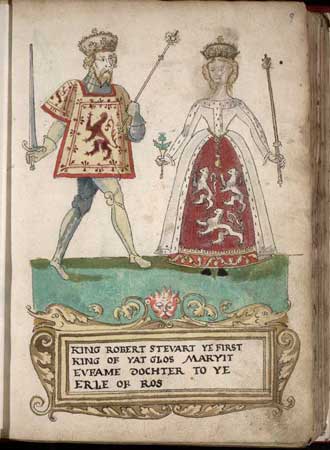
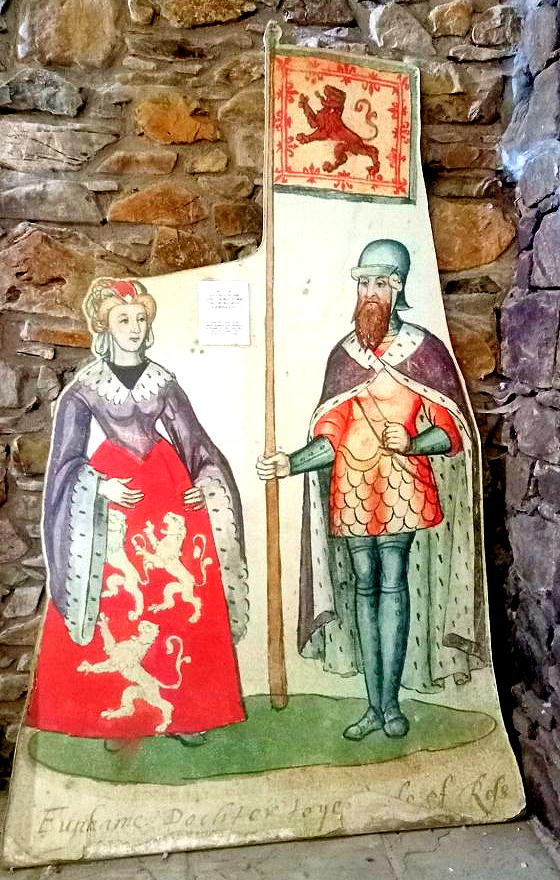
King Robert II’s eldest son, John, Earl of Carrick (later King Robert III) had been kicked by a horse (said to be a Douglas horse) and lamed. This prevented him from being as active as he would have liked. He was also of a more retiring nature than his almost larger-than-life younger brothers. This was still a time when Kings were expected to lead their armies into battle. Just a few generations earlier, Tanistry (selecting the most able candidate from the royal derbfine) rather than primogeniture (where the eldest male heir of the previous monarch succeeded) had been the system used to select kings. Under the system of Tanistry, John, Earl of Carrick would undoubtedly have been passed over for a “more suitable” candidate, perhaps one of his brothers, or another close relative.
The second son, Walter Stewart, had married Isabella MacDuff, in 1360. She was an important heiress as she was Countess of Fife suo jure (in her own right). However Prince Walter died in 1362, not long after the marriage, while still in his twenties, and without leaving any children.
The third, but second surviving son, was Robert Stewart, the archetypical pantomime villain and Wicked Uncle. In 1361, he married Margaret Graham, Countess of Menteith in her own right and gained control of that Earldom. In 1371, he somehow managed to persuade his sister-in-law to resign the Earldom of Fife in his favour. In 1398 he was created Duke of Albany by his brother and in 1403, King Robert III granted his brother the Earldom of Atholl.
As if all this was not power enough for just one man, Parliament appointed Robert Stewart as Guardian of the Realm on 1st December 1388, replacing his elder brother, John, Earl of Carrick. John, Earl of Carrick succeeded as King Robert III in 1390, but due to his infirmity, Robert, Earl of Fife continued as Guardian until 1393, when he was forced to return power to his brother, King Robert III.
After touring the northeast of Scotland in late January 1390, King Robert II returned to Dundonald Castle in Ayrshire, in March 1390. He died there, at the grand old age of 74, on 19th April 1390 and was buried at Scone on 25th April 1390.
We remember him as the first monarch of one of the longest reigning dynasties in Europe.
How King Robert III is Remembered
King David II (Bruce) and King Robert II (Stewart) have, almost inevitably, suffered in comparison to their respective father and grandfather, the hero King, Robert the Bruce.
For example, in his 1967 book, Scottish Kings, Gordon Donaldson, the Sir William Fraser Professor of Scottish History and Palaeography at the University of Edinburgh, described Robert Stewart’s early career as “to say the least, undistinguished, and his reign did nothing to add lustre to it.“
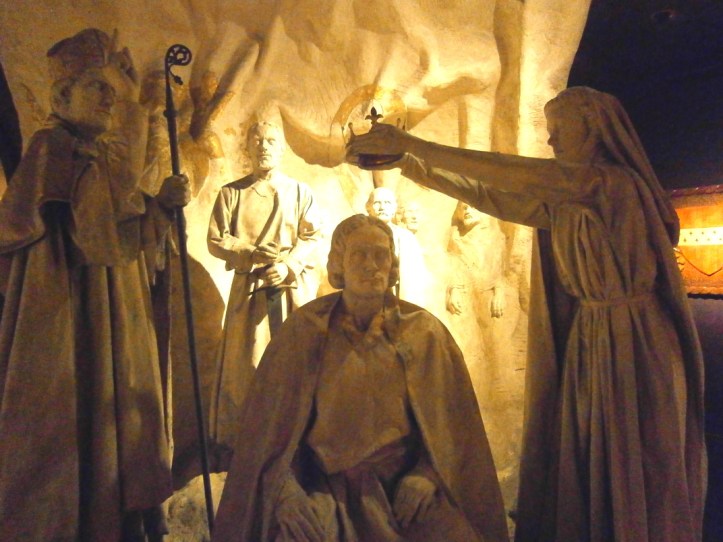
Photo taken during a visit to Edinburgh Castle.
However, Robert the Bruce was not always a hero, just as he was not always a king. Likewise, the reigns of his two successors need be analysed in context. David II became King of Scots when he was just five years old, and then spent eleven years in captivity following his capture at the Battle of Neville’s Cross. In contrast, King Robert III succeeded when he was aged 55 and is perhaps remembered as old “King Blearie” whose sons usurped his power in this later years.
Titles and Honours
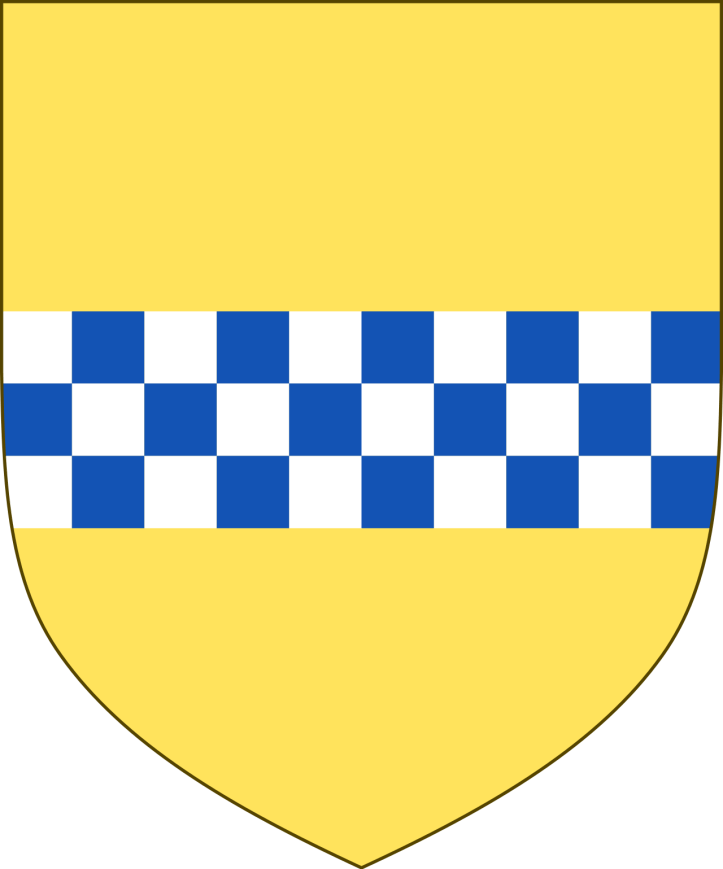
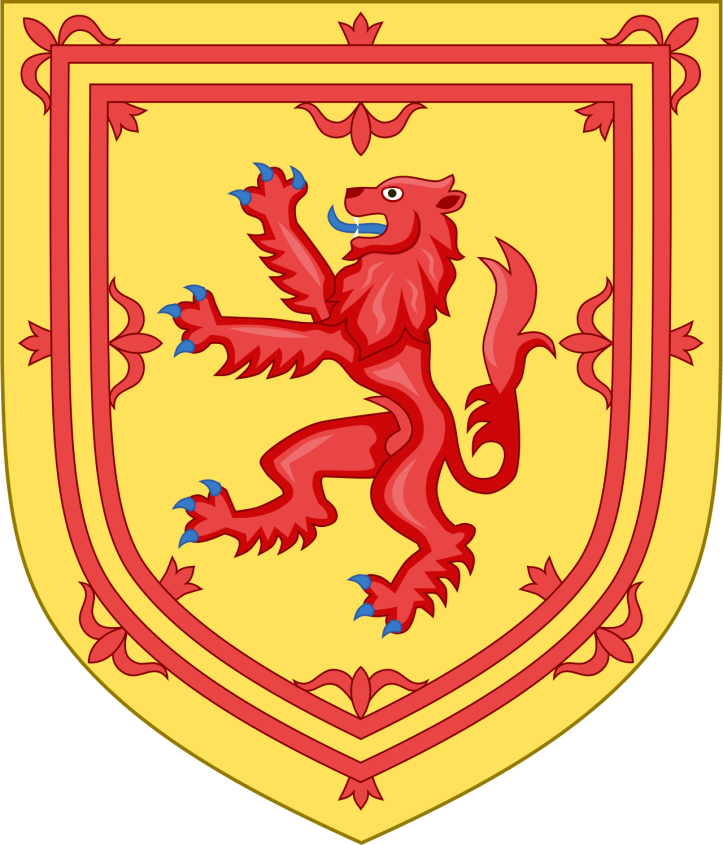
In his lifetime, Robert Stewart saw the rise of the House of Stewart from Stewards of the Kings of Scots to the powerful family in Scotland. Robert himself was granted a number of Lordships and Baronies by his grandfather, King Robert I (the Bruce) and then the forfeited Earldoms of Strathearn and Atholl by King David II (Bruce). His eldest son, John was granted the Earldom of Carrick by King David II (Brice) while his sons and grandsons married great heiresses, gaining control of the Earldoms of Fife, Menteith, Buchan, Ross, Orkney and Mar. His third son Robert and grandson, David also became the first two Scottish Dukes as Duke of Albany and Duke of Rothesay respectively, although these titles did not come with any additional territories.
Lordships and Baronies
Before his death in 1329, King Robert the Bruce provided his grandson with a number of Lordships and Baronies which made him Lord of Kintyre, Lord of Methven, Baron of Cunningham, Baron of Renfrew, Baron of Eckford, Baron of Nisbet, Baron of Longnewton, Baron of Maxton and Baron of Caverton.
7th High Steward of Scotland (1327 – 1371)
9th April 1327. Succeeded his father, Walter as High Steward of Scotland upon his death.
22nd February 1371. His eldest son John succeeded him as High Steward when Robert succeeded his half-nephew as King Robert II of Scots.
Earl of Atholl (1342 – 1367)
1342. Created Earl of Atholl by his half-nephew King David II.
31 May 1367. Resigned title in favour of his son, John, later King Robert III.
Earl of Strathearn (1357 – 1371)
1357. Created Earl of Strathearn by his half-nephew King David II.
26 Match 1371. Resigned title in favour of his elder son David from his second marriage, on the day of his coronation as King Robert II.
Guardian of the Realm (1334 – 1335), (1338 – 1341), (1346 – 1357)
1334 – 1335 During the minority of his half-uncle David II.
1338 – 1341 During the minority of his half-uncle David II.
1346 – 1357 During the captivity of his half-uncle David II.
King of Scots (1371 – 1390)
22nd February 1371 -19th April 1390.
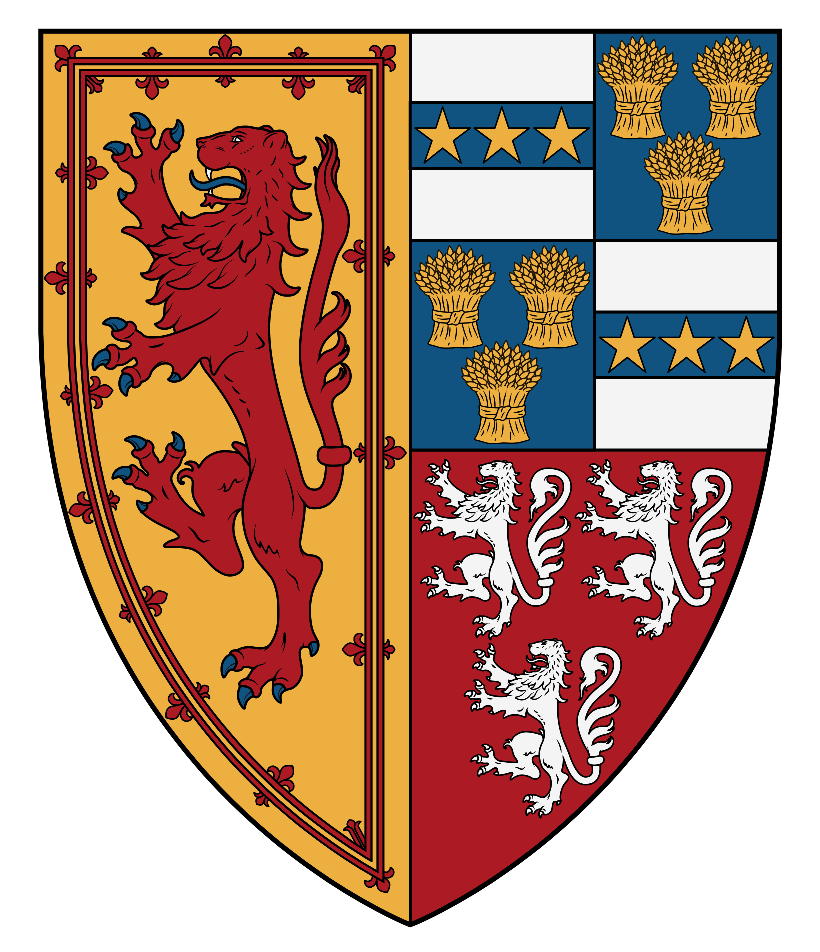
King Robert II as the Ancestor of Thomas Drummond of Auchterarder
King Robert II was the great (x8) grandfather of Thomas Drummond via his son, King Robert III.
King Robert II was also the great (x9) grandfather of Thomas Drummond via four other lines, twice via his third son, Robert Stewart 1st Duke of Albany, once via Robert II’s daughter Elizabeth Stewart, Countess of Crawford, and once via Robert II’s daughter Jean Stewart, Lady Glamis.
Three of these children were from Robert II’s first marriage to Elizabeth Mure of Rowallan, while one, Jean Stewart, was the daughter from Robert II’s second marriage to Euphemia Ross.
 | ||||
| Descent of Thomas Drummond in Auchterarder as great (x8) grandson of King Robert II and his first wife Elizabeth Mure of Rowallan via King Robert III & his wife Annabella Drummond; Princess Mary Stewart & her husband George Douglas, 1st Earl of Angus; Lady Elizabeth Douglas & her husband Alexander Forbes, 1st Lord Forbes; Annabella Forbes & her husband Sir Patrick Gray; Janet Gray & her husband Alexander Blair, 5th of Balthayock; Thomas Blair, 6th of Balthayock & his wife Katherine Ayton; Christian Blair; & her husband, Alexander Blair, 5th of Balgray; William Blair, 1st of Tarsappie & his wife Margaret Olipher; and Barbara Blair & her husband John Drummond, 8th of Colquhalzie. | Descent of Thomas Drummond in Auchterarder as great (x9) grandson of King Robert II and his first wife Elizabeth Mure of Rowallan via Robert Stewart, 1st Duke of Albany & his wife Margaret Graham, Countess of Menteith suo jure; Lady Marjory Stewart & her husband Sir Duncan Campbell, 1st Lord Campbell; Archibald Campbell, Master of Campbell & his wife, Elizabeth Somerville; Colin Campbell, 1st Earl of Argyll & his wife Isabel Stewart, Countess of Argyll; Archibald Campbell, 2nd Earl of Argyll & his wife, Lady Elizabeth Stewart, Countess of Argyll; Donald Campbell, Abbot of Coupar Angus & an unknown partner; Janet Campbell & her husband John Drummond, 5th of Colquhalzie; John Drummond, 6th of Colquhalzie & his wife Barbara Campbell; John Drummond, 7th of Colquhalzie & his wife Jean Maule; & John Drummond, 8th of Colquhalzie & his wife Barbara Blair. | Descent of Thomas Drummond in Auchterarder as great (x9) grandson of King Robert II and his first wife Elizabeth Mure of Rowallan via Robert Stewart, 1st Duke of Albany& his wife Margaret Graham, Countess of Menteith suo jure; Lady Marjory Stewart & her husband Sir Duncan Campbell, 1st Lord Campbell; Archibald Campbell, Master of Campbell & his wife, Elizabeth Somerville; Colin Campbell, 1st Earl of Argyll & his wife Isabel Stewart, Countess of Argyll; Archibald Campbell, 2nd Earl of Argyll & his wife, Lady Elizabeth Stewart, Countess of Argyll; Donald Campbell, Abbot of Coupar Angus & an unknown partner; Donald Campbell, 1st of Easter Denhead & his wife Grissel Maxwell; Barbara Campbell & her husband John Drummond, 6th of Colquhalzie; John Drummond, 7th of Colquhalzie & his wife Jean Maule; & John Drummond, 8th of Colquhalzie & his wife Barbara Blair. | Descent of Thomas Drummond in Auchterarder as great (x9) grandson of King Robert II and his first wife Elizabeth Mure of Rowallan via Princess Elizabeth Stewart, Countess of Crawford & her husband, Sir David Lynsay, 1st Earl of Crawford; Lady Marjory Lindsay & her husband Sir William Douglas of Lochleven; Sir Henry Douglas of Lochleven & & his wife Elizabeth Erskine; Sir Robert Douglas of Lochleven & his wife Elizabeth Boswell; Margaret Douglas & her husband Henry Mercer of Meikleour; Sir Laurence Mercer of Meikleour & his wife Janet Dundas; Isabella Mercer & her husband Alexander Blair, 4th of Balgray; Alexander Blair, 5th of Balgray & jis wife Christian Blair; William Blair, 1st of Tarsappie & his wife Margaret Olipher; and Barbara Blair & her husband John Drummond, 8th of Colquhalzie. | Descent of Thomas Drummond in Auchterarder as great (x9) grandson of King Robert II and his second wife Euphemia Ross via Princess Jean Stewart, Lady Glamis & her husband Sir John Lyon of Glamis; Sir John Lyon of Glamis & his wife, Lady Elizabeth Graham; Sir Patrick Lyon, 1st Lord Glamis & his wife Isabel Ogilvy; John Lyon, 2nd Lord Glamis & his wife Elizabeth Scrymgeor; Margaret Lyon, Lady Guthrie & her husband Sir Alexander Guthrie of Guthrie; Elizabeth Guthrie & her husband John Ogilvie, Younger of Inverquharity; Sir John Ogilvy of Inverquharity & his wife Elizabeth Fotheringham; Marian Ogilvy & her husband James Maule of Melgum, Jean Maule & her husband John Drummond, 7th of Colquhalzie; & John Drummond, 8th of Colquhalzie& his wife Barbara Blair. |


