
Heraldry and its Misuse in Family History
“Since at least the 16th Century to be recognised as chief of a clan or family has required an individual to be entitled to bear the undifferenced arms of the clan or family (i.e. the principal arms of the clan or family that descend from one chief to the next in undifferenced form through the generations) and so be “Chief of the Name and Arms” of the clan or family. It is for the Lord Lyon to determine who has legally succeeded and is entitled to bear the undifferenced arms of a clan or family.“
Dr James Morrow, Lord Lyon King Of Arms, 6th December 2021.
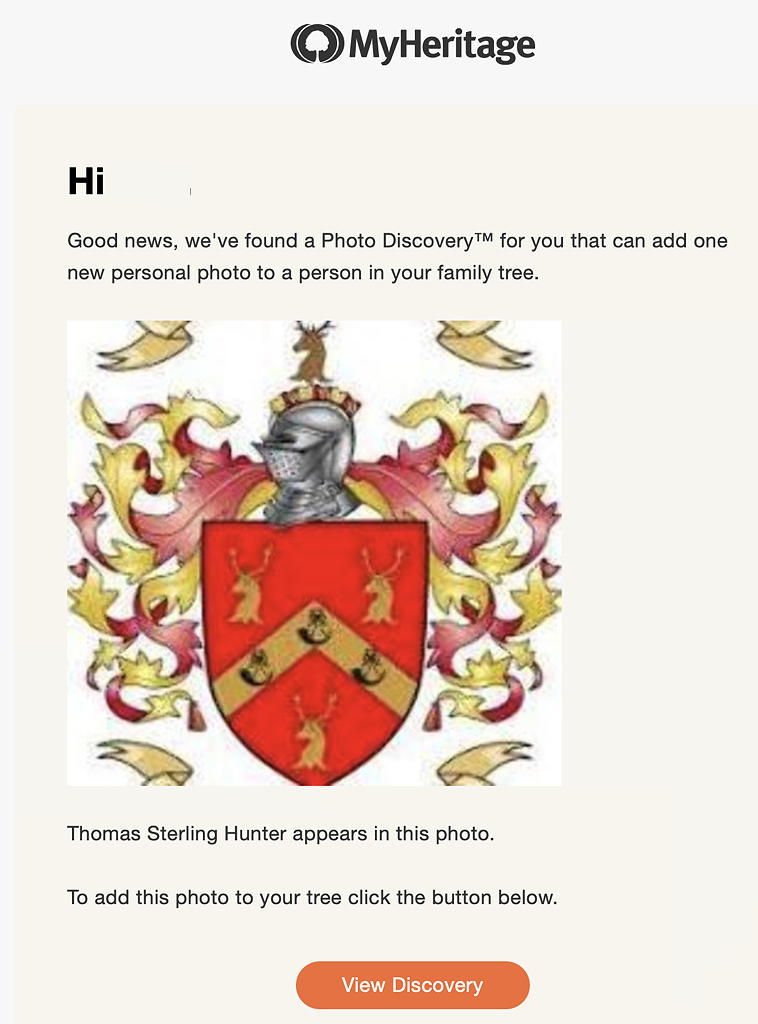
Heraldry, in the form of coats of arms, can often be seen as striking and colourful illustrations in on-line family trees.
Unfortunately, heraldry is all too often misunderstood and mis-used by many non-Scots, and even by some who should know better.
Arms in Scotland do not, as is sometimes assumed, belong to all people with the same surname, or to anyone who might wish to use them. They are personal and can only belong to one person at a time.
In fact, it is not only a social error, but also illegal, for anyone to attempt to assume and use arms to which they are not entitled.
An Example: Heraldry and its Misuse in Sport
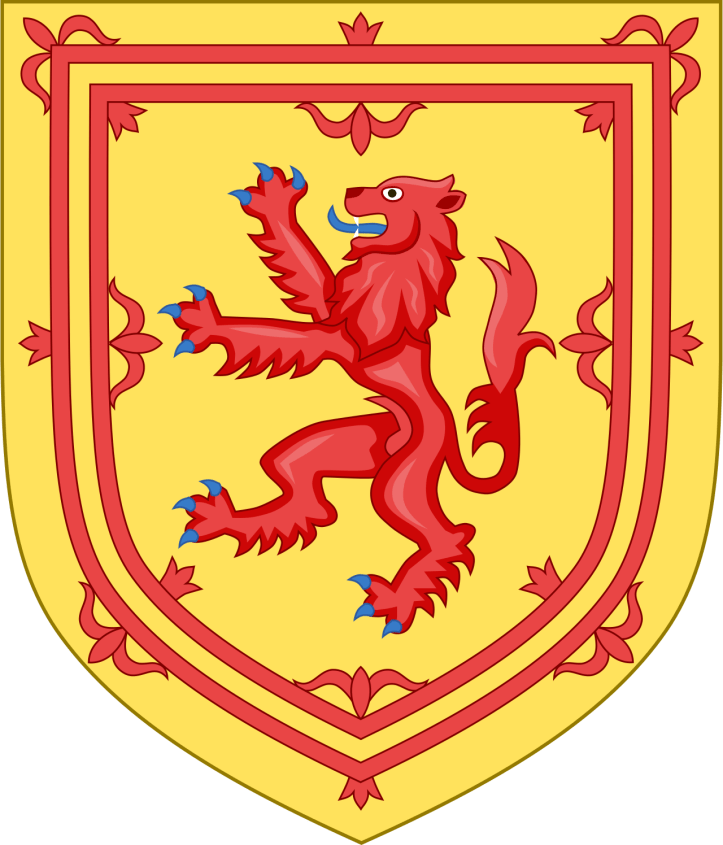

In Scotland of old, two flags would be borne into battle by royal armies. The first was the Lion Rampant the personal banner of the monarch, and the second, the Saltire, Scotland’s national flag. The bearers of these flags became hereditary and in 1952, following years of conflict, the Lord Lyon decided that the Earl of Lauderdale’s right was to bear the Saltire, whereas the Earl of Dundee as Bearer of the Royal Banner had the right to carry the Royal Banner of Scotland, the “Lion Rampant“.
Clan Members May Use a Belted Variant of their Chief’s Badge
© Copyright 2024 by The Clan Buchanan Society International Inc.
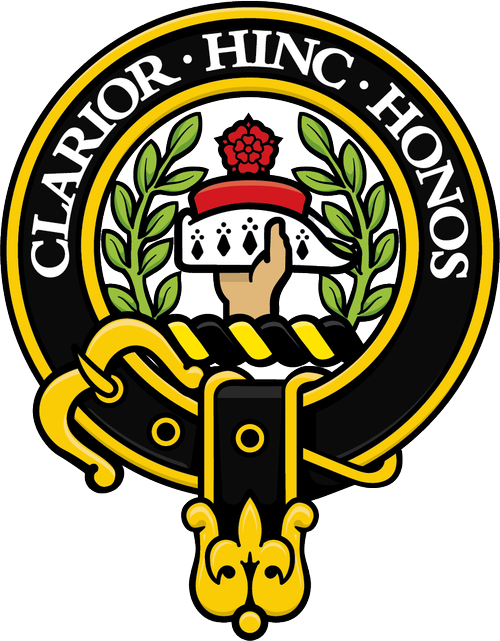
Some of the misuse of arms may arise from a misunderstanding of the use of clan badges. Ordinary members of a clan are entitled to wear their chief’s Crest as a badge, but the clan member’s version must be encircled with a strap and buckle bearing their Chief’s Motto or Slogan.
Heraldry In Scotland and The Court of the Lord Lyon
Prince Charles surprised many by assuming the regnal name of King Charles III. This proved to be controversial, unpopular, and was seen by some to be a deliberate insult to Scotland. For many Scots, there had already been a King Charles III (1st January 1766 – 30th January 1788), who was best known as Bonnie Prince Charlie. When the highly unpopular Prince Charles appeared in Edinburgh on 25th July 2023 to be presented with the Honours of Scotland, there were protests and extremely loud chants of “NOT MY KING!” which could be clearly heard within the High Kirk of Saint Giles where the ceremony was held.
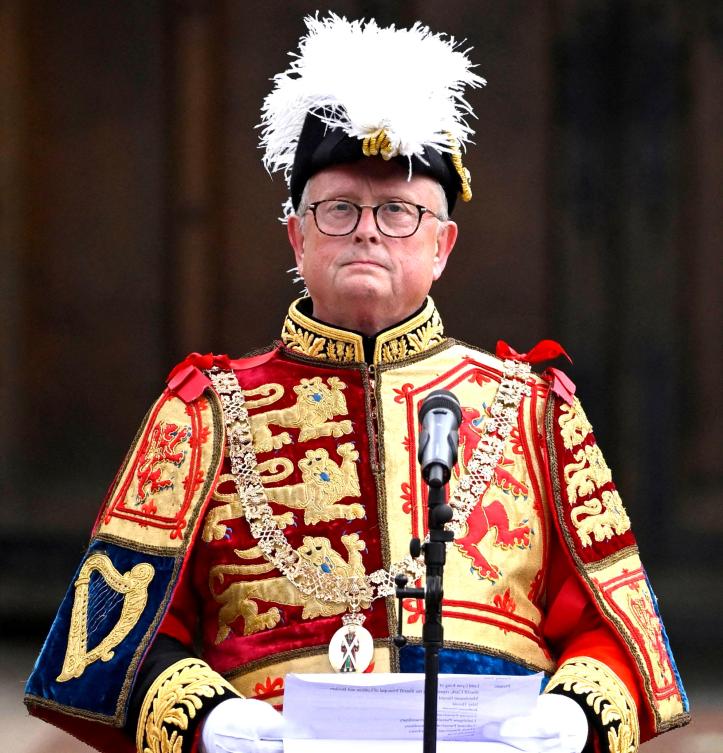
The Lord Lyon King of Arms, is the head of Lyon Court, and is one of the Great Officers of State in Scotland. He is the official charged with responsibility for regulating heraldry in Scotland. He authorises new grants of arms, and serves as the judge of the Court of the Lord Lyon, which is the oldest operational heraldic court in the world. The historic title of the post was the High Sennachie, and he was given the title of Lord Lyon from the lion in the coat of arms of Scotland.
The first recorded Lord Lyon was Henry Greve during the reign of King Robert III (19th April 1390 – 4th April 1406). Notable Lord Lyons include Sir David Lindsay of the Mount (Lord Lyon from 1542 to 1554); Sir James Balfour, 1st Baronet of Denmilne and Kinnaird, (1630 to 1654); Alexander Brodie, 19th of that Ilk, (1727 to 1754); Thomas Hay-Drummond, 11th Earl of Kinnoull, (1804 to 1866); Sir James Balfour Paul (1890 to 1926); Sir Francis Grant (1929 to 1945); and Sir Thomas Innes of Learney (1945 to 1969).
The current Lord Lyon is Dr Joseph John Morrow CVO CBE KC DL FRSE, who was appointed on 17 January 2014.
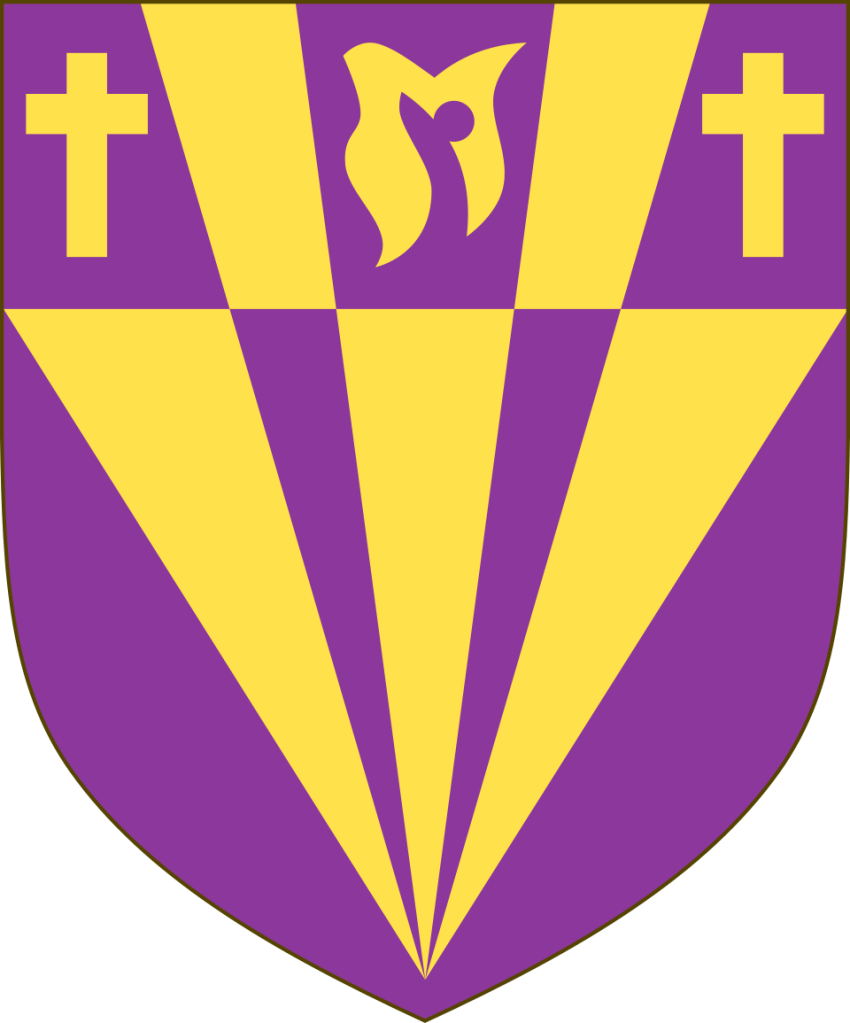
Recently I attended the AGM of the Scottish Genealogy Society which was chaired by the current Lord Lyon. The AGM was followed by an excellent and informative illustrated talk by the Lord Lyon on the Heraldry of the Scottish Clan Chiefs with a post-talk discussion over tea, coffee and biscuits.
Recommended Reading on Heraldry
Heraldry, while colourful, can be a somewhat difficult subject to understand for the novice due to its complex rules and unfamiliar terminology.
Possibly the best and most easily accessible book ever written on the subject is Simple Heraldry Cheerfully Illustrated by Iain Moncreiffe and Don Pottinger.
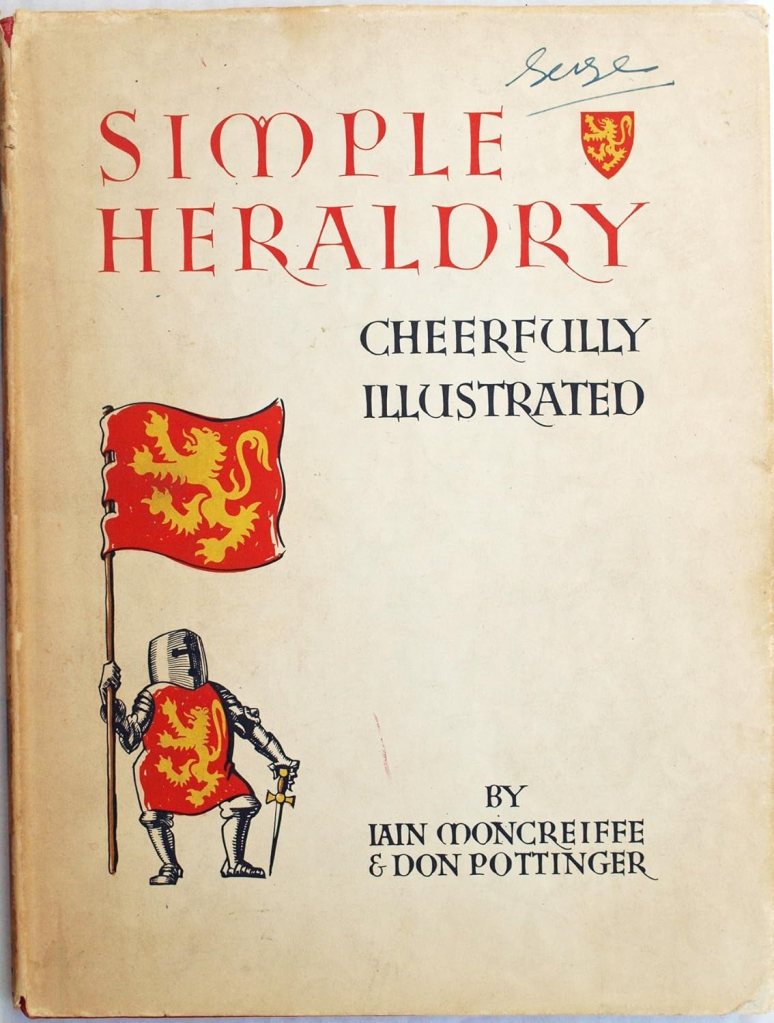
My copy of Simple Heraldry Cheerfully Illustrated is not a First Edition, but an 1953 Second Edition.
Sir Iain Moncreiffe of that ilk (1919–1985) was the 11th Baronet and 24th Chief of the Name and Arms of Moncreiffe. World famous as a heraldist and genealogical historian, he took part as Kintyre Pursuivant of Arms in the 1953 Coronation of Queen Elizabeth, later becoming Unicorn Pursuivant and then Albany Herald.
Don Pottinger (1919–1986) was a professional free-lance artist and author or co-author of many illustrated books and charts. He was the country’s outstanding heraldic designer and lived in Edinburgh, where he was Unicorn Pursuivant in the Court of the Lord Lyon King of Arms for many years.
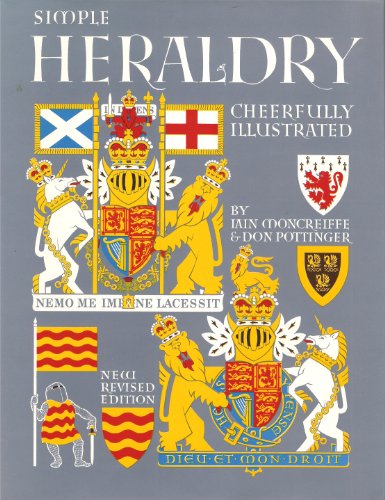
I also own a 1985 reprint of the book. The flyleaf on this edition states:
“It has been said that this is the book that has been responsible for the great renaissance of interest in heraldry over the last twenty-five years. The authors decline so great a responsibility, but it is still a book for everyone. It explains heraldry in a light-hearted way – with humour and wit and with a panoply of vivid colour on every page. And despite the deceptive cheerfulness it covers the whole subject so completely that there has never been any need for a sequel. It is all here, combining brilliant illustrations with terse and authoritative text, and with no trace of pedantry.“
The Arms of the Head of the Drummond Family
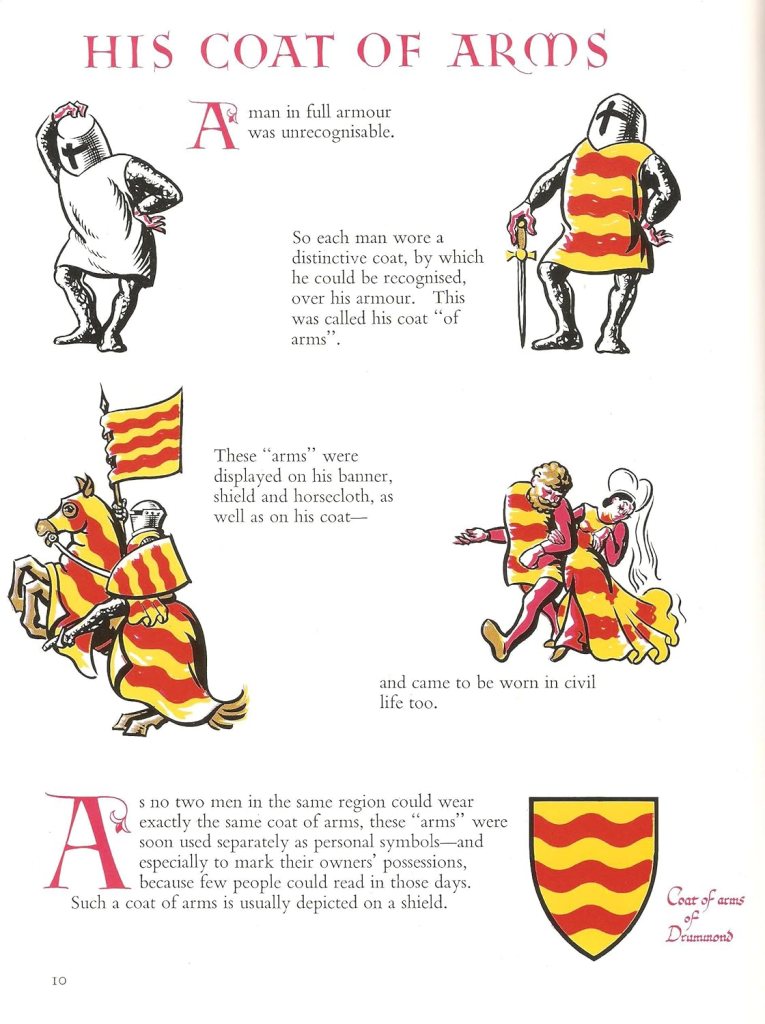
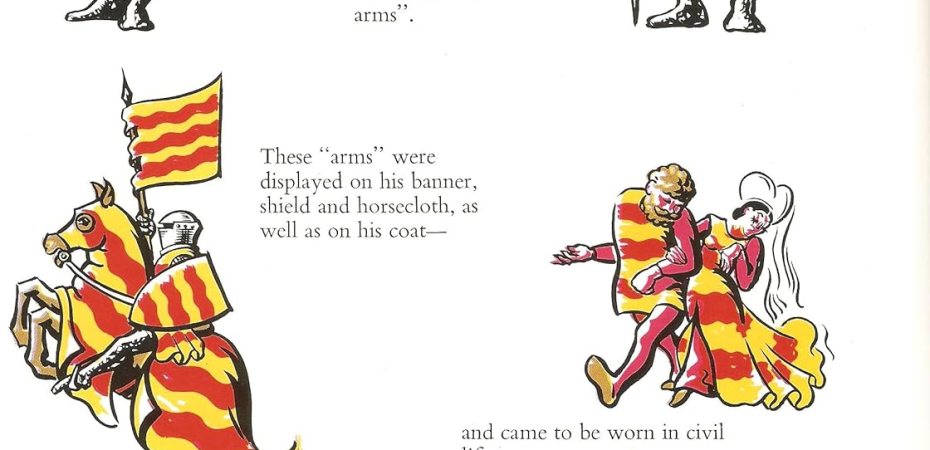
The book has an additional personal appeal in that it uses, as an example, the arms of the head of the Drummond family, of which our Drummonds of Colquhalzie were a junior branch.
Copies of the book can still be found in second-hand bookshops and on-line retailers. It is highly recommended to anyone with an interest in the subject of heraldry.
Heraldry as an Aid to Family History Research: The Setons and Oliphants
Arms that are similar can suggest that seemingly unrelated families may have shared a common ancestor. For example, old pedigrees exist claiming that the Scottish families of Seton and Oliphant descend from Lambert II, Count of Lens (ca 1030-1054).
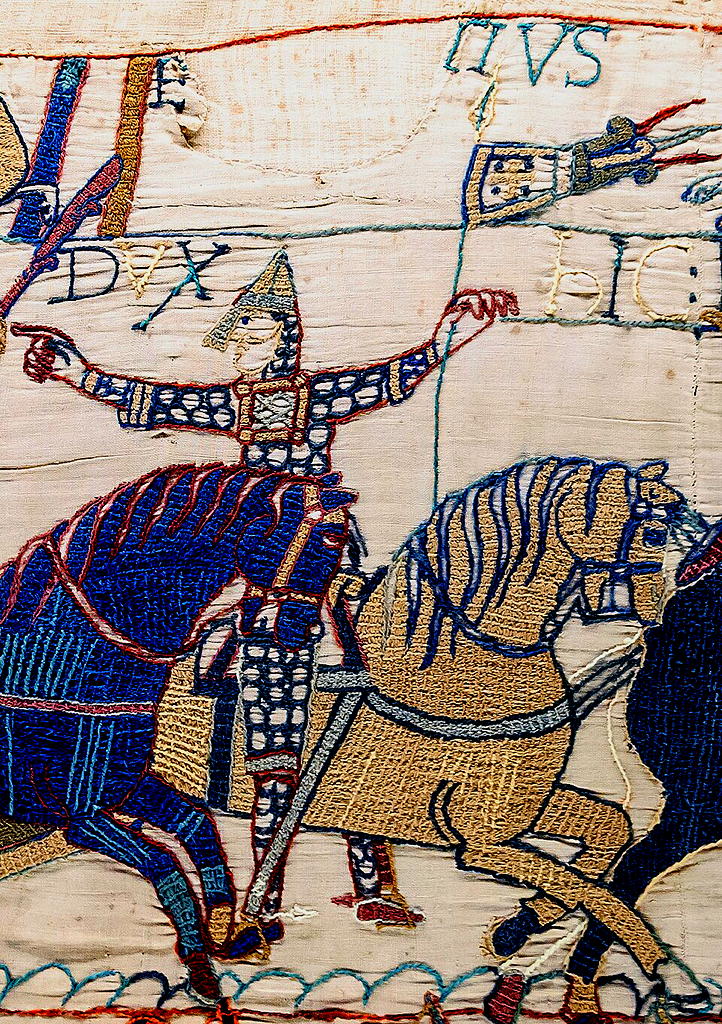
Lambert was a brother-in-law of William the Conqueror and younger brother of Eustace II, Count of Boulogne, who fought at the Battle of Hastings in 1066.
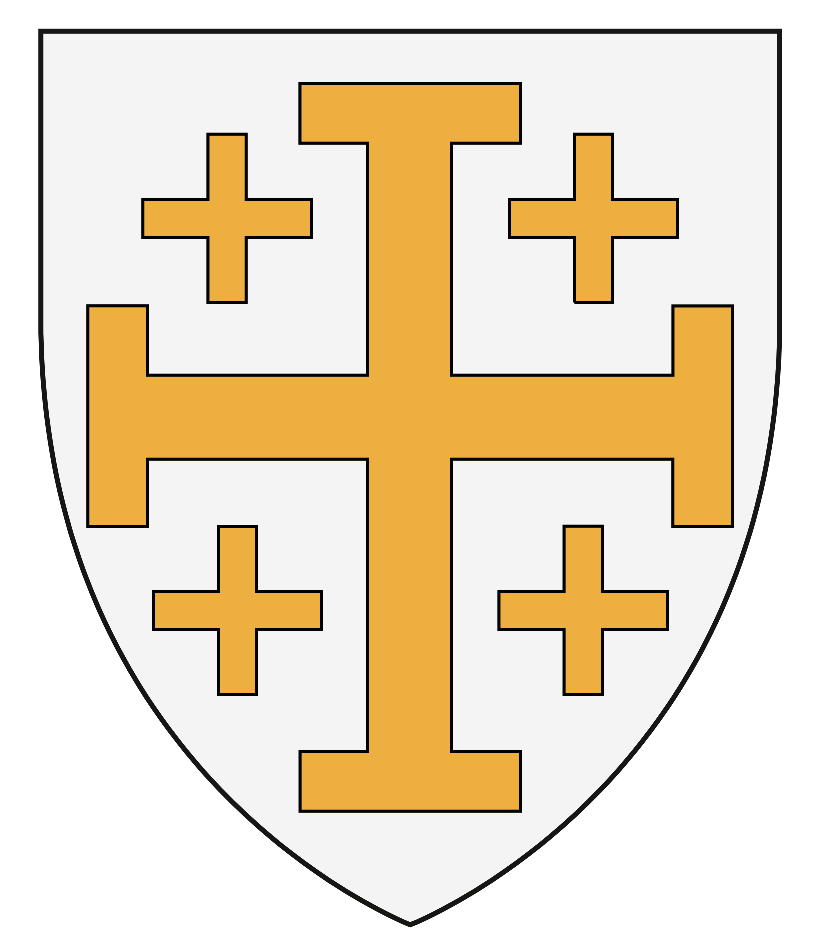
Lambert was also an uncle of Godfrey de Bouillon, who in 1099 became first ruler of the Kingdom of Jerusalem, refusing the title of king and choosing instead the title Advocatus Sancti Sepulchri, that is Advocate or Defender of the Church of the Holy Sepulchre. Godfrey’s brother succeeded him in 1100 and was crowned as King Baldwin I of Jerusalem.
Lambert’s daughter, Judith of Lens (ca 1055-after 1086) married Waltheof of Northumberland. Waltheof was the second, but surviving son of Siward, Earl of Northumbria. His mother was Aelfflaed, daughter of Ealdred, Earl of Bernicia, son of Uhtred, Earl of Northumbria. Waltheof’s father Siward died in 1055, but as Waltheof was considered to be far too young to rule the earldom, King Edward the Confessor appointed in his place Tostig Godwinson, younger brother of the future King Harold II (Godwinson) as Earl of Northumbria. As compensation, around 1065, Edward the Confessor appointed Waltheof as 1st Earl of the Honour of Huntingdon & Northampton.
Lambert’s granddaughter, Maud, Countess of Huntingdon suo jure (in her own right), married, as her second husband, King David I of Scots, who thus became Earl of Huntingdon jure uxoris (in right of his wife). King David I was the youngest son of King Malcolm III of Scots, known as “Canmore” and his wife Margaret, later Saint Margaret, of Wessex. It is interesting to note that, as heir to the house of Wessex, King David had, arguably, as good a claim, if not better, to be King of England as he did to be King of Scots.
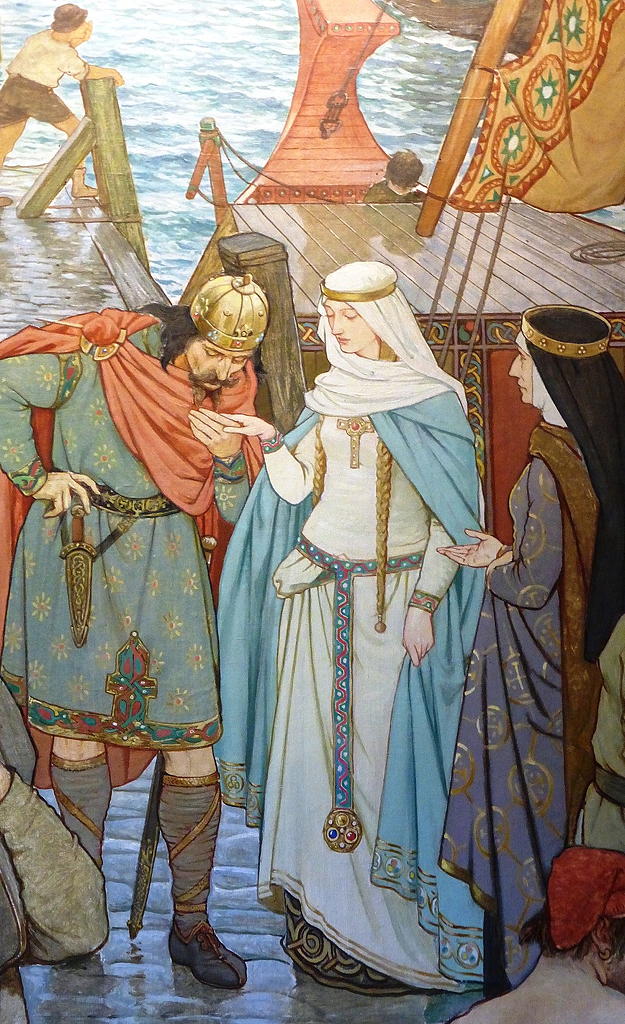
Detail of a mural (circa 1898) in the Scottish National Portrait Gallery by William Hole.
King David I’s mother, Saint Margaret, was a member of the House of Wessex and the great (x5) granddaughter of Alfred “the Great“, King of the Anglo-Saxons. Her brother was Edgar the “Ætheling” (or Royal Prince). In 1057, their father Edward the Exile arrived in England with his family but died almost immediately. Edgar, a child of about five years old, was left as the only surviving male member of the royal dynasty apart from the king, his great-uncle Edward the Confessor.
When King Edward died on 5th January 1066, he was succeeded by his brother-in-law Harold Godwinson, Earl of Wessex, who was crowned in great haste on the very next day, 6th January 1066. This succession was contested and although King Harold defeated rival claimant King Harald Hardrada of Norway on 25th September 1066 at the Battle of Stamford Bridge near York, he himself was defeated by a second claimant, William, Duke of Norway at the Battle of Hastings on 14th October 1066.
Following the death of King Harold at the Battle of Hastings, Edgar the “Ætheling” was proclaimed by members of the King’s Council or Witenagemot, as King Edgar II of England. However, he was never crowned, and on 25th December 1066 the coronation of William the Conqueror took place at Westminster Abbey. Edgar died unmarried in or after 1125, and with his death the male line of the house of Cerdic of Wessex became extinct.
Lambert’s granddaughter Maud, Countess of Huntingdon and her husband King David I of Scots were the ancestors of every subsequent monarch of Scotland, including Malcolm IV, William I, Alexander II, Alexander III, Margaret of Norway, the Balliols, the Bruces, and the Stewarts, who in 1603, became monarchs of not just Scotland, but also of England, Wales and Ireland.
Lambert was also the ancestor of the United Kingdom’s ruling houses of Orange, Hanover, Sachen-Coburg und Gotha and Windsor and also of all of the ruling European ruling houses.
It is possible that Lambert may also have been the ancestor of most of the current population of Europe.
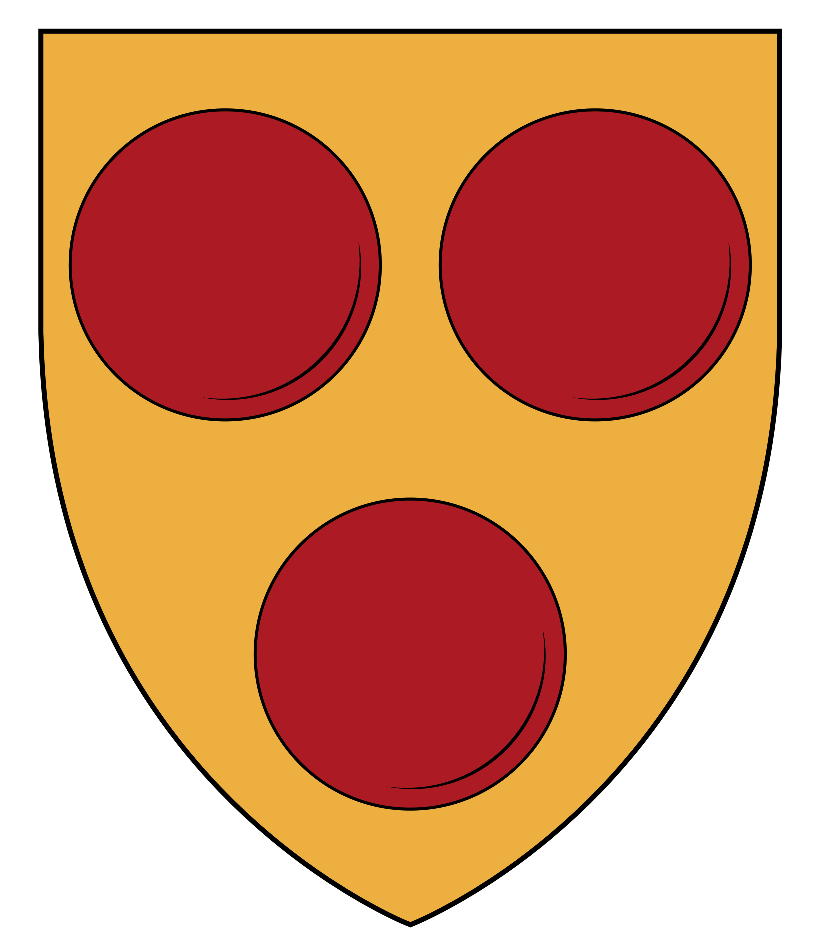
Image credit: Wappenwiki.
Could the Scottish families of Seton and Oliphant be, as in old family histories, descended from Lambert and the Counts of Boulogne? We initially viewed the tale with some doubt as many old families, including the Drummonds and McAuslands, have ancient pedigrees that begin with ancestors who appear to be more legendary than historical.
It is interesting to note that the arms of the Counts of Bolougne was three red balls on a golden field.
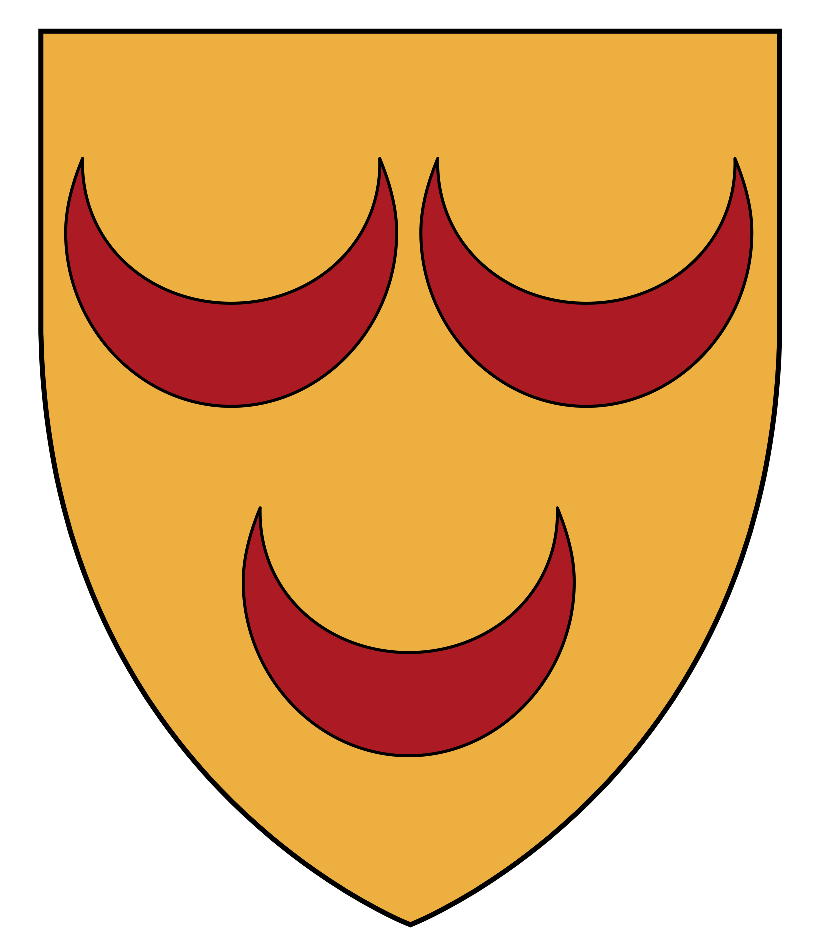
Image credit: Wappenwiki.
Meanwhile, that of the head of the Seton family was rather similar, with three red crescents, rather than balls, on a golden field.
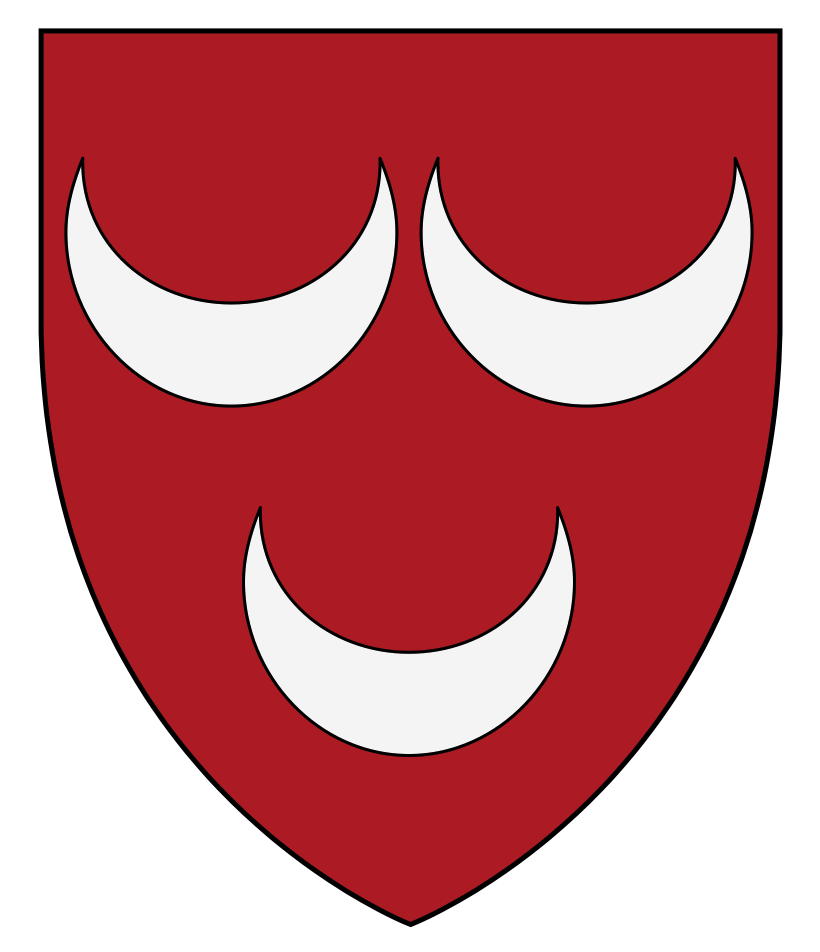
Image credit: Wappenwiki.
The arms of the head of the Oliphant family was another variant on that theme with three silver crescents on a red field.
Therefore, while not definitive proof of the descent of the Setons and Oliphants from the Counts of Boulogne, their coats of arms suggest that the old genealogies might indeed have some basis in fact.
The Inspiration for the Drummond Arms? The Ancient Earldom of Menteith
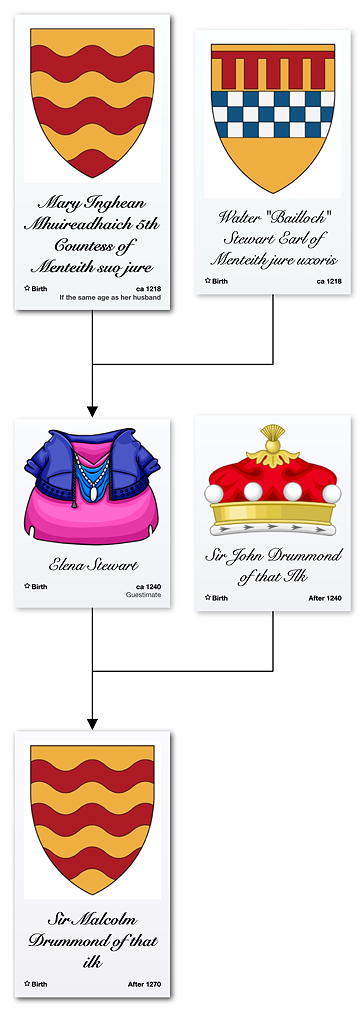
Above, in the second example, it can be seen that the arms of Sir Malcolm Drummond of that ilk bear a striking resemblance to those of his grandmother, Mary, Countess of Menteith suo jure (in her own right) who was the last of the old line of Celtic Earls and Mormaers of Menteith.
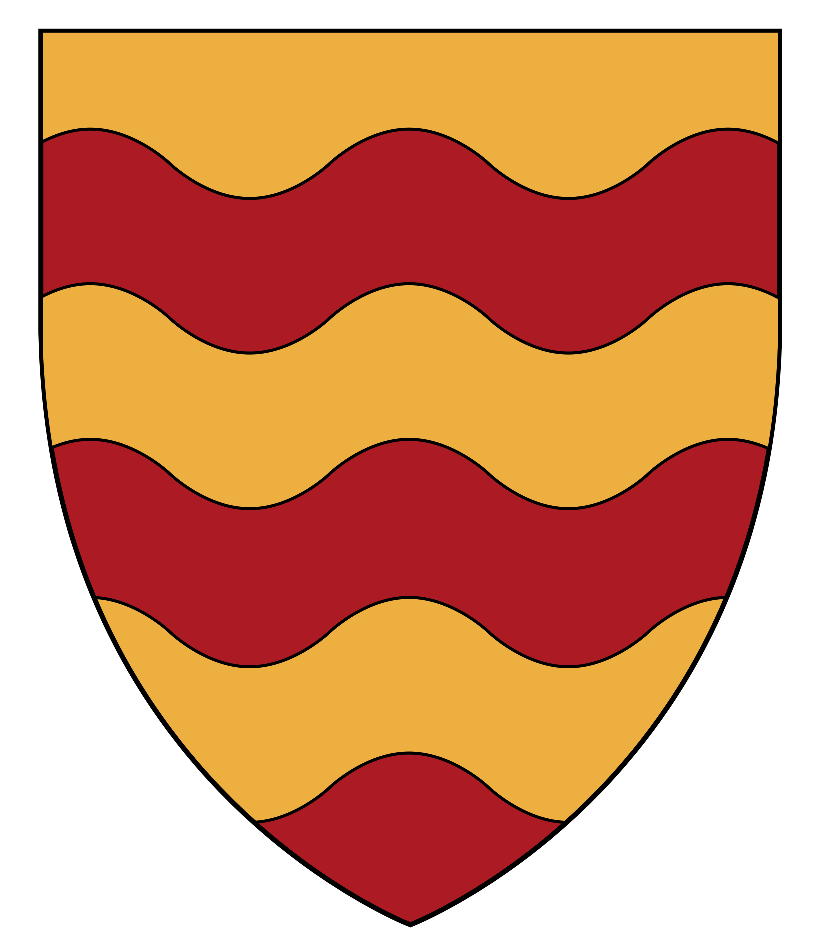
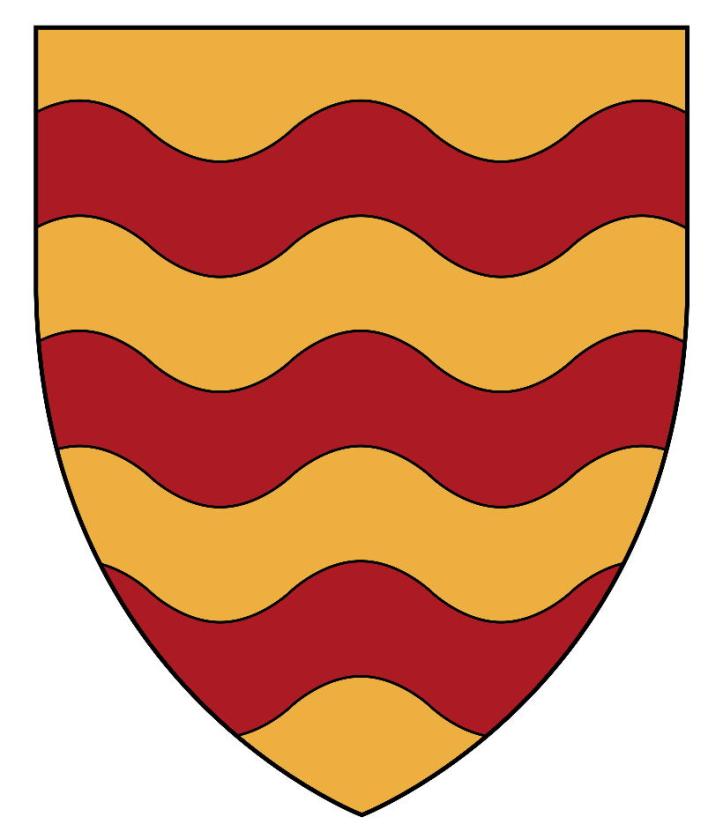
As with most heraldry there is a message to be read here, which in the case of the Drummonds would appear to be:
“Look at me! I’m descended from the ancient Earls of Menteith!“
Conclusion
Heraldry, when applied and interpreted correctly, can be incredibly useful when investigating old family pedigrees.
One important part of a grant of arms is the motto. In the case of heraldry in general, perhaps its motto should be:
Verbum sapienti sat est.
This is often seen abbreviated to “Verb sap.” and means literally: “a word to the wise (is sufficient)“
Acknowledgements
None of this research would have been possible without the truly amazing heraldry website WappenWiki. There you can find standardised coats of arms from hundreds of families from countries in medieval Europe, Anatolia and the Holy Land.
We are also grateful to the Lyon Lyon King of Arms and the staff at the Court of the Lord Lyon for their expert help and advice over many years.
Postscript

“I am in the business of putting old heads on young shoulders, and all my pupils are the crème de la crème. Give me a girl at an impressionable age and she is mine for life. You girls are my vocation. If I were to receive a proposal of marriage tomorrow from the Lord Lyon, King of Arms, I would decline it. I am dedicated to you in my prime. And my summer in Italy has convinced me that I am truly in my prime!”
The Prime of Miss Jean Brodie, by Muriel Spark.
 Vecchio
[…] descended from the Oliphants – and so potentially from the Counts of Boulogne as discussed previously. Other families from which she was descended include those of Olgily, Glen, Erskine, Gray, Forbes, […]
LikeLike