

This series of articles looks into the claim of the Rev. Oliver McCausland of Strabane (Born 6th November 1757, died 1st September 1846) to be, according to Burke’s Landed Gentry, “Chief of the Clan of McAuslanes of Glenduglas, in Dunbartonshire.“
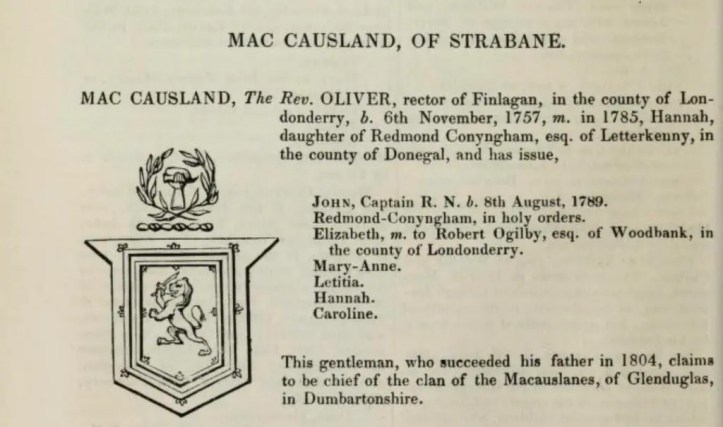
In the first four parts of this series we looked in the claim, pointed out a number of errors and misinterpretations, and concluded that the Irish McAuslands were descended from a third son of Patrick McAusland, 21st Baron of Caldenoch in our reckoning, who died in August 1616. Therefore as a junior, albeit very rich and powerful, branch of the family, they had no legitimate claim to be Chiefs of the McAusland Clan.
In this, Part 5, we will look into a letter of 6th December 1711 that Oliver McCausland, of Strabane in County Tyrone, Ireland received from the McAuslands of Glen Fruin in Dunbartonshire, Scotland.
This letter would appear to be the basis of the claim of members of the Irish branch to be Chiefs of the McAusland Clan.
However, what appears to be basically an appeal for money to redeem the mortgage on the McAusland Barony seems to have been, whether mistakenly or deliberately, taken to be an offer to Oliver McCausland, and therefore his successors, to be Chiefs of the Clan.
We conclude that the claim in Burke’s had no legitimacy and appears to be based upon a misunderstanding or misinterpretation of the 1711 letter. Despite being the senior branch of the family in Ireland, Oliver and his heirs were and remained merely a junior (albeit an extremely rich and influential) branch of the McAusland Clan.
The 1711 Letter to Oliver McCausland


- The letter was from “Kilbryd in glen fruine” i.e. Kilbryde in Glen Fruin.
- It was dated “6 decer 171“, with the second “1” having a dot above it suggesting that the date was 6th December 1711.
- It begins “Deir Cussing” i.e. Dear Cousin.
- The original envelope has been lost, but it was seemingly addressed to: “Oliver McAuslane Esqre, Strabane, Ireland.“
- The letter ends with “We rest Yrw affectionate and ever obleiged Cousings” i.e We remain Your affectionate and ever obliged cousins. It was signed by ten McAuslands.
The Text of the Letter
The text of the letter contains an appeal to Oliver McAusland from a group of McAuslands, who are likely to be the senior members of the sept. We will look into their possible identities later.
It starts with the statement that they are like a body without a head with none to appear for them or speak for them, and laments that every other clan has taken advantage of them, slighted them and wronged them.
They have consulted with “Archibald Buchannan of Drumheid” (Archibald Buchanan of Drumhead) and have finally persuaded Buchanan to write to Oliver McAusland, hoping that after the latter has read their letter, he will come across to Scotland and appear from both himself and them.
They mention that although the lands are not yielding their full rent due to the “simplicity of the Last Barrone” (i.e. Alexander McAusland, 24th Baron in our reckoning) they believe that if there was a man to own the lands, they would be worth their old value of Twenty Pounds Scots.
Archibald Buchanan of Drumhead has advised them that if Oliver McAusland will “come over and settle with” (i.e. redeem the mortgage on the lands) with “Sir Wmphray Colquhoune“(1) then he (i.e. Buchanan) would advance as much money as required. They add that Buchanan is much in favour with “Luss” (i.e. Sir Humphrey Colquhoun) and repeat that Buchanan has as much money as would be needed.
(1) Sir Humphrey Colquhoun, 5th Baronet Colquhoun, who succeeded his father in 1688 and died in 1718, leaving a daughter, Anne Colquhoun, as his heiress. She married James Grant of Pluscardine, who changed his surname and became Sir James Colquhoun, 6th Baronet Coulquhoun in 1718. However, upon the death of his elder brother in 1719 he resumed his original surname, becoming Sir James Grant of that ilk. Their second son, Ludovick, succeeded to the Luss and Colquhoun baronies, becoming Sir Ludovick Colquhoun, 7th Baronet.)
The Scottish McAuslands ended by stating their earnest desire that Oliver McAusland should come over as soon as possible or else answer them regarding the affair. They recommended their love and service to Oliver, his Lady and Children and all his friends in Ireland.
Who Was This Oliver McCausland, and What Was His Response?
The Oliver to whom the 1711 letter was sent was the first of his name, named in honour of Oliver Cromwell by his father, Alexander who is believed to have served with Cromwell in his 1649 Irish campaign.
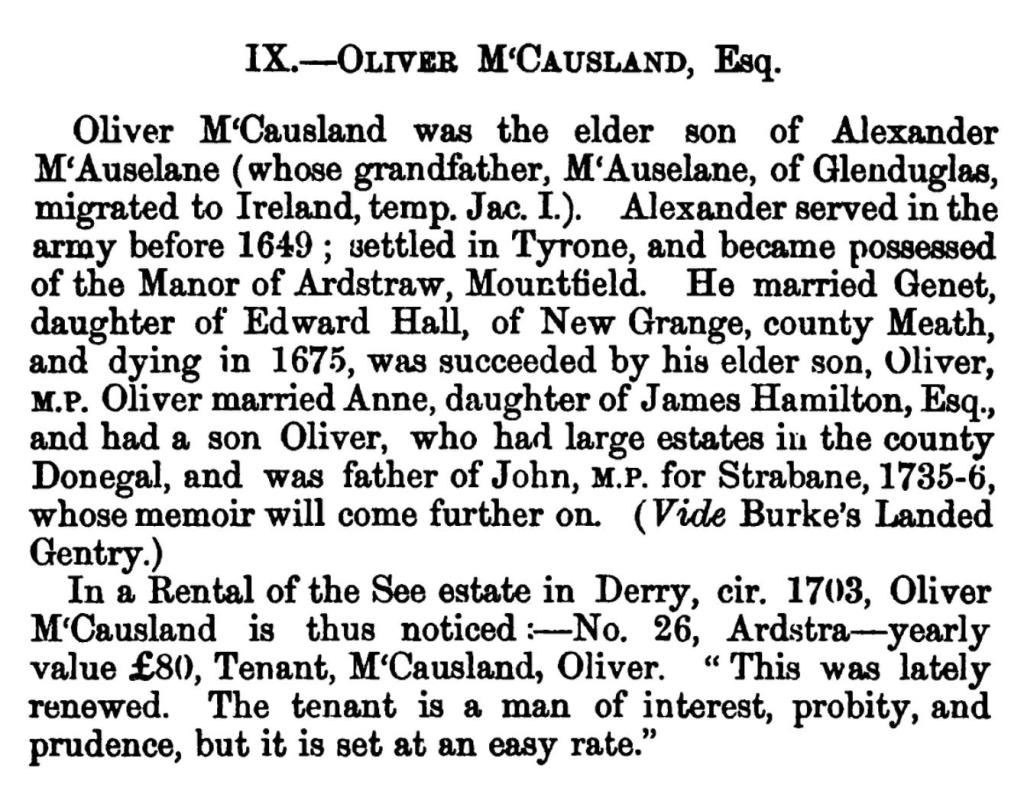
This Oliver was elected as the Member of Parliament for the Strabane constituency of the Irish Parliament in 1692, and served until his death in 1723.

Ulster Historical Foundation.
There is no known record of Oliver McCausland’s response to the 1711 letter.
However, he did not take up the offer to redeem the mortgage on the McAusland Barony and remained in Ireland.
This was reputedly because he had been born in Ireland, had no desire to go to Scotland, and he was also of advanced years.
The Intent of the Letter and its Interpretation
The intention of the letter seems clear. It was a request to a rich relative to return to his ancestral home and redeem the mortgage on the McAusland lands.
However, whether when it was initially received, or later by succeeding generations, it appears to have been interpreted that Oliver McCausland had been offered the position of Chief.
If Oliver had returned to Scotland and redeemed the mortgage on the lands (which he did not do), he would have become the 25th McAusland Baron, in our reckoning, but not the Chief.
From at least the times of John McAuslane of Caldenocht, 12th Baron of Caldenoch in our reckoning, who flourished 4th July 1395, until the time of Alexander, the last Baron McAusland, the Barons of Caldenoch held not only the position of Scottish Feudal Baron but also Chief of the McAusland Clan.
Had Oliver redeemed the mortgage he would have become not just Baron McAusland, but also the richest and most powerful member of the family. However, there were others with a better claim to be Chief of the Clan. For example, the second signatory to the letter, Dougald McAuslane who had added “neirest aire” (i.e. nearest heir) to his signature.
There are many other examples where the highest ranking member of a family was not the head. One notable example is the Comyns during the Wars of Independence: The head of family was John (III) Comyn, Lord of Badenoch and Guardian of Scotland, he who was killed by Robert the Bruce (later King Robert I) at Dumfries on 10th February 1306. Meanwhile, the highest ranking member of the family was his relative, another John Comyn, who had succeeded his father in 1289 to become 3rd Earl of Buchan and High Constable of Scotland.
Even had he become Baron, Oliver McCausland and his successors would not have been Chief of the McAusland Clan.
Therefore we conclude that the claim in Burke’s had no legal basis, and despite being the senior branch of the family in Ireland, Oliver and his heirs were and remained merely a junior (albeit an extremely rich and influential) branch of the McAusland Clan.
In Part 6, we will attempt to refute the claims that the 1711 letter did in fact give the McCauslands of Strabane the right to declare themselves chiefs.
Thanks to Brian Anton, Matthew Gilbert, Michael Barr, Dave McCausland and others for helpful discussions and sharing their research.
 Vecchio