
In Part 1, we demonstrated that:
1) The McAuslands were not based in GlenDuglas, but at Callench in Callenachglen.
2) While we initially concluded that McAuslands were a Sept of Clan Buchanan, having since seen new evidence we have concluded that the Irish McCauslands were correct to describe the McAuslands as a Clan.
3) However, the Rev. Oliver MacCausland had not been recognised as Chief of the McAusland Clan by the Lord Lyon King at Arms.
In Part 2, we looked at sources which suggested that:
4) The Rev. Oliver MacCausland was the senior male representative of the Irish line of McAuslands, and
5) He also appeared to be descended from one of the McAusland Barons.
In Part 3, we attempted to identify the unnamed Baron McAuslane who was the progenitor of the Irish line. While it is very difficult to be certain, our analysis suggests:
6) The unnamed Baron at the top of the PRONI tree was Patrick McAusland, 21st Baron of Caldenoch in our reckoning, who died in August 1616.
7) That Andrew, who appears as Baron Patrick’s son in the PRONI tree, was actually one of Baron Patrick’s younger brothers.
8) That Alexander, who appears as Andrew’s son in the PRONI tree was actually Baron Patrick’s third son and Andrew’s nephew, but as Andrew and Alexander both emigrated to Ireland, later generations assumed they were father and son.
9) Finally, and most importantly, the Irish McAuslands were descended from the third son of Baron Patrick, they were a junior branch of the family, with no obvious claim to be Chieftains.
In this, Part 4, we review what we know regarding the first McAusland settlers in Ireland and conclude that:
6) Contrary to some claims, there is no evidence that any McAusland Baron settled in Ireland.
7) Alexander McCausland, who served with Oliver Cromwell, appears to have settled in Ireland by 1631.
8) The Irish McAuslands were a junior branch of the family and had no legitimate claim to be Chiefs of the McAusland Clan.
Did A McAusland Baron Go To Ireland?
According to Burke’s Landed Gentry, the answer is a resounding Yes.

Source: A genealogical and heraldic history of the Landed Gentry of Great Britain and Ireland, Vol. 2 M-Z by John Bernard Burke Esq. (1847), Henry Colburn, London.
They state that “Baron McAuslane of Glenduglas came over to Ireland in the latter end of King James I’s reign, about the year 1600…”
As previously noted, this short statement is full of errors.
1) The Barons resided at Callanach in Callanachglen, not in Glenduglas.
2) The use of the title “King James I” is open to misinterpretation. It is crucial to note that the King in question was not King James I of Scots, who reigned from 4th April 1406 to 21th February 1437, but his great x4 grandson, King James VI of Scots and I of England & Ireland.
3) It should also be noted that King James VI of Scots did not become King James I of England and Ireland until 1603, three years after the events described in Burke’s. In 1600, Elizabeth Tudor was still Queen of England & Ireland.
4) King James VI & I’s reign as King of Scotland, England and Ireland continued until his death in 1625, so 1600 can hardly described as “in the latter end of King James I’s reign.”
Where Did Burke’s Source Their Information?
Burke’s source seems likely to have been page 275 of Auchmar’s 1723 history of the Buchanan family, which had been reprinted in 1820, some 27 years before the entry in Burke’s quoted above.
Buchanan of Auchmar wrote his family history in 1723, and as his family had a good, but contested, claim to be Chiefs of Clan Buchanan, it has been suspected that he was not always as impartial a historian as he might have been. Nevertheless, in this case it would appear that Auchmar’s history has been misinterpreted and incorrect information added by Burke’s.
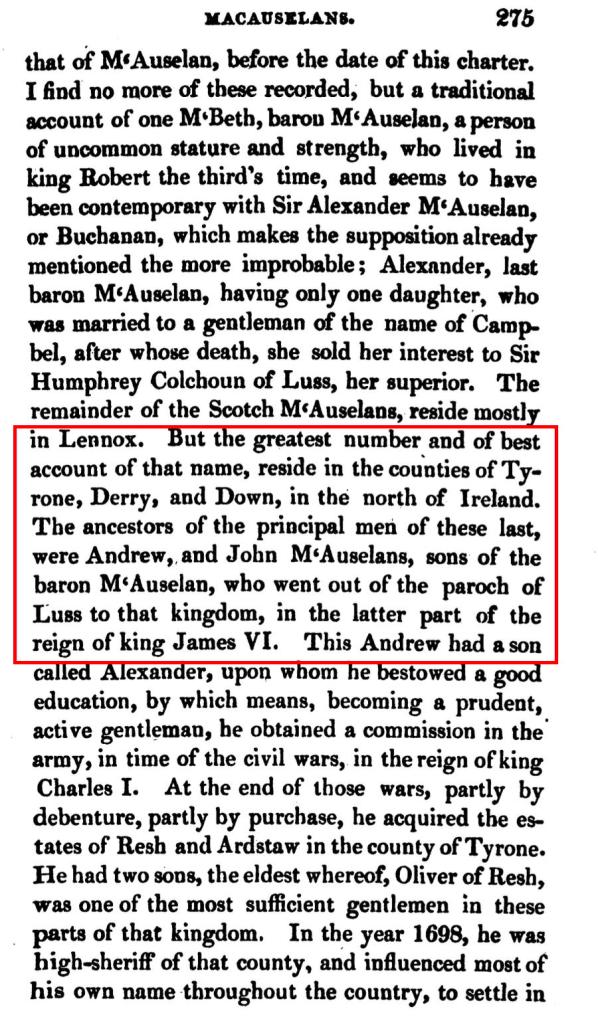
Auchmar stated that “The ancestors of the principal men of these last,” (i.e. the Irish McAuslands) “were Andrew and John McAusleans, sons of the Baron McAuslean, who went out of the paroch of Luss to that Kingdom, in the latter part of the reign of king James VI.”
- There is no mention in Auchmar’s account of the year 1600.
- He correctly, and unambiguously, identifies the monarch in question as “king James VI”
- Also, while Auchmar’s statement is open to (mis)interpretation, it seems clear that he meant that it was Andrew and John, two sons of the Baron, rather than the Baron himself who went to Ireland.
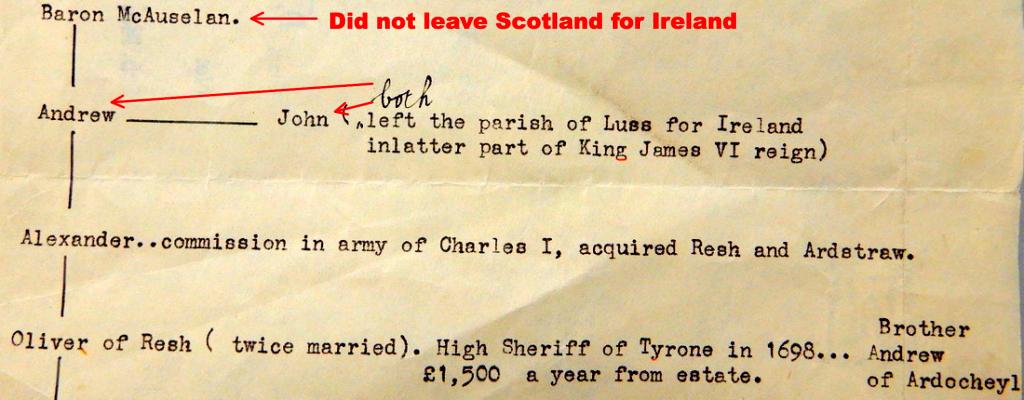
This interpretation is supported by the above extract from a typed document in the PRONI archive which states that John, and his brother Andrew “both (inserted in manuscript) left the parish of Luss for Ireland in latter part of King James VI reign.”
In conclusion, there appears to be no evidence that a Baron McAusland went across to Ireland.
Nevertheless, it seems entirely plausible that one of the McAuslane Barons might have travelled to Ireland as part of the Plantation of Ulster.
However if he did, he most certainly did not settle there.
Why Did McAuslands Settle In Ireland?
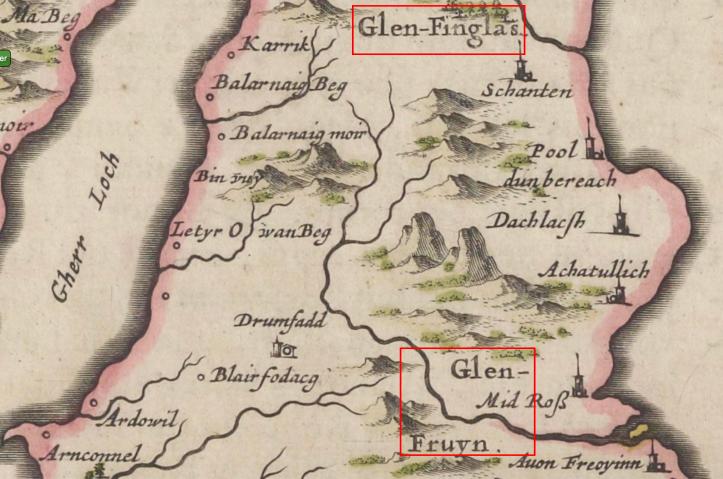
Reproduced with the permission of the National Library of Scotland.
The late 1500s and early 1600s were a time of great conflict in the McAusland homeland and this might, at least in part, explain the seemingly rapid turnover of McAusland Barons in this time period. Incidents included the 1592 murder of the McAusland’s feudal superior Sir Humphrey Colquhoun of Luss at his castle of Bannachra, and the 1602 Glen Finlas raid where the McAusland seat of Caldenoch was sacked by marauding MacGregors. Events culminated in the 1603 Battle of Glen Fruin, which was fought on 7th February 1603 between the Clan Gregor and its allies on one side, and the Clan Colquhoun and its allies on the other. The Colquhouns and their allies, including the McAuslands and Napiers, were comprehensively defeated, with Peter Napier, Baron of Kilmahew one of the most significant casualties. Reprisals included the proscription of Clan Gregor, who were outlawed for the massacre.
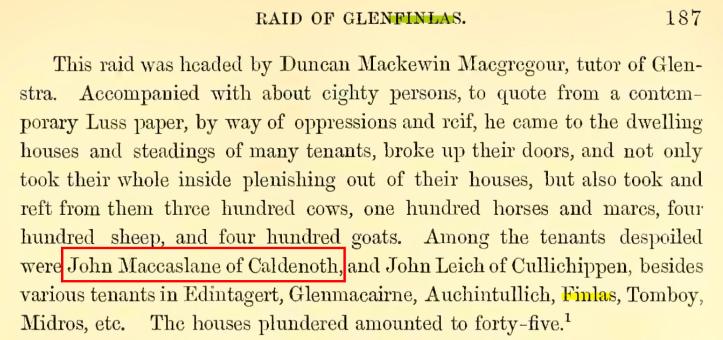
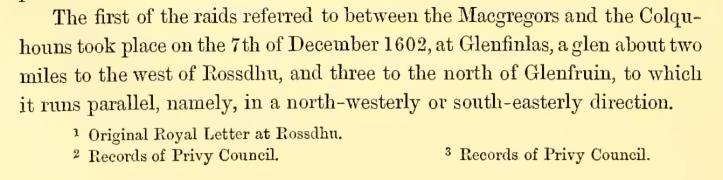
Caldenoth, the property of John McCaslane of Caldenoth, is among the list of places despoiled in the so-called Glen Finlas Raid of December 1602. As well as various properties despoiled on Loch Lomondside, others so treated included places in Glen Luss, Glen na Caoruinn and Glen Mallan, most likely giving an indication of the route taken by the raiders as they made their escape northwards. (Fraser; Chiefs of Colquhoun).
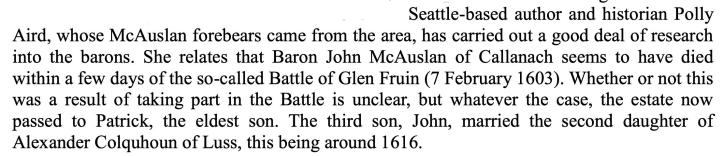
In such difficult circumstances, it may well have been very tempting to seek additional land in Ireland after King James VI’s territories expanded to include England and Ireland on 24th March 1603.
When Did Alexander McCausland Emigrate to Ireland?
Image Copyright Playgroup.
As noted above, Burke’s Landed Gentry is unhelpful, stating that McAuslands came over to Ireland “about 1600“. The official Plantation of Ulster did not begin until 1609, although unofficial private settlement had taken place from 1603 onwards.
Auchmar, meanwhile, stated that Andrew and John McAusland: “went out of the paroch of Luss to that Kingdom, in the latter part of the reign of king James VI.” (i.e. before 1625)
The PRONI tree may be more helpful. It states that Andrew McAuslane, and also his son Alexander “came to Ireland temp. Car(olus) I.” (Charles I ruled from 27th March 1625 – 30th January 1649.)
According to the PRONI tree, Alexander also “served for many years under Cromwell“, while Burke’s states that he “served in the army in Ireland before the year 1649, as appears by the auditor-general’s accounts of the period, wherein the said Alexander is said to be entitled to a share of the forfeited and debenture lands, and to a share of money as one of the adventurers and soldiers before the rebellion of 1641.”
It is interesting that the Tyrone Muster Rolls of 1631 include an Alexander McCaslane who was armed with a sword and snaphance. The latter is a a primitive flintlock.
| # | Surname | Firstname | Weapon |
| 111 | McCASLANE | Alexander | sword and snaphance |
It seems quite likely that this Alexander McCauslane was the same person who later served with Oliver Cromwell in his 1649 campaign in Ireland.
Conclusions
- While the statement that a Baron McAusland settled in Ireland appears to have no basis in fact, it is not impossible that one, or more of the Barons may have visited Ireland. However, none of the McAusland Barons settled in Ireland.
- Alexander McCausland, the first positively identified member of the Irish McAusland line, appears to have settled in Ireland by 1631.
- However, it seems clear that the Irish McAuslands were a junior branch of the family, with their progenitor a third son of Baron Patrick who died in 1616, and therefore that they had no claim to any genealogical seniority to back up their claim to be Chiefs of the McAusland Clan.
In Part 5, we will answer some questions that have been posed regarding the statements made in these first four articles..
Thanks to Brian Anton, Matthew Gilbert, Michael Barr, Dave McCausland and others for helpful discussions and sharing their research.
 Vecchio