
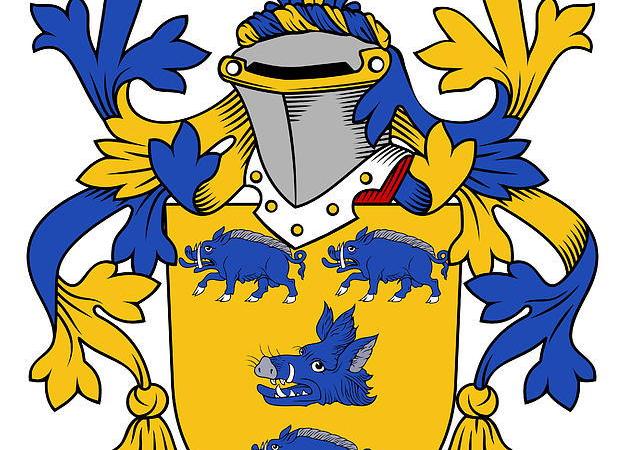
We are once again indebted to Dr Yulia Anya Guthrie, one of several contributors to this blog, for the following article continuing her research into the grants of Arms to the McAuslands.
It is a year since we first looked at the four grants of arms to the McAuslands by the Lord Lion King at Arms between 1863 and 1965. Since then, we have been made aware of some grants of arms that were made to members of the family in Ireland.
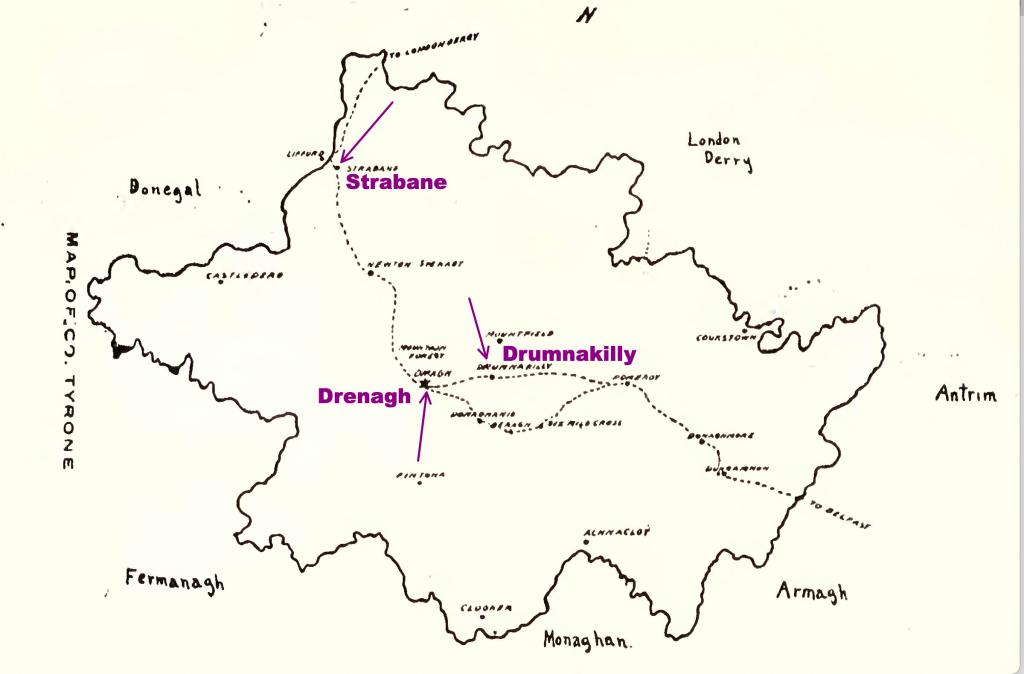
“The McCauslands of Donaghany and Allied Families” by Miss Merze Marvin (1911).
MacCausland of Strabane (Ireland)

From: A genealogical and heraldic history of the commoners of Great Britain and Ireland enjoying territorial possessions or high official rank, but uninvested with heritable honours, by John Burke (1836).
In 1836, John Burke published the arms of the Rev. Oliver MacCausland of Strabane, Ireland, who claimed to be “chief of the clan of the Macauslanes, of Genduglas, in Dumbartonshire.” Note that these arms are basically those of Buchanan with the lion holding a sword. The arms registered in Scotland by Robert McCasland of Newlandmuir in 1863 appears to be inspired by these arms.

The 1912 edition of Burke’s Landed Gentry of Ireland does not appear to contain any entry for MacAuslands of Strabane. The male line of Strabane was still extant at that date: One of the Rev. Oliver McCausland’s grandsons, Lieutenant-Colonel Redmond Conynham Samuel Macausland, J.P., a retired Indian Army Officer, was living at Woodbank, Garvagh, co. Derry, J.P., in 1915. His son, Lieutenant Oliver Bavington McCausland, 1st. Battalion Royal Irish Rifles, was killed in action, on 9th May 1915, aged just 19, at Fromelles, France.
McCausland of Drenagh (Ireland)

From: A genealogical and heraldic history of the landed gentry of Ireland, by John Burke (1912).
However, in 1912, there is an entry for a (presumed) junior line, the McCauslands of Drenagh.
“Lineage. – Andrew MacAuslane was grandfather of Colonel Robert McCausland, of Fruit Hill, near Newtown, Limavady, styled his “cousin” in the will of Captain Oliver McCausland, of Strabane, of which he was left executor and also a legatee. He had estates in the parish of Cappagh, County Tyrone, and succeeded under the will of the Right Honourable William Conolly to considerable property in County Derry. He married, in July, 1709, Hannah, daughter of William Moore, of Garvey, and relict of James Hamilton, junior, of Strabane, and by her left surviving issue, at his death, circa 1734.”

In 1912, the head of the Drenagh family was Colonel Robert’s three-times great-grandson, Maurice Marcus McCausland (1872 – 1938).

Maurice Marcus McCausland was a great-grandfather of TV personality Alexander Armstrong.
The Arms of Buchanan circa 1445
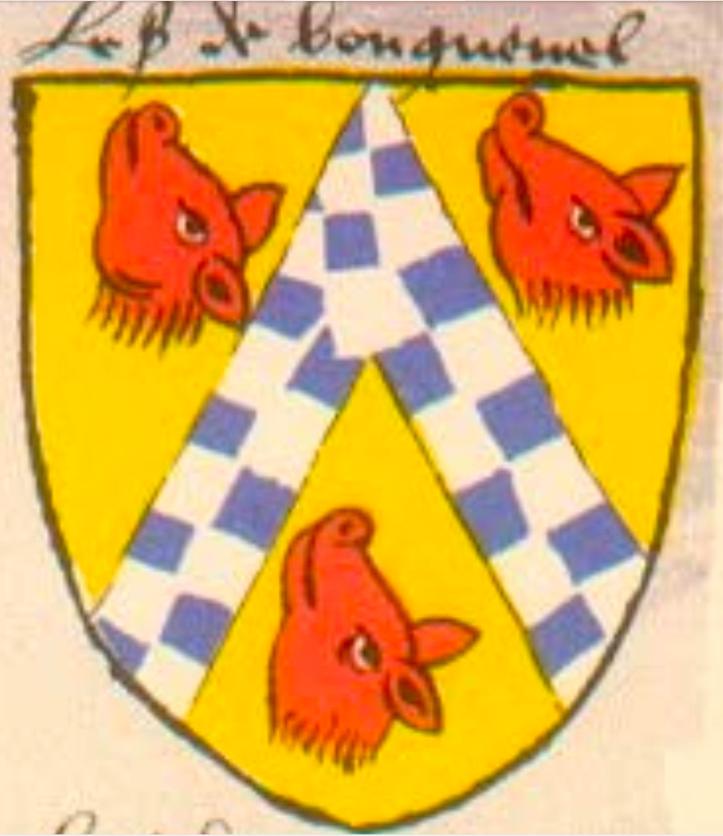
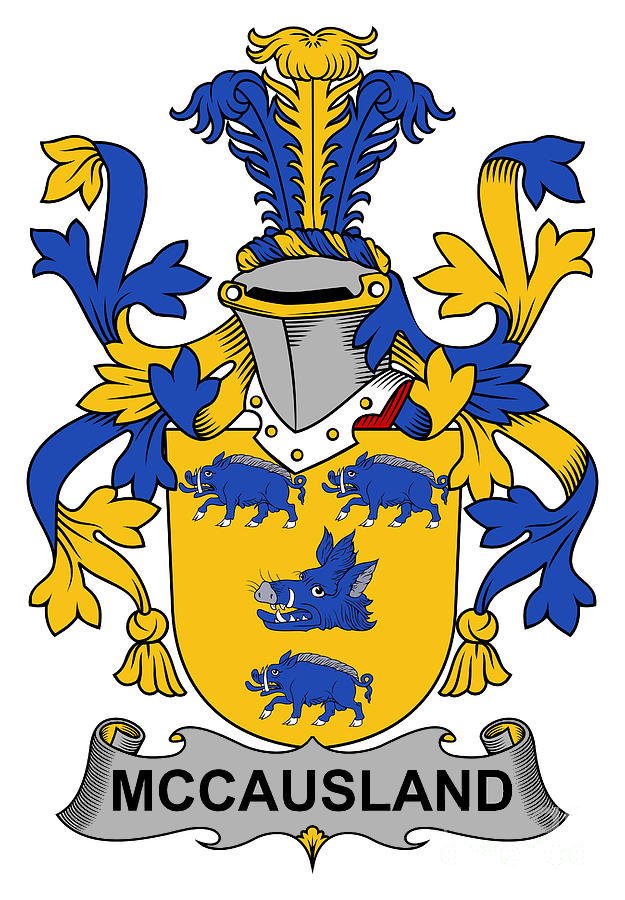
The arms of the McCauslands of Drenagh are strikingly different from the previous McAusland arms. However, it seems the boar’s head surrounded by three boars passant may have been inspired by the three boar’s heads on the Coat of arms of Buchanan (Le sire de bouguenal) that was published circa. 1445 in the Scottish section of the French Armorial de Berry
The following account appears in: Families of the Lennox,: A Survey. Scottish Genealogist Journal (1975) Part 2.
“The first recorded ancestor, of the Buchanans was Absolon, son of MacBed (or MacBethe), who was granted a charter of the island of Clarinish or Clarinch in Loch Lomond by. Maldouen, 3rd Earl of Lennox in 1225.1 A churchman of some sort, he appears as “clericus meus” in various charters and also as “dominus de Buchkanan“, the land on the shore of the loch opposite Clarinch and now a parish of Stirlingshire. The name Buchanan has been derived from the Gaelic both chanain, “the house of the canon“; and the Buchanans are called Canonaich in Gaelic. Absolon’s successors received the cognomen of Mac Absolon or MacAuslan, a name which in various forms is still to be found in the Lennox. In time, however, the family was known as Buchanan, and with several cadet branches occupied almost all the land between Loch Lomond and Kippen. The last Buchanan of Buchanan died in the seventeenth century and his estate eventually came into the possession of the Duke of Montrose, who took up residence at Buchanan Castle near Drymen. The Buchanans may have been related to the Galbraiths as their original coat-of-arms, before they adopted the lion rampant, also carried bears’ head. 2“
- The name MacBed or MacBeth was a patronymic, “son of Bede or Beda“. “Beda” was
not an uncommon name in the west of Scotland in the twelfth and thirteenth centuries. About 1175, Beda Ferdun, a tenant of the church lands in Kirkpatrick, used to provide hospitality to those who visited the shrine of St Patrick (Acts of Parliaments of Scotland, I, 95-96; Registrum Monasterii de Passelet 165-167). “Dominus Beda“, a conon of Glasgow Cathedral, acted as witness to charters before 1199 and about 1210 (Registrum Episcopatus Glasguensis, 1, 87-88; Registrum Monasteru de Passelet, 101). William, son of Bede, is on record as witness about 1225 and, 1230 (op. cit., 138a; Fraser: Lennox, II, 4, 403). - Buchanan of Auchmar was the first of many genealogists to write about the family. J. Guthrie Smith’s Strathendrick (1896) contains a full and accurate account of the various branches. Reference should also be made to The Ardoch Register, edited by John Parkes-Buchanan (1894). Additional manuscript notes by the editor are to be found in the copy presented to Dr David Murray and now preserved in Dumbarton Public Library.
McCausland of Drumnakilly (Ireland)
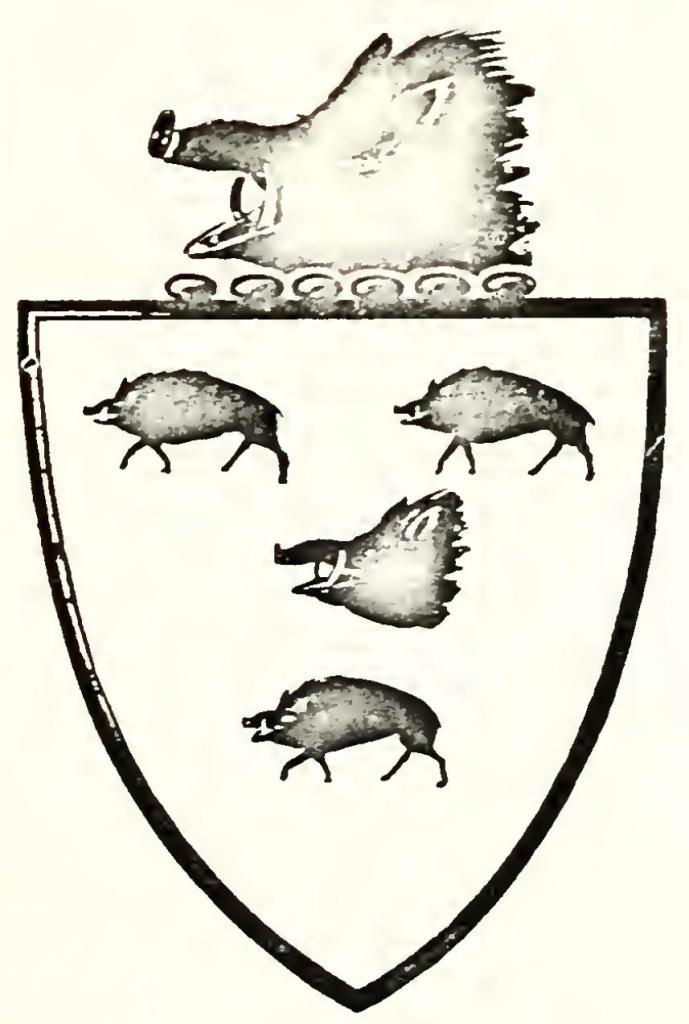
“It is impossible to determine the exact descent of the Drumnakilly McCausIands, but the armorial bearings (A boar’s head erased betw. three boars passant, azure. Crest: A boar’s head erased, azure) would indicate that the line sprang from Col. Robert McCausland of Drenagh. A later armour used by some members of the family show a mother pig with litter of young. The origin of this insignia is not known. Dilligent search has failed to reveal the name of the first McCausland to whom the Drumnakilly Estate was granted.“
Miss Merze Marvin of Shenandoah, Iowa, USA, 1911.
However, Miss Marvin did discover the following document from 1728 regarding a lease of lands including Upper and Lower Drumnakilly:
“Memorial of Deeds of Lease and Release, dated 28th and 29th November, 1728, the Lease made between Alexander McCausland of Omagh, Co. Tyrone, Esq, and John McCausland third son of said Alexander McCausland, of the one part, and William Hamilton of Calledon in sd Co. of Tyrone, clerk Archdeacon of Armagth and Oliver McCausland of Rush in sd Co. of Tyrone, Esq, of the other part; and the Release being an Indenture Tripartite made between said Alex. McCausland and John McCausland of the first part, the sd Wm. Hamilton and Oliver McCausland of the second part, and Jane Sampson of the City of Dublin, widow, one of the Executors of the Will of Michael Sampson, late of the City of Dublin, Esq. deceased, and Ann Sampson, daughter of said Jane Sampson of the third part witnessing that said Alex and John McCausland for the considerations in said Deed of Release men- tioned have granted, bargained, sold, released and confirmed unto said Wm. Hamilton and Oliver McCausland and their heirs; all that and those the towns, lands, messuages and premises following, viz: Upper Cloghfinn, Lower Cloghfinn, Crackencor, Upper Drumnakilly, Lower Drumnakilly, the tuck mill thereon, the half town land of Feccary and the corn mill thereon, the half town land of Ballenagelly, Racolpagh, Cullycurragh, Ferneagh, Deerpark, and all the messuage or tenement where ye said Alexander McCausland now dwells in the town of Omagh, formerly known be the name or names of Lamberts Tenement and John Baird’s Tenement, together with that park now in the possession of the said Alexander McCausland, known by the name of Hays Park, all situate lying and being in the Co. Tyrone, together will all singular the appurtenances thereunto belonging and the reversion and reversions, remainder and remainders, rents, issue and profits of all singular the said premises, To have and hold the said lands and premises with the appurtenances unto the said William Hamilton and Oliver McCausland, their heirs and assigns forever, Which said deeds of Lease and Release are witnessed by Richard Den and Redmond Cahan, both of the City of Dublin, Gents, and this memorial is witnessed by the said Redmond Cahan and Alexander McClintock of the City of Dublin, Gents.”
McCaslan of Inverlauran (Luss, Dunbartonshire, Scotland)
It is interesting to compare the boars on the arms of McCauslands of Drenagh (above) with the possible boars on the arms that feature on the very badly worn tombstone in Luss kirkyard of Archibald McCaslan, tenant in Inverlauren and Janet McAulay.

From Rhu Parish Church & Tombstone Inscriptions, Copyright 1999 by the Clan Colquhoun Society of the United Kingdom.
These arms are also mentioned in a publication from thirty years earlier: “Rhu Kirk Cemetery Monumental Inscriptions in Dumbartonshire” by John Fowler Mitchell, C.I.E. and Sheila Mitchell (Scottish Genealogical Society, 1969)” which is cited by Richard McAuley. He has included additional transcriptions made by him in 1989 and 1995; and these are shown in square brackets […].
“Archd McCaslan tenent in (Inverlauran) d July 17(4) ae 6- yrs; also Janet McAulay d Nov 17(8)2″ [the marker has initials “D McA” (on left side) and “K McA” (right side) of impaled arms but the heraldic devices are too eroded to distinguish but in the centre of K McA’s arms illustrates three animals, one in fess, one in chief, and one in base, quite possibly boars for MacAuslan, but these are whole animals rather than merely the three boar’s heads cabossed or erased as are found in the Buchanan’s arms].”
Possible Arms of the McAusland Barons of Caldenoch?
We have as yet found no records of the arms, if any, that were borne by the McAusland Barons of Caldenoch, but one possibility is that they may have resembled the above.
 Vecchio
Thank you for this detailed research – amazing! I’m a McCausland from Australia (descended from the Irish McCauslands) planning to visit Scotland, so it is very helpful to see all of this. Looks like I’ll be making a visit to Luss on the shores of Loch Lomond. Thanks again.
LikeLiked by 2 people
If you have a male McCausland relative who is willing to take a DNA test, there is a new and powerful test called BigY700 which can be very useful.
It can seem daunting at first, but there are plenty of experienced people around who can help advise.
https://lammermoor.org/2023/12/26/mcausland-and-buchanan-relationships-confirmed-by-y-dna/
LikeLiked by 1 person
Thanks, I will let them know. I’ve got a pretty good line back to the Irish McCauslands, we appear to be the second or third sons who became reverends.
LikeLiked by 2 people
Hola, yo soy McCausland de Colombia. Será posible conectarnos? Gracias. veraortega1954@Gmail. com
LikeLike
Thank you for this detailed research – amazing! I’m a McCausland from Australia (descended from the Irish McCauslands) planning to visit Scotland, so it is very helpful to see all of this. Looks like I’ll be making a visit to Luss on the shores of Loch Lomond. Thanks again.
LikeLike
Me gustaría conocer si es posible tu correo y poder comunicarnos, también me interesa en algún momento viajar y conocer algo o mucho de la tierra de mis antepasados que no conocí. Parece que llegaron primero a España y luego a Colombia. Saludos👋
LikeLike