

Image Copyright Playgroup.
In this post we refer back to the excellent Genealogy of the Calhoun Family blog, where Brian Anton presented a very well-researched article (one of many), this time looking into some of the errors that have crept into the genealogy of the McAusland family and that have become generally accepted as dogma.
William Buchanan of Auchmar’s 1723 “Historical and genealogical essay upon the family and surname of Buchanan” (re-issued in 1820 by William Chapman), is one of the most referred to sources for the history of Clan Buchanan, and also its septs which includes the McAuslands.
However, some of the early history must be taken with a large pinch of salt as Auchmar was not one to allow facts to stand in the way of a good and convenient story, and some of the entries in his book are as remote from reality as the highly entertaining 1954 musical Brigadoon starring Gene Kelly and Cyd Charisse.
For more details see:
By Brian Anton in the Genealogy of the Calhoun Family blog


The case that Alexander McCausland (father of Oliver McCausland) was the son of Baron Patrick McAusland of Caldenoch (rather than his nephew) is well argued in the article referred to above and the case presented is extremely persuasive.
However, while we agree that there have been indeed been many errors, we still tended to believe that Alexander was more likely to be Baron’s Patrick’s nephew than his son.
This is because of the names of Alexander’s children.
In Scotland, it was common, but not universal practice, for the eldest son to be named after the paternal grandfather, the second son to be named after the maternal grandfather, and the third son to be named after the father.
If Alexander was indeed the son of Baron Patrick, then we might have expected Alexander’s first son to have been named Patrick (after the paternal grandfather), his second son to be named Edward (after the maternal grandfather, Edward Hall) and any third son to be named Alexander after his father.
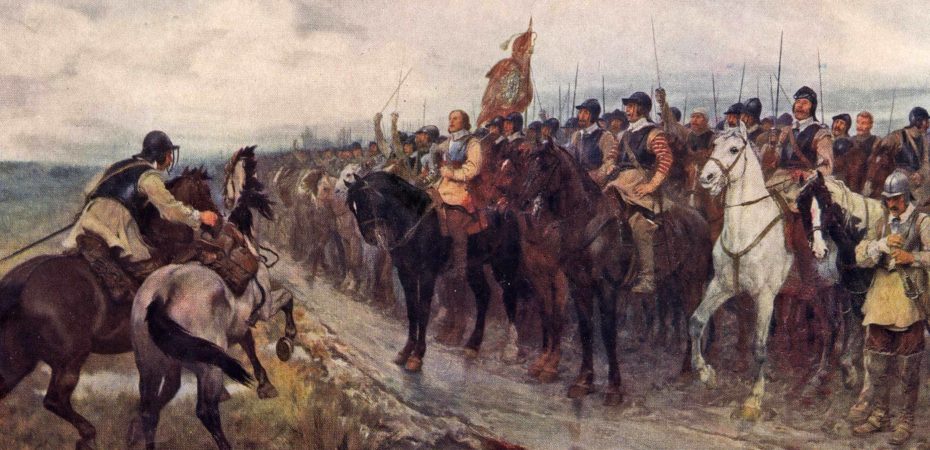
However, Alexander’s eldest child was named Oliver, which was a complete break with family tradition. It seems very likely that Oliver was named in honour of Oliver Cromwell, the Parliamentarian General and later Lord Protector of the Commonwealth, with whom Alexander is believed to have served in Ireland.

Painted in 1886, by Andrew Carrick Gow
Alexander’s second son also had a surprising name, not being named Patrick, after his presumed paternal grandfather, or Edward after his maternal grandfather, or even Alexander after his father.
Instead, Alexander’s second son was named Andrew.
This is exactly what would be expected if Alexander had indeed been the son of Andrew McAusland, younger brother of Baron Patrick, as is reported by the not always reliable Auchmar and as described in an 1814 tree that is held in PRONI, the Northern Ireland archives and that was certified by the King of Arms for Ireland.

The early part of the tree is contested – see Genealogy of the Colhoun Family for details.
Thanks to Dave McCausland for sharing this tree and research into the Irish McCauslands.
None of this is proof of Alexander’s parentage as Auchmar has been proved to be notoriously unreliable and the Irish King of Arms probably only guaranteed the authenticity of the tree deposited rather than its accuracy.
However, once again, we have two alternative and different interpretations of how the Scottish McAusland and Irish McCausland lines might be related.
Hopefully, further investigation and collaboration may help determine which of these theories might be correct.
Thanks to Brian Anton, Matthew Gilbert, Michael Barr, Dave McCausland and others for helpful discussions and sharing their research.
Update 3rd January 2025
- New analysis of the PRONI tree has suggested that the unnamed Baron at the top of the tree could be Patrick McAusland, 21st Baron of Caldenoch in our reckoning, who died in August 1616.
- Blogger “Baroness McAusland” has suggested possible reasons for the name of the second son of the Andrew McAusland who emigrated to Ireland and served with Cromwell. She believes that he may have chosen not to name his second son Patrick due to the fact that Saint Patrick was Patron Saint of Catholic Ireland, and instead to name him Andrew, after Andrew McAusland and Saint Andrew, the Patron Saint of Protestant Scotland.
- Our own relatives Captain John Philp and his uncle, also named John, emigrated to the USA on 14th August 1858. However, it was later assumed by researchers that “John Philp senior” and “John Philp junior” were father and son rather than uncle and nephew. It seems possible that a similar confusion may have arisen with the McAuslands resulting in Andrew and Alexander being assumed to have been father and son when they were, as with the Philps, actually uncle and nephew.
Conclusion
We now support Brian Anton’s proposal that the Alexander McAusland who emigrated to Ireland and served with Oliver Cromwell was indeed the same person as the Alexander McAusland, third son of Patrick McAusland, Baron of Caldenoch, who died in August 1617.
It seems possible that the Andrew McAusland who was believed to have been Alexander’s father was actually his paternal uncle. The John Philp (uncle) and John Philp (nephew) who emigrated to the USA were later mistakenly believed to be father and son, and a similar confusion may have arisen with the McAuslands.
Alexander McAusland is reported to have served with Oliver Cromwell and he named his eldest son Oliver after the Parliamentarian General. It seems quite possible that as a Protestant Ulster Scot settler, Alexander avoided naming his second son after his father, Patrick, due to Saint Patrick being the Patron Saint of Catholic Ireland and instead named him Andrew after his paternal uncle, and Saint Andrew the Patron Saint of Protestant Scotland.
ὅπερ ἔδει δεῖξαι – QED?
 Vecchio
Things seem to be moving incredibly rapidly after 300 years of uncertainty and confusion. It can be incredibly difficult to do accurate research into families before the Old Parish Registers, and so often we find the same old errors endlessly repeated and amplified, as with those who hijacked the McAusland tree to create an obviously fake connection to William the Conqueror. Why bother when there is a documented connection from the Prestilloch McAuslanes via the Stewarts of Ballachulish to the Royal Stuarts. So Well Done to all the many dedicated researchers who have actually looked into genuine documents from archives and attempted to make sense of them as opposed to deliberately creating fake genealogies.
LikeLiked by 3 people
There are still a number of parts of the McAusland tree where primary sources are either absent or open to interpretation, but thankfully there are now a number of researchers who are working together with the aim of creating as accurate a tree as possible rather than obsessing about being able to claim royal descent through dubious ancestry.
LikeLiked by 2 people
Thanks so much for this thought-provoking article and for the shout-out to the Colhoun blog. Your point about Alexander McAusland being the son of Andrew rather than Patrick based on naming patterns is well taken. I can’t say you are incorrect, since the evidence either way is circumstantial. I will offer a few ideas that I think still favor Patrick as the father.
First, the oral tradition in the Colhoun family of Ireland is that William Colhoun was raised by an “uncle” McCausland, and evidence points to Alexander as being that “uncle”. The fact that Patrick was married to Agnes Colquhoun creates a blood relationship between William and Alexander that comes close to satisfying this tradition. (However, I admit we don’t know who the wife of Patrick’s brother Andrew McAusland was. Do we?)
Second, we know for certain that Patrick had a son named Alexander (based on Patrick’s will), whereas we know nothing about the children of Andrew, assuming he had any.
Third, we don’t really know who all the children of Alexander McAusland and Jennet Hall were, only those who survived. Younger son Andrew was born about 1660 (since he was age 19 when entering TCD in 1679), and eldest son Oliver could have been significantly older.
Finally, it seems this family didn’t adhere closely to the Scottish naming traditions. Look at the (known and surviving) children of Oliver McCausland in Ireland: Catherine, John, William, Oliver, and Jane. No one named for the grandfathers, Alexander McAusland and Rev. James Hamilton, or at least none we know about.
I’m certainly hoping more evidence will eventually come to light, one way or the other.
LikeLiked by 3 people
I can understand why Alexander had a son named Oliver.
I can also postulate – see my post below – why Alexander had no son named Patrick.
But we still need to explain why he had a son named Andrew?
To pull together all the research and ideas:
Could we imagine that Alexander was indeed the third son of Baron Patrick as suggested.
But rather than Alexander naming his second son after his father Patrick and the Patron Saint of Ireland, he named him Andrew after the Patron Saint of Scotland and in honour of his country of birth, thus emphasising his Scottish roots?
And if Alexander initially went to Ireland following the example of his favourite uncle, Andrew McAusland, even better.
LikeLiked by 1 person
Excellent!
I feel that everything is finally fitting into place.
New analysis of the PRONI Tree suggests that the unnamed Baron may have been Patrick, the Baron McAusland who died in August 1616.
If Patrick’s brother Andrew and Patrick’s son, Alexander both emigrated to Ireland, then, as with our Philp relatives who emigrated to the USA, it may have later been assumed that the pair were father and son, rather than uncle and nephew.
Finally, I find your explanation of why Alexander named his second son Andrew – after his uncle and Saint Andrew of Protestant Scotland rather than his father and Saint Patrick of Catholic Ireland – rather convincing.
I will modify the tree accordingly.
LikeLike
McAuslane family history was, until relatively recently, clouded with mist and uncertainly. We were in a situation where mistakes, misunderstandings, and errors were endlessly repeated with sources or references rarely, if ever quoted. Sadly, even obviously fake genealogies were all too common, with corrections on public family history sites pointless as they were swiftly removed to maintain the false royal pedigrees. So, a vote of thanks to all those who have contributed to advancing our knowledge regarding our McAuslane ancestors.
Looking at the Scottish and Irish lines, it is perhaps worth noting that we often see particular Christian names favoured in a family. For example, if we look at the Barons of Colquhoun the 1st, 4th, 6th, 10th, 12th, and 14th were named Humphrey, while the 8th, 9th, 11th and 13th were named John.
In our own line, of the last seven McAuslane Barons of Cùlanach, four were named Patrick, two were named John, while the last Baron was named Alexander.
To compare this with the family in general, for identified McAuslanes born pre-1700 in the Luss area, the most common male names were John (16), Patrick (9), Duncan (8), Alexander (7), Humphrey (3), Archibald (2), Dougal (2), Robert (2), Andrew (1), Donald (1), and William (1).
I note the comment by fellow researcher, Mr Anton above: ‘No one named for the grandfathers, Alexander McAusland and Rev. James Hamilton, or at least none we know about.‘. While this is true, Alexander McAuslane of Rash and Ardstragh may have had two grandchildren named after him: Firstly Alexander McAuslane (son of his second son Andrew) who may have been (and I believe that this is disputed) the ancestors of the McAuslanes of Drenagh. There was also the Reverend Alexander Colquhoun, Senior, Rector of Templecarn, who was father, in turn of the Reverend Alexander Colquhoun, Junior. So the name Alexander did continue, at least in his Colquhoun/Calhoun descendants.
In contrast, I do find it very interesting that, as far as I am aware, Patrick, the most popular name in the McAuslane Scottish Baronial line, appears to be completely absent in the Irish line that purports to be descended from Baron Patrick himself. One might have expected such a name to be retained as a reminder of the family’s noble descent, and their chiefly aspirations?
It is certainly true that infant mortality was shockingly high in those days, but if a child died, as can be seen in the Old Parish Registers of Births and Baptisms in Scotland, a second, and even third or fourth might be given the same name so that it would not die out. So why do we not see the name Patrick in the Irish McAuslanes?
Perhaps, as the name of the Patron Saint of Ireland, Patrick was seen to be far too Irish and Catholic a name to be given to strongly Protestant Anglo-Scots who appear to have been devoted followers of His Highness Oliver Cromwell, Lord Protector of the Commonwealth of England, Scotland and Ireland (also known as ‘Old Ironsides‘?
LikeLiked by 2 people
Oliver Cromwell is still a highly divisive figure here. When Kenny MacAskill, ex Scottish Justice Secretary, was elected to the Westminster Parliament in 2019, his maiden speech contained the following thoughts regarding Cromwell:
‘There are historic links to my constituency in this institution, and not just through those who have been elected Members. When I first arrived here last month, I came across a statue of Oliver Cromwell, who is well known in my constituency, in the town of Dunbar. He is not viewed as the Lord Protector; far from it. He may not have been as brutal there as he was at Drogheda, but people still suffered at the Battle of Dunbar in 1650, when his English army killed thousands of Scottish soldiers and captured thousands more. Those who were captured were marched south, with many dying en route. They were taken to Durham cathedral, where thankfully a memorial now recognises what they suffered. Many died in incarceration there. Of those who were released thereafter, some were given by the Lord Protector to the army of France. Others were sent to do drainage work in the area of the Wash in southern England. Others still were transported to Barbados and to the Americas.
But some good did come from this, because in 1657, seven years after serving their penal servitude, some of those Scottish soldiers banded together to form the Scots Charitable Society of what is now Boston, which is argued to be the one of the oldest such charitable organisations not just in the United States but in the western hemisphere. They keep contacts with the community in Dunbar, as indeed did the Scottish Prisoners of War Society—because such an organisation does exist, with many American members, and they had a re-enactment of the battle last year.’
https://hansard.parliament.uk/Commons/2020-01-15/debates/2E5CA9CE-7506-468D-BB69-D5A72FC52A82/AGreenIndustrialRevolution#contribution-3DF9CC6A-1548-466E-B99E-EAE53FE24D59
LikeLiked by 2 people
As Mr Spock used to say: “Fascinating!”
I had never considered that “Patrick” might be an undesirable name for Plantation settlers.
That could well explain why the name suddenly disappears from the Irish branch.
LikeLiked by 1 person