

The following series of articles will attempt to present the current thinking regarding the McAusland Barons. However, much still remains as speculation, especially for the earlier generations for whom there is no documentary evidence, and even for later generations there are differences of opinions regarding the relationships of the family members.
Considerable progress had been made very recently in untangling the tangled web of the family history of the McAuslands of Caldenoch and in particular in debunking some of myths which had became dogma that persisted for over 300 years. However, it remains difficult, if not impossible, to attempt to construct a meaningful genealogy without any detailed knowledge these McAusland Baron’s dates of birth, succession and death, exactly how they were related to each other and whether the Barony was inherited directly from father to son, or to other relations.
In this first article we look at the misty origins of the Barony of Caldenoch and the possible first semi-legendary holders of the title.
Caldenoch – What’s In A Name?

Used with the permission of the National Library of Scotland.
The McAuslands were feudal superiors not just of Caldenocht (also known as Coldenocht, Caldenoth, Caldanacht, Caldenache, Caldonah, Callenach, Calanach, and Cùlanach) but also of Prestellach, Innerquhonlanes and Craigfad.(The Argyll Sasines: Otherwise Known as the Argyll Sasines. Abstracts of the particular register of sasines for Argyll, Bute and Dunbarton by Herbert Campbell. Brown, 1933).
A Luss Estates rental record from 1844 also states that Alderigan, along with Prestelloch and Stronmallanach, are believed to have once been owned by a Baron McAuslan.
A Dumbarton County Valuation of 1657, Baron McAuslan’s lands are listed as valued at £80 in the Parish of Luss, out of a total valuation of £2234.
The McAusland Barons of Caldenoch, Prestilloch, Innerquhonlanes and Craigfad were first mentioned in a historical document on 4th July 1395 when John McAuslane of Caldenocht witnessed a charter where Humphrey Colquhoun of Luss granted his brother Robert the lands of Camstradden. (Colquhoun of Luss charters). The fact that John McAusland was described as “of Caldenocht” is crucial as “of” a property implies having possession of a charter to that property, as opposed to simply just living there.
The Scottish Genealogist Journal (1975) part 2, contains an essay on Families of the Lennox: A Survey, which includes the following mentions of Caldenoch and Inverlauren, two of the McAusland properties:
“In the Highland part of the Lennox, i.e., the parishes of Arrochar, Luss and Rosneath, Gaelic was spoken down to the end of the eighteenth century, and it is not surprising that the surnames are generally Gaelic patronymics, e.g., MacAlpines of Doune in Glen Douglas; MacCauslanes of Caldenoch on Loch Long; MacRogers of Glenmacairn in Glen Luss; MacWalters of Auchinvennal, MacAulays of Duirland1 and Lennoxes of Inverlauren in Glen Fruin. Of these families, only the Lennoxes are still to be found in the district.2“
1. Fraser: Chiefs of Colquhoun, II 281, 369; II, 250, 269; II 105,179; II, 281, 320; Fraser: Chartulary of Colquhoun, 16, 253, 261-262, 285.
2. Sir William Fraser: Chiefs of Colquhoun, (1869), II 281, 320, 326, 333; Cartualary of Colquhoun (1873), 253: Donald MacLeod: Historic Families of the Lennox (1892), 83-84. “Gilbert de Inrelauran” was one of the Lennox vassals who pledged allegiance to Edward I in 1296 (Ragman Roll, 1834, 145). The mother of Hugh Fraser, the founder of the great drapery firm in Glasgow, was Elizabeth Lennox, daughter of Robert Lennox, farmer, Kirkton, descended from the Lennoxes of Glen Fruin.
We believe that the McAusland Barony may have been the original homeland of Clan Buchanan. While North Clyde Archaelogical Society do not go quite as far as to specifically suggest this, they do make a number of interesting remarks connecting the McAusland and Buchanan lands in their excellent study The history and survey of several settlement sites in Argyll by Alistair McIntyre (History) and Tam Ward (Archaeology):
“The lands of Preas Seilich have long formed part of Luss Parish, but this was not always the case. Writing in 1793, the Rev. John Stuart, author of the account for Luss parish in the Old Statistical Account of Scotland, notes various changes that had been made to the boundaries of Luss parish through the course of the 17th century. All bar one of these changes resulted in a reduction in size of the parish, which once stretched on the west side of Loch Lomond from one end to the other, and also included some lands on the east side of the loch. The exception was the addition of the lands of Caldonach, Prestelloch and Conglens, which had previously formed part of the lands of Inchcallioch parish.
“This discourse might come over as relatively arcane, but one interesting aspect of these additions to the parish of Luss is that they correspond to the core territory of lands once held by the McAuslane “Barons”. Here, it should be noted that the term “Baron” in Gaelic parlance is much less prestigious than its Anglo-Norman counterpart but equates rather to the owner of a relatively small estate. Despite this, there are a number of stories, long current in the area, relating to their power and prestige. For example, local historian Joseph Irving, in his magisterial “Book of Dumbartonshire” (1879), quotes the legend about how Luss got its name from the fleur-de-luce plants strewn on the grave of Baroness McAuslan, whose husband had distinguished himself at the siege of Tournay.
“Just possibly, there may be significance in the fact that the core territory that they held, including the lands of Prestelloch, had once formed part of Inchcallioch parish. This parish centred on several of the islands on Loch Lomond, and lands lying on the east side of the loch. These once formed the homelands of the Clan Buchanan, of whom the McAuslanes are a sept. Note too that the name of Inchcallioch parish changed to that of Buchanan, which is actually a place-name, as well as the clan name.“
Caldenoch – Remote and Sparsely Populated?
While today, with the core McAusland lands being abandoned, their barony may seem to modern city dwellers to have been “remote from civilisation” and in “the back of beyond“. However, in the early 1700s, it is estimated that some 30% of Scotland’s population was concentrated in the Highlands and Islands. By 1900, this had fallen dramatically to under 10%. But, before the notorious Highland Clearances, many a glen that is now deserted was full of small but thriving villages or “townships”.

Adapted from John Wood’s 1818 map of Dunbartonshire. Used with the permission of the National Library of Scotland.
Also, in the days of the McAusland Barony, the “Great Highland Road” ran through Glen Fruin and then up Glen Cùlanach, meaning that the McAuslands would see many travellers heading through their lands. Indeed, as discussed by Peter Lawrie the MacGregors travelled through Glen Cùlanach while heading for the fateful Battle of Glen Fruin on 7th February 1603:
“Most modern traffic going north from Dumbarton follows the A82 along the side of Loch Lomond, but in the 17th century, the road, such as it was, followed the Gareloch and Loch Long to Arrochar and Tarbet and thence to Glen Falloch. This route was known as the Great Highland Road. Many of the names in the Dewar account cannot be located on the modern map and there is no stream named Allt a’ chlèith. However, we are told that they had passed Bràigh sròn a’ Mhaolanaich which can only be Sron Mallanach at NS255975 on 1:50000 OS map 56. Therefore Allt a’ chlèith must be the stream which flows through Glen Culanach crossing the road and entering Loch Long at NS249963. The outfall today is very close to an MOD ordnance depot associated with the Faslane submarine depot. The area is now heavily wooded with overgrown rhododendron bushes. However, several hundred yards from the roadside, a site which closely resembles the description in Dewar’s manuscript can be found”.
Peter Lawrie. The Battle of Glen Fruin – Cath Ghlinn Freon. A Different Perspective. The Scottish Genealogist Journal (2002) Issue 4, pages 103-105.
The McAusland Barons of Caldenoch

The title of Baron in Scotland was rather different to that of Baron in England, which was the equivalent of the Scots title Lord of Parliament. Barons are defined in the Scots Genealogist Journal (1995) issue 3, page 97 as:
“Barons – With the introduction of the feudal system in the 12th century, pre-feudal, or Celtic tenures, were transformed into holding from the Crown and a number of these were held directly or in chief of the Crown and were held in libernam baroniam, in free barony, with high justice (i.e. with pit and gallows). These Baronies belonged to the same order as Earls and these Earls and Barons together formed the Order of the Three Estaits of the Scots Parliament known as The Baronage of Scotland. The Barons sat in the Scots Parliament until 1587 when they were relieved from attendance, which was burdensome and costly. The right of pit and gallows was removed in 1747 by the Heritable Jurisdictions Act, lesser powers continued to the twentieth century.“
A number of McAusland Barons are documented, and many of these, although not all, are listed in North Clyde Archaelogical Society’s excellent reports, which include The history and survey of Cùlanach settlement in Argyll, The history and survey of several settlement sites in Argyll and The history and survey of Alderigan settlement in Argyll by Alistair McIntyre (History) and Tam Ward (Archaeology). They use the name Cùlanach and state “As with many old settlements, there are a wide variety of spellings of the name, the meaning of which may translate as “place of hazels”. The form of spelling of the heading is as used on modern OS maps.”
Interestingly, there was also a Niall Culanach O’Neill a king of Tyrone in medieval Ireland on three occasions between 1261 and 1291. His nickname Culánach, also anglicised as Culanagh, is said to have meant “of the long back hair“. (Annála Connacht).
The McAuslands, Clan or Sept of Clan Buchanan?
As is well documented, the Buchanans were originally the McAuslands of Buchanan, but, unusually for a clan, over time they came to use the name of their territory as their surname, with the chiefs becoming known as Buchanan of that ilk. While the McAuslands are often considered to be a sept of Clan Buchanan, recent research has revealed that in 1711, the senior McAuslands considered that they were, in fact, a clan.
As with Caldenoth, there are multiple variations of the McAusland surname including MacAusland, MacAuselan, McAuselan, Macauslane, McAuslane, Macaslan, McAslan, Macauslan, McAuslan, MacCasland, McCasland, MacAslin, McAslin, McAuselan and Cousland.
According to The Clan Buchanan Society International: “Clan Buchanan is an old Highland Scottish clan. Our people have been in Scotland, particularly in Stirlingshire and on the shores of Loch Lomond, for thousands of years.
“According to DNA analysis, Clan Buchanan was located on the shores of Loch Lomond, in the Auld Kingdom of Alba, well before the year 1000 (CE) and possibly going way beyond that.
“The Y-DNA Project, with all the people who participated in that (including the MacAuslans and Buchanans), concludes that there is no individual descended from recognized family lines of the clan whose Y-DNA matches up with any O’Cahan/O’Kyan Y-DNA from Ireland.
“According to the official publication provided to the Clan Buchanan Society International (CBSI), “There is a strong DNA link to the Clan Gregor which seems to indicate a common ancestor around the year 400 C.E. (AD)” This discovery was made through extensive genetic testing information collected provides further proof of the existence of Clan Buchanan well before dates mentioned in the “Irish Prince Origin Myth”.
“Supported by Y-DNA research, the Clan now believes that our origins are ancient P-Celtic or Brittonnic who would have arrived in Britain, most likely Wales, around the start of the Bronze age 2500 BCE. They were next found in Kintyre in western Scotland and then Argyll between 300 B.C.E (BC) and 350 C.E. (AD). Pressured by an influx of the Irish Q-Celtic from Dál Riata, they moved farther eastward into Argyll and then across to the eastern shore of Loch Lomond where they settled.“
They also state: “The first recorded McAusland was Malcolm, Steward to Maldouen, Third Earl of Lennox during the reign of David II (1124-1153 A.D.) Malcolm may have inhabited land in Glen Fruin as well as in Luss, all to the west of Loch Lomond, whereas the current lands of Buchanan are to the east of Loch Lomond. This Malcolm may have been the Baron MacAuselan from whom the bearers of the patronym are descended. The seventh Chief of Buchanan, Gilbert, appears to be the first to permanently assume the surname of Buchanan rather than McAusland.“
The Chiefs of Clan Buchanan
Clan Buchanan International note: “The two main Clan historians, Buchanan of Auchmar (60) writing in 1723 uses the term ‘Laird of Buchanan’, while Guthrie Smith (61) writing in 1896 uses the term ‘Laird of Buchanan’ to describe the chiefs up to and including Sir Maurice the 10th of Buchanan and then ‘Buchanan of that Ilk’ up to and including Sir George the 15th of Buchanan and thereafter Buchanan of Buchanan.“
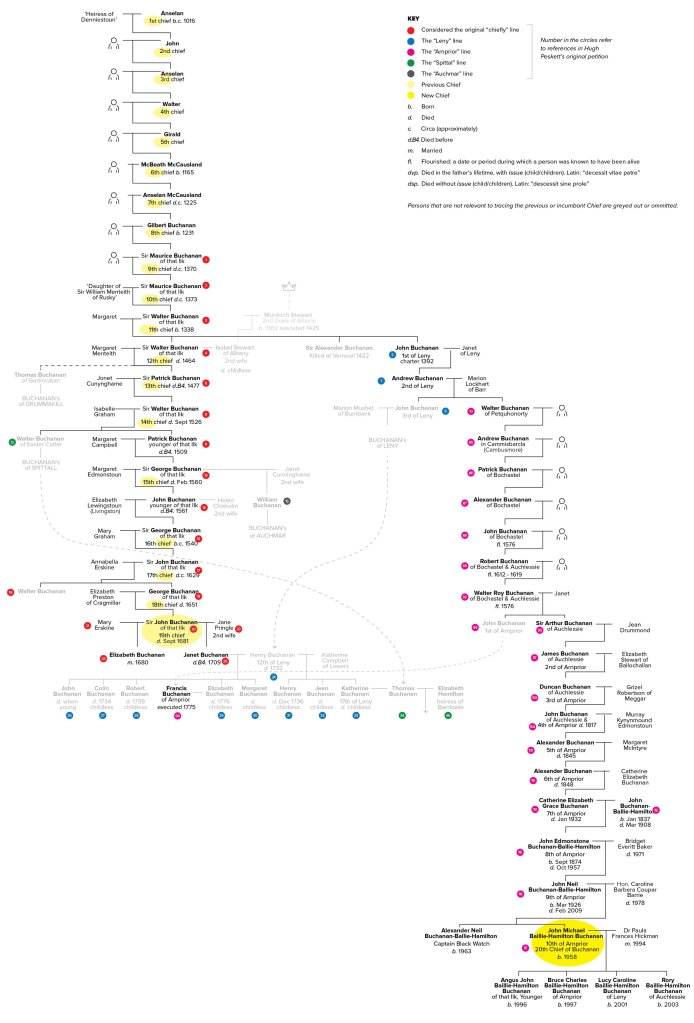
© Copyright 2024 by The Clan Buchanan Society International Inc.
“The first six Clan Chiefs are poorly represented in historical records and are included by some Clan historians and omitted by others. Buchanan of Auchmar and Guthrie Smith commence their respective numbering of Chiefs at a different person.
“It is not until the 7th laird that “we reach the firm ground of documentary proof.” Principal authors of the Buchanan histories, William Buchanan of Auchmar (1723) and John Guthrie Smith (1896), commence their respective numbering of Chiefs at different people in the Buchanan lineage.
“Also, they describe a different order and numbering for the Chiefs following Sir Walter 11th of Buchanan. In part, this is due to the heir apparent not succeeding to the chiefship before he dies and the chiefship passes directly from grandfather to grandchild.
“The above lineage reconciles the Chief’s numbering from Guthrie Smith, Buchanan of Auchmar and Hugh Peskett’s petition for the current Chief.
“Numbers in circles reference an individual in the family trees presented in Hugh Peskett’s petition for the current Chief (2018). Red circles reference the main Chiefly line and the blue circle reference the Leny branch.”
The 24 (or 25?) Possible Barons of Caldenoch
If we assume for the sake of convenience (almost certainly incorrectly) that the legendary Anselan was the progenitor of the McAuslands, and that his original lands were the McAusland barony to the west of Loch Lomond rather than the Buchanan lands to the east of Loch Lomond, then the legendary Anselan might be considered as the first Baron McAusland.
The numbering of the Barons below is purely our own interpretation, has not official standing, and will be liable to change. Where there is no documentary evidence, we make the assumption that the title passed from father to son. Clearly, in other families there are examples where as many as four brothers held a title in succession, or where a title devolved upon a distant cousin for lack of a direct male heir, and similar things may very likely have happened with the McAuslands. Indeed we know that Johnne Mccauslane, Younger of Caldonoche, eldest son of Patrik Mccauslane of Caldonoche, 21st Baron of Caldenoch, either predeceased his father or died before Patrik’s testament was confirmed in 1617.
- Anselan, Legendary 1st Chief of Clan Buchanan & 1st Baron of Caldenoch.
Born circa 1016 - John, eldest son of the above, Legendary 2nd Chief of Clan Buchanan & 2nd Baron of Caldenoch.
- Anselan, eldest son of the above, Legendary 3rd Chief of Clan Buchanan & 3rd Baron of Caldenoch
- Walter MacAnselan, eldest son of the above, Legendary 4th Chief of Clan Buchanan & 4th Baron of Caldenoch
- Girald (aka Bernard), eldest son of the above, 5th Chief of Clan Buchanan & 5th Baron of Caldenoch
- McBeath, eldest son of the above, 6th Chief of Clan Buchanan & 6th Baron of Caldenoch
Born 1165 - Anselan, eldest son of the above, 7th Chief of Clan Buchanan & 7th Baron of Caldenoch
Born circa 1195? - Gilbert Buchanan of that ilk, eldest son of the above, 8th Chief of Clan Buchanan & 8th Baron of Caldenoch
Born 1231 - Sir Maurice Buchanan of that Ilk, eldest son of the above, 9th Chief of Clan Buchanan & 9th Baron of Caldenoch
Born circa 1261? - Sir Maurice Buchanan of that Ilk, eldest son of the above, 10th Chief of Clan Buchanan & 10th Baron of Caldenoch, Possible MRCA of R-FGC32576 Haplogroup?
Born circa 1290? - MacBeath, possible younger son of the above, 1st Chief of Clan McAusland & 11th Baron of Caldenoch.
- John McAuslane of Caldenocht, presumed eldest son of the above, 2nd Chief of Clan McAusland & 12th Baron of Caldenoch.
Flourished 04 July 1395. - Unknown McAusland, possible eldest son of the above (?), 3rd Chief of Clan McAusland & 13th Baron of Caldenoch
- Unknown McAusland, possible eldest son of the above (?), 4th Chief of Clan McAusland & 14th Baron of Caldenoch
- Unknown McAusland, possible eldest son of the above (?), 5th Chief of Clan McAusland & 15th Baron of Caldenoch
- Unknown McAusland, possible eldest son of the above (?), 6th Chief of Clan McAusland & 16th Baron of Caldenoch
- Unknown McAusland, possible eldest son of the above (?), 7th Chief of Clan McAusland & 17th Baron of Caldenoch
- Patrick McCaslane of Caldanacht, possible eldest son of the above (?), 8th Chief of Clan McAusland & 18th Baron of Caldenoch
Flourished from 1536 to 20 February 1543 - Patrick McAwslane of Caldenache, presumed eldest son of the above, 9th Chief of Clan McAusland & 19th Baron of Caldenoch
Flourished from 1599 to before 1602. Possible MRCA of R-A9015 haplogroup. - John McCaslane of Caldenoth, presumed eldest son of the above, 10th Chief of Clan McAusland & 20th Baron of Caldenoch
Flourished from December 1602 to after 7th February 1603. - Patrik Mccauslane of Caldonoche, presumed eldest son of the above, 11th Chief of Clan McAusland & 21st Baron of Caldenoch
Flourished from after 7th February 1603. Died August 1616.- Johnne Mccauslane, Younger of Caldonoche, eldest son of the above.
Died before 11th November 1617.
- Johnne Mccauslane, Younger of Caldonoche, eldest son of the above.
- Patrick, McAusland of Caldenoch, presumed eldest son of Johnne Mccauslane, Younger of Caldonoch, 12th Chief of Clan McAusland & 22nd Baron of Caldenoch
Flourished 30th June 1651. - John McCauslane of Caldenoch, presumed eldest son of the above, 13th Chief of Clan McAusland & 23rd Baron of Caldenoch
Flourished from 8th May 1656 to before 20th May 1664. - Alexander McCauslane of Caldenoch, eldest son of the above, 14th Chief of Clan McAusland & 24th Baron of Caldenoch
Flourished from 20th May 1664 to 1694. - Janet, heiress of Caldenoch, daughter of the above, possibly 15th Chief of Clan McAusland and 25th Baroness of Caldenoch. She married Duncan Campbell, son of John Campbell, 3rd of Kinloch.
Flourished 10th June 1690.
The Barony of Caldenoch under the ownership of the Colquhouns of Luss
Janet is said to have sold the Barony of Caldenoch to Sir Humphrey Colquhoun of Luss, and if this is correct, she was undoubtedly Baroness McAusland suo jure (in her own right) and Chief of Clan McAusland.
It should be noted however, that at least parts of the Barony appear to been mortgaged by her father, Alexander, in 1678 and 1692. An entail from 1707 and tax documents from 1782 and 1802 demonstrate that on these dates it was the Colquhouns of Luss and their successors who held the McAusland Barony of Caldenoch.
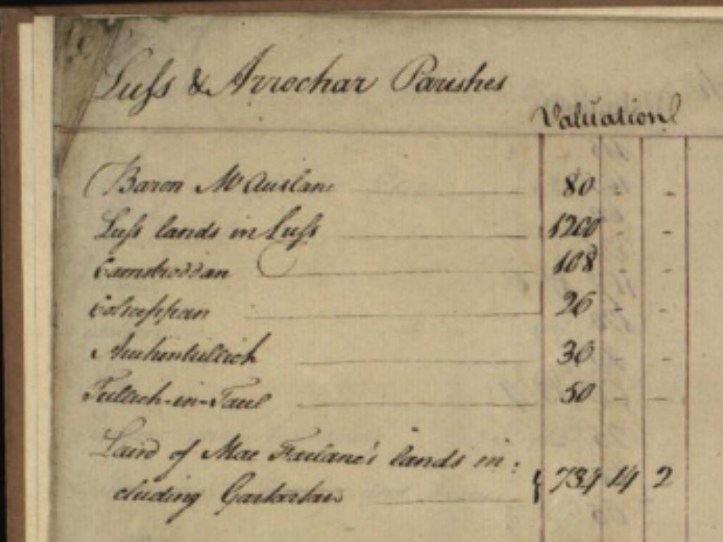

The land tax information from the parish of Luss for 1802 was more informative than that for 1782, making it clear that Baron MacAuslane’s lands were owned by Sir James Colquhoun, Baronet and along with his other lands, and the were now designated as part of the Lands and Barony of Luss.
Next Article in the Series
In the next article we will look briefly at the possible first ten Barons of Caldenoch, who may also have been the chiefs of Clan Buchanan.

 Vecchio
Hi, some great research, it would be nice to have a chat regarding the McAusland and Buchanan lines. I am one of the Editors of the Buchanan family tree in UK.
Kind Regards
Mike
LikeLiked by 1 person
Thanks for your kind words. The numerous authors and collaborators for this particular series have been doing some sterling work in debunking myths that have arise from misinterpretation by early authors such as William Buchanan of Auchmar – who unlike us did not have access to primary sources on the internet.
Also very interesting to discover that in 1711 the McAuslands believed that they were a clan, and not a mere sept of the Buchanans, as that clan’s spin doctors would have us believe. 😉
Indeed, there could be an argument that Buchanans are a sept of Clan McAusland.
Christina.
LikeLiked by 1 person