
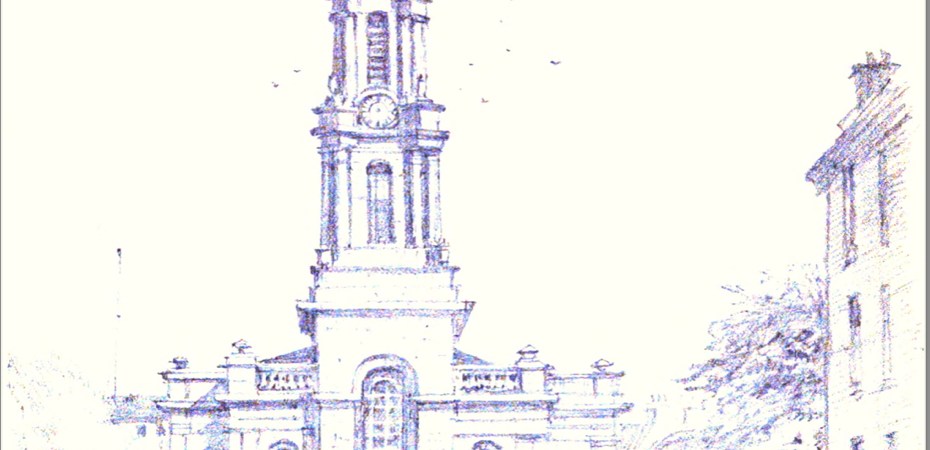
Duncan McAslan in Greenock and his wife Elizabeth Campbell are known to have had two sons; Archibald McAslan who was born on 19 September 1722 in the Old or West parish of Greenock and baptised on 23 September 1722, and Shaw McAslan who was born on 22 October 1723 in the same parish and baptised on 27 October 1723. Shaw was unique as a Christian name for a McAusland, so how did it come into use?

The Old Parish Register of Births & Baptisms for Greenock Old or West parish provided the answer: Duncan McAslan was recorded as “Officer to Sir John Shaw“. So who exactly was Sir John Shaw?

The family of John Shaw, the original Laird of Greenock, is described in Crawfurd’s A General History of the Shire of Renfrew (1818) and additional information on the family can be found in George William’s 1888 book on Old Greenock. In time, the Schaws of Greenock added the lands of East Greenock and Sauchie to their estates.

Duncan McAslan’s employer, Sir John Shaw, 3rd Baronet of Greenock and Member of Parliament, built a harbour at Greenock. Being 22 miles west of Glasgow on the Clyde this was a prime location for a port. At first Sir John attempted to obtain financial assistance from the crown, but when that was not forthcoming he financed it himself and became enormously wealthy when Greenock went on to become the fourth busiest port in the United Kingdom by the start of the 19th Century.
Sir John Shaw, 3rd Baronet of Greenock, MP
Sir John Shaw, 3rd Baronet (c. 1679–1752) of Greenock was a Scottish Whig politician who sat in the House of Commons between 1708 and 1734. He was instrumental in the construction of Greenock Harbour, and took part in actions against the Jacobite risings.
Shaw was the eldest son of Sir John Shaw, 2nd Baronet and his wife Eleanor Nicolson, daughter of Sir Thomas Nicolson, 2nd Baronet, of Carnock. The Shaw (or Schaw) family owned estates in Clackmannan, and his father became instrumental in developing the growth of Greenock to rival Glasgow on the River Clyde, and in particular seeking funds to build a harbour at Greenock. Shaw was educated at Glasgow in 1694. He married Margaret Dalrymple, eldest daughter of Hon. Sir Hew Dalrymple, 1st Baronet of North Berwick, Haddington on 15 March 1700. Also in 1700 he became a Burgess of Glasgow. He succeeded his father to the baronetcy on 16 April 1702 and set out to achieve his father’s aim of creating a harbour at Greenock.
Shaw’s various family properties at Greenock, Renfrewshire, Sauchie, Clackmannanshire; and Carnock Stirlingshire gave him several options for a parliamentary seat at the 1708 general election, and he chose to stand for Renfrewshire. He was returned unopposed as Member of Parliament for Renfrewshire. He and his fellow citizens raised their own funds to build Greenock Harbour, and the work was completed in 1710, with quays extended out into Sir John’s Bay to enclose the harbour. Shaw did not stand at the 1710 and 1713 general elections, but he continued fight for better regulation of customs in western Scotland.
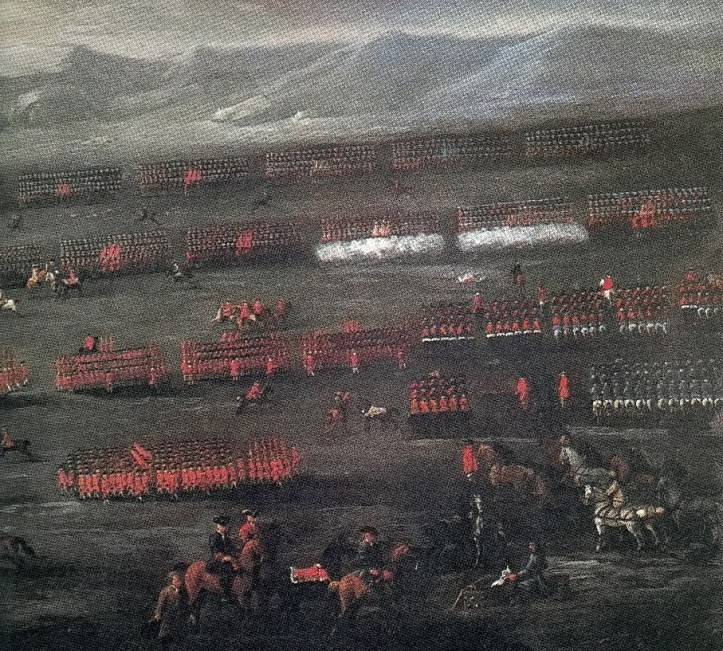
Shaw celebrated the safe arrival of the Elector of Hanover George I in October 1714 in an elaborate manner. He did not stand at the 1715 general election but was active during the year in suppressing the Jacobite rising. He fought at several battles, including the Battle of Sheriffmuir in November 1715, acting closely with the Duke of Argyll. He became a burgess of Inveraray, the Duke’s home town, in 1720.
With the support of the Duke of Argyll, Shaw revived his parliamentary career, and was returned as a Whig MP for Clackmannanshire in the 1722 general election. He supported the government and voted for the bills of pains and penalties against those involved in the Atterbury plot. He protested to Walpole against filling offices in Scotland with Englishmen. He was active on behalf of the Government. in the malt tax riots of 1725, when the Glasgow magistrates would not take action against the mob. For several years he had been pressing for strong measures to prevent the running of Irish goods into Scotland, and in 1725 was granted a commission which permitted him ‘to burn all boats that shall bring meal or grain from Ireland to Scotland’.
Shaw was returned unopposed as MP for Renfrewshire at the 1727 general election. He continued to vote with the Administration. In 1734 he stood for parliament at Clackmannanshire but was unsuccessful. During the 1745 Jacobite rebellion, he and his wife mobilised support locally for General John Campbell’s forces, and raised a militia in Greenock despite opposition from Jacobites.
Shaw died at Sauchie on 5 April 1752, and the baronetcy became extinct on his death. His daughter Marion married Charles Cathcart, 8th Lord Cathcart in 1718 and commissioned a new building at Nether Greenock Castle in the 1730. However, on her death in 1733 the mansion reverted to her father. On his death, his estates went to the family of his sister Margaret, who married Sir John Houston, 3rd Baronet and was grandmother of Sir John Stewart. Stewart adopted the additional surname Shaw, and his succession continued as the Shaw Stewart baronets of Greenock and Blackhall.
References
- Cokayne, George Edward, ed. (1904), Complete Baronetage volume 4 (1665-1707), vol. 4, Exeter: William Pollard and Co, p. 350, retrieved 4 August 2019
- “SCHAW, Sir John, 3rd Bt. (?1679-1752), of Greenock, Renfrew; Sauchie, Clackmannan; and Carnock, Stirling”. History of Parliament Online (1690-1715). Retrieved 18 August 2018.
- “SHAW, Sir John, 3rd Bt. (?1679-1752), of Renfrew and Carnock, Stirling”. History of Parliament Online (1715-1754). Retrieved 18 August 2018.
- Stravaiging around Scotland – Greenock Castle
- Henry Colburn (1839). A Genealogical and Heraldic Dictionary of the Peerage and Baronetage of the British Empire. p. 987. Retrieved 22 August 2018.
- The Shaws of Down and Antrim in the 17th Century.
 Vecchio
HI good Lady. With all respect I’m speaking perhaps with a Baroness and may adjust my countenance as such.
My full name is Kenny Hugh Thomas Shaw and I am searching feverently for information on the origin of my family name within the region of Newtownards, Bangor and Antrim, Co Down and Co Antrim. I do not profess to be anything more then I seem, although noble perhaps in intention. Any information you have will undoubtedly prove to be both fascinating and enlightening. If you have any information I would be highly receptive.
Thank you for taking the time to read this.
Godspeed.
LikeLiked by 1 person
My research area is Scotland – anything in this blog concerning Ireland will likely have been contributed by others.
A good place to start might be the books by Chris Paton (https://scotlandsgreateststory.wordpress.com) – several concern Irish genealogy
https://www.pen-and-sword.co.uk/Chris-Paton/a/1799
(Use the .com site if you are based in the USA)
Another excellent site is Irish Genealogy (https://www.irishgenealogy.ie) which contains not just records but helpful advice.
https://www.irishgenealogy.ie/genealogical-research/how-to-start-your-family-history/
Good luck with your research
LikeLike
Thank you for taking the time to get back to me. I will have a look through the links and material, eventually I’ll let you know how I get on
LikeLike