

“Any surname that also belonged to an aristocratic family can become a licence to claim an unrealistically close connection to the noble house concerned.”
Adolph, Anthony. Tracing Your Aristocratic Ancestors: A Guide for Family Historians (Tracing Your Ancestors) 2013. (p. 42). Pen & Sword.
Biography
Our great (x7) grandfather Colin Drummond (ca. 1687 – 1737) lived during an exceptionally turbulent time in Scottish history. It is likely that he was born before 01 November 1688 when, after storms defeated an earlier attempt on 19 October 1688, William of Orange sailed from the Netherlands with an enormous invasion fleet of 6o warships and 500 smaller vessels, landing at Torbay in Devon, on the south-west coast of England on 05 November 1688.[1]

Despite having a large army of 25,000 men, King James VII doubted their loyalty and called upon James Graham of Claverhouse, 1st Viscount Dundee for help. “Bonnie” Dundee marched to London with 6,000 Scots troops but the King’s English forces turned their coats and joined the invaders leaving the Scots army stranded and isolated. On 11 December King James attempted to flee, but was captured and handed over to William of Orange, who, not knowing what to do with him, allowed him to sail for France where he landed on 25 December 1688.[1]
On 22 January 1689, an assembly in London declared that James’ reign was over and that he had de facto – if not de jure – abdicated. Prince William of Orange – James’ nephew – and his wife Mary – James’ daughter – were proclamed joint King and Queen of England and Ireland on 13 February 1689. However it was not until 4 April 1689 that the Scottish Convention of Estates declared that James VII had “forefaulted” his right to the crown and on 11 April 1689 the Prince and Princess of Orange became William II and Mary II of Scots.[1]
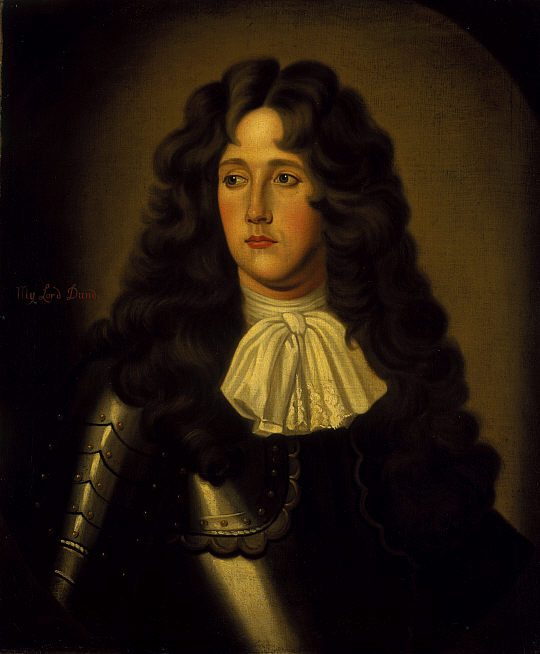
Nevertheless, Viscount Dundee remained loyal to King James VII and on 27 July 1689 his forces defeated those of general Hugh MacKay at the Battle of Killiecrankie between Blair Atholl and Pitlochry. However, despite the stunning victory for the Jacobites, Viscount Dundee’s death in the final minutes of the battle robbed King James VII of his most able and charismatic commander and destroyed any hopes of his restoraton as King of Scots. He died in exile at Saint-Germain-en-Laye near Paris on 05 September 1701.[1]
There was little serious military opposition in Scotland to James’ nephew William, daughter Mary and Mary’s sister Anne after the Battle of Cromdale on 30 April and 01 May 1690. However many still supported the exiled King James VIII and attempts to persuade the Highland chiefs to swear fealty to his son-in-law and daughter resulted in the notorious Massacre of Glencoe of 13 February 1692. War almost broke out between Scotland and England on several occasions and the 1707 Union of the Parliaments was seen to be undesirable but a political necessity by the English Parliament in order to ensure that troublesome Scotland would not be allowed to go its own way and choose its own monarch, just as modern day Scotland was dragged out of the European Union despite voting massively to remain. In Scotland, King James VII’s son James, Duke of Rothesay and Prince of Wales, was viewed by many to be the logical and legitimate heir and successor to Queen Anne.[1]

In contrast to the “Bloodless Revolution”, which had actually been far from bloodless in Scotland and more so in Ireland, a major civil war was triggered when James VIII’s daughter Queen Anne died on 01 August 1714 and her second cousin, the Elector Georg Ludwig of Hanover was proclaimed in London as King of Great Britain and Ireland. The Elector did not land in his new realm until 18 September 1714 and his coronation on 20 October 1714 was met with protests in Scotland and rioting in more than 20 English towns. He was derided in popular verse as a “wee bit German lairdie“.
The Wee German Lairdie – Early Scottish Jacobite Song This one is recorded in the The Book of Scottish Song, and is an early Jacobite Song from the first years of the reign of George I of Hanover, whose hobby was to care for his vegetable patch. 1 min. 59 secs.
The succession of the Elector of Hanover set the scene for a new round of more than 40 years of dynastic conflict and turmoil. [1]
Birth & Baptism of Colin Drummond
Colin Drummond may have been born around 1687 to 1692 assuming that he was aged 20 to 25 at his marriage to Janet Barnet. His exact date and place of birth and baptism is unknown. The Old Parish Register of Births & Baptisms for Auchterarder dates back to 1661 with the baptism of a Janat Drwmond, daughter of John Drwmond and Betrix Gairdner being recorded on 15 December 1661, so there were certainly Drummonds in Aucherarder parish from the date of the earliest parish records.
Banns & Marriage for Colin Drummond and Janet Barnet
On 20 February 1712 in the town of Auchterarder in the parish of Aucherarder in the county of Perthshire in Scotland, banns were proclaimed between Colin Drummond and Janet Barnet, both resident in that parish. They were married on 28 February 1712.
Children of Colin Drummond and Janet Barnet
Colin Drummond had two known children with Janet Barnet:
- James Drummond, born at Borland in Auchterarder parish, Perthshire, Scotland and baptised on 12 July 1713. In 1748 there was a James Drummond who was renting a quarter of the lands of Borlandbogg Park and this is assumed to be our James.
- Margaret Drummond, also born at Borland and baptised on 03 August 1715. Margaret Drummond went on to marry James Steel or Steil, tenant at Clarty Mire and had a large number of descendants.
Auchterarder and the 1715 Civil War
No further mention of Colin Drummond was found in the old parish records after the baptism of his daughter Margaret on 03 August 1715. The dramatic events that happened in and nearby the town of Auchterarder in the next few months may give some clues as to why this might be.

The civil war of 1715 began less than a month after the baptism of Margaret Drummond when John Erskine, 23rd & 6th Earl of Mar sailed from London to Scotland. On 27 August at Braemar in Aberdeenshire he held his first council of war and on 06 September the standard of “James the 8th and 3rd” was raised there with the King being acclaimed by some 600 of his supporters. However, the Earl of Mar had acted on his own initiative as he had received no commission from James to start a rising. [2]
A few weeks later, the Earl of Mar and his whole army marched from Perth, arriving in the town of Auchterarder on 16 October 1715.

Before the end of the month, Lt-Gen Alexander Gordon arrived in Auchterarder from Argyll with Jacobite Highland clans. On 04 November 1715 the Earl of Mar, who by then had returned to Perth, made reference to the celebrated Roy Roy MacGregor being in Auchterarder.
On 10 November 1715, Mar with 2300 horse and 5000 foot reviewed his troops at Auchterarder and was joined the next day by General Gordon with the clans, who numbered 100 horse and 3000 foot.
On 13 November 1715, the inconclusive Battle of Sherrifmuir took place near Dunblane, with both sides claiming victory, although it was a strategic victory for the Hanoverians who prevented the Jacobites from marching south.

With thousands of soldiers marching back and forth in Auchterarder, there would undoubtedly have been a great deal of disruption with soldiers being billeted in houses and items such as food and shoes being requisitioned for the army. But much worse was to come.
On 17 January 1716, the Earl of Mar gave orders, carried out on the 25th, to “burn and destroy the village of Auchterarder, and all the houses, corn, and forage, whatsoever within the said town, so as they might be rendered entirely useless to the enemy.” There are some detailed and harrowing accounts of this, such as the minister pleading that his mother was dying and to give her a few minutes to die in peace in her own home but being dragged out into the snow and expiring soon after.
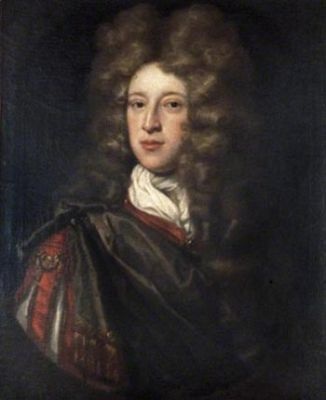
In these circumstances, it is perhaps telling that there were no more recorded children for Colin Drummond and Janet Barnet after the baptism of Margaret in 1715. Margaret obviously survived as she went on to marry James Steel or Steil, tenant at Clarty Myre in 1737, but the fates of Colin and Janet and their son James were, until recently, unknown.
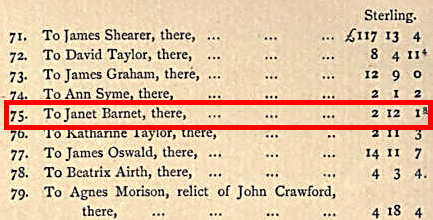
On 14 October 1731, a Commission of Inquiry declared that a number of people had proved losses sustained by the burning of Auchterarder and surrounding villages and amongst those awarded compensation was a Janet Barnet who was to get £2 12s and 1d sterling (as opposed to Scots). There is no indication that this was the same Janet Barnet who married Colin Drummond, but it does seem to be a distinct possibility.
As for Colin Drummond, it seemed unclear whether he was the scion of a noble family – some believed he was Colin Drummond of the Megginch line – or simply a local whose baptism was not recorded. Was he a Jacobite, a Hanoverian or merely an innocent bystander? Did he perish at the Battle of Sherrifmuir, was he one of those who died following the burning of Auchterarder or did he die of natural causes? There appeared to be much that remained unknown. But more recent research has uncovered some fascinating further details.
Testament Dative and Inventory of Coline Drummond and Janet Burnet, 21st April 1737
It had been believed that Colin Drummond might have died in 1715, but in fact he survived until 1737, dying at Borlandbog of Auchterarder. The Testament Dative and Inventory of Coline Drummond and his wife Janet Burnet was confirmed on 21 April 1737 at Dunblane.
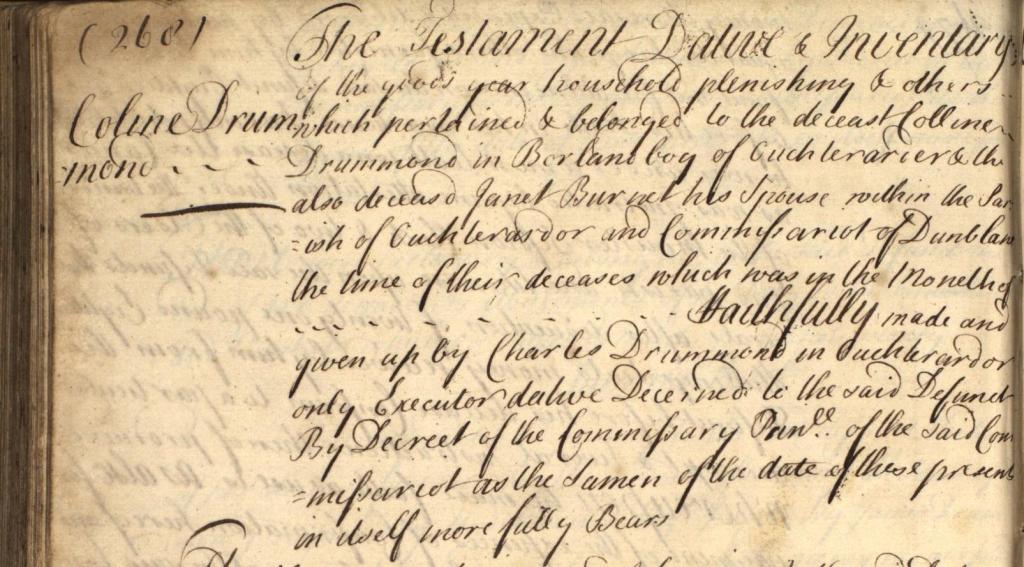
Drummond Coline 21/4/1737 in Borlandbog of Auchterarder, and Janet Burnet, his spouse, parish of Auchterarder TD Dunblane Commissary Court CC6/5/24. Crown Copyright.
The document is a Testament Dative, which means that Colin Drummond and Janet left no will, i.e. were intestate. The excellent Scottish Handwriting site explains that while in the absence of a will there was no obligation for successors to go to court, sometimes they felt “the need to appoint an executor to make the necessary legal and financial arrangements relating to the estate on their behalf. The process by which an executor is appointed by a court, in the absence of a will, results in a document called a testament dative.“
National Records of Scotland note that “under Scots Law, an individual’s property was divided into two types:“
- “Heritable property consisted of land, buildings, minerals and mining rights, and usually passed to the eldest son.
- Moveable property consisted of anything that could be moved, for example, household and personal effects, investments, tools, machinery. It was divided into a maximum of three parts: the widow’s part, the children’s part (all children had a right to an equal share) and the deceased’s part (what was to be disposed of in the will).
Wills and testaments before 1868 only contain details of moveable property. Between 1868 and 1964 a will could transfer both moveable and heritable property. It is worth remembering, then, that the eldest son in a family will often not be mentioned in wills before 1868 because he usually inherited the heritable property of his deceased father.”
It is interesting that a Charles Drummond was named as executor and it seems possible that he was a relative of Colin Drummond. Interestingly, there was a Charles Drummond who married an Isobel Drummond on 08 March 1717 in Auchterarder. We have a possible, but as yet unconfirmed, DNA connection via this couple supporting the theory that the two families were related. It may even be that Isabel was Colin’s sister, with her being named after Colin’s aunt Isabel.
Cousins to the Lairds of Drummond?
David Freer from Canada, another descendant of Colin Drummond and Janet Barnet contacted us as he has a document written by James Steel born 1782 in Auchterarder which states:
“…My Grandfathers name was James Steel who lived long in Clarty Mire Auchterarder Parish & died in Langshot at 84 a very advanced age & his Wife my Grandmother’s name was Margret Drummond Daughter to Collin Drummond (was an officer in the Highland army in the 45), Farmer in Borland Park near Auchterarder and his father was Andrew Drummond Farmer in —- hill and cousin to the then Laird of Drummond —all there were honest and respectable men on their station of life.“
The letter refers to the “45” but this clearly should have been the “15” as Colin Drummond had died by 1737. The letter does appear to confirm the likelihood that, as we suspected, Colin Drummond had been involved in the tumultuous events that occurred in and around Auchterarder in 1715.
But who was the “then Laird of Drummond” who was the cousin of Colin’s father, Andrew? The local Barony of Auchterarder was held by the Earls and Dukes of Perth. They were on the Jacobite side in the civil war and were disinherited by the Hanoverians.
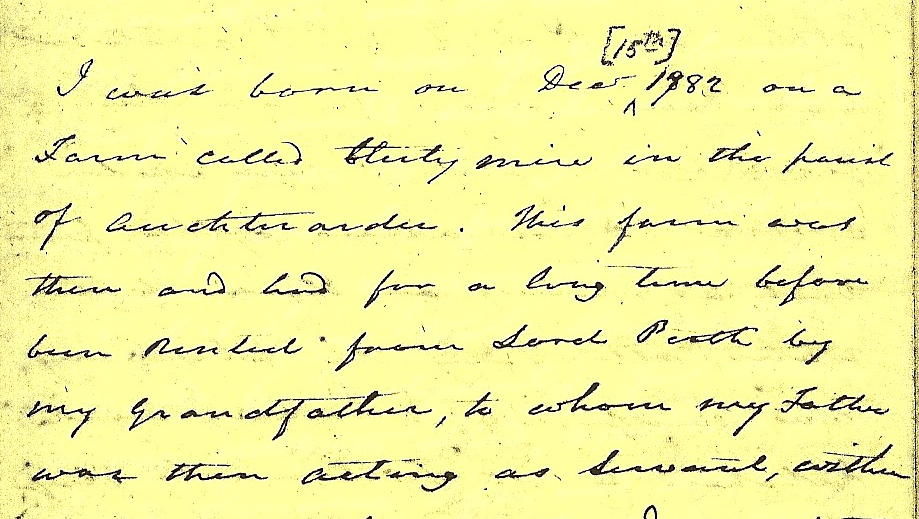
Wisconsin Historical Society, WIS MSS 51PB, Folder 11.
Interestingly, the autobiography of James Steel, another descendant of Colin Drummond and Janet Barnet states: “I was born on Dec [15th] 1782 on a Farm called Clarty mire in the parish of Auchterarder. This farm was then and had for a long time before been rented from Lord Perth by my grandfather, to whom my Father was then acting as servant…“
The Lord Perth referred to by James Steel was Captain James Drummond of the 73rd Regiment of Highlanders who was born in 1744). The Drummond Estates, including the Barony of Auchterarder, were forfeited to the Crown in 1747, but restored in 1785, under the terms of the Act of Restoration of 1784, to Captain Drummond as the surviving son of the late 7th Duke of Perth in the Jacobite peerage and the nearest male heir of the forfeited Lord John Drummond. Captain Drummond was created Lord Perth in 1797, and shortly thereafter he disposed of the Barony of Auchterarder, which had belonged to his ancestors for 500 years, to the Hon. Basil Cochrane, son of Thomas, eighth Earl of Dundonald.
James Steel’s father (and servant to Lord Drummond) was Andrew Steel (baptised 16 February 1755 in Auchterarder) the son of James Steel (1710-1794) and Margaret Drummond (1715-1795). Margaret Drummond was the daughter of Colin Drummond and Janet Barnet, and granddaughter of Andrew Drummond who was reported to be a cousin to the Laird of Drummond. Was it this distant connection that had helped the Steels become tenants of Clarty Mire and Andrew to become servant to a distant relative?
Three more daughters for Colin Drummond and Janet Barnet
Some trees had three more daughters for the couple, but as there were no dates of baptism or references, these were assumed simply to be the kind of errors of which many internet trees are full.
However, in this case the three daughters did not turn out to be fictional.
Muthill Free (CH3/694) PERTH
While ScotlandsPeople contains records for Muthill Free Church, it has no records for the Episcopal Church there.
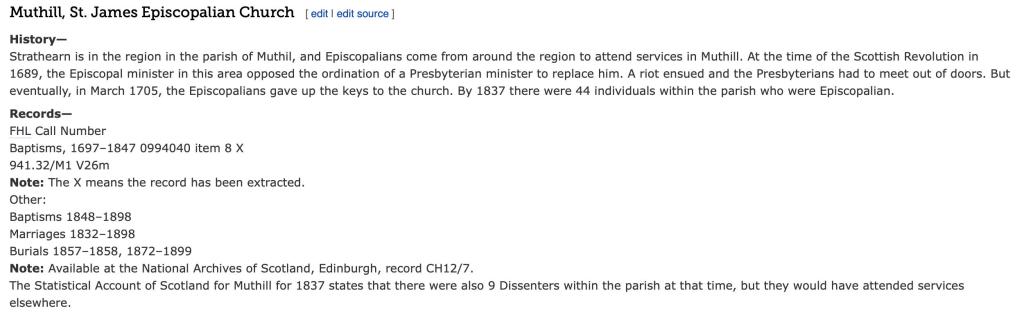
Meanwhile, FamilySearch notes that baptismal records for Saint James Episcopal Church in Muthill are available to consult at the National Records of Scotland (CH12/7 Muthil, St. James, 1691-1902).

The baptismal records were also transcribed by A. W. Cornelius Hallen and a copy of this book is available in the library of the University of Edinburgh.



These transcripts confirm that Colin Drummond and Janet Barnet did have three additional daughters, Ann, Jean, and Janet who were born on 7th March 1717, 20th April 1718 and 17th February 1720 respectively. The first and third (and presumably also the second) were born at Borland Bog in the parish of Auchterarder, in Perthshire but baptised at the Episcopal Church of Saint James in Muthill.
Conclusions
It had been believed by some that our Colin Drummond had been baptised in 1684 in Errol parish and some internet trees even describe Colin Drummond of Auchterarder as Sir Colin Dummond, Earl of Lennoch – Lennoch was actually a Scottish feudal barony, not an Earldom. However, we have demonstrated that Colin Drumond, son of Adam Drummond, 9th of Lennoch and 2nd of Megginch actually had a distinguished career as Professor of Logic, Metaphysics and Greek at Edinburgh University, died on 02 November 1753 and was buried in Greyfriars kirkyard.
Our Colin Drummond is clearly a different person to Professor Drummond and it seems possible that he was born in or around Auchterarder but that his baptism was not recorded in the Old Parish Registers of Births & Baptisms. There is a certain irony that we carried out extensive research to prove that our Colin Drummond was not a son of the Barons of Megginch and Lennoch only to discover that family letters suggest that our Colin’s father, Andrew Drummond, was “cousin to the then laird of Drummond“. These letters document additional connections to the Drummonds of Perth. But whether these were due to family relationships or simply coincidental has yet to be proved.
Our Colin Drummond did not die in 1715 as we initially suspected, but survived for years after the Battle of Sheriffmuir and the burning of Auchterarder, dying some time before 21st April 1737, when his estate was confirmed.
Colin Drummond and Janet Barnet also had three daughters who do not appear in the available baptismal records at ScotlandsPeople. They were born in Auchterarder, but were baptised at Muthill parish, both in Perthshire.
In a letter, Colin’s father, Andrew Drummond had been described as “Farmer in ____hill“. Given the later Muthill connection, perhaps Andrew was a farmer in Muthill and perhaps Colin had been born and baptised there?
Sources
- ↑ 1.0 1.1 1.2 1.3 1.4 1.5 The Story of Scotland (2000) Magnus Magnusson. HarperCollins Publishers
- ↑ Christoph v. Ehrenstein, ‘Erskine, John, styled twenty-second or sixth earl of Mar and Jacobite duke of Mar (bap. 1675, d. 1732)’, Oxford Dictionary of National Biography, Oxford University Press, 2004; online edition, January 2008, accessed 14 August 2020.
 Vecchio
I loved reading this story. Please update us if you find out the identity of the Laird of Drummond!
LikeLiked by 1 person
I believe that the “Laird of Drummond”, that James Steel’s autobiography refers to, maybe the 9th Laird of Colquhalzie (John Drummond ~b1640).
ScotlandsPeople has a birth record for Andrew Drummond b1674 as follows,
Birth Data: ScotlandsPeople District – Auchterarder Ref – 329/10 23 **Forename = Andro **Surname = Drwmod **Father = THOMAS DRWMOD **Mother = ELIZABATH SCOT **The image is too diffcult to read. I believe that it is the 4th entry.
Thomas Drummond b1646 as follows,
Birth Data: ScotlandsPeople District – Trinity Gask Ref – 396/10 16 **Parents = JOHNE DRUMMOND/BARBARA BLAIR.
In this document, https://deriv.nls.uk/dcn23/9655/96555145.23.pdf, you will find reference to the marriage of John and Barbara Blair and that John is the 9th Laird of Culqualzie. Although, it says that they only had 3 sons (John, William and Harie) and three daughters (Issobel, Elspet, yet fail to list the 3rd), ScotlandsPeople has birth/baptismal records for,
Isobell – JOHNE DRUMMOND/BARBARO BLAIR
David – JOHNE DRUMMOND/BARBARA BLAIR
Henrie (Harie) – Jon. Drummond/(mother not listed)
Thomas – JOHNE DRUMMOND/BARBARA BLAIR
George – JOHNE DRUMMOND/BARBARA BLAIR
Regards,
David Freer
LikeLiked by 1 person
Congratulations!
It does look like you have managed to completely demolish the Drummond brick wall.
I had Thomas Drummond and his wife Elizabeth Scot in my tree as being born circa 1652 “assuming they were aged 20 when they married.” So, Thomas being baptised in 1646 in Trinity Gask parish just to the north of Auchterarder makes perfect sense.
The fact that his father was John Drummond of Culqualzie also fits with Andrew Drummond being “the cousin of the laird of Drummond“.
As you mention, although Andrew is not listed in the Genealogy of the House of Drummond, it is clear from the record in ScotlandsPeople that he is a younger son of John Drummond, 9th laird of Culqualzie and his wife Barbara Blair.
I suppose what is perhaps most astonishing is that a genealogical work that was compiled way back in 1681, without the help of the modern technology and databases that we now take for granted, contains so much information that is still incredibly useful to us today.
Thanks again for sharing your fascinating discovery with us. It really is the most astonishing breakthrough!
LikeLike