

The Leather Processing Industry
On our maternal side there were a number of people involved in working with leather. Robert Philp, originally a master saddler, was best known as the inventor of the Lochgelly Tawse, while several members of the McAusland were curriers in Greenock (rather than couriers as I originally thought).
A currier is a specialist in the leather processing industry. The first step is tanning, the process of treating skins and hides of animals to produce leather. A tannery is the place where the skins are processed. Tanning hide into leather involves a process which permanently alters the protein structure of skin, making it more durable and less susceptible to decomposition, and also possibly coloring it. Before tanning, the skins are de-haired, degreased, desalted and soaked in water over a period of six hours to two days. Historically this process was considered a noxious or “odoriferous trade” and relegated to the outskirts of town. The Tannery at Ladyburn was at the extreme east of Greenock, where the prevailing winds would have carried the smell away.
Traditionally, tanning used tannin, an acidic chemical compound from which the tanning process draws its name, derived from the bark of specific trees. An alternative method, developed in the 1800’s, is Chrome Tanning, and Chromium Salts are used instead of natural tannins
After the tanning process, the currier applies techniques of dressing, finishing and colouring to the tanned hide to make it strong, flexible and waterproof. The leather is stretched and burnished to produce a uniform thickness and suppleness, and dyeing and other chemical finishes give the leather its desired colour. After currying, the leather is then ready to pass to the fashioning trades such as saddlery, bridlery, shoemaking and glovemaking.)
David Stewart McAusland
The first McAusland who is known to have been a currier was our great (x3) grandfather, David Stewart McAusland. He was born in Greenock, Renfrewshire, Scotland on 19 February 1797 and baptised on 23 February 1797 as David Stewart MacAuslan. He was the 5th child of Archibald MacAuslan, a cooper and his second wife, Margaret Muir (or Moore).
David Stewart McAusland had four elder full siblings:
- James McAusland, who was born 17 October 1786 in Greenock and baptised on 23 October 1786. It is not known if he survived and went on to marry and have children.
- Captain George McAusland, who was born on 28 February 1788 in Greenock and baptised on 05 March 1788. On 24 February 1829 in Greenock, he married Christian Mackie, whose sister, Williamina was married to the Rev. John Dunmore Lang. They emigrated to Australia and had four children, but George died at sea on 27 July 1851. His wife and three daughters returned to Greenock, with only their son, Captain Archibald John Bonar McAusland remaining in Australia.
- Aemilia McAusland, who was named after he father’s first wife. She was born on 05 November 1789 in Greenock and baptised on 10 November 1789. It is not known if she survived and went on to marry and have children.
- Margaret McAusland, who was named after her mother. She was born on 03 May 1794 in Greenock and baptised on 08 May 1794. She had been thought to have married Alexander MacGregor on 29 June 1822 in Greenock and had eight children with him but this must have been another Helen McAusland as ours died on 14 December 1858 in Rothesay on the isle of Bute when she was aged 65 and single.
On 1 August 1772 in Greenock, his father had married Amelia Black, and they had seven children who were David Stewart McAusland’s elder half siblings.
- Humphrey McAusland, who was born on 18 June 1773 in Greenock and baptised on 20 June 1773. It is not known if he survived and went on to marry and have children.
- Mary McAusland, who was born on 12 February 1775 in Greenock and baptised on 14 February 1775. She is assumed to have died before 13 December 1778 as a second daughter named Mary was born on this date.
- Archibald McAusland, who was born on 20 May 1777 in Greenock and baptised on 24 May 1777. He is assumed to have died before 24 March 1782 as a second son named Archibald was born on this date.
- Mary McAusland, second of that name, who was born on 13 December 1778 in Greenock and baptised on 14 December 1778. She married Robert King in Edinburgh on 16 April 1800 and they had at least two sons, Robert and Archibald.
- Helen McAusland, who was born on 05 May 1780 in Greenock and baptised on 08 May 1794. It is not known if she survived and went on to marry and have children.
- Archibald McAusland, who was born on 24 March 1782 in Greenock and baptised on 26 March 1782. It is not known if he survived and went on to marry and have children.
- John McAuslan, who was born 10 April 1783 in Greenock and baptised by the Rev. Dr. John Adam at an unspecified date. It is not known if he survived and went on to marry and have children.
David Stewart McAusland had 3 children with Elizabeth McKechnie:
- Captain Archibald Muir McAusland, who was born 20 March 1824 in Greenock and baptised on 11 April 1824. He became a shipmaster rather than a currier like his father and he married Jane Thom on 05 June 1848. The couple do not appear to have any children and he died at Sir Gabriel Wood’s Mariners Home in Greenock on 19 April 1888.
- Alexander Macdonald McAusland, who was born on 22 July 1826 in Greenock and baptised on 06 August 1826. There is some confusion about his appearance with the family on the census of 07 April 1861, as that Alexander McAusland is list as aged 24. This is assumed to be a mis-transcription of 34. If it is him, he became a currier like his father.
- George McAusland, who was born on 31 May 1831 in Greenock and baptised on 26 June 1831. He joined the 24th Regiment Grenadier Company and died of hepatitis, aged 24, at Rawalpindi in India (now Pakistan).
On 2 December 1840 David Stewart McAusland married Catherine Weir (born 17 October 1807), the daughter of Hugh Weir (b 1759) in Glendarurel, Argyll. in Greenock, Renfrewshire, Scotland. He had 2 children with Catherine Weir:
- Hugh Weir McAusland, our great (x2) grandfather who was born on 21 February 1842 in Greenock and baptised on 24 April 1842. He was named after his maternal grandfather, Hugh Weir and became a currier like his father.
- Margaret Muir McAusland, who was born on 21 January 1846 in Greenock and baptised on 22 February 1846. She married Andrew Agnes on 03 July 1873 in Greenock. they were the parents of three daughters, Catherine, Annie and Margaret, and a son, Sir Andrew Agnew. (see blog entry regarding Sir Andrew for more details.)
David Stewart McAusland was described as a currier on 24 June 1823 when he married Catherine McEachren and until the baptism of his daughter, Margaret Muir McAusland on 21 January 1846. At the census of 1851 he is still a currier, but in 1861, he was listed as a Currier (Master employing 4 men). In the will of his father-in-law, Hugh Weir, who died in 1852, he was described as a tanner, perhaps due to a failure to fully understand the steps of leather processing.
On 11 March 1867, David Stewart McAusland died at Ladyburn, Port Glasgow Road in Greenock, Renfrewshire, Scotland, aged 70. His occupation was listed as currier and the cause of death was Apoplexy, 30 hours.
The McAusland Tannery at Ladyburn was actually the Marshall Tannery
It had been assumed for many years that the tannery at Ladyburn was owned by the McAuslands, who lived in the area. However, Andrew McFarlane’s 1842 map clearly allocates the Tan Works and nearby Ladyburn House to a Mr Marshall. In the 1841 census, William Marshall was listed as Tanner and Merchant, and 1851 he was described as Tanner, Skinner and Wool Merchant and as the employer of 24 men. By 1861 it was his son, William Marshall junior, who was living at Ladyburn House as head of the family. He was described as Tanner, Master, employing 24 men.
In 1851, David Stewart McAusland was a currier, but by 1861, he was listed as a Currier (Master employing 4 men. However, his address is 44 East Hamilton Road, which appears to have been just to the west of the Marshall tannery. It seems likely that David Stewart McAusland purchased tanned hides from the Marshall Tannery and his proximity to the Ladyburn Tannery was probably not coincidental. So, now the search is on to discovery where the McAuslands actually worked.
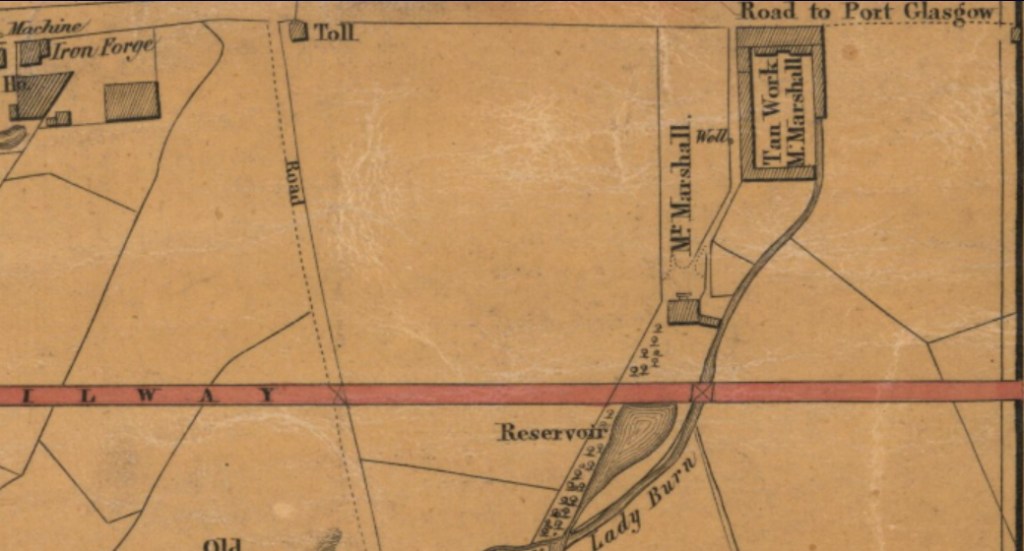

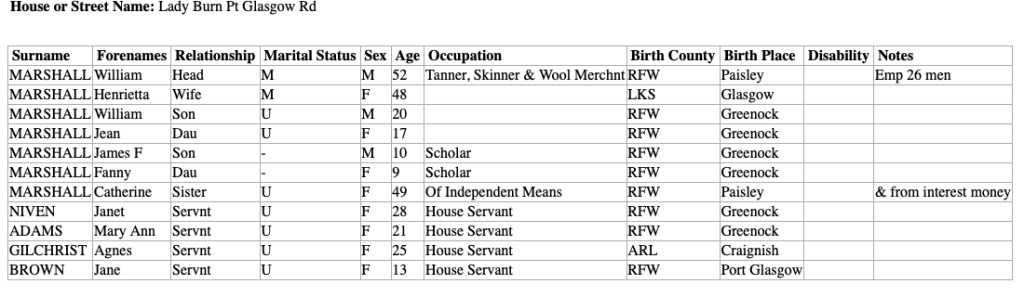

The Ladyburn Tannery Through Time


Between 1858 and 1896, the railway had greatly expanded, with Ladyburn House apparently disappearing while the Tannery had doubled in size.

The plans in the local directory, however, continued to show Ladyburn Cottage from the 1873 to the 1938/39 editions.

Little had changed from 1873 to 1881, but by 1887/8, a branch line had appeared between Ladyburn Cottage and the Tannery.
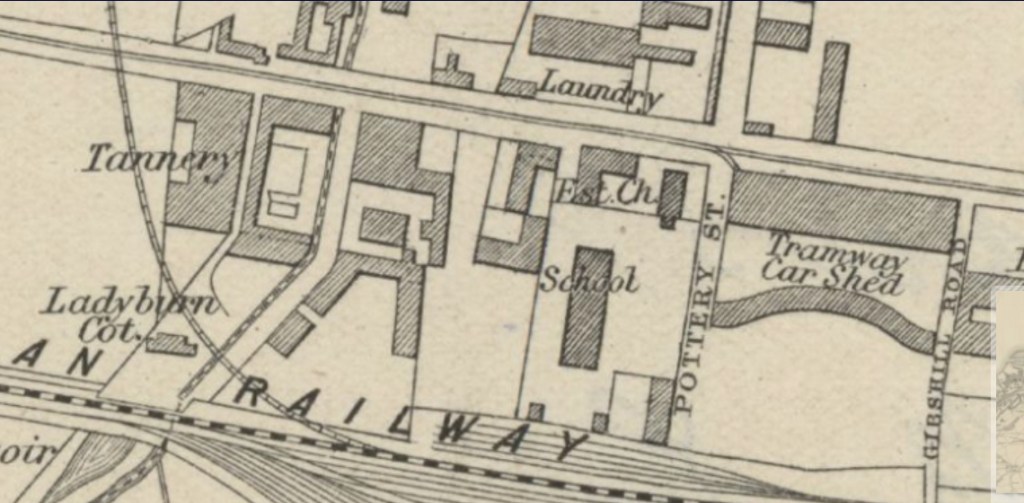
As late as 1916/17, Ladyburn Cottage continued to appear on the Greenock Directory map.

Ladyburn Cottage was still present on the 1938/39 local directory map.

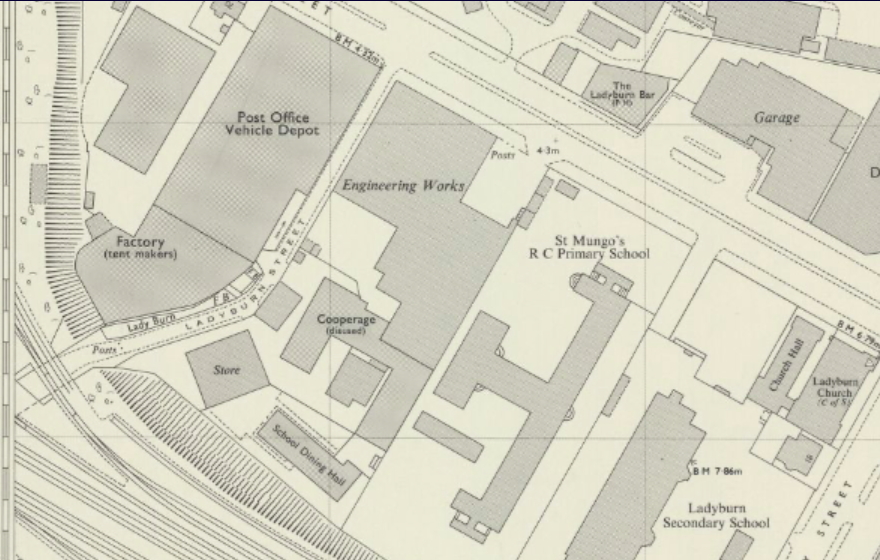
By the time of the publication of the 1970 map, the Tannery had gone and been replaced by a Post Office Vehicle Depot.
The Greenock Telegraph of 22 November 2011 notes a tannery that was operated by Fisher Henderson & Co. at Ladyburn, which is presumably the Marshall tannery above.
Ladyburn Secondary School was close to the site of the Tannery. The school is now closed and has been turned into a Business Park.


 Vecchio
So interesting to read the story of what I had certainly thought was the McAusland Tannery at Ladyburn. A great example of how every theory needs to be double checked and verified!
LikeLiked by 1 person