

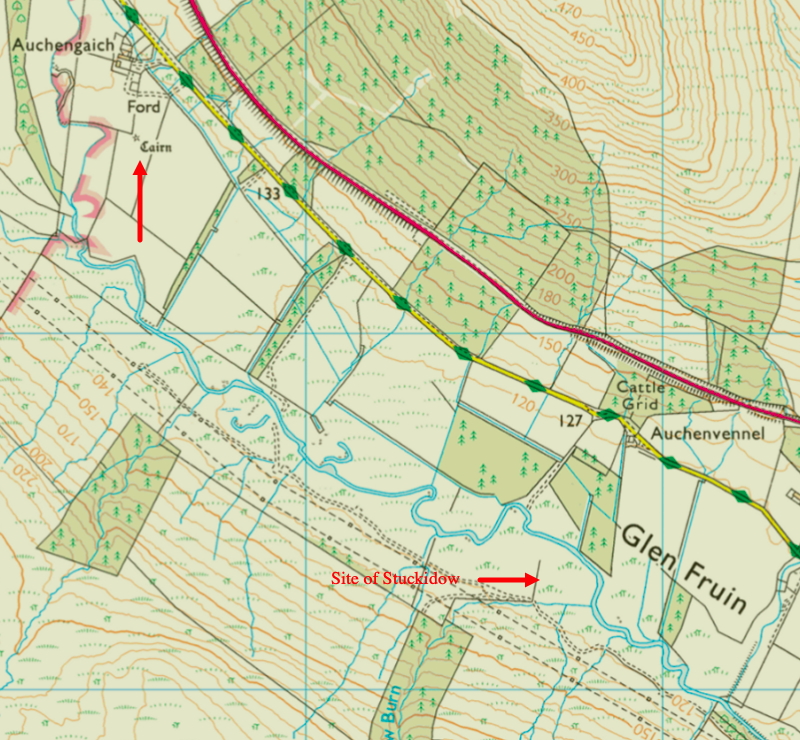
Stuckidow was a farmstead in Glen Fruin, not far from the site of the 1603 Battle of Glen Fruin between the MacGregors and the Colquhouns. The McAuslands were the allies of the Colquhouns, their feudal superiors, and Baron John McAuslan of Callanach is believed have died within a few days of the Battle of Glen Fruin (7 February 1603), possibly of wounds. He is believed by some to be the ancestor of the McAuslands of Stuckidow.
Others who died at the battle included, on the Colquhoun side, Peter Napier, Baron of Kilmahew (grandfather of Patrick McAusland, 22nd Baron of Caldenoch in our reckoning) and Adam Colquhoun, third son of Robert Colquhoun, 8th of Camstradden. And on the MacGregor side, John MacGregor, brother of the MacGregor chief.
The Battle of Glen Fruin
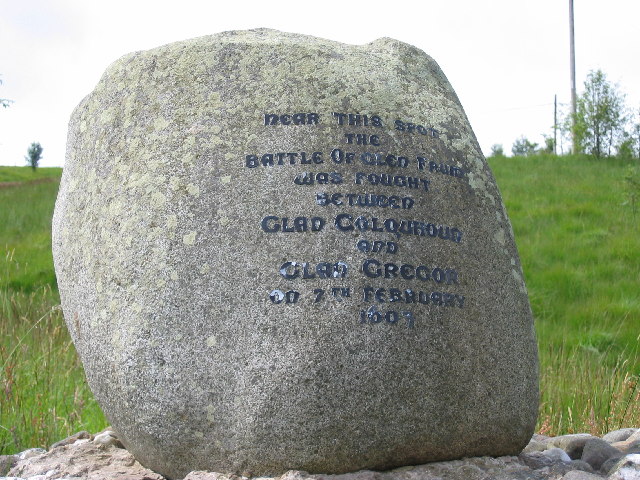
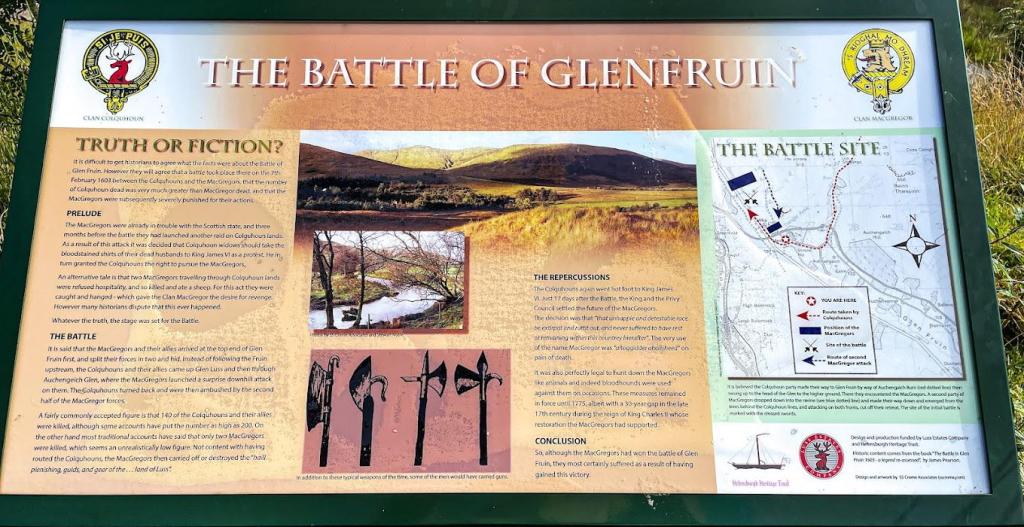
The Battle of Glen Fruin was a Scottish clan battle fought on 7 February 1603 between the Clan Gregor and its allies on one side, and the Clan Colquhoun and its allies on the other. The Clan Gregor (or MacGregor) and Clan Colquhoun were at feud due to the MacGregors carrying out raids on the Colquhoun’s lands. The Colquhouns gained royal support and raised an army against the MacGregors. However, during the subsequent battle of Glen Fuin, the Colquhouns were comprehensively defeated. Glen Fruin is in the Loch Lomond area, in the county of Dunbartonshire, Scotland. In the aftermath of the battle royal policy punished the MacGregors for 150 years.
Background
Archibald Campbell, 7th Earl of Argyll, was responsible for keeping the Clan Gregor under restraint and in January 1593 he had received a commission to charge all those of the surname MacGregor for not keeping the peace. On 5 March 1594 he became bound so that he should keep himself and all those answerable to him to keep his Majesty’s peace under surety of £20,000. In July 1596, upon paying a sum of money into the royal treasury, he received a commission as the King’s lieutenant in the bounds of Clan Gregor “wherever situated”. Subsequently, on 22 April 1601 Allaster MacGregor of Glenstra, chief of Clan Gregor, gave Argyll who was the King’s lieutenant, a bail-bond for the whole clan, one clause of which was that any offence committed by the clan was to be understood as a forfeiture of any lands that they possessed. However, despite this, Argyll, instead of repressing the Clan Gregor used his power over them to stimulate them into various acts of aggression against Alexander Colquhoun of Luss, chief of Clan Colquhoun. Among the Luss Papers, there are lists of items stolen by the MacGregors from the Colquhous in the year 1594 and in other years previous to this up to 1600, showing how much the Colquhouns had suffered from the MacGregors.
In 1602 the MacGregors began to make more formidable inroads into the lands of Luss and Colquhoun of Luss complained to King James VI of Scotland who despite having passed an Act of Parliament forbidding the carrying of arms, granted permission to Colquhoun and his tenants to wear various offensive weapons. However, the right granted to Colquhoun and his followers to carry arms seems to have caused resentment from the MacGregors and resulted in the conflicts at both Glenfinlas and Glen Fruin. In 1602, Colquhoun made a complaint to the King against Argyll, who as the King’s lieutenant in the bounds of Clan Gregor, had permitted the latter and others to commit outrages upon him and his tenants. Argyll was fined under the terms of the bond, but was later acquitted of the charge brought against him because Colquhoun had failed to prove it.
Glenfinlas
On 7 December 1602, at Glenfinlas, which is a glen about two miles west of Rossdhu and three miles to the north of Glen Fruin which runs parallel to it, a raid was carried out led by Duncan Mackewin MacGregor, tutor of Glenstra, against the Colquhouns. He had with him about eighty men and they plundered the houses and took away three hundred cows, one hundred horses and mares, four hundred sheep, and four hundred goats. Two Colquhouns were killed in the raid, one of them a house-hold servant of Colquhoun of Luss. According to the Clan Gregor account, based on Walter Scott‘s supposed factual introduction to his 19th century novel Rob Roy (MacGregor); two MacGregor clansmen, away from home, were forced to spend a night in Colquhoun lands. After being refused shelter, the two MacGregors found an abandoned outhouse and slaughtered a sheep which they ate. When the two were discovered they were seized and brought forward to Colquhoun, the Laird of Luss who had the men tried by summary trial and then executed. Walter Scott also gives this incident as the direct cause of the conflict at Glen Fruin. 19th century historian William Fraser disputes the account given by 17th century historian Sir Robert Gordon, 1st Baronet in his Genealogical History of the Earldom of Sutherland who strongly favors the MacGregors, representing the Colquhouns as the aggressors and that the Colquhuns had made the first raid. Fraser also states that Gordon mistakes the conflict at Glenfinlas for the more serious one at Glen Fruin which took place shortly after. According to Fraser, Colquhoun of Luss visited the King at Stirling on 21 December 1602, accompanied by a number of female relatives of the people who had been killed or wounded at Glenfinlas and who were carrying the bloodied shirts of their dead or wounded relatives. The King was sympathetic and vowed to take vengeance on the MacGregors. He granted a commission of lieutenancy to Colquhoun of Luss giving him the power to repress the crimes made against him and to apprehend the perpetrators. This however roused the MacGregors to raise a strong force against the Colquhouns.
Fraser also disputes Gordon’s contemporary account that in early 1603 the MacGregors and Colquhouns made friendly proposals to hold conference to find a peaceful settlement, again favouring the MacGregors, but Fraser says that there is no evidence to show that this conference ever took place, let alone that at the end of it the Colquhouns treacherously attacked the MacGregors as stated by Gordon. Fraser states that at this time the town council of Dumbarton issued an order for the burgesses to be provided with weapons and armour in readiness, no doubt, for the Clan Gregor.
The conflict at Glen Fruin
Allaster MacGregor of Glenstra, at the head of a large body of his clan, which also included men from the Clan Cameron, all armed with hagbuts, pistols, murrions, mailcoats, axes, two-handed swords, darlochs, and other weapons, advanced into the territory of Colquhoun of Luss. At the time there was no road on the Loch Long side, the present road apparently built at a later date by the Duke of Argyll and called The Duke’s Road. However, there was a track or path of some kind along the side of Loch Long which may have been the way that the MacGregors came into Glen Fruin. To repel the invaders Colquhoun gathered together a considerable force of armed men, who under the royal commission, he had raised to protect the district and punish the MacGregors.
The two sides met on 7 February 1603 at Glen Fruin. The MacGregors have been estimated as numbering between 300 and 400 foot soldiers. The Colquhouns have been estimated as numbering about 300 horse and 500 foot. The ground on which the battle took place was extremely unfavourable to the Colquhouns, especially for their horse. The MacGregors had assembled in two divisions, one was at the head of the glen and the other was placed in an ambush position near to the farm of Strone. The Colquhouns entered Glen Fruin from the Luss side through the glen of Auchengaich which is opposite Strone. Colquhoun pushed on his force to get through the glen before encountering with the MacGregors, but they were already aware of his approach and Allaster MacGregor pushed forward one of his divisions and entered the head of the glen in time to prevent the Colquhouns from emerging out of the upper end of the glen. Meanwhile, his brother, John MacGregor, with the ambush division took a detour to the rear of the Colquhouns which prevented their retreat back through the glen without fighting their way through. The Colquhouns also least expected to be attacked from the rear.
Allaster MacGregor, at the head of his division furiously charged Colquhoun of Luss and his men. The Colquhouns bravely maintained the contest for a while. Fraser disputes other accounts of the battle which say that the MacGregors only lost two men killed. However, due to the unfavorable circumstances in which they had to fight, the Colquhouns were unable to maintain their ground and fell into the moss at the farm of Auchengaich where they were thrown into disorder. Here, on the moss, Colquhoun’s cavalry was useless. The MacGregors killed many of them and forced them into a retreat in which they had to fight through John MacGregor’s division which proved even more disastrous. However, according to the Clan Gregor account, John MacGregor, who was the chief’s brother was killed in the battle.
Alexander Colquhoun, the chief, was chased all the way to Rossdhu Castle which afforded him some refuge. According to Fraser, 140 Colquhouns were killed in the battle and many more were wounded. Other sources state that over 200 Colquhouns were killed.
Aftermath
Government reprisals included the proscription of the Clan Gregor, who were outlawed for the massacre. King James sought to make the Highlands and Islands “answerable to God, justice and himself” and to assimilate them into his new Britain. One of the most radical manifestations of this new programme was the extermination of the MacGregors. Their chief, Allaster MacGregor, was executed in 1604, along with eleven of his chieftains, and in 1633 it became legal to kill MacGregors and hunt them with bloodhounds. The Clan Gregor was scattered with many taking other surnames such as Murray or Grant. Charles II restored the MacGregor name in 1661, but in 1693 it was once again disallowed by William of Orange. In 1784 the MacGregors were allowed to resume their own name and were finally restored to all of the rights and privileges of British citizens.
In 1609, John Murray, 1st Earl of Tullibardine, had apprehended one Alan Oig Mcan Tuagh in Glen Coe who was one of the principal executors of the slaughter committed by the Clan Gregor at the Battle of Glen Fruin and who with his own hand had slew forty people who were “without armour”.
At the end of the eighteenth century the chiefs of Clan Gregor and Clan Colquhoun visited and shook hands on the site of the slaughter at Glen Fruin.
Alleged slaughter of students
There is a tradition that after the battle the victorious MacGregors slaughtered a group of clerical students who had come to watch it, but this story is not supported by historical records. The tradition is that the MacGregors murdered about eighty youths in this incident. It is alluded to in the supposed factual introduction to Walter Scott‘s novel Rob Roy in which it says that the culprits were from the Clan MacFarlane, allies of the MacGregors.
Music and poetry associated with the battle
The poet David Wardlaw Scott alluded to the chief of MacGregors, chief of Colquhouns and the Battle of Glen Fruin in his poem Dora Marcelli, The Last of Her Race. The writer Peter McArthur composed a ballad entitled The Raid of Glen Fruin in memory of the battle.
Archaeology
In July 1967, an excavation took place on a mound in Glen Fruin that was thought to be the burial place of the Colquhouns who were killed in the battle. However, it was discovered that the mound was not the burial site of the Colquhouns but a Bronze Age encampment. There is also a grey stone in the glen where it is believed that John MacGregor, the chief’s brother, who was one of the few slain on the other side was buried.
Stuckidow

Stuckidow can be seen on Roy’s Military map of the Highlands (1747-1752) and the 1818 map of Dumbartonshire (above), but by the time the 1846 OS map was published it had disappeared from the landscape.

The valley of the Stuckiedow Burn. The burn flows through a narrow strip of woodland (part of which is visible here) on its way down to the floor of Glen Fruin. The background hills are on the other side of the glen.
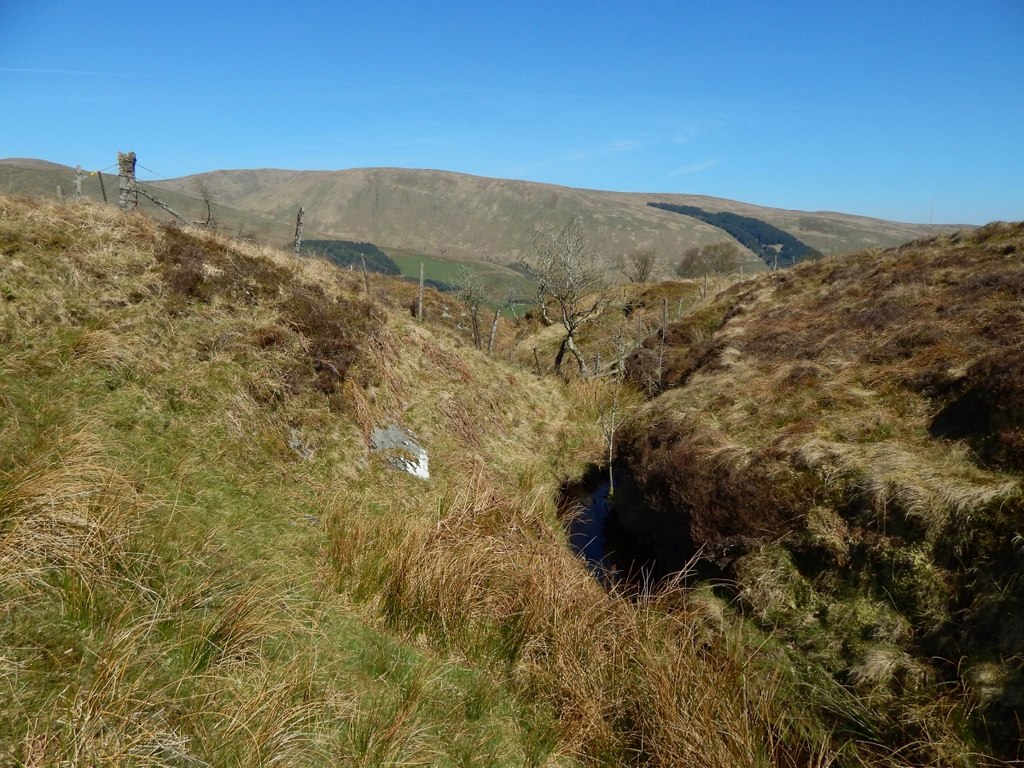
A few years ago, the area just ahead was still wooded; it has now been cleared; compare earlier picture above.

The photograph was taken from the minor road that leads through the Glen. The strip of woodland on the hillside in the background is shown, from near its upper end, in NS2887 : Woods alongside the Stuckiedow Burn, and is centred on NS2887 : The valley of the Stuckiedow Burn.

The woods in the middle distance form a narrow strip on either side of the Stuckiedow Burn. In those woods, the burn descends towards the floor of Glen Fruin, which is the area of low ground that runs from left to right across this photo. For the valley of the Stuckiedow Burn, see: 1301332. The far side of the glen is traversed by two roads. The closer road is also the older; the various farms in the floor of the glen lie alongside it. The newer Glen Fruin Road follows an almost parallel course, just behind it; part of that road is highlighted here by yellow gorse bushes.
Visible right of centre in the background is another glen, that of the upper reaches of the Luss Water; back towards the head of that glen, a single peak, Cruach an t-Sìdhein (NS2796), can be seen through a gap.
At the right-hand edge of the picture, Auchengaich Hill (NS2890) almost hides the taller Beinn Tharsuinn (NS2991). On the other side of that glen, the hills just left of centre range from the Strone (NS2692) at the near end to the more distant Beinn a’ Mhanaich (NS2694).
Finally, the more distant rocky peaks near the left-hand edge of the image are the Saddle (NS2296), on the left, with the larger Beinn Reithe (NS2298) to its right; just to the right again, a small part of Cnoc Coinnich (NN2300) is visible behind the nearer hills.
The owners of Stuckidow
Feudal land tenure was a system by which land was held by tenants from lords. In its simplest form, the tenant might hold their land directly from the king, but the hierarchy could be much more complicated involving numerous levels of lesser lords down to the occupying tenant. In the case of Stuckidow, the feudal superiors, under the monarch, were the Earls, and later Dukes of Lennox, who in turn, granted a charter of various lands, including Stuckidow to the Colquhouns of Luss.
Stuckidow is mentioned several times in The chiefs of Colquhoun and their country. [With plates, including portraits and facsimiles, and genealogical tables.] 1869 by Fraser, William, Sir, 1816-1898. From these entries it appears that Stuckidow was in the possession of the Earls of Lennox until 1496, when the Colquhouns were granted a charter of the land. The Earls of Lennox remained a feudal superiors of Stuckidow, but eventually either Matthew, Earl of Lennox or his son John, Earl of Lennox sold the lands outright to the Colquhouns.
17 April 1496: sir john colquhoun receives Stuckidow from John, Lord Darnley (later 1st earl of lennox)
Sir John Colquhoun, Knight, Eleventh of Colquhoun and Thirteenth of Luss, (1493-1536) married, about the year 1480, Elizabeth Stewart, daughter (apparently the youngest) of John Lord Darnley, afterwards first Earl of Lennox, of the name of Stewart, by his spouse Margaret, daughter of Alexander second Lord Montgomerie, ancestor of the Earls of Eglinton; a matrimonial alliance by which he was enabled to make valuable additions to his estate of Luss. From Matthew second Earl of Lennox, his wife’s brother, Sir John Colquhoun received a charter, dated 17th April 1496, of the lands of Auchingache, Larg of Glenfruin, Auchenvennel, Stuckiedow, and Blairhangane, all in the earldom of Lennox and shire of Dumbarton, in liferent, as the dowry of his spouse, Elizabeth Stewart.
16 August 1575: Sir Humphrey Colquhoun inherits STUCKIDOW from his father
On 16th August 1575, Sir Humphrey Colquhoun, Fourteenth of Colquhoun and Sixteenth of Luss, (1574-1592) was served heir to his father, Sir John, by a special service. The lands enumerated in the retour are Ballernick-mor, Lettrowald-mor [Letrualt-mor], and Stuckinduff, with the mill of Altdonalt in Letrualt, the lands of Kilniardinny, Blairvaddoch, Dureling, Stronratan, Auchingaich, Auchenveniiel-nior, Stuckiedow, and Blairhangane, in the earldom of Lennox and shire of Dumbarton, which lands were held in chief of the Earl of Lennox.
10 march 1598: The colquhouns forced to resign stuckiedow in favour of the duke of lennox
ALEXANDER COLQUHOUN OF COLQUHOUN AND LUSS, (1592-1617).
In 1597, the Laird of Luss and his nieces, Margaret and Agnes, became involved in a lawsuit with Ludovic second Duke of Lennox, Chamberlain of Scotland. The Duke, who had been constituted by his Majesty assignee to all reversions granted by whatsoever persons to the deceased Earls of Lennox, wished to redeem various lands which his grand- father or father had sold under reversion to Alexander’s grandfather. But these lands Alexander wished to retain. Hence the legal proceedings adopted by the Duke against him, and Ms deceased brother Sir Humphrey’s daughters.
At the instance of the Duke, on 23d August 1597, they were summoned to compear before his Majesty, and the Lords of Council, at Edinburgh, on the 1st of January next, to resign and overgive in his favour the lands of Letterowald [Letrualt] and Stuknagart, which had been sold by Matthew Earl of Lennox, the pursuer’s ” foirgrandsyr ” [great-grandfather] to John Colquhoun of Luss, Alexander’s great-grandfather, under reversion, and the Mains of Inchinnan, which had been given in warrandice of these lands. In an action at the instance of the Duke against them in reference to the redemption of other lands, they were decerned and ordained by the Lords of Council, 10th March 1597-8, to renounce and overgive the mill of Altdonalt, the lands of Auchingaich, Auchenvennel-mor, Stuckiedow, Balchannan, Mamore, Mambeg, Blairvaddan, Feorlingcarry, the Strone and Dureling, all which had been sold under reversion by Matthew and John, preceding Earls of Lennox, to the foresaid John Colquhoun of Luss.
13 May 1630: Sir john colquhoun, 1st baronet. purchased stockiedow from walter colquhoun
In the year 1630, Sir John Colquhoun, first Baronet (1617-1647), added to his estates by new purchases of lands. At Glasgow, on 13th May of that year, he purchased from John Colquhoun of Kilmardinny, “for great sums of money,” the lands of Auchingaich, Larg, Auchenvennel-mor, Stuckiedow and Blairhangen, in the dukedom of Lennox and shire of Dumbarton. The disposition of these lands in his favour states that they were first disponed by Sir John Colquhoun of Luss, Knight, “foir grandschir to John Colquhoun, now of Luss,” to Walter Colquhoun, lawful son of the granter, and ” grand-schir” of the said John Colquhoun of Kilmardinny.
27-29 January 1653: sir john colquhoun, 2nd baronet, infefted on a precept of sasine as superior of Stuckidow
1653 January. On the 27th, 28th, and 29th of the same month, Sir John Colquhoun, 2nd baronet (1647-1676) was infefted, on a precept of sasine contained in a charter from James Duke of Lennox, in Blairvaddock, Stuckiedow, Letraalt-mor, Faslane, Garelochhead, Mamore, Mambeg, Ferlincary, Dureling, Auchenvennel-mor, Auchingaich, three Tullychewens, Craigroston, Balloch, and other lands.
The mcauslands in stuckidow from ca 1550?
Peter McAuslan (30 January 1824-21 December 1908) was said to be the grandson of the last tenant of Stuckidow.
Meanwhile, Robert McCasland of Newlandmuir, (30 November 1822-04 January 1873) who matriculated arms in 1868, produced documents stating that he was the great grandson of Robert McCausland: “which Robert was youngest son of Robert McCausland, Sheep Farmer in Stukkidow and Auchingach in the last mentioned Parish and County by Elizabeth Erskine his Wife of that place as evidenced by a Drawing of Tombstones in Row Churchyard, Dunbartonshire produced with the said Patentee’s petition.” and “That it was said the Ancestors of the last mentioned Robert McCausland had been in Stukkidow from a very remote period and extending over nine generations as extracted from an old M.S. Book written by the Petitioner’s Father in and previous to the year Eighteen hundred and thirty four.“
Assuming that each successive McAusland had been aged 21 at the birth of his eldest son, this could mean that the McAuslands had been in Stuckidow since circa 1550, and possibly earlier.
 Vecchio
[…] McAusland, Baron McAusland is reputed to have died soon after the 1603 Battle of Glen Fruin where the Conquhouns and their allies, including the McAuslands, were routed by the MacGregors. The […]
LikeLiked by 1 person