
Deep in most of us is the potential for greatness or the potential to inspire greatness.
The Prime of Miss Jean Brodie

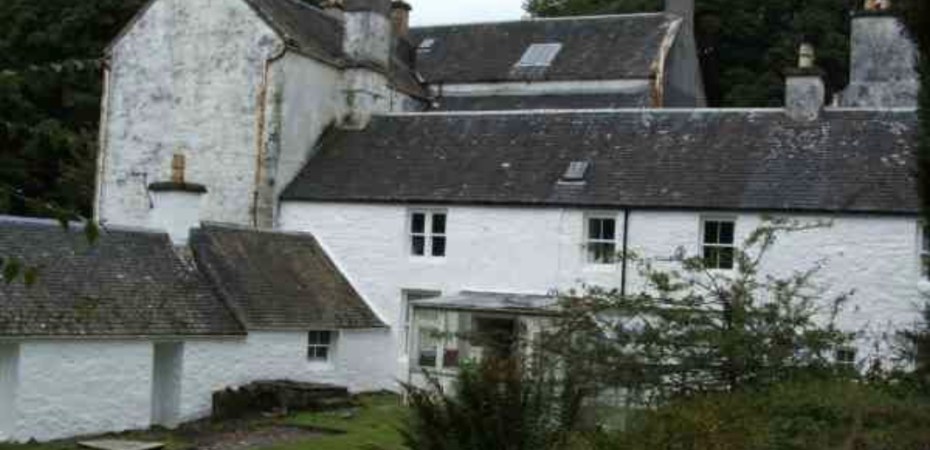
Dunollie House
Dunollie was the royal centre of the Cenél Loairn within the kingdom of Dál Riata. The Irish annals record that “Dun Ollaigh” was attacked or burned down three times, in 686, 698, and in 701. It was subsequently rebuilt in 714 by Selbach mac Ferchair (died 730), the King of Dál Riata credited with destroying the site in 701. Excavations in the 1970s suggest that this early fortification was abandoned some time in the 10th century.

The area around Dunollie subsequently became part of the semi-independent Kingdom of the Isles, ruled over by Somerled in the 12th century. On his death the MacDougalls became Lords of Lorne. Dougall, Somerled’s son, held most of Argyll and also the islands of Mull, Lismore, Jura, Tiree, Coll and many others in the 12th century.
Excavations show that Dunollie was refortified with an earthwork castle in the 13th century or potentially the late 12th century. The builder may have been Dougall, or his son Duncan. Ewan MacDougall, great-grandson of Somerled and the third chief of the MacDougalls, switched the clan’s allegiance in the mid 13th century: initially allied with Haakon IV of Norway, from the 1250s Ewan remained loyal to the kings of Scotland.

The MacDougalls built nearby Dunollie House in 1746 or earlier, although there was already a house here dating from about 1600, and the old stronghold was abandoned. The newer house was remodelled and extended in 1835, and there is a museum in some of the older parts. The castle is still owned by the MacDougalls, and is being consolidated and repaired.
There are stories of a phantom piper or Highlander haunting the ruins of Dunollie Castle.
Ann Wilson Webb
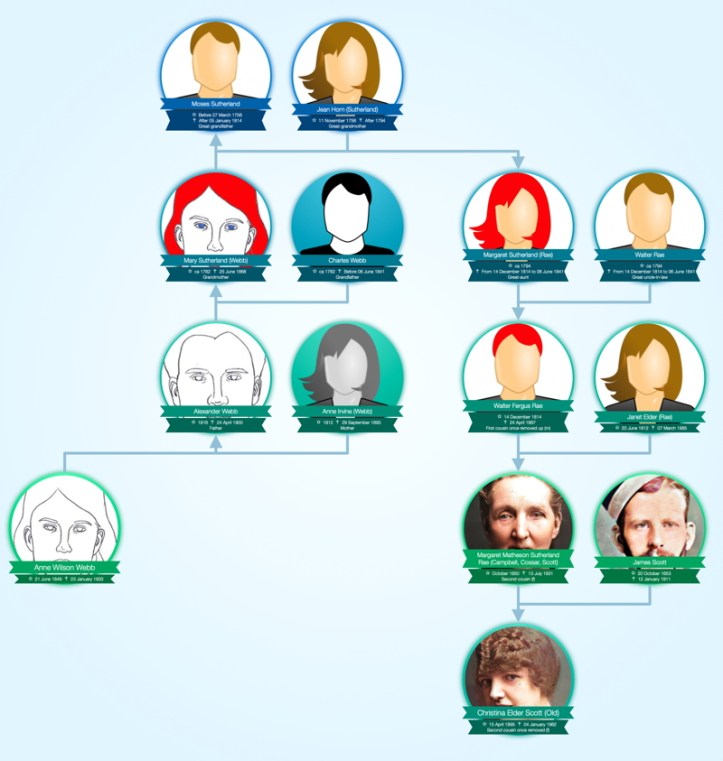
Our second cousin three times removed, Anne Wilson Webb was born on 21 June 1849 at 49 Thistle Street in Edinburgh and baptised on 04 December 1849. She was the daughter of Alexander Webb, shoemaker and his wife Anne Irvine.
At the 30 March 1851 census she was a year old and living at 23 Dundas street with her father, mother, elder brother Charles and maternal grandfather, William Irvine. By the census of 07 April 1861, she was aged 11, a scholar and living at 28 Pitt Street in Edinburgh with her father, mother and elder brother. At the following census of 02 April 1871, she was a book keeper and living at 17 William Street in Edinburgh.
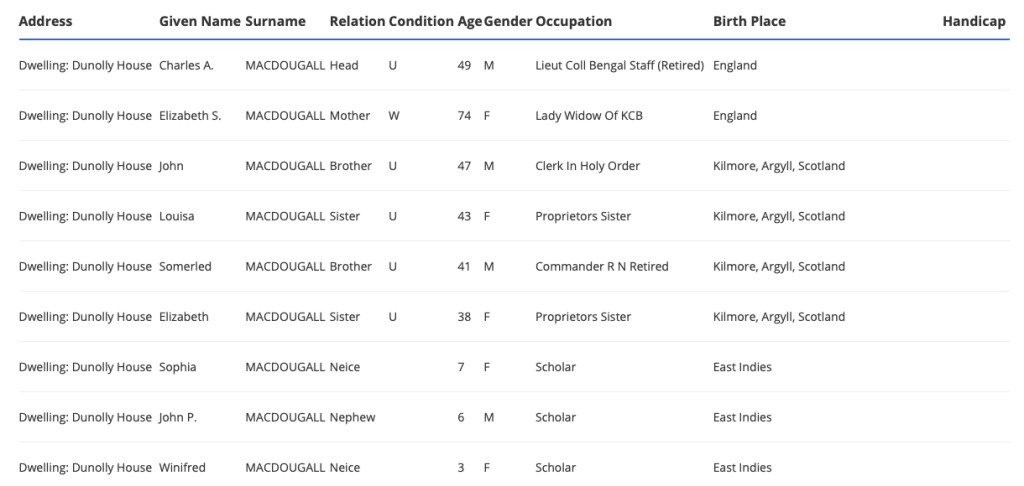
However, on 03 April 1881, she was no longer in Edinburgh, but at Dunollie House by Oban where she was working as a nurse.

As the nurse her task was likely to look after Sophia, John P. and Winifred MacDougall, the nieces and nephew of Lt.-Col. Charles A. MacDougall of the Bengal Staff (Retired).
The Chiefs of Clan MacDougall
I. Dougal son of Somerled, 1164 – d. 1207) the first chief.
The founder of the MacDougall clan was Dougall MacSomairle, King in the (Hebrides) Isles (1164 – d. 1207). He was born ca. 1140, the son of Somerled, King of the Hebrides and Regulus of Argyll and his second wife, Raghnild, daughter of Olaf, King of Man.
IV. Sir Alexander, Lord of Lorne (1266-1309) and the forfeiture of the MacDougalls
The MacDouglas prospered until the Scottish wars of independence, when the fourth chief, Sir Alexander de Ergadia (of Argyll), Lord of Lorne, was a supporter of King John Balliol. His wife was Julienne Comyn, the daughter of Sir John Comyn of Badenoch and Marion de Galloway. Sir Alexander took the side of the English and fought against King Robert the Bruce. However, the clan was divided and Sir Alexander’s own brother Duncan (later the sixth chief) fought on the side of Robert the Bruce. At the Battle of Dalrigh in August 1306, the MacDougall warriors led by his son John de Ergadia (often called John of Lorn), ambushed Bruce’s force and stripped what was later known as the Brooch of Lorn from Bruce’s cloak. However, the MacDougalls lost the Battle of Brander on the slopes of Ben Cruachan beside Loch Awe in the summer of 1308 and in March 1309 Sir Alexander attended Bruce’s Parliament at Saint Andrews. The Lordship of Lorn was forfeited and the vast lands of Ergadia and the isles were distributed to Bruce’s allies, the MacRuairies, Campbells and MacDonalds.
XXV Vice Admiral Sir John MacDougall (1825 – d. 1865)
When Ann Wilson Webb was at Dunollie, the head of the family was the third son of the twenty-fifth chief, Sir John MacDougall of Dunollie (1825 – d. 1865) and his wife Elizabeth Sophia Timins. She was the daughter of Captain Charles Timmins of the East India Company. Sir John was born in 1789 and at age thirteen in 1802 he went to sea as a midshipman in the Royal Navy where he fought in many engagements during the Napoleonic wars and afterwards. Sir John rose from midshipman to the rank of Vice Admiral, R.N., K.C.B. He was known for his courageous seamanship and for his consideration to his tenants as Chief of the clan. In October 1824 the Brooch of Lorn was restored to him after being lost for 177 years since being looted by Covenanter forces in the sack and burning of Gylen castle on the island of Kerrera in 1647. Beginning in 1828 Sir John extended Dunollie House, planted many trees, and improved the grounds. After a long and distinguished naval career in which he rose to the rank of Admiral in 1863 after fifty years in the navy. He died on 12 April 1865. Lady MacDougall survived her husband and was living at Dunollie House in April 1881 when Anne Wilson Webb was nurse to her grandchildren. She died just two months later on 08 June 1881.
XXVI Captain Alexander John MacDougall (1865 – d. 1867)
Sir John was succeeded by his eldest son, Captain Alexander John MacDougall of Dunollie (1865 – d. 1867) who became the twenty-sixth chief. As a Captain of Artillery he served in India and fought with distinction in the Crimean war. He married Anna, the daughter of Thomas Barclay. He had been engaged for seven years and died of pneumonia seven weeks after his marriage. He was born on 03 August 1827 and died in on 26 August 1867. There is a plaque dedicated to him at the school built in 1872 on the island of Kerrera near the Ferry house which overlooks the Sound of Kerrera.
XXVII Lt.-Col. Charles Allan MacDougall (1867 – d. 1896)
In 1881, when Anne Wilson Webb was working as nurse at Dunolly House, Lt.-Col. Charles Allan MacDougall of Dunollie (1867 – d. 1896) had been the twenty-seventh chief of the clan for over 13 years. He was the third son of the twenty-fifth Chief, Sir John MacDougall of Dunollie and had succeeded his elder brother, who had died childless. He had served as a Member of the Bengal Staff Corps, was active in the local government of Argyll, and encouraged the formation of a Clan MacDougall Society. He was born in 1831 and died without issue in 1896, having married his cousin, Harriet Elizabeth Munro, a widow and the daughter of Charles Munro of Ingsdon on 28 October 1886.
XXVIII – Deputy Surgeon General Henry Robert Lawrence MacDougall of Dunollie (1896 – d. 1899)
Lt.-Col. Charles Allan MacDougall of Dunollie was succeeded by his younger brother, Deputy Surgeon General Henry Robert Lawrence of Dunollie (1896 – d. 1899), who became the twenty-eighth chief of Clan MacDougall. He was not present at Dunollie house at the 1881 census. He was the the fifth son of the twenty-fifth chief, Sir John of Dunollie. He graduated with an M.D. From the University of Edinburgh and made a career in India where he was a member of the Bombay Medical Service. He married Caroline Harriette Forsyth, the daughter of James Forsyth of Glengorm on the island of Mull. He was born in 1835 and died in 1899.
The MacDougall Children
The three MacDougall children who were presumably in Anne Wilson Webb’s care were the younger son and daughters of Dr Henry Robert Lawrence MacDougall above and his wife Caroline Harriette Forsyth. The parents were presumably in India with their eldest son, Alexander James MacDougall, who in turn succeeded his father as 29th chief of Clan MacDougall. The three children who remained at Dunollie were:
- Sophia Magdalene MacDougall, who was born on 26 April 1873 and baptised on 22 May 1873 at Karachi, India (now Pakistan). She died on 21 December 1946 at age 73, unmarried.
- John Patrick MacDougall, who was born on 11 February 1875 in India. He was educated at Clifton College, Clifton, Bristol, Gloucestershire, England and at the Royal Military Academy, Woolwich, London, England. He gained the rank of Lieutenant in the Royal Artillery and fought in the Boer War, being killed in action on 29 May 1901 at the age of 26.
- Winifred Julia MacDougall, who was born on 22 April 1878 in India. She married Major Bernard John Haslam on 22 December 1902. He was an officer in the Royal Engineers and gained the Distinguished Service Order (D.S.O.), being killed in action on 26 August 1918 in the last months of the war. She died on 24 November 1962 at age 84.
The Brooch of Lorne
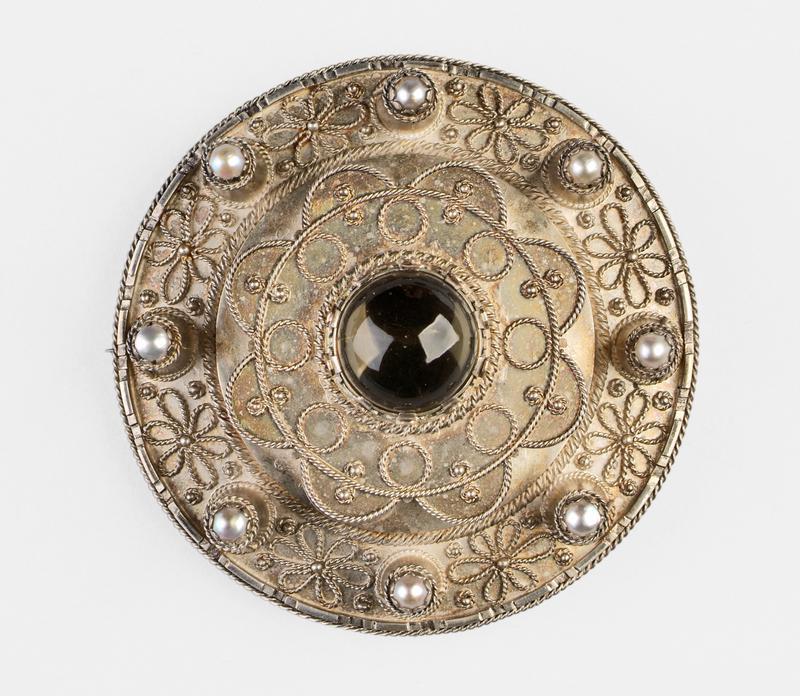
It is not impossible that Anne Wilson Webb and the children were permitted to see the Brooch of Lorne, which had been restored to the MacDougalls in October 1824. The brooch is currently owned by the MacDougall of Dunollie Preservation Trust and was rarely seen in public until it was loaned to an exhibition in the British Museum in London in 2012. Queen Victoria had viewed the brooch during a visit with the MacDougall clan chief in 1842, taking it in her hand and examining it closely. A rare appearance in public was when the MacDougal chief wore it when Elizabeth II visited Oban in 1956.
The Brooch of Lorn or Braìste Lathurna in Gaelic, is a medieval “turreted” disk brooch supposedly taken from Robert the Bruce (Robert I of Scotland) at the Battle of Dalrigh in 1306 where Robert the Bruce of Scotland was ambushed by John of Argyll, chief of the Clan MacDougall. The attack was revenge for the murder of John III Comyn, Lord of Badenoch, a nephew of John of Argyll and rival for the throne of Scotland. According to tradition, the attackers tried to dismount Robert the Bruce but only pulled off his cloak and brooch. The brooch was kept at Dunollie Castle until being moved to Gylen Castle on the island of Kerrera during the Covenanter Wars. The castle was captured and burned by David Leslie, Lord Newark in 1647 and the brooch was taken.
It was hidden until the early 19th century when it was found in a chest by Major Campbell of Bragleen after his return from fighting in the Napoleonic Wars. A document confirmed that it had been taken from Gylen Castle by the Campbells, and it was viewed by the MacDougall chief before Major Campbell’s death in 1819. It was returned to the MacDougalls in 1824 by General Duncan Campbell of Lochnell.
The dating of the Brooch of Lorn varies somewhat, though all contemporary specialists are clear that it is from well after Robert the Bruce’s lifetime. The British Museum describes it as “dated on stylistic grounds to late 16th C but incorporating earlier rock crystal charmstones in which there was revived interest in the 16th C.”, and dates its own Lochbuie Brooch, which it believes was by the same hand, to “1600 (circa)”.
David Caldwell, curator of the Scottish medieval collections at the National Museums of Scotland, is quoted as saying, “It is a very important piece of west Highland art, but it dates from the mid 15th century, so cannot be Bruce’s. Maybe the original brooch fell to pieces and this one was substituted for it”.
Findlay in 1999 preferred the earlier part of the 16th century, and Catherine Gillies, curator for the clan, says, “The re-setting has been narrowed by style and historiography to roughly the third quarter of the 16th century”, but still uses the description “medieval”.
The brooch is centred on a large quartz charmstone, and it is not implausible that this stone had belonged to the Bruce; the brooch also acted as a reliquary.
Somerled’s DNA and Descendants
The Clan MacDougall Society of the USA notes that:
“Somerled is proudly claimed as a patrilineal ancestor by several Scottish clans. Recent genetic studies suggest that Somerled has hundreds of thousands of patrilineal descendants, and that his patrilineal origins may lie in Scandinavia. Since the early 2000s, several genetic studies have been conducted on men bearing surnames traditionally associated with patrilineal descendants of Somerled. The results of one such study, published in 2004, revealed that five chiefs of Clan Donald, who all traced their patrilineal descent from Somerled, were indeed descended from a common ancestor. Further testing of men bearing the surnames MacAlister, MacDonald, and MacDougall, found that, of a small sample group, 40 percent of MacAlisters, 30 percent of MacDougalls, and 18 percent of MacDonalds shared this genetic marker. These percentages suggest that Somerled may have almost 500,000 living patrilineal descendants. The results of a later study, published in 2011, revealed that, of a sample of 164 men bearing the surname MacDonald, 23 percent carried the same marker borne by the clan chiefs. This marker was identified as a subgroup of haplogroup M17, known to be extremely rare in Celtic-speaking areas of Scotland, but very common in Norway. Both genetic studies concluded that Somerled’s patrilineal ancestors originated in Scandinavia.”
Dunollie House reveals its secrets. In 2011, work was underway to convert the 1745 buildings at the back of Dunollie House, Oban, into a small exhibition space, archive and meeting room and as each day passes, the house reveals more of its history. 6 mins, 27 secs.
 Vecchio
I loved reading this as our family originated from just a few miles north of Oban so the area is all very familiar.
LikeLiked by 1 person