

Really? I should have saved the fantasy genealogy session for the 1st of April, but here goes.
“It all felt a bit too crowbarred into place, the kind of surmises dreamed up by amateur genealogists determined to find that elusive link to royalty. He’d lost count of the number of clients who had claimed to be descendants of a mistress of Henry VIII, as if that even meant anything.”
Hiding the Past, The Forensic Genealogist #1 by Nathan Dylan, Goodwin (2013).
“Too often genealogy is used merely as a means of establishing a connection, usually remote, with the exalted and the great, royalty and famous national figures. There is little point in this. Simple arithmetic will show that, were the records complete, it would be possible within the reasonably measurable past, to establish a relationship with almost anybody. It is surely of much more interest to ascertain what kind of people one’s ancestors were, what they thought and what they did, and something of their character. Even the skeleton in the cupboard has his interest and should. not be suppressed.”
A History of the Galloway Families of McCulloch by Walter Jameson McCulloch, M.C., T.D., W.S., of Ardwall, 1964.
I have found the informative UsefulCharts videos on YouTube to be interesting. Yesterday, I watched “Who Would Be Jacobite King Today?” which follows the heirs general of the Stuart dynasty, and suggests that an independent Scotland could even choose a different monarch from the descendants of the “Wee German Lairdie“, as the Elector of Hanover was known.
The original video has been updated following the death of the late Queen Elizabeth.
I then watched the following video: “Are All Europeans Descended From Charlemagne?” While the theory was interesting, I found myself unable to take the leap of faith that the Six Degrees of Kevin Bacon means that everyone is descended from royalty. It is certainly statistically more probable with every generation back in time, and perhaps even likely. However, in some communities, such as our own East Lothian and Midlothian miners, miners tended to marry into other mining families. Unlike in The Princess Bride, princesses rarely married farm boys. Meanwhile if you find someone famous, you often find that they are well connected – eg, as detailed in an earlier article, the actress Dame Margaret Rutherford was the cousin of the 1st Viscount Stansgate, father of the late Tony Benn.
Then I found a video on “Finding Your Royal Roots“. Never yet having found that any of the numerous claimed noble or royal roots in public trees for our ancestors had stood up to close scrutiny, I decided to watch it. Sensibly, the video urged caution even if a link to royalty was found. We all have errors in our tree that we constantly attempt to correct, but public global trees such as Family Search are especially prone to errors. They can be incredibly valuable repositories of years of excellent and in depth research, but are also notorious for being riddled with problems, especially in the days before parish registers. This is due to many factors including the copying of careless errors without any verification, square pegs being forced into round holes, confusion between different people with the same name, unsourced profiles, random merges of unrelated families and sometimes even the deliberate addition of fake ancestry. If someone really wants to be descended from royalty, then they will almost certainly be able to find a tree somewhere that proves that they are descended from the kings of old.
I followed the instructions in the video, and to my surprise, when I added a GEDCom to Geni, I discovered that my mother – without her knowledge or consent – had already been added as a public profile to Geni, along with her family members, by someone who did not even seem to be related to us. Where had the information come from? I recognised much of my own research into the McAuslands, which seemed, for the most part to have been faithfully reproduced.
I was even more surprised when I completed the instructions given above and was informed that, via my mother, William the Conqueror was my 29th great grandfather!
Perhaps I should not have been surprised as the internet is full of trees claiming royal descent. But, the strange thing was that my mother had told me that her father claimed the McAuslands were descended from “The Kings of the Isles“. Now, in the line below, Angus Og, Lord of the Isles (and companion of Robert the Bruce) was a descendant of Somerled, who was indeed – Rì Innse Gall – or King of the Isles! Could the old family story really be true? Time to investigate the claims in more detail.
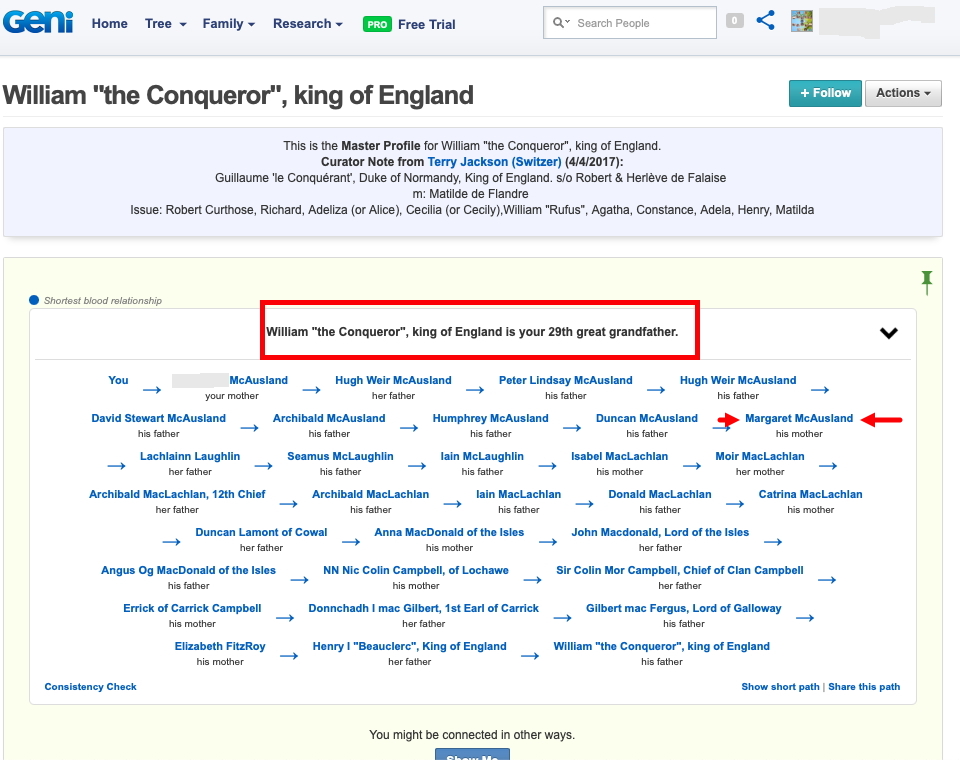
The crucial question is, can the line above actually stand up to scrutiny? A chain is only as strong as its weakest link, and straight away, I could see a potential problem. In the chart, my great times six grandfather, Duncan McAusland, who I had researched in detail, is linked as the son of Margaret McAusland, daughter of Lachlainn Laughlin, neither of whom I had ever come across before. Was this our missing link to the royal families of Europe, or merely a red herring?
The McAuslands of Inverlauren and Blairnyle
As detailed in several previous articles, the McAusland heartland was in Glen Fruin, between Loch Long and Loch Lomond, and the site of a 1603 battle between the MacGregors and the Colquhouns. There were a number of McAusland farmsteads in Luss and Row/Rhu parishes and our own Duncan McAusland seems to have been a tenant farmer at the McAusland farm of Inverlauren, where his eldest known child, Humphrey was born. It is assumed that Duncan was a younger son as while other McAuslands remained at Inverlauren, he moved to nearby Blairnyle to the north east and his four other children were born there.

Inverlauren, close to, but not quite in Glen Fruin, and near to Loch Lomond, is one of several ancestral McAusland farmsteads, which included over the years, Coldenoch, Prestilloch, Innerquhonlanes, Craigfad, Stuckidow, Kilbride, and others.
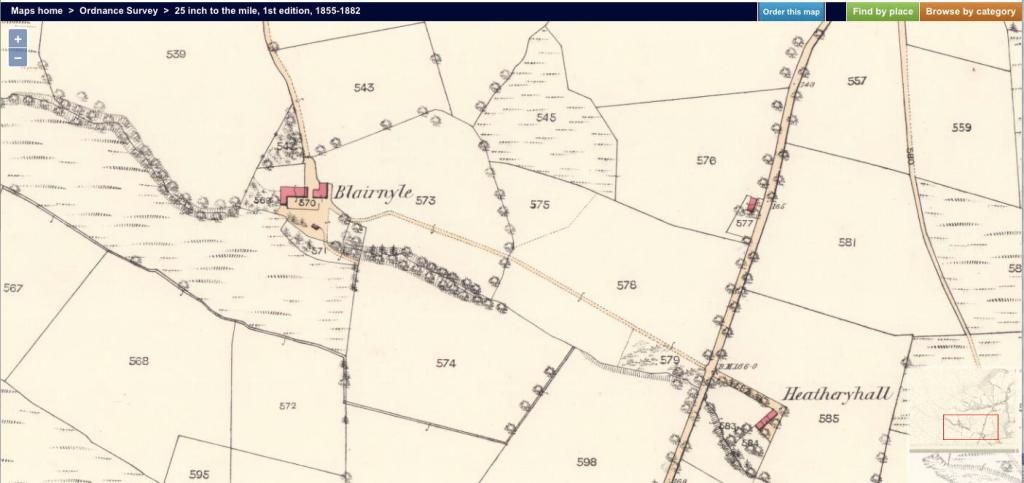
Duncan McAusland and his wife Margaret Glen moved from (High or Wester) Inverlaran to Blairnyle.
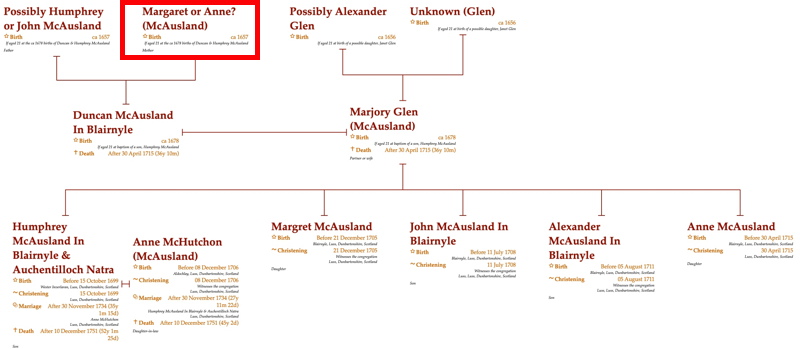
Duncan McAusland and his wife Marjory Glen had the following children:
- Humphrey, who was born at Wester Inverlaran in Luss parish and baptised on 15 October 1699.
- Margaret, who was born at Blairnyle in Luss parish and baptised on 21 December 1705, with witnesses, the congregation.
- John, who was born at Blairnyle in Luss parish and baptised on 11 July 1708, with witnesses, the congregation.
- Alexander, who was born at Blairnyle in Luss parish and baptised on 05 August 1711, with witnesses, the congregation.
- Anne, who was born at “Blairnile of Auchintullich” in Luss parish and baptised on 30 April 1715, with witnesses, the congregation.
It should be noted that the first entries in the Luss Old Parish Registers of Births & Baptisms and of Banns & Marriages were in 1698. Therefore, Duncan McAusland and his wife Marjory Glen most likely married before 1698 and they could well have had additional children before the baptism of Humphrey in 1699. If Duncan McAusland and his wife Marjory Glen were aged 21 at the baptism of Humphrey in 1699, then they may have been born around 1678, and possibly earlier.
The Scottish Traditional Naming System
In Scotland, there was a traditional naming system, which is explained by Scottish Kin. Some families followed the system almost religiously, some dabbled with it and others simply ignored it:

Although we do not know if Duncan McAusland and his wife Marjory Glen had any daughters apart from Margaret and Anne, it is possible that Duncan McAusland’s mother may have been named Margaret or Anne, therefore the theory that Duncan’s mother was Margaret, daughter of Lachlainn Laughlin, seemed plausible.
DNA Does Not Lie

There was some information on the DNA tab which looked to be potentially interesting!
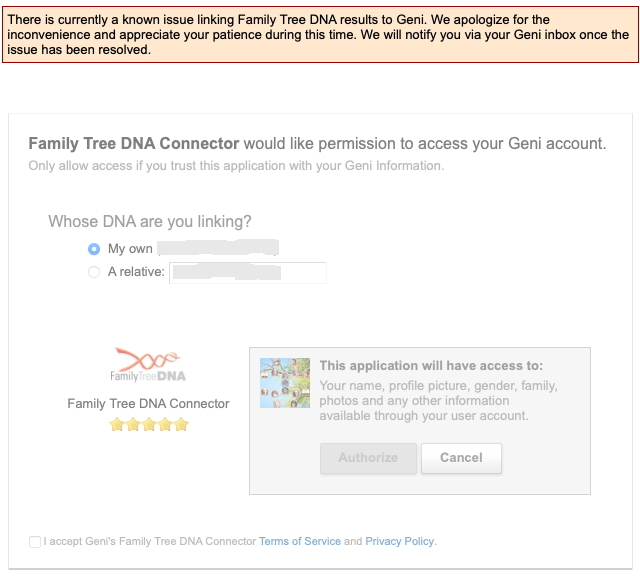
Unfortunately, there seemed to be an issue adding Family Tree DNA results to Geni, so this line of enquiry would have to wait.
The ancestry of the two DNA kits that had been connected to this profile was investigated. They turned out to be two McLaughlins who were distant cousins of each other. However they shared no common ancestry with the McAuslands and had no apparent connection to our line.
The profile owner claimed he had a DNA match on FamilyTreeDNA suggesting that my mother was his eighth cousin. He claimed that proved firstly that he was related to us via Duncan McAusland who was born ca 1707 in County Antrim and second that he was descended from royalty. Despite polite requests, no supporting evidence was provided by the author for either statement and despite in-dept investigation no evidence whatsoever could be found to support his claims that there was any genetically significant DNA match.
The owner of the fake profiles also refused to disconnect the Irish McAuslands that he had grafted onto the Scottish branch, claiming we had no proof for any of our claims. This was rather ironic considering that he had hacked into our accounts and plagiarised our entire research and family tree right down to adding my mother as a public profile on Geni without her knowledge or permission.
While certainly not impossible, the flaws of such an argument are probably obvious to many with even an elementary understanding of ancestry. There are many possible lines of ancestry connecting eighth cousins and knowing via which specific line a common fragment of DNA descended requires firstly research and secondly triangulation in order to confirm the relationship.
Most genetic genealogists have the experience of having cousins as DNA matches but not being able to find the connecting recent common ancestors. We usually look for surnames in common in both family trees. But our genealogical brick walls mean we know a smaller fraction of surnames in the more distant generations.
This article in the ISOGG wiki discusses the number of expected cousins and the probability of matching DNA with them: http://www.isogg.org/wiki/Cousin_statistics while Kitty Cooper’s Blog, 19 July 2016 has an excellent article on How many cousins share my 5th grandparents?.
So, while the DNA evidence – or lack of it – did not back up any of the claims made, did any of the dates fit the theory?
Incoherent Dates Of Birth
Margaret Laughlin, born circa 1688 in County Donegal, Ireland
Margaret Laughlin’s estimated date of birth of around 1688 in County Donegal (see image above) was clearly out by a whole generation and more as our ancestor (her claimed son Duncan) is estimated to have been born in around 1678 in Scotland or possibly even earlier – ten years before she was supposedly born in Ireland.
Duncan McAusland, born circa 1707 in County Donegal, Ireland

Looking at her son Duncan McAusland on Geni, there are clearly problems there too he was supposedly born ca. 1707 in County Donegal in Ireland.
Our Duncan McAusland would have been born circa 1678 if he was aged 21 at baptism of his son, Humphrey McAusland, and he may well have been born several years before that.

Geni has some useful fact-checking safeguards and in this case the alarm bells were ringing.
According to the Geni profile, Duncan McAusland, had five children and died on 30 April 1715 in Argyll, when, if born ca 1707, he would have been aged around eight!
All the evidence suggests that the Scottish McAuslands and the Irish McAuslands were different family groups from different generations that had been conflated and randomly merged.
The Hearth Tax Rolls show Humphrey McAusland in Innerlaren in 1694
Our great times six grandfather Duncan McAusland was possibly born around 1678 – the Luss parish records only start in 1698 – and on 15 October 1699, Humphrey McAusland, the first of his five known children were baptised. The birth date of around 1678 assumes that Duncan was aged twenty one at the baptism of Humphrey, although he could have been considerably older.

According to Geni, these McAuslands were living in County Donegal in Ireland in 1707. However, if we look at the 1694 Hearth Tax records for the parish of Luss, in Dunbartonshire, Scotland, we find Humphrey McAusland, who is recorded as Humphra mccauslune in Innerlarran, who is being assessed for tax at the family farmstead. There was a continuous presence of McAuslands, and their descendants, at Innerlarran from at least 1694 until at least 1911.
The Irish McAuslands
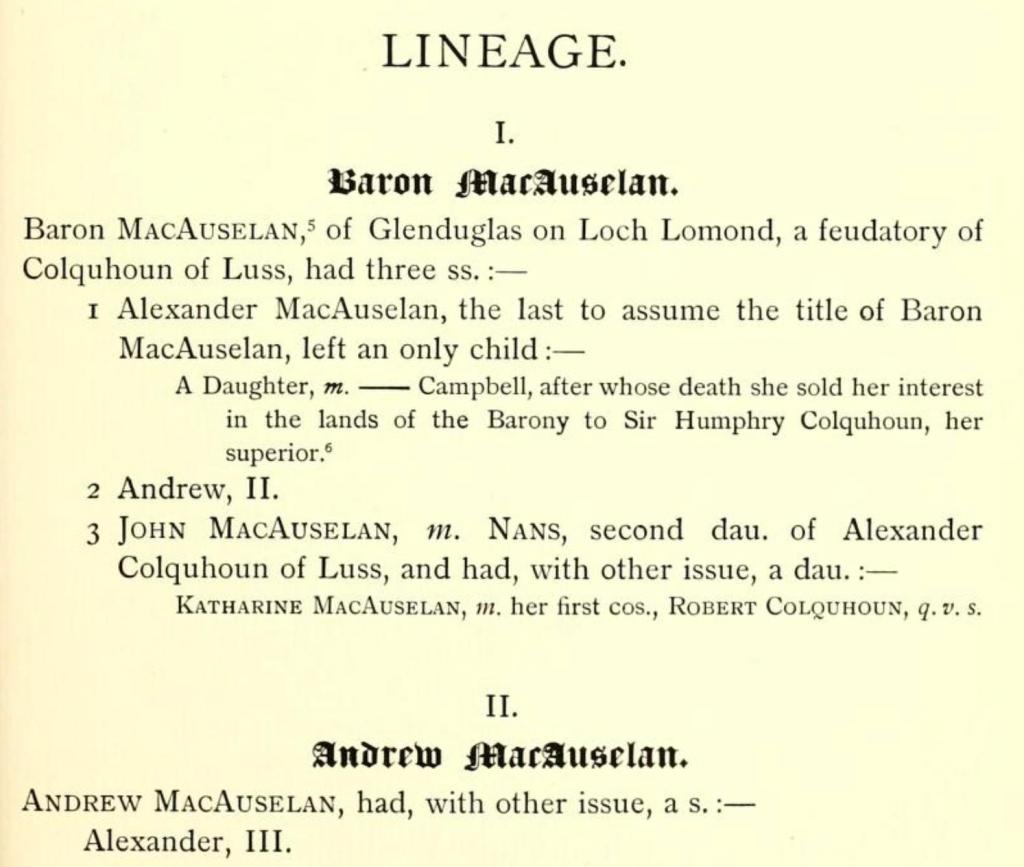
There were McAuslands who appear to have emigrated from Luss to Ireland in the reign of King James VI. These were junior members of the family of the Barons of Caldenoch. Amongst others, Andrew, and his brother John, younger siblings of Alexander, Baron McAusland. John was reported by Buchanan of Auchmar to have married a daughter of Colquhoun of Luss and he and John went to manage the new Colquhoun plantations in Ireland:
“The authority for the early story of the MacCauslands is an essay, pubhshed in 1723, by William Buchanan, of Auchmar.” In that essay there is a good deal that is involved, and of somewhat doubtful interpretation. But much of his testimony is clear and consistent enough.…
“Buchanan of Auchmar, who writes from documents belonging to the Buchanan branch of the family, is unable to furnish an unbroken line of the M’Auselan branch. “All the evidents,” he tells us, “of any considerable antiquity which belonged to the Baron M’Auselan are long ago lost.”
Yet he was in a position to give some information about them, his account being “fully confirmed by the evidents of the Family of Buchanan.” He says : — “The first of these M’Auselans I could find upon record is Malcom M’Auselan, inserted witness in a charter by Malcolm, Earl of Lennox, of the lands of Luss, in favour of John, Laird thereof, in the reign of King Alexander III.” He mentions “M’Beth, Baron M’Auselan, a person of uncommon stature and strength,” who lived in the time of King Robert III. And he tells us that Alexander M’Auselan, — I. in our Lineage — was the last to bear the title of Baron M’Auselan. Whence this title was derived does not appear. Possibly it may have been attached to lands settled upon his only daughter, “who was married to a gentleman of the name of Campbell, after whose death she sold her interest to Sir Humphry Colchoun of Luss, her superior.” Certainly the title did not lapse through failure of male representatives. For Buchanan, writing a century later, not only speaks of “a remainder of the Scotish M’Auselans residing mostly in the Lennox,” but he tells us that “the greatest number and best account of that name {i.e. M’Auselan) reside in the counties of Tyrone, Derry, and Down, in the North of Ireland.” And he adds “The ancestors of the principal men of these last were Andrew and John M’Auselan, sons of Baron M’Auselan, who went out of the Paroch of Luss to that Kingdom, in the latter part of the reign of King James VI“
How Did All These Glaring Errors Arise?
It seems possible that some of the errors were introduced to Geni by copying data from Family Search. There, despite clear explanations on the profiles, oft-repeated careless and random merges have been made to the McAusland profiles resulting in several incoherent families such as in the above example where the father was supposedly born after the birth of several of his children!
Some family members even suspect that genuine, but inconvenient baptismal dates were repeatedly removed from this line in order to conform better with a fictional royal genealogy, but this interesting theory is as yet unproven.
The second error was attempt to graft a branch of McAuslands from Ireland onto a branch of Scottish McAuslands of a different generation resulting in an incoherent and disfunctional tree.
However, the problem did not lie in the errors in grafting on an Irish tree onto a Scottish one. None of us are perfect and we all have errors in our tree which most of us constantly strive to detect and correct.
One serious issue was the plagiarism of years of research, adding the information to Geni and then, somewhat ironically, claiming that there was no evidence to back up the tree.
Another problem was the point blank refusal to listen to reason or accept evidence coupled with a refusal to correct incoherent and clearly incorrect information. Uncoupling the incorrect parents would, of course, have disconnected the spurious royal ancestry and this seems to be the basis of the refusal, which was accompanied by threats and abuse.
Perhaps the most serious problem was the harvesting of private details regarding living individuals and making them public without the knowledge or permission of those concerned. This kind of action exposes individuals, and especially vulnerable and elderly individuals to scammers and identity theft.
“Should web hosting companies,” such as Geni, “be responsible for website content?” is a question that is often posed. Damien, the owner of a hosting site notes that when someone plagiarises your content, if the owner doesn’t respond to your notice to take that content down, you can contact the web host and they have to remove if from their server. “So in a way, a web host does have to be responsible for the content posted on their server.”
Conclusion
The fake ancestry on Geni and spurious link to William the Conqueror is a clear demonstration of how easy it is for a well-researched tree to be highjacked and for royal ancestry, for which there is no real evidence, to be grafted on to a genuine tree. Merging profiles, rather like mixing salt and sugar, is easy, but once the damage has been done, it is can sometimes be simpler to delete the garbage and start afresh.
In this case, it took only a few seconds to spot the likely weakest link. However, it took several hours to check through all the generations (not covered in the current article). Some links, such as Gilbert, Lord of Galloway being the son of Elizabeth Fitzroy, an illegitimate daughter of Henry I, King of England are unproven, but seem possible. However the claimed McAusland link to the Lachlans and MacLachlans on Geni appears to be pure fantasy based on random merges, plagiarism and the hacking and publication of private data regarding living people without their knowledge or permission.
So, as we suspected:
William “the Conqueror”, king of England is NOT my 29th great grandfather
– at least not in the way that Geni would like us to believe.
Causal Loops in Fiction
The McAusland family connection to the Lauchlans on Geni is reminiscent of The Flipside of Dominick Hide, a British television play first transmitted on BBC1 on 9 December 1980 as part of the Play for Today series. Plot spoiler alert in the following paragraphs.
Peter Firth stars in the title role as a time traveller from Earth’s future who illegally visits the London of 1980 to search for an ‘ancestor’ and finds a world very different from the one he left behind. The story concludes with a plot twist involving a causal loop, a popular concept in time-travel fiction.
An oft bandied around paradox about time travel is the ‘Grandfather paradox‘. This questions the effects of a time traveller going back in time and killing their Grandfather. Headaches then begin to form whilst trying to figure out how this could happen if the protagonist was, in theory, never born due to their Grandfather’s untimely demise.
The Flipside of Dominick Hide eschews this and, instead, looks at the great-great-great-Grandmother paradox. This curious postulation features a time traveller going back in time to kick-start his own lineage with their great-great-great-Grandmother. Child’s play for any theoretical physicist.
Genuine Lines of Descent From William the Conqueror
Unlike us, comedian and actor Alexander Armstrong has proved that family history is not Pointless as he discovered he was descended from William the Conqueror when he traced his family tree on the BBC’s Who Do You Think You Are?


The person who has been creating the dubious profiles on Geni in order to link to royalty is an American who clearly has little knowledge of Scotland in general, the Luss area in particular and of the history of the McAuslands.
Baron John McAuslan of Callanach is believed have died within a few days of the Battle of Glen Fruin (7 February 1603), possibly of wounds. His third son, John, married the second daughter of Alexander Colquhoun of Luss around 1616. It was at this period that King James VI started the “Plantations of Ulster” policy of settling English and Scottish protestants in Ireland. Alexander Colquhoun of Luss was one of those granted land there by King James and according to Polly Aird, a McAusland descendant and researcher, Colquhoun now sent his daughter and her McAusland husband to Ulster to manage the new estate on his behalf. A letter from the “Lennox Herald” of 1st February 1900 by Lt. Col. R.C.S. MacAusland refers to research carried out by James Dennistoun of Camis Eskan, showing that the Irish branch of the McAuslands could be traced back to John McAuslan, son of John McAusland of Caldenoth.
The Geni member has confused the different McAusland lines and has attempted to graft on your McAuslands to the Irish branch who were descended from the McAusland Barons and the Colquhouns. This has resulted in an incoherent tree that has grandparents born after their grandchildren.
The first McAusland of Newlandmuir was a genealogist in the 1830s who traced his family back in Stickidow in Dunbartonshire for nine generations, with no Irish connections.
I have attempted to explain this but was met with bluster and threats. Sadly, those who create fake ancestry, and who plagiarise the research of others and hack into private information in order to do so, are not happy when their deceit is discovered and made public
LikeLiked by 5 people
I have no idea where the American on Geni gets the spurious Irish ancestry. As you say, the weakest link is easy to spot and it is two generations out! Sloppy and careless and obvious at a glance that the tree is nonsense, so why attempt to defend it? Plagiarism is bad enough but when the person who has done the years of research that has been misappropriated points out that the tree is impossible you would think that they could quietly acknowledge it and remove the problem profiles?
LikeLiked by 5 people
Robert McAusland of Newlandmuir was:
“Eldest son of John McCausland Esquire of Newlandmuir aforesaid by Anne, his wife, daughter of the later Robert Hall, Merchant in Glasgow, by Bethia his wife, daughter of James Steele Esquire of Inchnauch in the Parish of New Monkland and County of Lanark;
“which John was youngest son of Robert McCausland, sheep farmer in Westrtoun of Ardincaple by Jean his Wife, daughter of Aulay McAulay, Sheep Farmer in Blairnerne, both in the Parish of Row in the County of Dunbarton;
“which Robert was youngest son of Robert McCausland, Sheep Farmer in Stukkidow and Auchingach in the last mentioned Parish and County by Elizabeth Erskine his Wife of that place as evidenced by a Drawing of Tombstones in Row Churchyard, Dunbartonshire produced with the said Patentee’s petition.
“That it was said the Ancestors of the last mentioned Robert McCausland had been in Stukkidow from a very remote period and extending over nine generations as extracted from an old M.S. Book written by the Petitioner’s Father in and previous to the year Eighteen hundred and thirty four.
LikeLiked by 5 people
I found this rather revealing comment regarding fake royal ancestry on Geni which matches my experience as I can no longer access the site!
Christine F. JULY 28, 2019
Don’t enter your data on geni.com! If one day you have dissenting evidence on a profile and dare discuss it, they will BAN you and your work will be for naught. The “curators,” have no genealogical training (no certifications, few have degrees in history and many live in a studio their parent’s home ~ it’s pretty easy to check). Curators also are unpaid, but they proudly put this unpaid “volunteer” work onto their resume and post it on linkedin (that’s so sad).
Geni curators have the power to disconnect parentage and management can kill you (poof your profile is gone, like you never existed or they’ll put in a fake death date). Check the numerous complaints on the internet, including with the BETTER BUSINESS BUREAU and you’ll see there are many complaints of users who find they are dead on Geni.com! Also, when curators merge your profile into another’s suddenly you do not control the content. They call this “collaboration.” They steal your family photos.
BEWARE that they are trying to sell you on the fantasy that you’re related to royalty. You can’t take a site seriously that connects you to Adam and Eve. Seriously, they try to connect you to God when no such acceptable genealogical records exist to connect you directly to the bible.
Adam and Eve (garden of Eden).
Don’t believe the lies.
https://familyhistoryfoundation.com/2018/01/23/is-ancestry-losing-its-market-share-to-myheritage-and-geni/
LikeLiked by 4 people
“One cannot be unmoved by the personal distress of those whose dearly held ancestral fantasies are exploded. However, blame must lie squarely with those who promulgate invalid genealogical and historical information.”
Sean Murphy MA, Centre for Irish Genealogical and Local Studies, 16 June 1999.
LikeLiked by 5 people
Sounds like your American wannabe royal has hacked into your accounts and stolen person data.
Cyber crime is still a crime
Here is an article about a similar site:
“Despite its trappings as a genealogy site, it is in fact a “people search engine” best-suited for stalkers, blackmailers, and hackers. As young adult fiction author Anna Brittain wrote, the site is an internet safety hazard.
Searching for my name and birthdate yielded the following information: my full name, my address history for the last decade, and presumed relatives and associates. Associates generally include roommates, significant others, landlords, and tenants. In an age when everyone is at risk of being targeted by online mobs, cyberstalking, and identity thieves, this information being in one place is terrifying for anyone concerned for their safety and the safety of close friends and family.”
https://theoutline.com/post/904/how-that-creepy-fake-genealogy-site-knows-so-much-about-you
LikeLiked by 4 people
Thanks for the warning Jemima. Yes, that site seems to take it one step even further than Geni.
LikeLiked by 4 people
Misleading Software and Services
“There are a few genealogy software products and online services on the market which can be described as misleading with regard to what they actually provide. This isn’t to say that they are fraudulent in the true sense of the word, but they are often charging you for something you could get on your own for free. Most of the worst have been put out of business by vigilant genealogists, but new ones do crop up from time to time.
Unfortunately, some of the biggest offenders are websites that pay for high placement in search results on Google and other sites. Many also appear as “sponsored links” on reputable websites that support Google advertising, including Ancestry.com and About.com. This makes it appear the fraudulent site is being endorsed by the website on which it appears, although that is generally not the case. Therefore, before you provide anyone with credit card details or payment, check out the site and its claims to see what you can learn. There are a number of things you can do to identify and protect yourself from online genealogy scams.
Some may argue that such genealogical software and services do offer value because they do some of the work for you — which is fine as long as they accurately represent their product. Before you purchase any genealogy product or service, take time to research their claims and look for some type of money-back guarantee.”
Powell, Kimberly. “5 Family History Scams to Avoid.” ThoughtCo, Feb. 16, 2021, thoughtco.com/family-history-scams-to-avoid-1421694.
LikeLiked by 4 people