

Try as I might, I could not find any entries in the Statutory Death Register for my great (x3) grandparents Thomas Sterling Hunter and Jean Henry Brown, who seemed to disappear after the 1871 census. What had happened to them?
Both families appear to have been members of dissenting churches and no trace of their baptismal records have been found. Their first appearance in the official records appears to be at Tillycoultry church on 23 November 1839 when they “gave their names in order to proclamation“. They were both residents of Tillicoultry parish in Clackmannanshire, and they were married on 11 December 1839.
The couple appeared to have had five children, born in Coalsnaughton and Tillicoultry, but the baptisms were not registered until many years later, in 1854. However, at registration, a considerable amount of detail was recorded including the children’s names dates and places of birth and the minister and church of baptism. This revealed that the family had been members of a dissenting church, the Independent congregation of Tillicoultry.
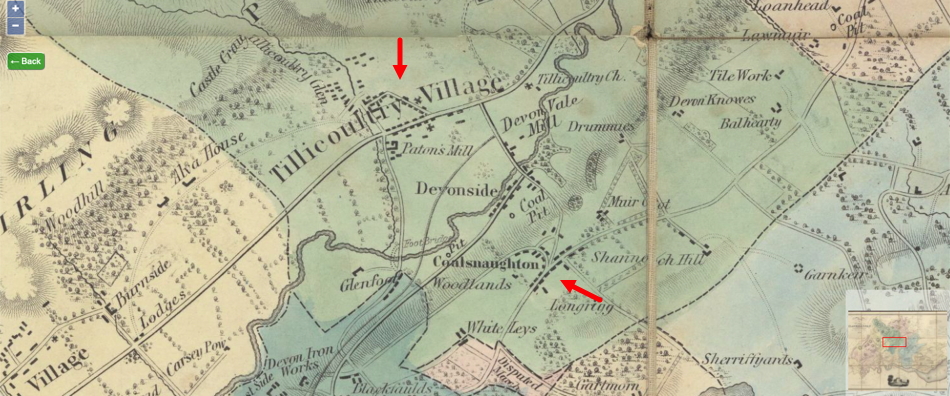
Official years of birth of the children
According to the 1854 register “Thomas Hunter and Jane Brown” had the following children:
- Jane. Coalsnaughton. 15th April 1838
Daughter of Thomas Hunter and Jane Brown his wife, was born at Coalsnaughton on 15th April 1838 and baptised before the Independent congregation of Tillicoultry by the Revd. Mr Browning. - Mary. Union Street, Tillicoultry, 4th June 1840.
Daughter of Thomas Hunter and Jane Brown his wife, was born at Union Street on the 4th June 1840 and baptised before the Independent congregation of Tillicoultry by the Revd. Mr Browning. - Thomas. Stirling Street, 27th February 1844.
Son of Thomas Hunter and Jane Brown his wife, was born in Stirling Street on the 27th February 1844 and baptised before the Independent congregation of Tillicoultry by the Revd. Mr Browning. - James. Park Street, Tillicoultry, 29th May 1846.
Son of Thomas Hunter and Jane Brown his wife, was born in Park Street on the 29th May 1846 and baptised before the Independent congregation of Tillicoultry by the Revd. Mr Browning. - Isabella. Park Street, Tillicoultry, 24th June 1849.
Daughter of Thomas Hunter and Jane Brown his wife, was born in Park Street on the 24th June 1849 and baptised before the Independent congregation of Tillicoultry by the Revd. Mr Browning.
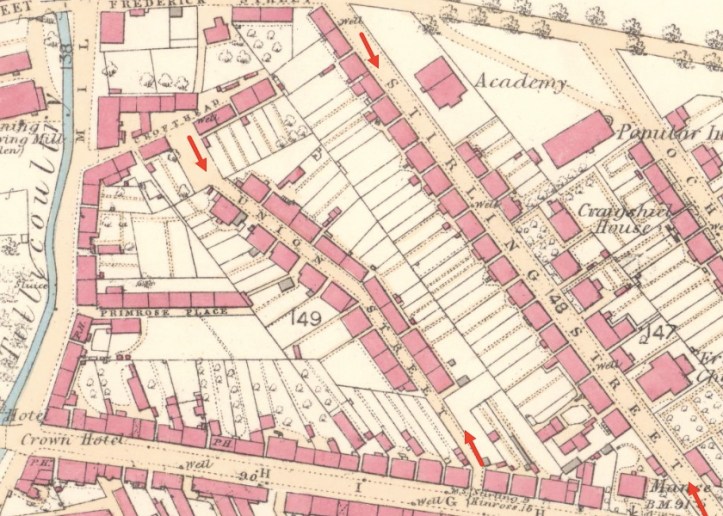
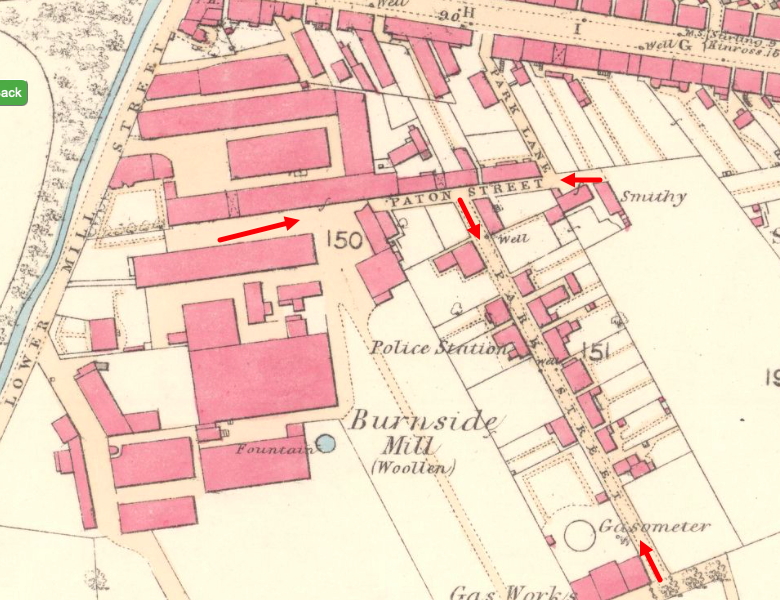
Possible errors in the recorded years of birth of the children
However, the years given above may not be accurate for the following reasons:
- Jane. Birth 15 April 1838 according to the 1854 record. However, her parents married on 23 November 1839 and she was aged 1 in the 1841 census, suggesting that she may actually have been born in 1840.
- Mary. Birth 4th June 1840 in 1854 record. However, she does not appear in the 1841 census and was aged 8 in 1851, suggesting she may have been born in 1842.
- Thomas. 27th February 1844 in 1854 record. However he was aged 5 in 1851 census and aged 15 in 1861 census suggesting he may have been born in 1846.
- James. Born 29 May 1848 in 1854 record. Aged 2 in 1851 census and 13 in 1861 census suggesting this year was probably correctly recorded.
- Isabella. Born 24 June 1849 in 1854 record. However she was aged 9 months in the 1851 census, suggesting she was born in 1850.
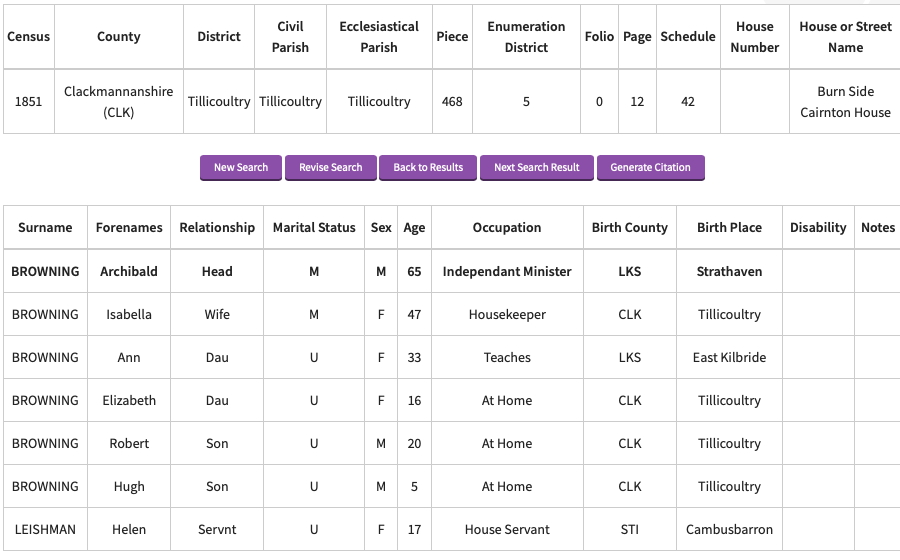
The Rev. Archibald Browning
Information about the minister who baptised the children, the Rev. Browning can be found in the following text:
Reminiscences of Dollar, Tillicoultry and other Districts adjoining the Ochils
Chapter X – Teachers, Bankers, and Ministers that have been in Tillicoultry Departed Townsmen
From Electric Scotland.
The Rev. Archibald Browning was settled in Tillicoultry in the year 1818, and almost from the first he managed to combine with his pastoral duties the education of a few boarder-pupils, with whom were associated such day-scholars as the district afforded. The school gradually increased till it demanded his whole attention, and accordingly in 1825 he resigned his ministerial charge. His seminary became quite famous throughout the country, and he had frequently close on forty boarders. He was an excellent teacher, and pupils came from neighbouring villages to attend his classes. The late Rev. Dr. Eadie of Glasgow was one of his scholars, travelling all the way from Alva to be under him. He was afterwards one of his assistant teachers for about three years.
In the Life of Dr. Eadie by Dr. James Brown, the late Rev. George Gilfihlan of Dundee furnished the author with ‘Reminiscences of Dr. Eadie,’ in which Mr. Browning’s name is so prominently and favourably referred to, that I think it will not be out of place here to give a few extracts from them. Mr. Gilfihlan says: ‘At college I knew Dr. Eadie somewhat, though slightly. . . . I remember him in the Logic class in the year 1828, a fair-haired youth of eighteen.
My more intimate connection with Dr. Eadie began somewhat later, and resulted from our common acquaintance with a very remarkable man, to whom I owe much, and Dr. Eadie owed a vast deal more,—the late Rev. Archibald Browning of Tillicoultry. I have since that time met with and listened to the conversational eloquence of some of the most eminent men of our age, such as De Quincey, Professor Wilson, Leigh Hunt, and Thomas Carlyle, but I never was more impressed by any of’ these than I was the first evening I spent in Mr. Browning’s company. His talk was in a very high degree racy, original, suggestive, and stimulating,—full of humour and anecdote, as well as of bold speculation, and glimpses of far-stretching thought. I know not whether young men were more attracted by his fearless speculations, by his frank manners, by his public preaching, or by his private converse. He shone in various departments, being an admirable teacher of the young, a powerful though peculiar preacher, and a very popular lecturer on social and political questions, such as Temperance and the People’s Charter. . . . Some of his pupils and assistant teachers, such as the Rev. David Connal of Bo’ness, and the Rev. William Smith of Bannockburn, to whom they ultimately stood in the relation of sons-in-law, and whom, even while widely severed iii political and religious views, they regarded to the last with reverence and love. But Dr. Eathe’s debt to him might be called, in Milton’s language, ‘a debt immense,’ and involved a duty of ‘endless gratitude,’ which we have no doubt was duly paid.
‘Mr. Browning taught him first at his day school, assisted him to go to college, received him (after an estrangement which lasted for more than a year, and which was produced, as Eadie often acknowledged, entirely by his own fault) back into favour again, installed him as tutor in his academy, and assisted him in going to the Divinity Hall of the United Secession Church to prosecute his studies for the ministry. . . . It was while John Eadie was an assistant teacher in Mr. Browning’s academy that I first really met him. Mr. Browning, while visiting my late lamented brother in Stirling, where I then was, had kindly invited me to spend a few days in his house at Tillicoultry. Here I found Eadie very busy and happy in his tutorial work. I remember spending a long May holiday with him and some of the pupils of the academy among the Ochil Hills, and our chief employment was reading Shakespeare. . . . Eadie had been a good classical scholar at college, and had profited much afterwards in Latin and Greek while assisting Mr. Browning.’
Having lived for many years in Cairnton House (Mr. Browning’s property, and adjoining his own dwelling house), I ever found him a kind and obliging neighbour, and our intercourse together as landlord and tenant was always of the pleasantest kind. We had a joint garden, and thus came very much in contact with each other. As Mr. Gilfihlan says, he was indeed ‘a very remarkable man,’ and occupied a very prominent position in Tillicoultry for the long period of forty years.
Although he lived to a good old age, the heavy bereavements he experienced in the death of the three of his family previously noticed (all grown up), a few years before his own death, would no doubt hasten that event, which took place very suddenly in the end.
Mr. Browning was born in Strathaven in 1785, and died in the year 1858, aged seventy-three years.
Miss Browning (afterwards Mrs. George Paton) carried on a very successful school for some time, being latterly assisted in it by her husband.
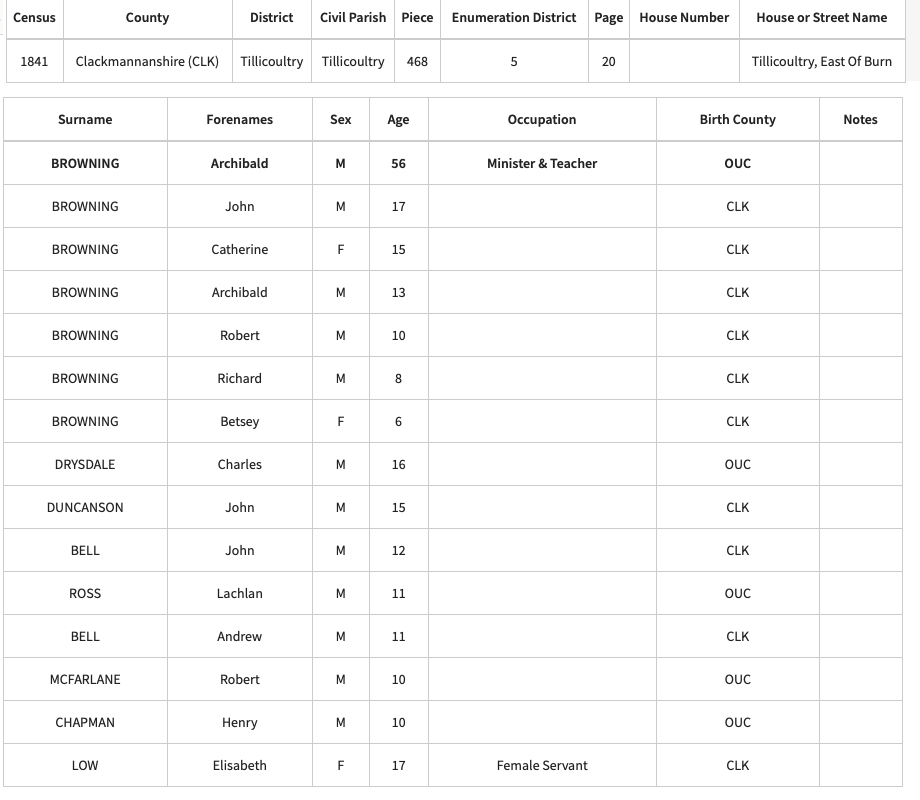
The Independent Congregation of Tillicoultry
This is assumed to be the Tillicoultry Associate Session Church listed on Family Search. While the baptismal register for 1844-1854 was available at the Stirling Council Archives (and more recently on ScotlandsPeople) there is no record in these registers of any of the Hunters.
Tillicoultry Associate Secession Church
History—
In March 1739, several persons in the parish acceded to the Associate Presbytery. At the formation of the first Secession congregation in Alloa, these persons were included in it; but on the 11th April 1797, the Seceders in Tillicoultry, Alva, and Clackmannan were, on petition, disjoined from Alloa, and were formed into a separate congregation the following year with their seat in Tillicoultry. The first church was built in 1797 the second in 1840. This congregation later became United Presbyterian, and united with the Free Church congregation in 1912.
Membership: 1789, 161. This is from the Statistical Account of c.1795.
Source: Annals and Statistics of the United Presbyterian Church, by Rev. William MacKelvie, D.D., pub. 1873. Film #477618. More details are given in the source including a list of ministers.
Records—
Baptismal Register 1844–1854
Note: Available at the Stirling Council Archives, Stirling, Scotland, record CH3/915.
The other non-conformist churches in Tillicoultry were:
Tillicoultry Free Church
History—
The minister of the parish ‘came out’ in 1843, with a portion of his congregation. They worshiped first in a hall and then in the Secession church, until in June 1844, the Free Church was opened. They united with the United Presbyterian congregation in 1912.
Membership: 1848, 189; 1900, 323.
Source: Annals of the Free Church of Scotland, 1843–1900, ed. Rev. William Ewing, D.D., 2 vols. pub. 1914. Film #918572. More details are given in the source including a list of ministers.
Records—
Deacons Court Minutes 1843–1851, 1858–1873, 1901–1911
Communion Roll 1850–1852, 1896–1929
Note: Available at the Stirling Council Archives, Stirling, Scotland, record CH3/914.
Tillicoultry Congregational Church
History—
A preaching station was formed in 1850. In September 1851 it became an Evangelical Church, meeting in a building on Ann Street, and later joined the Union in 1862. A second church was formed on High Street in 1872 by members of the United Presbyterian Church who had adopted Congregational principles. In 1911 the two churches amalgamated and the Ann Street Church building was sold. High Street became the place of worship of the united congregations, under the designation of the Tillicoultry Evangelical Union Congregational Church.
Source: A History of Scottish Congregationalism, by Harry Escott; Glasgow Congregational Union of Scotland, 1960; Family History Library British Book 941 K2es. This source contains a list of ministers.
Records—
The extent of records is unknown. For more information write to:
The United Reformed Church, Scottish Synod Office
PO Box 189
240 Cathedral Street
Glasgow G1 2BX
Scotland.
1841 – 1871 census reports
My great (x3) grandparents Thomas Sterling Hunter and Jean Henry Brown and their family appeared in each census from 1841 to 1871.
In 1841, they were living in Union Street in the town of Tillicountry in Tillicoultry parish, Clackmananshire. Thomas was aged 23, a Woolen Hand Loom Weaver, born in Clackmananshire, while Jean was aged 23 and born outside the county with Jane being aged one and born in Clackmananshire.
In 1851, they were living at Park Street. Thomas was the head of the family, aged 33, a Hand Loom Weaver (Woolen) born Tillicoultry, Clackmananshire, while his wife Jane (rather than Jean) was aged 33 and born Auchterarder in Perthshire. They had five children: Jane aged 10 (assumed to have left school), Mary aged 8, a scholar; Thomas, aged 5, a scholar; James, aged 2, and Isabella 9 months, with all the children having been born in Tillicoultry in Clackmannanshire.
In 1861, the family were living at 8 Paton Street. Thomas was the head of the family, aged 43, and now a Power Loom Geuter (?) Tender, born Tillicoultry in Clackmananshire, while his wife Jane H. was aged 43 and born Auchterarder in Perthshire. The eldest daughter Jane had married Peter Rolland on 05 June 1863, and the remaining children were: Mary, aged 18, a Yarn Winder; Thomas, aged 15, a Grocer’s Apprentice, James, aged 13, a Wool Twister; and Isabella, aged 10, a scholar, with all the children having been born in Tillicoultry in Clackmannanshire.
In 1871, the family were still living at 8 Paton Street. Thomas was the head of the family, aged 53, and now a Power Loom Manager, born Tillicoultry in Clackmananshire, while his wife Jane was aged 43 and born Auchterarder in Perthshire. The second daughter Mary had married Thomas Henderson Drysdale on 03 January 1870, and the eldest son Thomas was no longer living with the family. The remaining children were: James, aged 22, a Power Loom Tuner; and Isabella, aged 20, a Power Loom Weaver, with both children having been born in Tillicoultry in Clackmannanshire.
Mary Hunter and her husband Thomas Henderson Drysdale had moved to Callander in Perthshire by 28 September 1871 and to Greenock in Renfrewshire by 01 May 1880, but no trace could be found after the 1871 census for the other members of the family.
So where were they?
The story will be continued tomorrow.
 Vecchio