
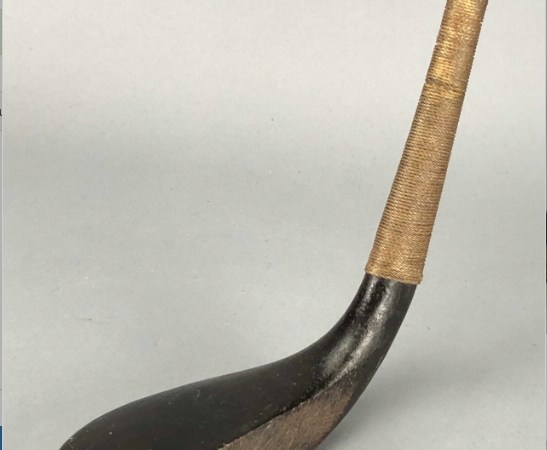
In March 2020, a putter made by our great (x4) uncle, Old Bob Kirk was put on the market by Jeff Ellis Golf Auctions with a suggested starting price of $1,000 and after eight bids it sold for no less than $2,125.20.
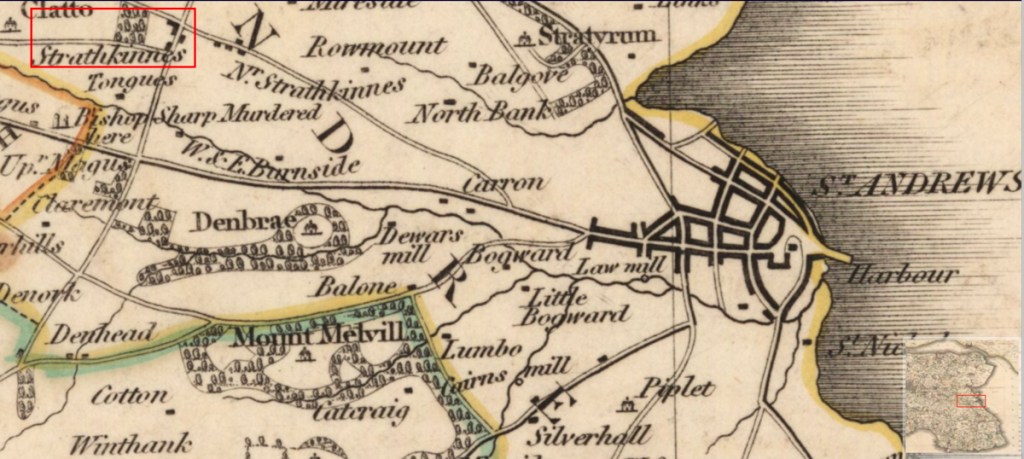
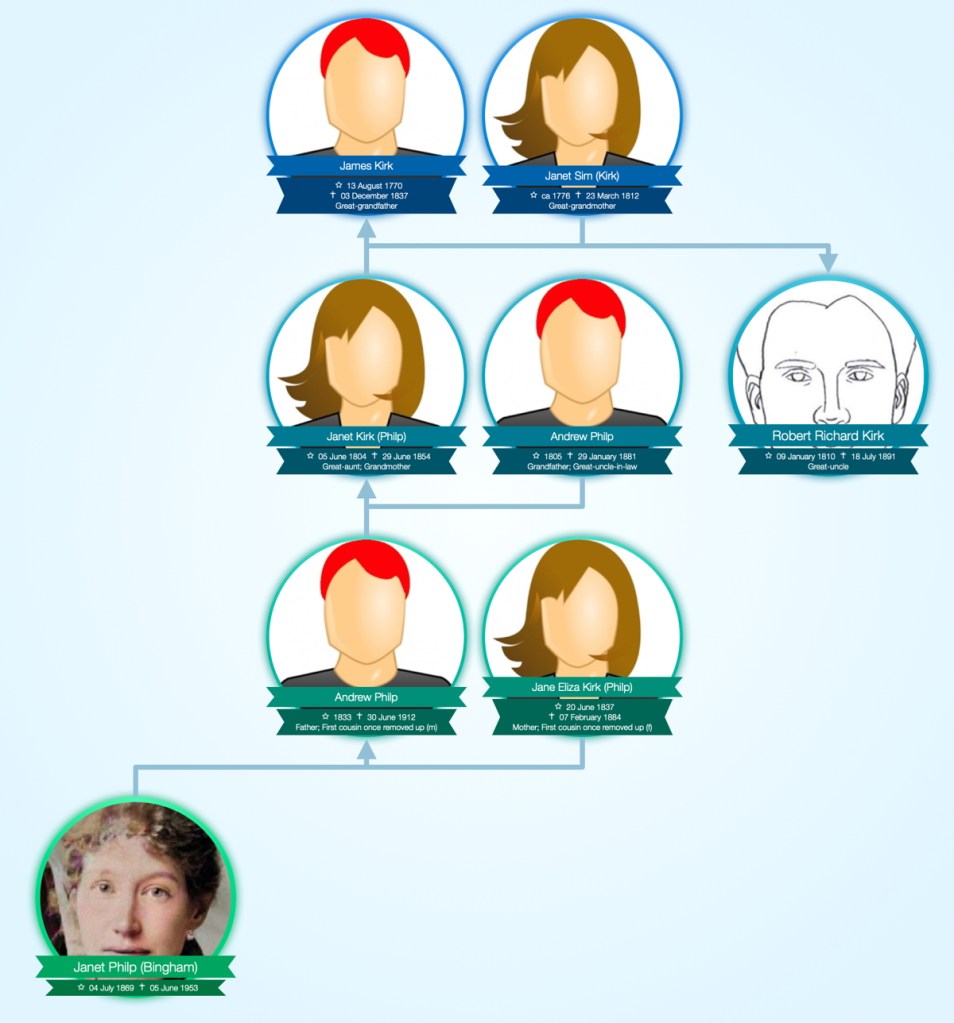
Robert Richard Kirk was born on 09 January 1810 in Strathkinnes in the parish of Saint Andrews and Saint Leonards in the county of Fife in Scotland. He was baptised on 04 February 1810 in Saint Andrews by Dr Hill with witnesses John Kydd & Spens Douglass.
He was described as a “shoemaker” in the 1851 census, but by 1860, when he was “Tennant & occupier of a house & shop on Pilmuir Links owned by his brother, James Kirk Mason with rent £3 5s annually adjusted to £2 10s.” he was described as a “golf ball maker”.
At the census of 02 April 1871, Old Bob Kirk was living at 1 Pilmuir Links while Old Tom Morris was living at number 6.
From feather-filled leather to gutta-percha golf balls
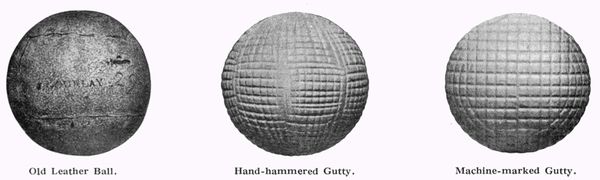
Old Bob Kirk was one of the first to comment on the use of a gutta-percha ball around 1850:
Balls, before the introduction of gutta-percha, were made by stuffing stout leather cases with feathers, a process which I shall describe in a future chapter. The price at which they were sold was almost prohibitive to all but fairly well-to-do men. The turn-out, of course, was as nothing compared with the present output.
When Tom Morris was working as an apprentice in Allan’s shop, it was in 1840, 1021 balls; in 1841, 1392; in 1844, 2456 balls.
It was not until 1850 that Allan took to making balls from gutta-percha.
Mr Charles Anderson remembers seeing Allan taking his first swipe with a gutta. He was following a match of Allan’s when he told old Bob Kirk to tee one for a trial shot. Allan took a full swing, deliberately topped the ball, and remarked in pretended disgust, “Ach, it winna flee ava.” “Flee, d–n ye,” cried out old Bob, “nae ba’ cud flee when it’s tappit.”
The Life of Tom Morris, Chapter 2, Allan Robertson
Captain of Saint Andrews Operative Golf Club
In 1855, Old Bob was captain of the Saint Andrews Operative Golf Club and on 01 January 1865, he came fifth in the Operative Club’s competition with a score of 103 while his son, “Young Bob” took second place. Young Bob would go on to become Scottish Champion and a three times runner-up in the British Open.
The Most Wonderful Shot in the World.
In 1888, Old Bob Kirk was involved in an amusing incident at the Open in Prestwick which was related by Horace G. Hutchison, first English Captain of the Royal and Ancient.
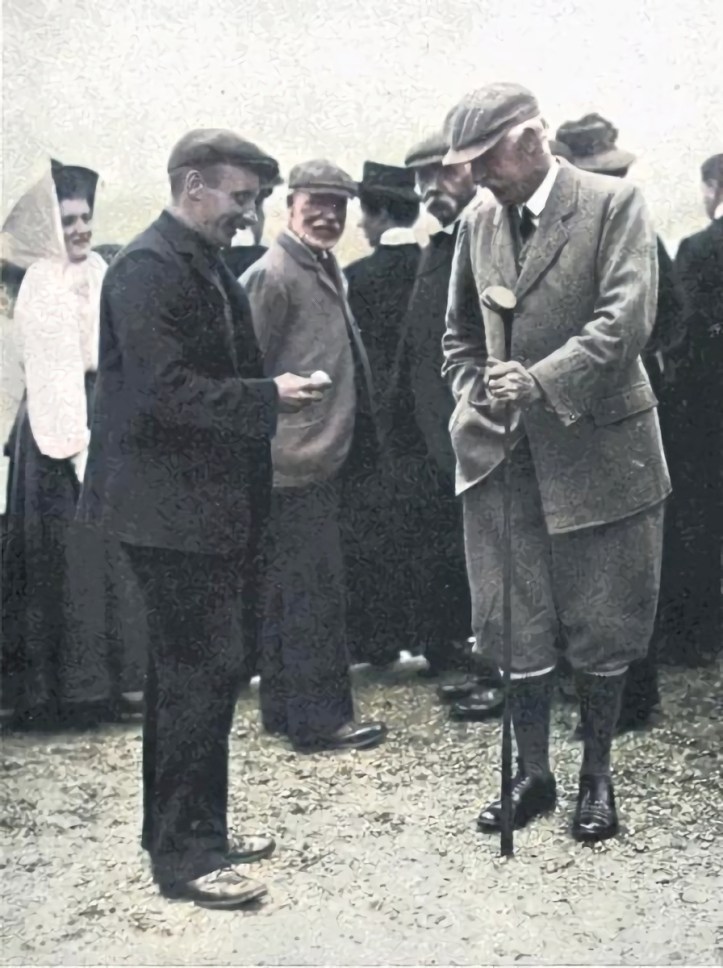
HOW I LOST THE CHAMPIONSHIP AND PLAYED THE MOST WONDERFUL SHOT IN THE WORLD
“In 1888 I lost the amateur championship at Prestwick, and I lost it badly. I do not mean by that that I lost it to a bad player. It was Andy Stuart who knocked me out, and for his game I have always had a high respect. But I do not think that either of us played very well in that match. I know that I did not. For one thing (or for two things) I topped two tee-shots running, and one of them was going to the “Himalayas Coming In,” which, as all who know Prestwick will realize, is not a good place to choose for a tee-shot “along the carpet.” He was three up and five to play, and I worried him down to one up and two to play, but he did the seventeenth hole better than I and finished by laying me a stimy. But I do not think I should have holed the putt anyhow—I was by no means dead—and at all events he won the hole and so the match.
“And then the next morning, when he was stropping his razor, he cut his hand so severely that it was against the doctor’s advice that he played at all, but play he did, and seeing that he was far from his best by reason of this damaged hand and that it was Johnny Ball that he had to play, it is no great wonder that he was defeated; and he had all my sympathy. He had my sympathy by reason both of his damaged hand and of his defeat, but still I did think that if he were going to cut his hand at all, it would have been as well that he should have done so the morning before. In that case I, and not he, might have been up against Johnny on the morrow.
“I have no reason to look back on that match with pride, but I remember it with special interest, because it had one of the most extraordinary incidents in it that ever did happen in any match at golf. And this notable incident was as follows. Going to the hole after the Himalayas going out, which was much the same then as it is now, save that the green was not levelled up and that the tee-shot probably did not run as far, I sliced my second very badly, right over the hillocks on the right of the green. I went over the ridge, with my caddie, to play the ball, and pitched it over, with a loft, to the place where I thought the green to be. Then I ran up to the top of the ridge, and looked, but could see no ball. I asked then, as I came down over the ridge, where the ball was. There was a small concourse of perhaps a score of spectators. “Oh,” they said, “the ball has not come over.” “Not come over!” I repeated, filled with astonishment. “Why, I know it has!” As a matter of fact it had been lofted high into the air and both I and the caddie had seen it with the most perfect distinctness. Still, it appeared that it was not there; it almost seemed as if the ordinary operations of Nature’s laws had been suspended and the solid gutty had been dissolved into thin air in mid flight.
“Then, as we all were looking about, in much surprise, a man spoke up. He was a Mr. Kirk, a townsman of Saint Andrews and a fine golfer. He took part in the first amateur championship when it was played at Saint Andrews, but he had come to this one as a spectator only. He said, “Well—I did think I felt a tug at my pocket.” (By this time we all were very much intrigued to imagine what could have happened to the ball.) And at that he looked into the outside breast pocket of his coat; and there the ball lay, on his handkerchief, like an egg in a nest.
“Has a more wonderful thing ever happened at golf? I, at all events, have never heard of any more extraordinary series of small marvels ever taking place. In the first instance it was wonderful enough that the ball should thus plump down so cleanly and neatly into the pocket at all; then that none of the score or so of watchers should have seen it; next, that not even the man into whose pocket it thus plumped should have noticed it as it came down, imperilling his very nose and eyes; and, finally, that it should have landed so gently that he did not actually realize that anything had struck him—only “fancied he felt something tug at his pocket.” Naturally, if it were not for the cloud of witnesses, I should never have ventured to tell the tale. My own character, if I have any, for veracity is not nearly high enough to stand such a strain.
“These are the facts; and then of course arose the question as to what should be done with the ball. As it happened, it did not arise in a form very acute, because Andy Stuart was well on the green in two and I, in Mr. Kirk’s pocket, standing on the edge of the green, in three. We agreed finally that the pocket should be emptied where the pocketer stood, and from there I played out the hole and lost it. It is almost a question whether such a shot as this did not deserve to win the hole.
“Curiously enough the only other golfer I ever knew who played a ball into a man’s pocket is Andy Stuart himself. He hit a full drive right into the coat tail pocket of Lord Lee, the Scottish Lord of Session. But his lordship was very far from being unaware, like Mr. Kirk, of the pocketing. He was quite painfully aware of it. As Andy was at that time at the Scottish Bar, it seems to me that it was a very injudicious stroke for him, as a rising young advocate, to play.
“The curiosities of that great shot of mine are not exhausted yet. For a full quarter of a century I told that story, saying that not a soul had seen the ball come over the hill, and that, but for Mr. Kirk bethinking himself of the fancied tug at his pocket, I should have had to treat that ball as lost. And then, one day when I was waiting before the Clubhouse at Biarritz, there came up to me one whom I knew by sight only, Colonel Von Donop, of the Royal Engineers. He introduced himself, using as the medium of introduction that stroke and that ball. It appears that he, though I had not known it all those years, had been standing further along the ridge at a point whence he could see both me as I played the shot on the one side and the little crowd of spectators on the other. He saw the ball rise into the air, and also saw it drop, as he thought even at the time, into a spectator’s pocket. He also saw the discussion and the search which took place when I came over the hill, and when I replied with some indignation to the statement that the ball had not gone over also. He was just about to come forward to explain what he had seen when Mr. Kirk found the ball and the incident terminated. It was the last and crowning act in the curious comedy, that I should discover, twenty-five years later, and in the south of France, that there had been an unsuspected spectator of that funny little episode in the West of Scotland.“
Fifty Years of Golf, by Horace G. Hutchison (1919) Country Life.
Old Bob as a Golf Club Maker
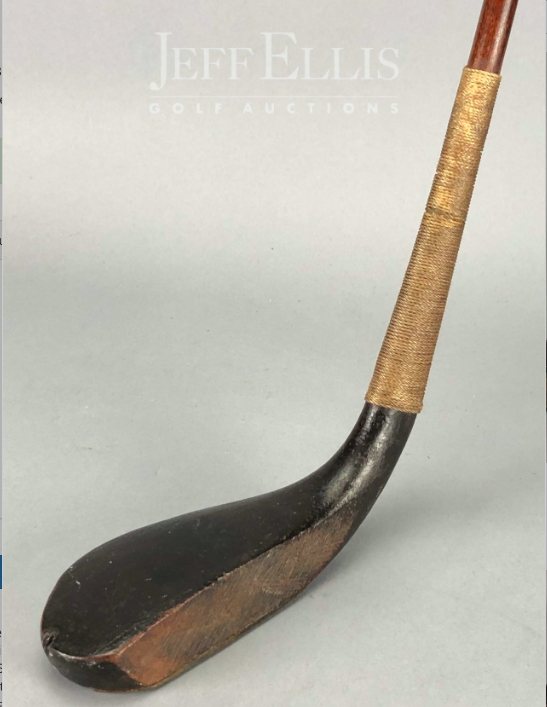
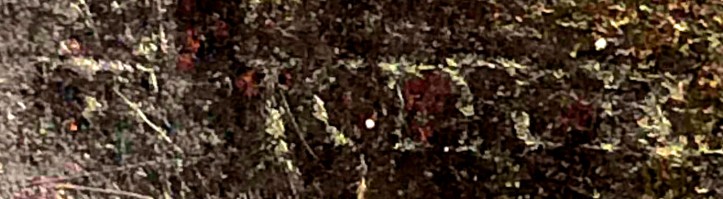
This Robert Kirk Sr. putter with its broad head (5 ½” long and 2 1/6″ wide ), thin neck, 1” face depth, and relatively flat crown, clearly dates to the 1850s if not a little before. It is consistent in shape and style with other putters made late in the featherball era. The first picture shows just how graceful this club is.
Born in 1810, Kirk was listed in a July 1855 newspaper as a Ballmaker in St. Andrews. He was again listed in Westwood’s St. Andrews directory as a ballmaker in 1862 and 1866. He was listed as one of three ballmakers in St. Andrews in an 1863 newspaper. As reported in newspapers of the time, he won or finished high in various golf competitions during the 1850s. He was well known and respected. Born in 1810, Kirk was captain of the St. Andrews Operative Golf Club in 1855.
While Kirk was listed as a ballmaker, there is little doubt that he was versed in clubmaking and made the odd club or two. Kirk’s ability to do both was not an isolated case. G.D. Brown was also described in an 1856 and 1863 newspaper as a ballmaker, but a few long nose clubs stamped “G.D. Brown” are known. Willie and Jamie Dunn are described as ballmakers in an 1849 newspaper, but they are better known for being clubmakers, examples of their clubs also remaining.
Artisans able to make both clubs and balls was relatively common during the middle and late 1800s. Not all clubmakers were ballmakers, and visa versa, but a number of each were known to do both, including Tom Morris, Robert Forgan, Alex Patrick, Robert Ferguson, and others in addition to Brown, the Dunns, and Kirk Sr. Furthermore it was Allan Roberson, the famous ballmaker and employer of Tom Morris who, according to Morris himself, taught Morris how to make both clubs and balls. Back on May 6, 1722, John Dickson, who is consistently referred to as a ballmaker, wrote a letter to the Marquis of Annandale wherein he states that he worked night and day making both clubs and balls to fill the Marquis’ order.
Born in 1845, Robert Kirk Jr. learned from his father and became the professional and clubmaker at Blackheath in 1864. Bob Jr. also became an even better player than his father, finishing runner up in the 1869, ’70, & ’78 Open. Bob Kirk and his Bob Jr. were close associates of Tom Morris and Tom Jr. Again, in my opinion, I do not believe Kirk Jr. made this club. The lines and characteristics of this club as listed above are clearly c1850.
Clubs made by Kirk Jr. are scarce, as few remain. Clubs made by Kirk Sr. are extremely difficult to find. In writing both editions of The Clubmaker’s Art, the auctioneer was looking for but unable to procure a decent club made by either one. The example offered here is a very good one all things considered. The neck whipping appears to be the original whipping only it was never coated with tar pitch as was virtually always done. The rigid greenhart shaft and sheepskin grip are original. The finish looks original but with an extra coat of varnish or shellac applied at some point, so the “R. Kirk” name stamp is not easy to read, but it is there (see closeup image). If you like to collect long nose clubs, this one is worth great consideration.
 Vecchio