

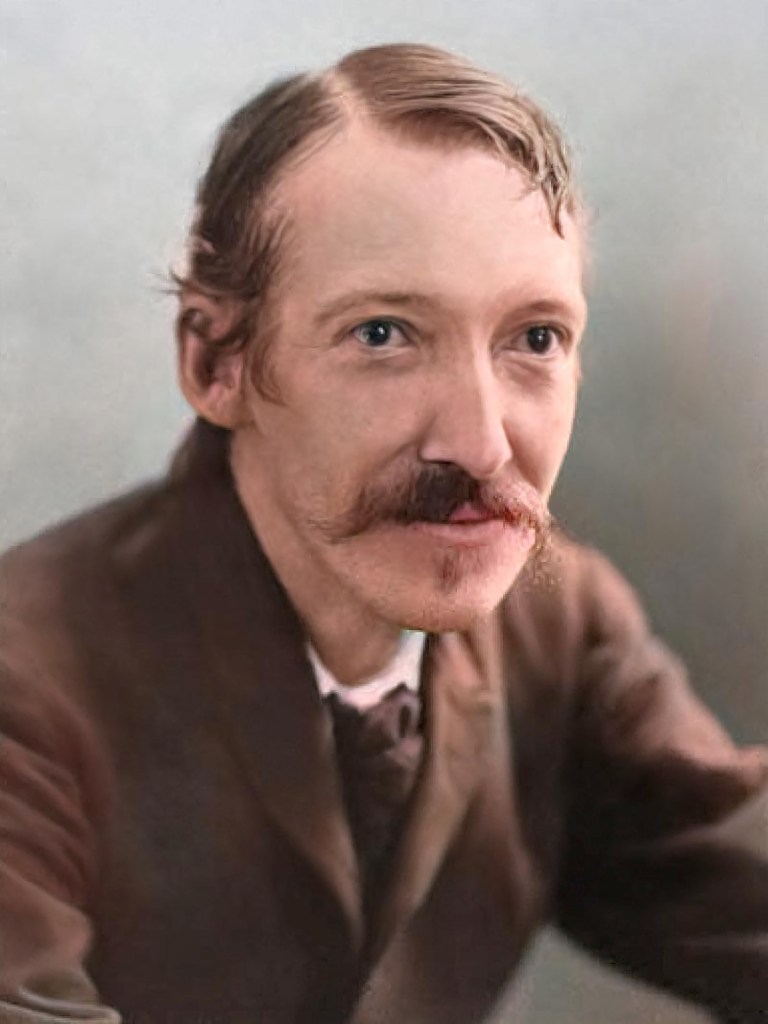
Robert Louis Stevenson (born Robert Lewis Balfour Stevenson; 13 November 1850 – 3 December 1894) was a Scottish novelist, poet and travel writer, most noted for writing Treasure Island, Strange Case of Dr Jekyll and Mr Hyde, Kidnapped, and A Child’s Garden of Verses.
Born and educated in Edinburgh, Stevenson suffered from serious bronchial trouble for much of his life, but continued to write prolifically and travel widely in defiance of his poor health. As a young man, he mixed in London literary circles, receiving encouragement from Andrew Lang, Edmund Gosse, Leslie Stephen and W. E. Henley, the last of whom may have provided the model for Long John Silver in Treasure Island. In 1890, he settled in Samoa where, alarmed at increasing European and American influence in the South Sea islands, his writing turned away from romance and adventure toward a darker realism. He died in his island home in 1894.
Fidra Island


The small rocky island Fidra lies 300m off the beach at Yellowcraig, part of a group of small islands in the Firth of Forth including Lamb, Craigleith and the Bass Rock.
Robert Louis Stevenson often visited the beaches as a child and it is said to have been the inspiration for Treasure Island, as well as being described in his novel Catriona. The lighthouse was built in 1885 by David and Thomas Stevenson and has been automated since 1970 (The light flashes 4 times every 30 seconds).
The name is believed to be from Old Norse (feather island) and the island is home to a large colony of puffins and is a designated reserve owned by the Royal Society for the Protection of Birds (RSPB). The colony can be viewed online from a webcam at the Scottish Seabird Centre in North Berwick and on its website.
Also on the island are ruins of an old chapel, or lazaretto for the sick, which was dedicated in 1165 to Saint Nicholas. The de Vaux family built a stronghold, known as Tarbet Castle, on the island, but it was later gifted to the monks of Dryburgh Abbey in 1220 by William de Vaux gifted Fidra.

Robert Louis Stevenson was related to the Dale family, who still own and farm much of the land around Seacliff today.

Treasure Island (1972) extract.
Exploring the real “Treasure Island” (Fidra Island) by sea kayak.
Seacliff Secrets
Exploring Seacliff beach in East Lothian
See also:
Live Fidra webcams at the North Berwick Seabird centre “The island of Fidra is an RSPB reserve and believed to be the inspiration for Robert Louis Stevenson’s Treasure Island. This small island is about three miles from the Scottish Seabird Centre and with grassy slopes and cliffs, it is home to significant populations of guillemots, razorbills, shags, gulls and puffins. During spring there are fantastic views of nesting fulmars.“
 Vecchio