
Exodus 22 King James Version
18 Thou shalt not suffer a witch to live.
Historical Context
Margaret Dickson or Dicksone lived at a time of considerable civil and religious strife. From 1639 until 1653, the Kingdom of Scotland was embroiled in a series of conficts known collectively as the Wars of the Three Kingdoms. These began with the Bishops Wars (1637–1640), the Irish Rebellion (1641), the English Civil War (and its extension in Scotland), the Irish Confederate Wars, and finally the subjugation of Ireland and Scotland and the imposition of a military dictatorship. This was followed by a republic ruled by Cromwell, who was effectively a monarch with the title of “His Highness Oliver Cromwell, Lord Protector of the Commonwealth of England, Scotland and Ireland” rather than King. [1]
In April 1646 King Charles I escaped from the Seige of Oxford and surrendered to the Scottish presbyterian army that was besieging Newark. In January 1647 the Scottish army withdrew from Newcastle and handed Charles over to the commisioners of the English Parliament. On 30 January 1649, King Charles I was executed after the English High Court of Justice sentanced him to death. This unilateral action led to England becoming a republic but Scotland declared for Charles’ son, Charles II who was proclaimed as King of Scots. However, hopes of a Royalist victory were crushed by Cromwell first at the Battle of Dunbar on 03 September 1650 and then exactly a year later at the Battle of Worcester on 03 September 1651. [1]
Thus the three kingdoms were in a state of civil war when, in the summer of 1649, no less than 14 people from the Penston area, a small mining settlement in Gladsmuir parish (but then in Haddington parish) in East Lothian in Scotland, were executed as witches. [2]
Margaret Dickson was one of those accused of being a witch and being found guilty, she was taken to The Sands, beside the river Tyne, in Haddington on 23 June 1649. There she was strangled to death and her body was then burnt to ashes. [2] [3] [4] [5] [6] [7]
Birth & Baptism
The date and place of birth of Margaret Dicksone are unknown. She was known to have a daughter in 1642 who annoyed a farmer by pulling up some of his wheat, so she is assumed to have been born around 1620, but she may well have been considerably older.
A Margret Dicksone, daughter of James Dicksone, was baptised on 03 April 1614 in Pencaitland parish in the county of East Lothian in Scotland, but it is not known whether this was the woman who was executed for witchcraft in 1649. [8]
Marriage
Dicksone is assumed to be Margaret’s name at birth as in Scotland at this time married woman continued to be known by their maiden name. A John Dickson appears to have been tried at the same time as Margaret but his relationship, if any, to her is unknown. [2]
Children
Margaret Dicksone was known to have a daughter in 1642 but her name and age were not stated. [2]
Death
Margaret Dickson was strangled and then burnt at the stake at The Sands in the town on Haddington on 23 June 1649. [2]
Accusation, Trial & Execution for Witchcraft
Margaret Dicksone had been living at Nisbet in Pencaitland parish in 1643 when James Mill lodged a complaint against her with Pencaitland Kirk Session. [2]
A year earlier, in 1642, at harvest time, James Mill had caught Margaret’s daughter pulling up some of his wheat, and had reprimanded her. This had annoyed Margaret, and she mocked Mill for making such a fuss about a few ears of wheat. She warned him that a time would come when he would lose much more than that! Witnesses claimed that Margaret Dickson hoped to God that Mill would be stabbed in a gutter like his grandfather, and that his children would come to a bad end. Soon after, Mill’s livestock were struck with “a kind of trembling disease”, and several of the animals perished. James Mill blamed Margaret Dickson for their demise. [2]
A year prior to this, in 1641, when James Mill had been ill, Margaret Dickson had allegedly offered to cure him by “putting him through a hank of yarn“. A worse accusation was that she had allegedly made the offer on the Sabbath at the time of Divine Worship. [2]
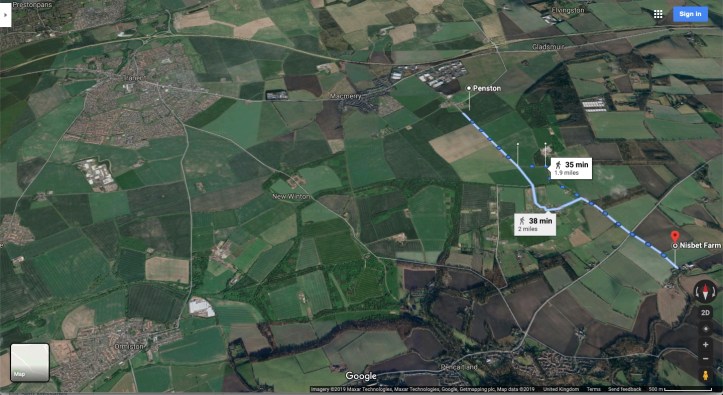
On 08 June 1649, four senior members of the local community met at Penston in order to to question two witchcraft supects: Margaret Dickson and Agnes Hunter. Penston was at that time in Haddington Parish as Gladsmuir parish would not be created until many years later. The four men were:
1. Rev. Robert Kerr, Minister of Haddington.
2. Thomas Foulis probably a Kirk Elder.
3. John Easton, probably a Kirk Elder, and
4. John Baillie, the Barony Baillie, acting for his brother William Baillie, the Laird of Lamington. [2]
Some reputed witches such as Helen Guthrie claimed to have met individually with the devil at midnight. [9] Similarly, Margaret Dickson declared that the devil had appeared to her in the likeness of a gentleman in green clothes at midnight. As with many other witches, she appeared to have been drawing on folk belief regarding fairies to satisfy her interrogators’ questions regarding the devil. [10]

On 20 June 1649 the Presbytery of Haddington judged that the confessions of Margaret Dickson, Agnes Hunter and Isobel Murry represened sufficient evidence for them to apply for a commission in order to conduct a formal witchcraft trial. [2]
The next day, on 21 June 1649 at Penston, Margaret Dickson, along with Agnes Hunter and Isobell Murray, was convened before the said commission for the crime of witchcraft. [2]
On 23 June 1649, Agnes Hunter, Margaret Dickson & Isobell Murray were formally tried in Haddington along with John Dickson and Marion Richieson. The jury found them guilty and they were sentenced to death. They were taken that same day to “the Sands” by the hangman with their hands tied behind their backs. [2][11]
At about three o’clock in the afternoon Agnes Hunter, Margaret Dickson, Isobell Murray, John Dickson & Marion Richieson were strangled to death and their bodies were burn to ashes. [2]
Sources
- The Story of Scotland (2000) Magnus Magnusson. Harper Collins Publishers
- The Grimsay Press. Wise Wives and Warlocks. A rogues’ gallery of East Lothian witchcraft compiled by David McK Robertson ISBN 987-1- 84530-144-6, p 47
- Survey of Scottish Witchcraft Database Margaret Dicksone (2/7/1649)
- APS Vol6, part2, p732-3.
- Haddington Presbytery recordsCH2/185/6,p.50.
- RPC 2nd series, viii, pp.191-2
- RPC 2nd S, v8 pp.193-4
- Old Parish Register of Births & Baptisms entry for Margaret Dicksone: DICKSONE MARGRET JAMES DICKSONE /F03/04/1614 716/ 10 39 Pencaitland
- R. Begg Burns( Ed),‘ Notice of trials for witchcraft at Crook of Devon, Kinross-shire, in 1662’, Proceedings of the Society of Antiquaries of Scotland, vol 22 pp 191–192.
- Laura Paterson, The Witches’ Sabbath in Scotland, Proceedings of the Society of Antiquaries of Scotland, vol 142 (2012), pp 371–412.
- Haddington, TheSands
 Vecchio