
DNA Status
James Scott is a confirmed DNA ancestor.
Biography
James Scott was the third of the ten children of James Scott and Agnes Hogg. Following Scottish naming traditions, as the third son, he was named after his father. [1]
He was born in 20 October 1853 in the mining village of Penston in the parish of Gladsmuir, in the County of East Lothian in Scotland and baptised there on 01 December 1853 by the Revd. John Ramsay. No witnesses to the baptism were listed.[2]
He had five brothers:
- William Scott (born 15 August 1849) [3]
- George Scott (baptised 30 March 1851) [4]
- John Scott (born 21 May 1857) [5]
- Walter Elder Scott (born 05 May 1862) [6]
- Robert Scott (born 08 March 1865)) [7]
and four sisters:
- Isabella Scott (born 25 March 1856) [8]
- Catherine Scott (born 14 September 1859) [9]
- Agnes Scott (born 16 September 1866) [10]
- Margaret Scott (born 15 September 1869) [11]
His mother’s family had lived at Penston for generations and were from mining stock. However, his father was a farm labourer, who had been born at Clinthill, in the parish of Merton, in Berwickshire.
On 27 April 1888, James Scott married Margaret Matheson Sutherland Rae in Edinburgh. He was her third and final husband, her two previous husbands having predeceased her. The marriage took place at three Saint John Street and was celebrated by By James Macnair, Minister of Canongate church after Banns according to the Forms of the Church of Scotland. The groom was recorded as being aged 34, a bachelor, living at 109 Canongate and working as a Maltman, while the bride was described as aged 35, a widow, and living at 96 Canongate. The groom’s parents were described as james Scott, Maltman (deceased) and Agness Hogg (deceased). The bride’s parents were described as Robert Rae (Labourer) (Iron Foundry (deceased) and Janet Elder (deceased). The witnesses were Alex. Wilson & Janet Tait. Their relationship to the bride and groom is not known and it is presumed that they were friends rather than family. [12]
James Scott and Margaret Matheson Sutherland Rae had three children:
- George Pryde Young Scott who was born on 19 June 1889 at 96 Canongate in Edinburgh. [13] He appears to have been named George after his father’s elder brother. George emigrated to Canada in 1912.
- Robert Rae Scott who was born on 18 January 1892 at 67 Canongate in Edinburgh [14]. He appears to have been named after mother’s elder brother, Robert Todd Rae. George emigrated to Canada in 1921.
- Christina Elder Scott who was born on 15 April 1895 at 11 Saint John Street in Edinburgh. [15] She may have been named after her mother’s cousin or her maternal grandmother’s sister, both named Christina Elder.
James Scott passed away in 12 January 1911, at the City Hospital in the parish of Colinton, with his usual address being 160 Canongate in Edinburgh. He was described as being aged 58, a Foundry Labourer, and married to Margaret Rae. His parents were listed as James Scott, Maltman (deceased) and Agnes Hogg (deceased). The cause of death was Tuberculosis, or Phthisis Pulmonalis [16] as it was then known, and exhaustion, as certified by A. W. Frew, L.R.C.P.. The death was registered by his widow, M. Scott, on the same day, at Edinburgh on 12 January 1911.[17]
Military Service
James Scott’s father, James Scott senior died on 29 April 1879. He was possibly James’ last family member living in Edinburgh. James’ mother had died on 14 July 1874, and his younger siblings Isabella, Robert and Margaret had died on 26 May 1856, 11 July 1865 and 14 March 1876 respectively. [18]
James’ elder brother William, a silversmith, was living in Glasgow, at least from 02 March 1877, when he married Jessie Russell [19] while younger brother John had a son born in Glasgow in 1880. [20]
The fate of James’ elder brother George is unknown after 1861, as are those of his younger siblings Catherine and Walter after 1871, and it is unclear whether they had also predeceased their father. [21]
On 05 November 1879, six months after the death of his father, James Scott enlisted for General Service in the British Army. [22]
He later joined the Duke of Cornwall’s Regiment of Light Infantry [23] which was created on 01 July 1881 as part of the Childers Reforms. [24] It is unclear how he came to join a regiment with no apparent links to Scotland.
Following the Childers Reforms, one regular battalion of each regiment was to serve at “home” station, while the other was abroad with an exchange every few year. In the period from the regiment’s creation on 1 July 1881 as part of these reforms, the second battalion was stationed at Gibraltar from 1881 to 1882, in Egypt from 1882 to 1885 and in the Sudan from 1885 to 1886, before returning to England & Ireland for the period from England and Ireland from 1886 to 1900. [25]
James Scott participated in the battle of Tel-El-Kebir on 13 September 1882. The British forces were led by General Garnet Wolseley while the Guards Brigade was commanded by Queen Victoria’s third son, Prince Arthur, the Duke of Connaught & Strathearn. [26]

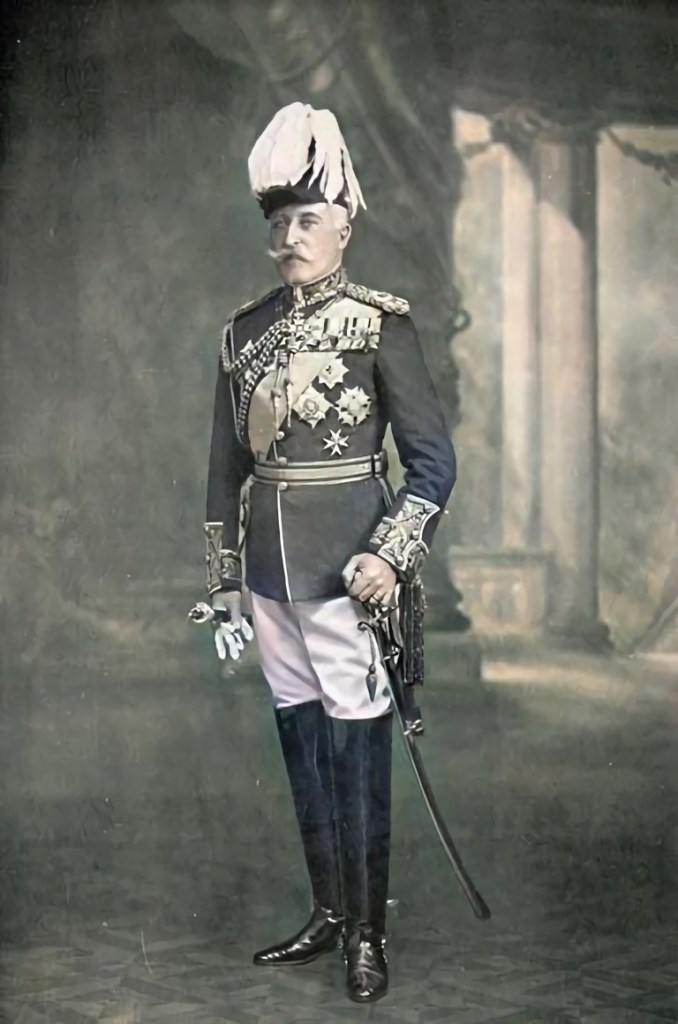
According to the National Archives “the Highland Brigade approached the Egyptian positions and there was a blaze of gunfire. The bagpipe players struck up and the Scots charged the Egyptian defences. The British army had approached the lines at Tel-el-Kebir in a staggered formation and so attacked in waves from left to right. The fighting was intense, but after just over an hour, the Egyptians fled”. [27]

James Scott also appears to have been a member of the Nile expedition (1884–85) [28] to Khartoum, which arrived too late to rescue General Gordon. [29]
On 18 November 1884, the Headquarters of the Duke of Cornwall’s Light Infantry left Wadi-Halfa for Gemai, there to embark for Dongala. [30]
On 10 February 1885, they engaged a Dervish army at Kirkbekan in the Sudan and defeated them. [31]
The British relief force finally arrived at Khartoun on 28 January 1885. However, they were two days too late as Khartoum had been stormed and General Gordon killed on 26 January 1885. [32]

On 14 November 1885 in Cairo, after six years and 40 days of service, four years and 338 days of which were abroad, James Scott was discharged from the regular army in consequence of having completed his army service. He was passed to the Reserve. [33]
While under the colours, he obtained a fourth class certificate of education. (The fourth-class certificate of education was abolished in 1888). [34]
On 04 November 1891, after 5 years and 327 days of service in the reserve, James Scott was discharged in consequence of having completed his first term of limited engagement. [35]
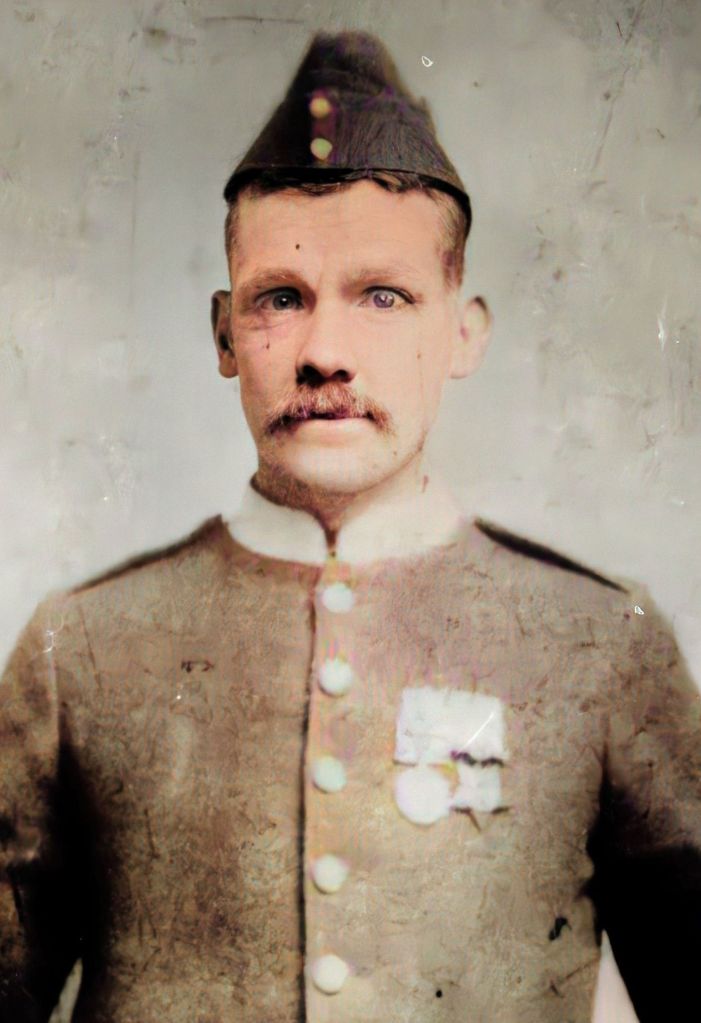
For his part in the Nile expedition he was awarded the British Egypt Medal [36] with a Tel-El-Kebir Clasp and the Egyptian Khedive Bronze Star. [37]

Sources
- Chapter on Scottish Naming Traditions in In Search of Scottish Ancestry by Gerald Hamilton-Edwards (1980) ISBN 0806305061
- Old Parish Register of Births & Baptisms entry for James Scott SCOTT JAMES JAMES SCOTT/AGNES HOGG FR995 (FR995) M 01/12/1853 708/ 40 171 Gladsmuir
- Old Parish Register of Births & Baptisms entry for William Scott
- Old Parish Register of Births & Baptisms entry for George Scott
- Old Parish Register of Births & Baptisms entry for John Scott
- Old Parish Register of Births & Baptisms entry for Walter Elder Scott
- Old Parish Register of Births & Baptisms entry for Robert Scott
- Old Parish Register of Births & Baptisms entry for Isabella Scott
- Old Parish Register of Births & Baptisms entry for Catherine Scott
- Old Parish Register of Births & Baptisms entry for Agnes Scott
- Old Parish Register of Births & Baptisms entry for Margaret Scott
- Statutory Marriage Register for James Scott & Margaret Matheson Sutherland Rae
- Statutory Birth Register entry for George Pryde Young Scott
- Statutory Birth Register entry for Robert Rae Scott
- Statutory Birth Register entry for Christina Elder Scott
- Tuberculosis
- Statutory Death Register
- Statutory Death Register
- Statutory Marriage Register
- 1881 Scottish Census Reports
- 1861 & 1871 Scottish Census Reports
- Army Service Record for James Scott, Duke of Cornwall’s Light Infantry
- Duke of Cornwall’s Regiment of Light Infantry
- Childers Reforms
- Duke of Cornwall’s Regiment of Light Infantry
- Battle of Tel-El-Kebir
- Battle of Tel-El-Kebir
- Nile Expedition
- General Gordon
- Too Late for Gordon and Khartoum
- Defeat of the Dervish army at Kirkbekan
- General Gordon
- Army Service Record for James Scott, Duke of Cornwall’s Light Infantry
- Certificates of Education in the British Army
- Army Service Record for James Scott, Duke of Cornwall’s Light Infantry
- Egypt Medal
- Khedive Star
 Vecchio