

R-Y61244: A novel Y-DNA Haplogroup from Caithness seemingly shared by individuals with the surnames Begg, Henderson, Oal/Old/Auld and Rosie/Rose/Ross

A Most Recent Common Ancestor (MRCA) born between 1243 and 1257 CE
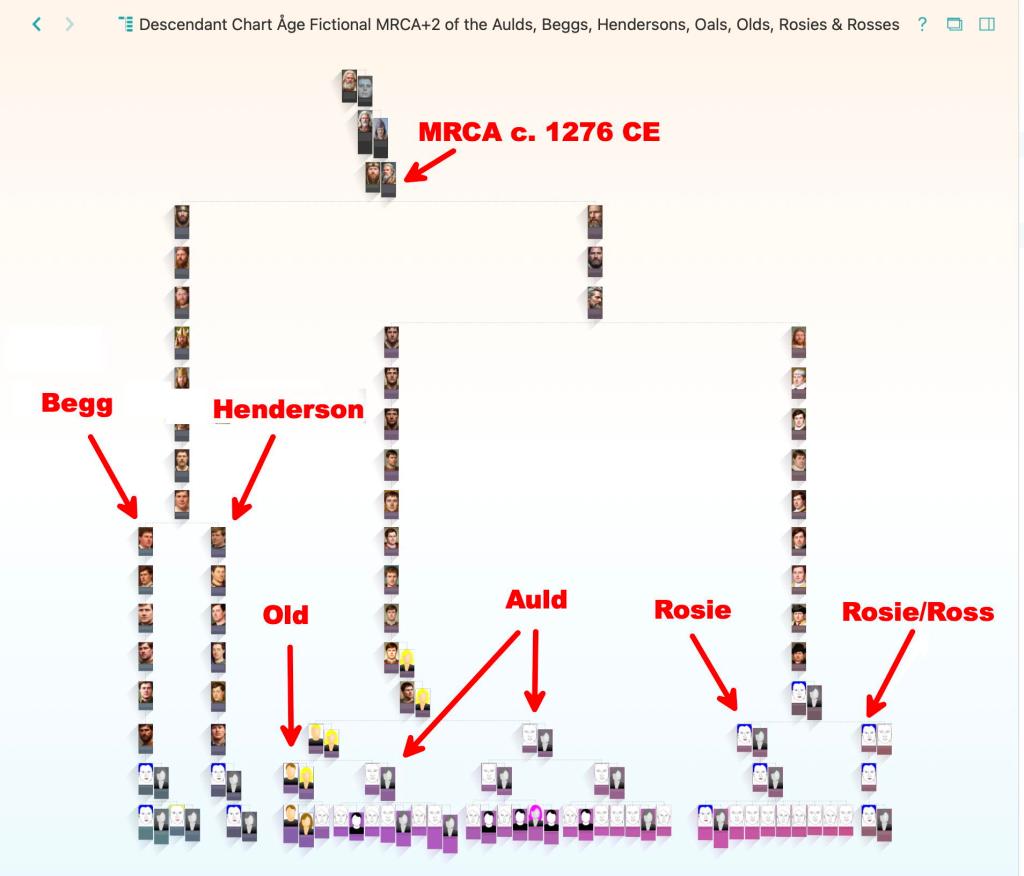
Using two different levels (67 and 111) of STR analysis and looking at over 1.25 million different SNPs on the Y-chromosome, it was calculated that the MRCA of the group was born in 1243 CE, 1256 CE and 1257 CE (currently 1300 CE) respectively.
The fact that two different methods came up with a mean birth year within a range of just 14 (currently 34) years is quite remarkable. However, it should be noted that these dates are means and that the actual date could have been as early as 206 CE and as late as 1807 CE.
STR analysis
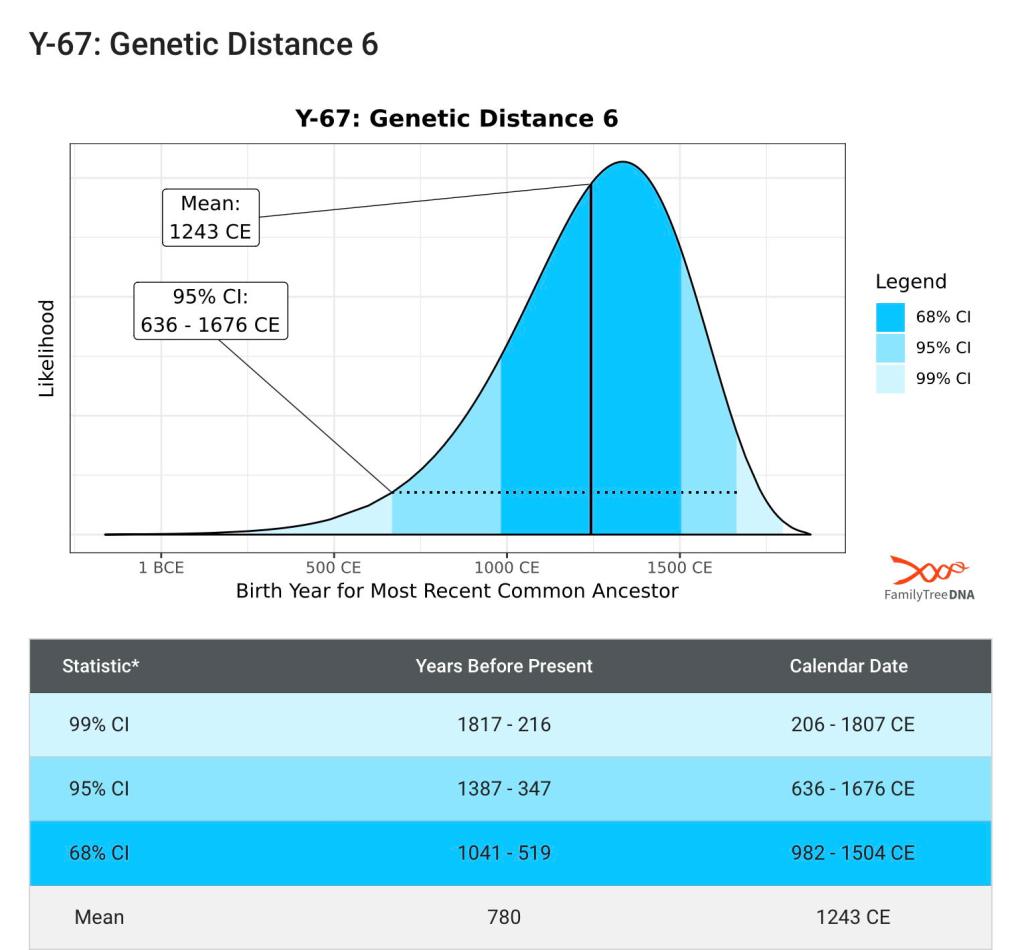
According to FTDNA’s comparisons of 67 different STRs (Short Tandem Repeats), three individuals with Caithness male line ancestry and the surnames Begg, Henderson and Old matched with a Genetic Distance of 6 at the 67 marker level.
According to FTDNA, this suggests a mean birth year for their Most Recent Common Ancestor of 1243 CE. However, as the various STRs mutate at different rates from very slow to very fast there is a 95% chance that the MRCA could have been born between 636 and 1676 CE, and a 99% chance that they were born between 206 and 1807 CE.
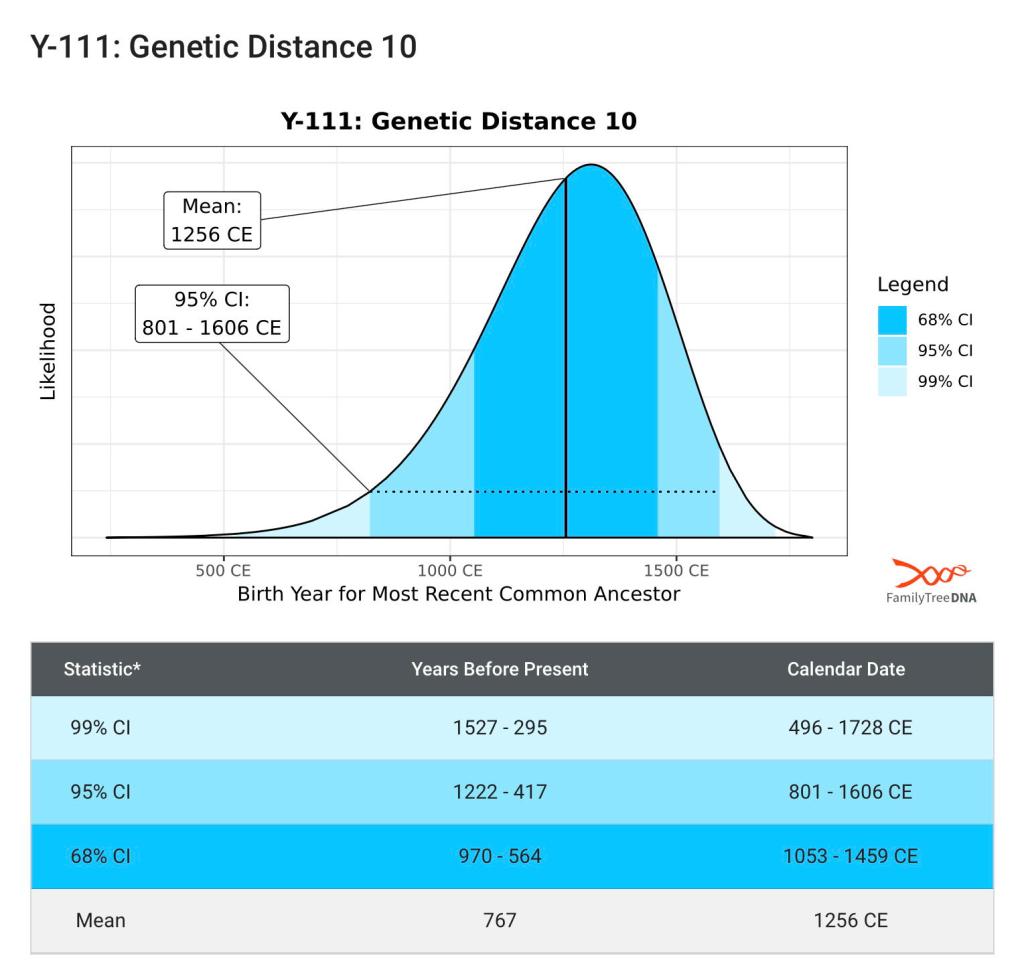
According to FTDNA’s comparisons of 111 different STRs (Short Tandem Repeats), two individuals with Caithness male line ancestry and the surnames Henderson and Old matched with a Genetic Distance of 10 at the 111 marker level.
According to FTDNA, this suggests a mean birth year for their Most Recent Common Ancestor of 1256 CE. However, as the various STRs mutate at different rates from very slow to very fast there is a 95% chance that the MRCA could have been born between 801 and 1606 CE, and a 99% chance that they were born between 496 and 1728 CE.
SNP Analysis
SNP (Single Nucleotide Polymorphism) analysis has been carried out for three individuals with the surnames Henderson, Old and Rosie. Henderson and Old shared 1,208,837 out of 1,271,672 variants, while Old and Rosie shared 1,247,755 out of 1,271,672 variants.
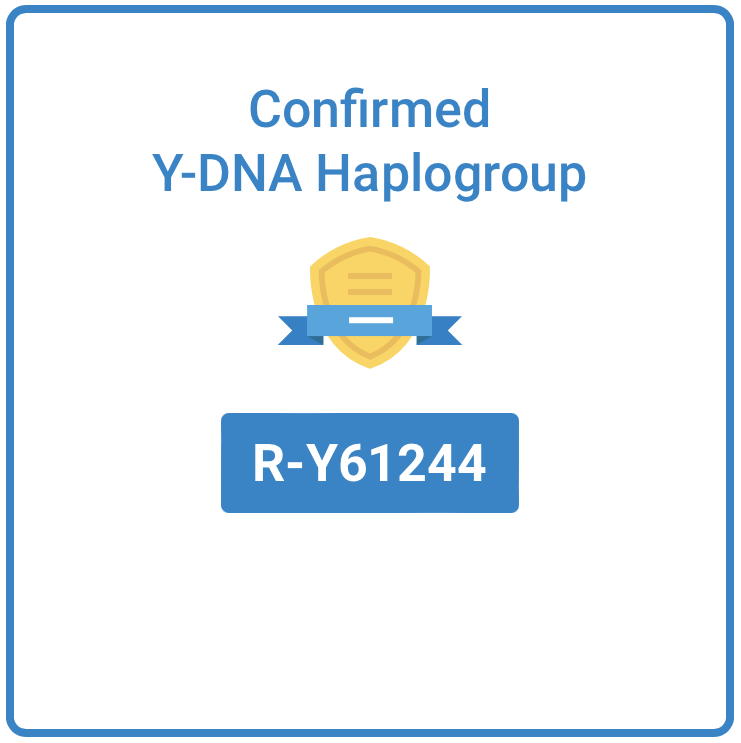
These results led FTDNA to create a new haplogroup named R-Y61244, with the MRCA estimated to have been born in 1257 CE (currently 1276 CE). With a 95% probability, the most recent common ancestor of all members of haplogroup R-Y61244 was born between the years 856 and 1572 CE, and with a 99% probability they were born between 598 and 1693 CE.

The R-Y61244 Haplogroup Story
The Y chromosome is passed from father to son remaining mostly unaltered across generations, except for small traceable changes in DNA. By tracking these changes, we constructed a family tree of humankind where all male lineages trace back to a single common ancestor who lived hundreds of thousands of years ago. This human tree allows us to explore lineages through time and place and to uncover the modern history of your direct paternal surname line and the ancient history of our shared ancestors.
R-Y61244’s paternal line was formed when it branched off from the ancestor R-Y60581 and the rest of mankind around 150 BCE.
This date is an estimate based on genetic information only. With a 95% probability, the ancestor R-Y60581 was born between the years 797 BCE and 340 CE. The most likely estimate is 165 BCE, rounded to 150 BCE.
This estimate will likely change in the future as more people test and FTDNA improves the method.
The man who is the most recent common ancestor of this line is estimated to have been born around 1250 CE.
This date is an estimate based on genetic information only. With a 95% probability, the most recent common ancestor of all members of haplogroup R-Y61244 was born between the years 856 and 1572 CE. The most likely estimate is 1276 CE.
He is the most recent paternal line ancestor of all members of this group.
Descendant lineages are identified as people test their Y-DNA with the Big Y test. At least two testers from a lineage are needed for a new branch to be named and added to the tree.
There are 3 DNA tested descendants, and they specified that their earliest known origins are from Caithness in Scotland. This information is self-reported by FamilyTreeDNA participants. It represents the earliest known countries of origin on their direct paternal lines.
But the story does not end here! As more people test, the history of this genetic lineage will be further refined.
Migration Map
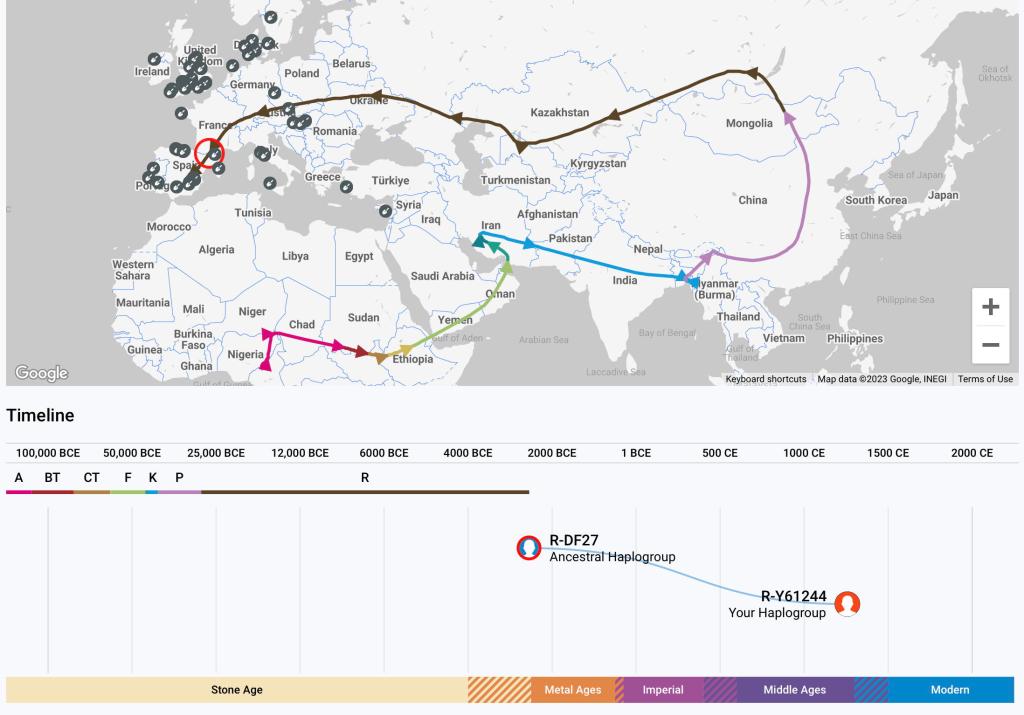
All human male lineages can be traced back to a single common ancestor in Africa who lived around 230,000 years ago, nicknamed Y-Adam. Here we show the estimated migration route from Y-Adam to your ancestral haplogroup R-DF27 (estimated to 2550 BCE) and his descendants found in ancient DNA from archaeological remains.
Notable Connections


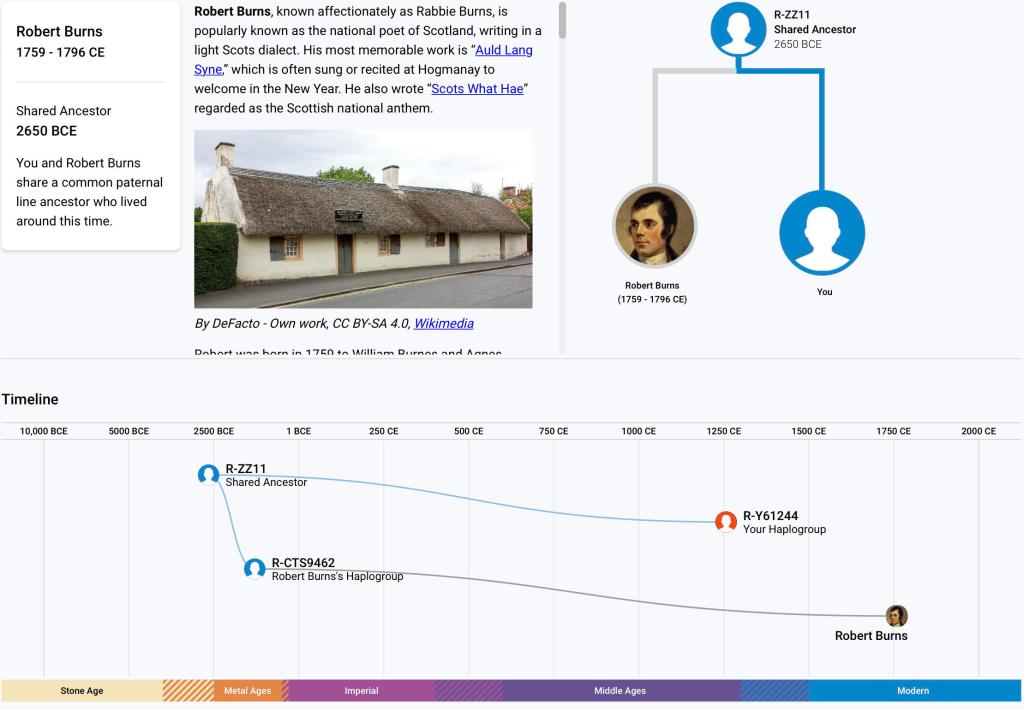
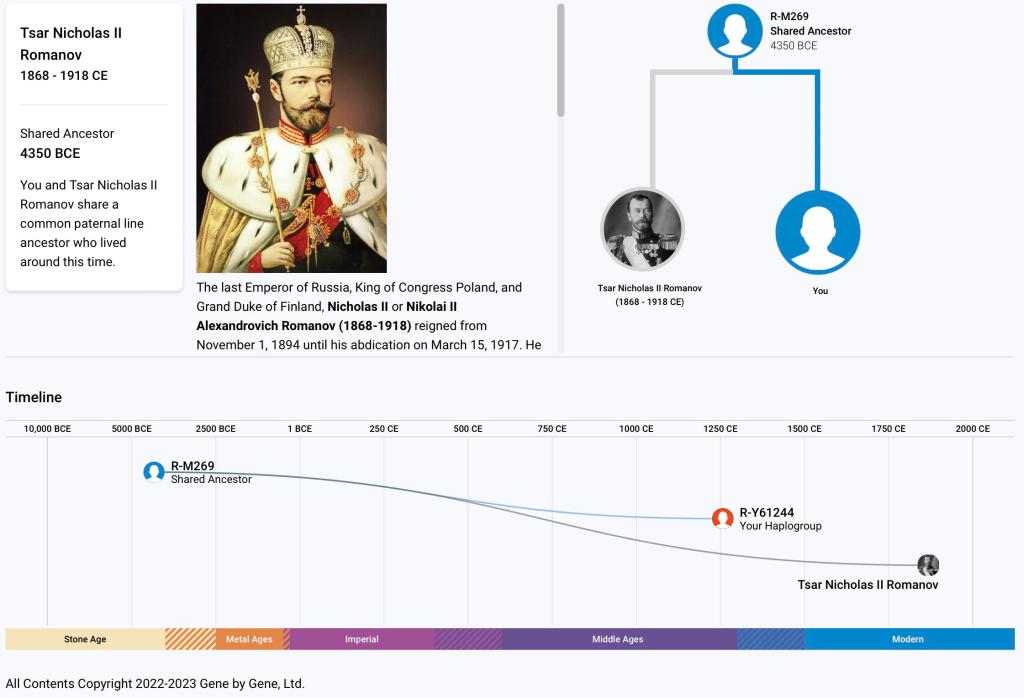
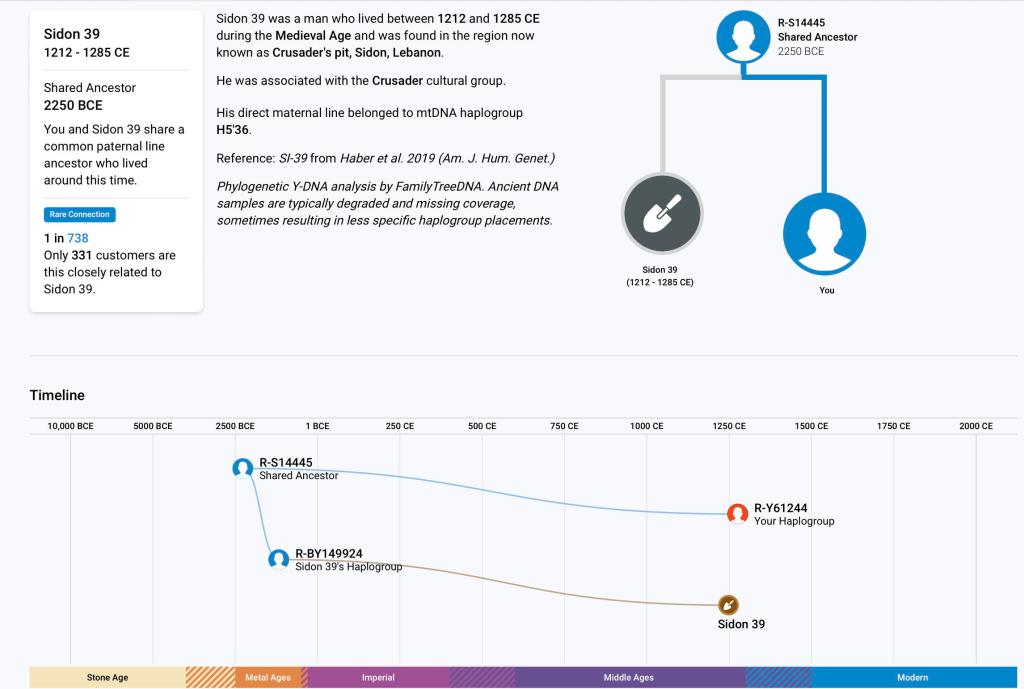
Ancient Connections



Membership of Haplogroup R-CTS4188 was determined by 23andMe.
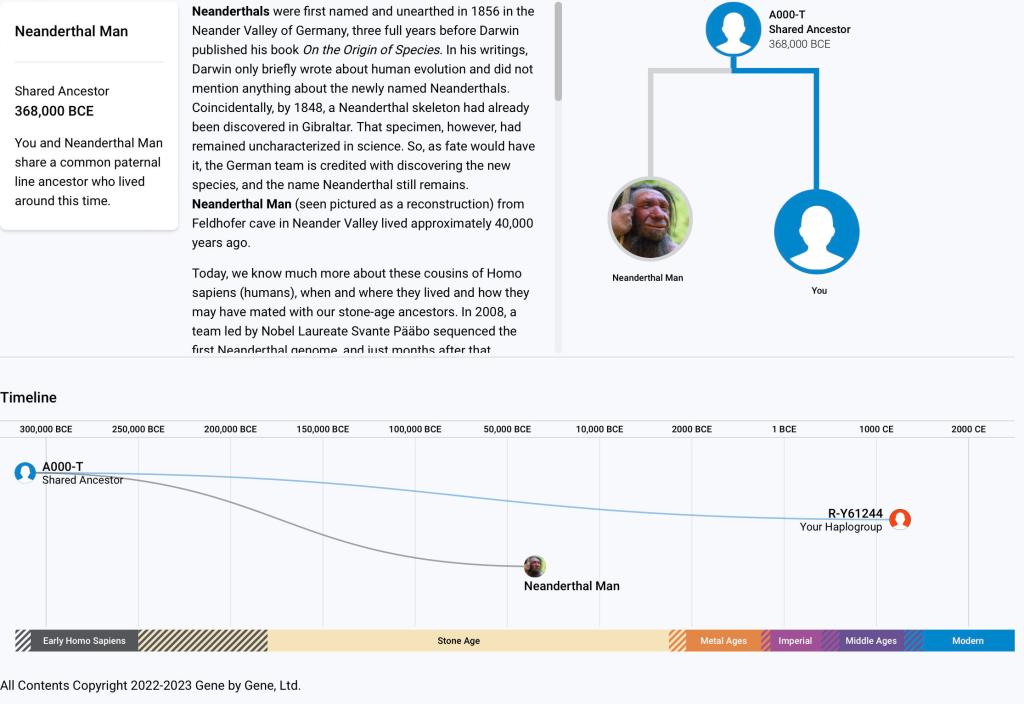

Ancestral Path
Every living man in the world shares a direct paternal line ancestor who lived around 230,000 years ago, and before that, our closest relatives are the Neanderthals and Denisovans.
Each step represents a genetic ancestor on your direct paternal line. As more people test, this path will be further refined, and we will identify more steps on your ancestral line.
Our detailed haplogroup path is:
R-M207>R-M173(R1)>R-M343(R1b)>R-L754>R-L761>R-L389>R-P297>R-M269>R-L23>R-L51>R-P310>R-L151>R-P312>R-Z46516>R-ZZ11>R-DF27>R-Z195>R-Z198>R-CTS4188>R-S14445>R-Z29704>R-S11121>R-PH3239>R-FT103345>R-FT100094>R-Y62074>R-Y60581>R-Y61244
| Steps | Haplogroup | Age Estimate | Archaeology Era | Time Passed | Immediate Descendants |
|---|---|---|---|---|---|
| 1 | R-Y61244 | 1250 CE | Middle Ages | 1,400 years | 3 |
| 2 | R-Y60581 | 150 BCE | Imperial | 900 years | 3 |
| 3 | R-Y62074 | 1050 BCE | Metal Ages | 100 years | 2 |
| 4 | R-FT100094 | 1150 BCE | Metal Ages | 350 years | 3 |
| 5 | R-FT103345 | 1500 BCE | Metal Ages | <100 years | 2 |
| 6 | R-PH3239 | 1500 BCE | Metal Ages | 550 years | 2 |
| 7 | R-S11121 | 2050 BCE | Metal Ages | 150 years | 3 |
| 8 | R-Z29704 | 2200 BCE | Metal Ages | <100 years | 2 |
| 9 | R-S14445 | 2250 BCE | Metal Ages | <100 years | 5 |
| 10 | R-CTS4188 | 2300 BCE | Metal Ages | 100 years | 2 |
| 11 | R-Z198 | 2400 BCE | Metal Ages | 150 years | 12 |
| 12 | R-Z195 | 2550 BCE | Stone Age/Metal Ages | <100 years | 4 |
| 13 | R-DF27 | 2550 BCE | Stone Age/Metal Ages | 100 years | 4 |
| 14 | R-ZZ11 | 2650 BCE | Stone Age/Metal Ages | <100 years | 3 |
| 15 | R-Z46516 | 2700 BCE | Stone Age/Metal Ages | 100 years | 4 |
| 16 | R-P312 | 2800 BCE | Stone Age/Metal Ages | 150 years | 9 |
| 17 | R-L151 | 2950 BCE | Stone Age/Metal Ages | 350 years | 5 |
| 18 | R-P310 | 3300 BCE | Stone Age/Metal Ages | 700 years | 4 |
| 19 | R-L51 | 4000 BCE | Stone Age/Metal Ages | 250 years | 2 |
| 20 | R-L23 | 4250 BCE | Stone Age | 100 years | 2 |
| 21 | R-M269 | 4350 BCE | Stone Age | 7,650 years | 2 |
| 22 | R-P297 | 12,000 BCE | Stone Age | 3,000 years | 2 |
| 23 | R-L389 | 15,000 BCE | Stone Age | <1,000 years | 2 |
| 24 | R-L761 | 15,000 BCE | Stone Age | 2,000 years | 2 |
| 25 | R-L754 | 17,000 BCE | Stone Age | <1,000 years | 2 |
| 26 | R-M343 (R1b) | 17,000 BCE | Stone Age | 3,000 years | 2 |
| 27 | R-M173 (R1) | 20,000 BCE | Stone Age | 6,000 years | 2 |
| 28 | R-M207 | 26,000 BCE | Stone Age | 3,000 years | 2 |
| 29 | P-P226 | 29,000 BCE | Stone Age | 5,000 years | 2 |
| 30 | P-P284 | 34,000 BCE | Stone Age | <1,000 years | 2 |
| 31 | P-M45 | 34,000 BCE | Stone Age | 8,000 years | 2 |
| 32 | P-P295 | 42,000 BCE | Stone Age | <1,000 years | 3 |
| 33 | P-PF5850 | 42,000 BCE | Stone Age | <1,000 years | 2 |
| 34 | K-YSC0000186 (K2b) | 42,000 BCE | Stone Age | <1,000 years | 2 |
| 35 | K-M526 (K2) | 42,000 BCE | Stone Age | 1,000 years | 2 |
| 36 | K-M9 | 43,000 BCE | Stone Age | 1,000 years | 2 |
| 37 | IJK-L15 | 44,000 BCE | Stone Age | 1,000 years | 2 |
| 38 | HIJK-PF3494 | 45,000 BCE | Stone Age | 1,000 years | 2 |
| 39 | GHIJK-F1329 | 46,000 BCE | Stone Age | <1,000 years | 2 |
| 40 | F-M89 | 46,000 BCE | Stone Age | 17,000 years | 2 |
| 41 | CF-P143 | 63,000 BCE | Stone Age | <1,000 years | 2 |
| 42 | CT-M168 | 63,000 BCE | Stone Age | 22,000 years | 2 |
| 43 | BT-M42 | 85,000 BCE | Stone Age | 35,000 years | 2 |
| 44 | A-V221 (A1b) | 120,000 BCE | Stone Age | 4,000 years | 2 |
| 45 | A-V168 (A1) | 124,000 BCE | Stone Age | 26,000 years | 2 |
| 46 | A-L1090 (A0-T) | 150,000 BCE | Stone Age | 82,000 years | 2 |
| 47 | A-PR2921 (Y-Adam) | 232,000 BCE | Early Homo Sapiens/Stone Age | 136,000 years | 2 |
| 48 | A000-T (Neanderthal divergence) | 368,000 BCE | Before Homo Sapiens/Early Homo Sapiens | 337,000 years | 2 |
| 49 | A0000 (Denisovan divergence) | 705,000 BCE | Before Homo Sapiens | 2 |
The future: A potential new haplogroup, named FTD64696?
According to Wayne Townsend (NPE Burk), Co-Admin for the DF27 Project, “the new Big Y result is going to create a new Haplogroup below the present result of Y61244. This will happen after the manual review, but it will happen.”
“Bottom line, the two of you share an MRCA much closer than Y61244, which FTDNA dates at 1450 AD. My back-of-the-envelop estimate for your MRCA would be between 1700 and 1740.“
“There is a third man at Y61244, Mr. Rosie. However he not only does not match any of your private SNPs …. because he has only tested up to Big Y 500. It is possible that if you encouraged him to upgrade he might bring more definition to your new branch. Mr. Rosie matches one of you at y67 GD=5, but does not match the other at all at any STR marker level. This seems a bit odd and may be a case of STR Divergence (random STR mutations that cause two men to appear more distantly related than they actually are). Only an upgrade by Mr. Rosie would clear this up.“
On 22nd March 2022,the BigY700 analysis for the late Mr Rosie were nearing completion. According to Wayne Townsend, Old and Rosie have “one Private Variant in common — position 20827807, aka FTD64696. That means that the Most Recent Common Ancestor [MRCA] is about 1 to 3 generations more recent than the the MRCA they share with Mr Henderson. While they appear positive for that SNP, the final result will have to await the manual review by the FTDNA Geneticist. That’s because the match has a couple of problems. In both men there are less than 20 reads and there is one “odd” read in each (mutation from G to A rather than G to C). However, I expect the two of them will share a new haplogroup named FTD64696.“
“In round figures that would place the MRCA of Old and Rosie in the 1400s; still outside the era when all surnames became stable. (It will take even longer for the FTDNA algorithm to estimate the age of that haplogroup, usually several months.) Even if the haplogroup is not “officially” called, this does show the Rosie/Old line is more closely related than the Henderson line.“
Common Ancestry
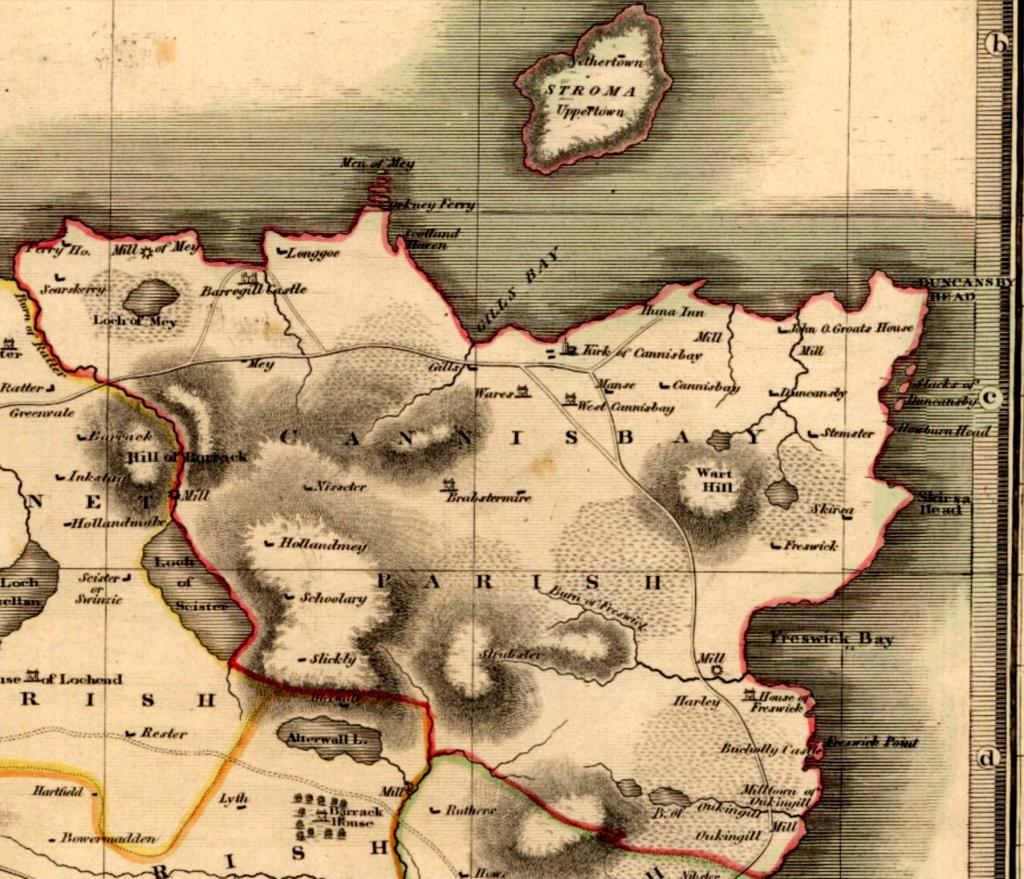
No common ancestry between R-Y61244 males has been determined in the short time since the new grouping was discovered. An examination of existing family trees reveals that the lines may have had a common origin in Canisbay parish in Caithness, which includes the now uninhabited isle of Stroma. One problem encountered is that there is a gap in the Old Parish Registers of Births & Baptisms for Canisbay parish between 15/03/1722 and 30/11/1746. However, it is hoped that DNA studies may help bridge this gap.
Abbreviations
CE (Common Era) is the secular version of AD (Anno Domini – Latin for in the year of the Lord).
BCE (Before Common Era) is the secular version of BC (Before Christ).
Either designation is acceptable by the international standard for calendar dates, although in scientific circles it is more usual to use the BCE/CE format
For More Information
See the full R-Y61244 story at Family Tree DNA.

 Vecchio