
In two previous articles, we investigated our ancestor Colin Drummond. We now report new evidence uncovered by fellow researcher and Drummond descendant David Freer which reveals that our Drummonds were descended from the Drummond lairds of Colquhalzie, a junior line of the Drummond Barons of Concraig.
Professor Colin Drummond of Edinburgh University – not our ancestor!
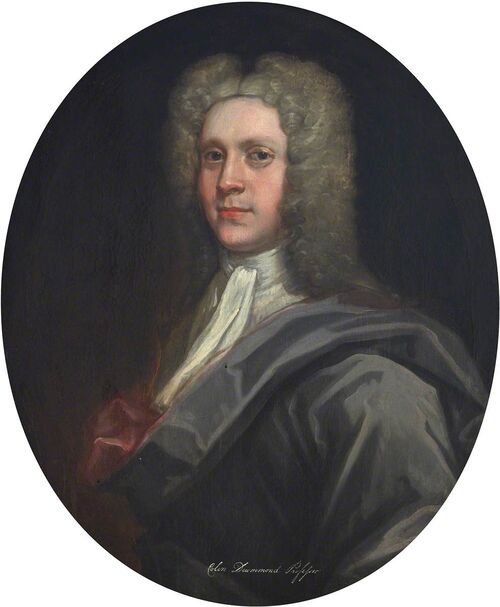
In the first article, Professor Colin Drummond of the Lennoch & Megginch line is not our ancestor!, we looked into claims in various internet trees that our Colin Drummond from Auchterarder was baptised on 11th June 1684 in Errol parish in Perthshire. This Colin Drummond was the son Adam Drummond, 9th Baron of Lennoch, 2nd of Megginch and his wife Alison Hay, daughter of John Hay of Haystoun. This Colin Drummond is even occasionally – and erroneously – described as “Sir Colin Dummond, Earl of Lennoch“. Lennoch was in reality a Scottish feudal barony, not an Earldom. Presumably Lennoch had been confused with the ancient Earldom of Lennox. Colin Drummond of the Lennoch & Magginch line was a descendant of, amongst others, King David I of Scots, Edmund Ironside, King of England, Henry I, King of France, Robert I, Duke of Normandy, and Yuruslav I, Grand Prince of Rus, and so was extremely well connected.
As this Lennoch connection seemed unlikely, although not impossible, I researched Colin Drumond, son of Adam Drummond, 9th of Lennoch and 2nd of Megginch. After initially drawing a blank, I was gradually able to assemble his life story and demonstrate that he had not married in Auchterarder but had in fact enjoyed a distinguished career as Professor of Logic, Metaphysics and Greek at Edinburgh University. Professor Colin Drummond died on 02 November 1753 and was buried in Greyfriars kirkyard in Edinburgh.
Colin Drummond of Auchterarder
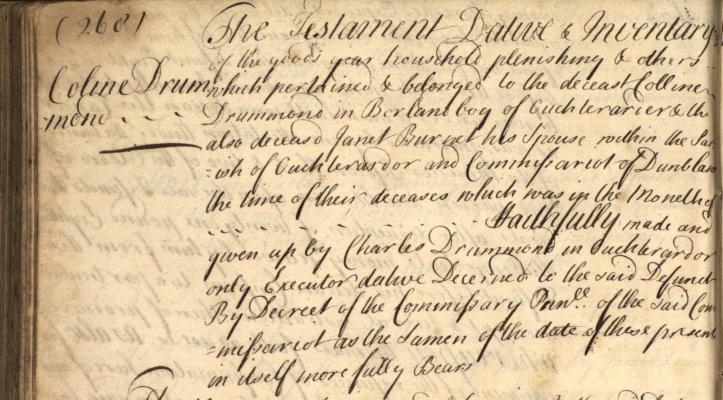
Drummond Coline 21/4/1737 in Borlandbog of Auchterarder, and Janet Burnet, his spouse, parish of Auchterarder TD Dunblane Commissary Court CC6/5/24. Crown Copyright.
In the second article, Colin Drummond and the 1715 civil war, we looked into our Colin Drummond and the events that occurred in and around Auchterarder in 1715. We concluded that that he was probably born in or around Auchterarder but that his baptism had not been recorded in the generally available Old Parish Registers of Births & Baptisms.
Banns for Colin Drummond and Janet Barnet were proclaimed on 20 February 1712 in Auchterarder and they had two children who appeared in the Old Parish Register of Births & Baptisms for the parish of Auchterarder: James, who was born at Borland and baptised on 12 July 1713; and Margaret, also born at Borland and baptised on 03 August 1715. Margaret went on to marry James Steil (Steel) in 1737 and have ten children.
Colin Drummond and Janet Barnet also had three daughters who do not appear in the baptismal records at ScotlandsPeople. Ann, Jean, and Janet Drummond were born on 7th March 1717, 20th April 1718 and 17th February 1720 respectively. The first and third (and presumably also the second) were born at Borland Bog in the parish of Auchterarder, in Perthshire but baptised at the Episcopal Church of Saint James in Muthill.
Thanks to research by descendant David Freer from Canada we know that Colin Drummond did not die in 1715 as we initially suspected, but survived for years after the Battle of Sheriffmuir and the burning of Auchterarder, dying some time before 21st April 1737, when his estate was confirmed.
In a letter, Colin’s father, Andrew Drummond had been described as “Farmer in ____hill“. Given that three of Colin Drummond’s daughter had been baptised at the Episcopal church in Muthill, we wondered whether Andrew may have been a farmer in Muthill and that perhaps Colin had been born and baptised in that parish?
There was a certain irony that we carried out extensive research to prove that our Colin Drummond was not a son of the Barons of Megginch and Lennoch only to discover, again thanks to David Freer, that family letters stated that our Colin’s father, Andrew Drummond, was “cousin to the then laird of Drummond“. These letters document additional connections to the Drummonds of Perth. But whether these were due to family relationships or simply coincidental we did not know.
New Research Regarding Colin Drummond’s Ancestry
Thomas Drummond and Elspit Scott, the grandparents of Colin Drummond of Auchterarder
Since those articles were published, the baptism of a candidate for Colin Drummond’s father, Andrew Drummond, was found. This was for Andro Drwmond, son of Thomas Drwmond and Elspit Scot, who was born the 18th and baptised on 19th June 1674 in the parish of Auchterarder in Perthshire.

Copyright ScotlandsPeople, National Records of Scotland.
Thomas Drummond (Drwmod) and Elspit Scott (Scot) were reprimanded for the sin of fornication by Auchterarder Kirk Session on 22th August 1671. The couple went on to have at least eight children:
- Janet Drummond (Janat Drwmond), baptised 28th March 1673 in Auchterarder parish
- Andrew Drummond (Andro Drwmod), born 18th and baptised 19th June 1674 in Auchterarder parish
- John Drummond (Drwmond), baptised 19 December 1676 in Auchterarder parish
- James Drummond, baptised 30th July 1678 in Auchterarder parish
- Aemilie Drummond, baptised 3rd August 1680 in Auchterarder parish
- Elspit Drummond, baptised 29th November 1682 in Auchterarder parish
- Margaret Drummond (Drumond), baptised 29th May 1686 in Auchterarder parish
- Isobel Drummond (Issobell), baptised 18th July 1688 in Auchterarder parish
John Drummond 8th of Colquhalzie and Barbara Blair, the great-grandparents of Colin Drummond of Auchterarder
On 11th March 2026, David Freer made the following post on this blog. This turned out to be a major breakthrough, adding a Drummond “gateway ancestor” to our family tree.
“I believe that the “Laird of Drummond”, that James Steel’s autobiography refers to, maybe the 9th Laird of Colquhalzie (John Drummond ~b1640).
ScotlandsPeople has a birth record for Andrew Drummond b1674 as follows,
Birth Data: ScotlandsPeople District – Auchterarder Ref – 329/10 23 **Forename = Andro **Surname = Drwmod **Father = THOMAS DRWMOD **Mother = ELIZABATH SCOT **The image is too diffcult to read. I believe that it is the 4th entry.
Thomas Drummond b1646 as follows,
Birth Data: ScotlandsPeople District – Trinity Gask Ref – 396/10 16 **Parents = JOHNE DRUMMOND/BARBARA BLAIR.
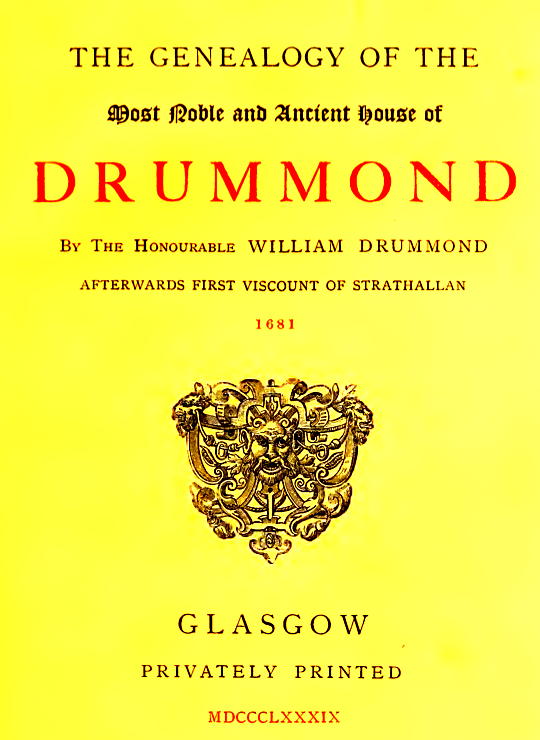
In this document, Genealogy of the House of Drummond, you will find reference to the marriage of John and Barbara Blair and that John is the 9th Laird of Culqualzie. Although, it says that they only had 3 sons (John, William and Harie) and three daughters (Issobel, Elspet, yet fail to list the 3rd), ScotlandsPeople has birth/baptismal records for,
Isobell – JOHNE DRUMMOND/BARBARO BLAIR
David – JOHNE DRUMMOND/BARBARA BLAIR
Henrie (Harie) – Jon. Drummond/(mother not listed)
Thomas – JOHNE DRUMMOND/BARBARA BLAIR
George – JOHNE DRUMMOND/BARBARA BLAIR
Regards,
David Freer”
The information referred to is reproduced below:
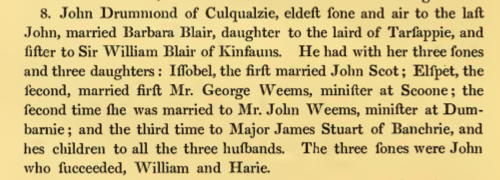
Perhaps what was most astonishing was that a genealogical work that was compiled way back in 1681, without the help of the modern technology and databases that we now take for granted, contained so much information that proved to be incredibly useful to us today.
The fact that Thomas Drummond’s father was John Drummond of Culqualzie fits with Thomas’ son Andrew Drummond being referred to in a family letter as “the cousin of the laird of Drummond“.
Although Thomas is not listed in the Genealogy of the House of Drummond entry for John Drummond 8th of Colquhalzie, it is clear from the Old Parish Register of Births & Baptisms for Trinity Gask parish (see below) that he was a younger son of John Drummond, 8th laird of Culqualzie and his wife Barbara Blair.

Copyright ScotlandsPeople, National Records of Scotland.
The record describes the baptism on 29th October (1646) of Thomas Drummond, son to John Drummond of Culgqylie and Barbara Blair. The witnesses were Sr (Sir) George Hay and Sr (Sir) James Drummond.
The first witness could be Sir George Hay, 8th of Megginch. Sir George had no sons to succeed him and in 1661, John Drummond, 8th of Lennoch and his wife Jean Campbell purchased Megginch from him. The Drummonds “packed all their belongings into Oxen carts and moved from Lennoch near Crieff in July. They brought with them the old Drummond cradle, the smoke-darkened Begger’s bench, the two-handed crusader sword belonging to Maurice, the Crusader Drummond – all still in the Castle today.“
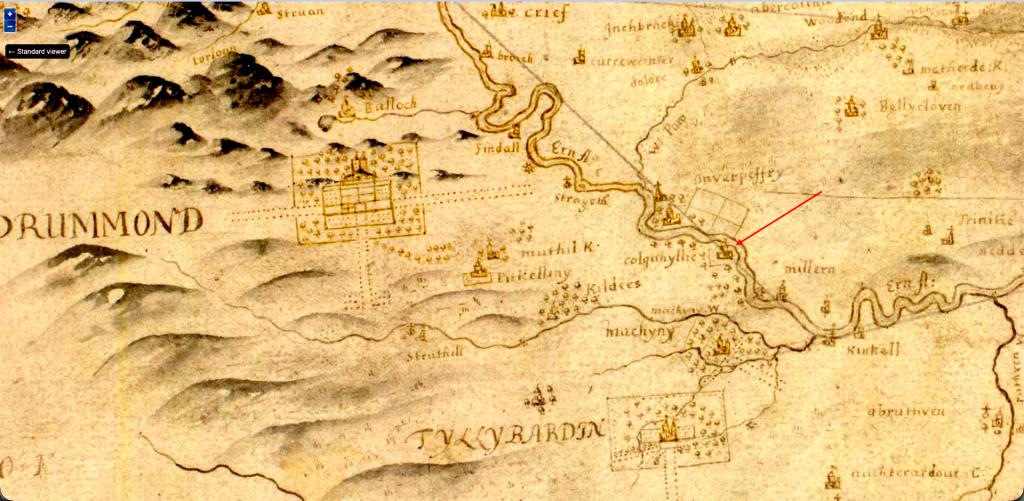
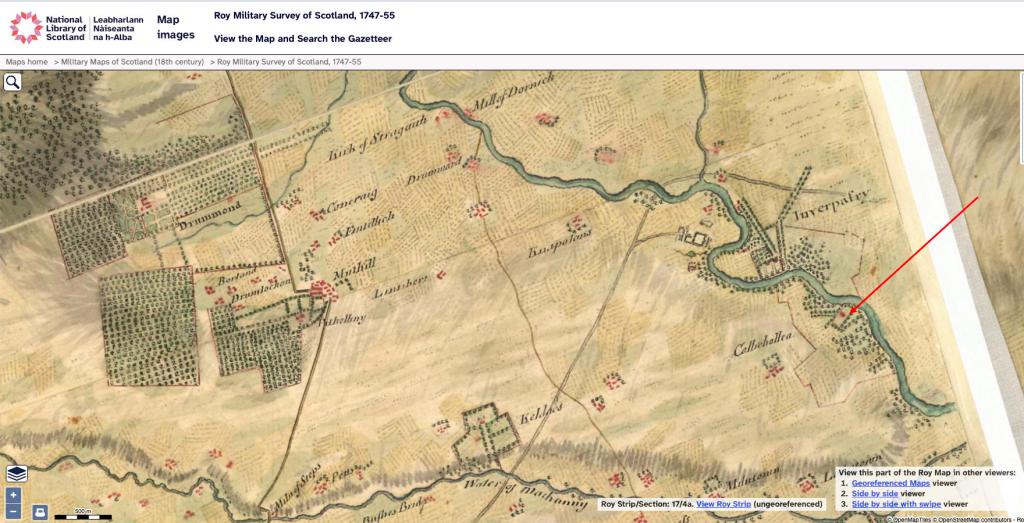
The second witness may be Sir James Drummond, 1st of Machany, who died in July 1675, or less likely, his son, Sir James Drummond, 2nd of Machany. Lilias, daughter of the 2nd laird of Machany married firstly James Murray 2nd Earl of Tullibardine and secondly James Drummond, 4th Earl of Perth (and 1st Duke of Perth in the Jacobite peerage). It can be seen from the maps below that Machany was just to the south of Colquhalzie (with Tullibardine a little further to the south) and having a fellow Drummond laird and neighbour as witness would make sense.
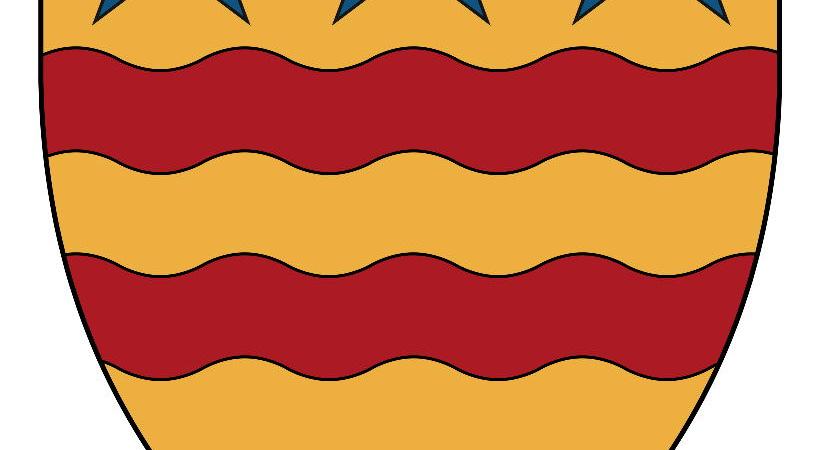
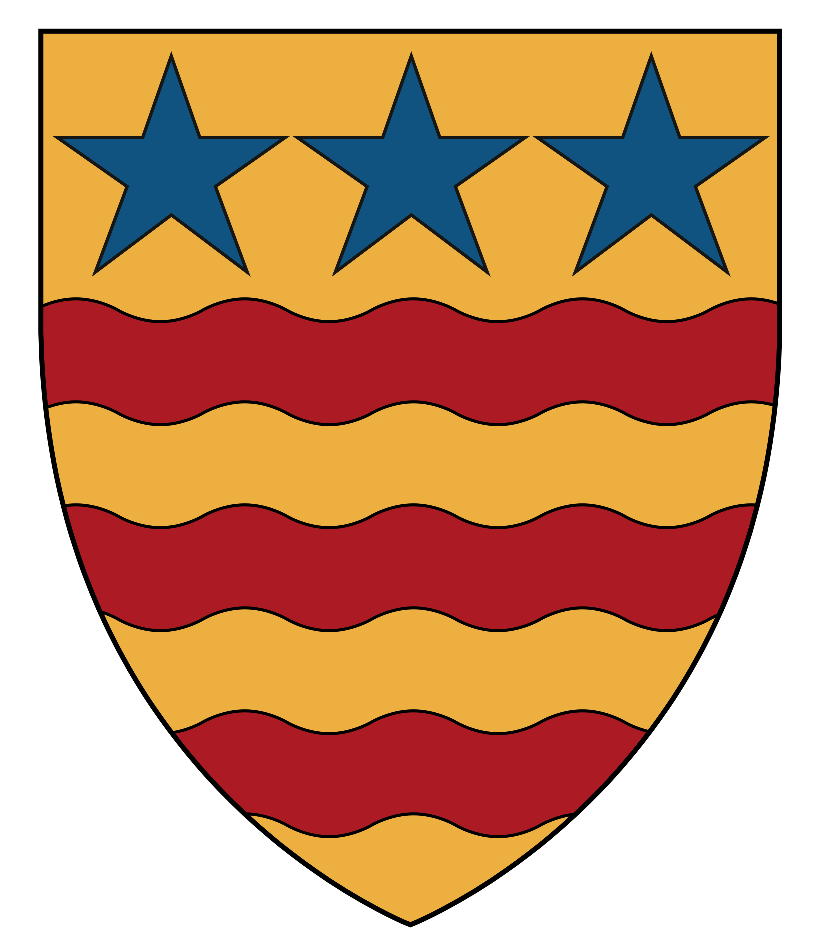
Drummond of Colquhalzie Arms
The Public Register of All Arms and Bearings in Scotland contains all recordings of coats of arms in Scotland from 1672 to the present day, with arms up to 1924 available online. Coats of arms cannot be used legally in Scotland unless they are recorded in the Register. It is maintained by the Court of the Lord Lyon, the office responsible for heraldic matters in Scotland. The arms of John Drummond of Colquhalzie appear in 1672, the first year of the register.
| John Drummond of Colquhalzie | 1672 | 1 | 732 |
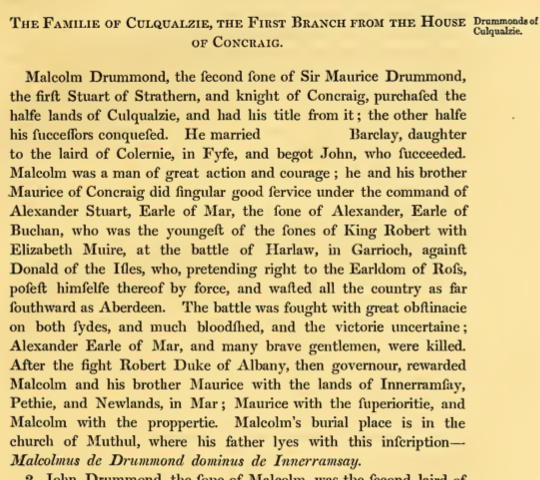
As noted above, Malcolm Drummond, 1st of Colquhalzie was the second son of Sir Maurice Drummond, first Baron of Concraig. He and his elder brother, Maurice, 2nd Baron of Concraig fought in the royal army against Donald, Lord of the Isles at the bloody Battle of Harlaw, near Bennachie, on 24th July 1411. Although the Earl of Mar’s forces arguably lost the battle, they were left in possession of the field. At dawn they found that Donald of the Isles had withdrawn during the night, going first to Ross and then back to the Isles.
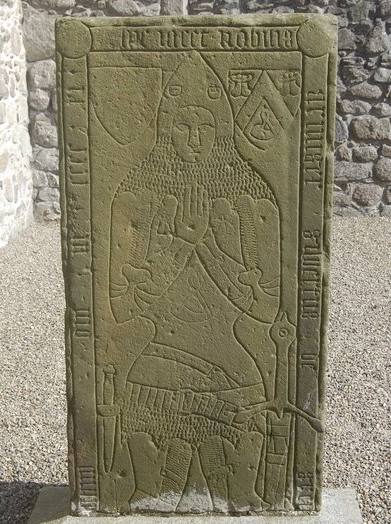
Photo credit: Bill Harrison
Many of those who died were buried at Kinkell Church south of Inverurie in Aberdeenshire. The heirs of the slain Scots were exempt from death duties. One of those who was killed was Sir Gilbert de Greenlaw. The carving on his graveslab is an invaluable resource as it gives us an idea how Malcolm Drummond, 1st of Colquhalzie and his elder brother, Maurice, 2nd Baron of Concraig might have been armed and armoured. Sir Gilbert is depicted with hand and a half sword and wore an open-faced bascinet helmet with a mail-reinforced arming doublet beneath plate armour.
Colquhalzie, Trinity Gask parish, Perthshire
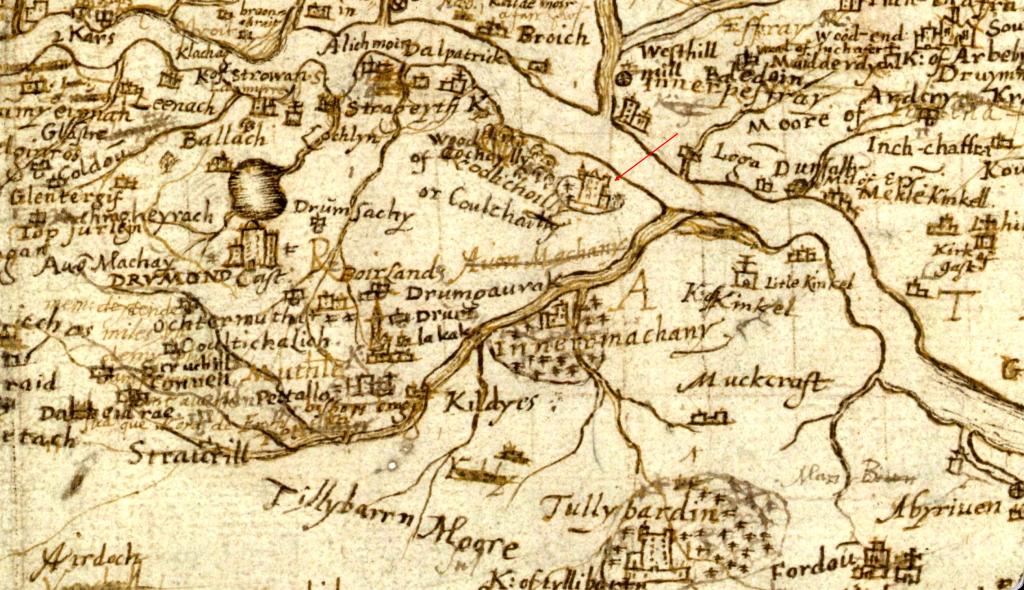
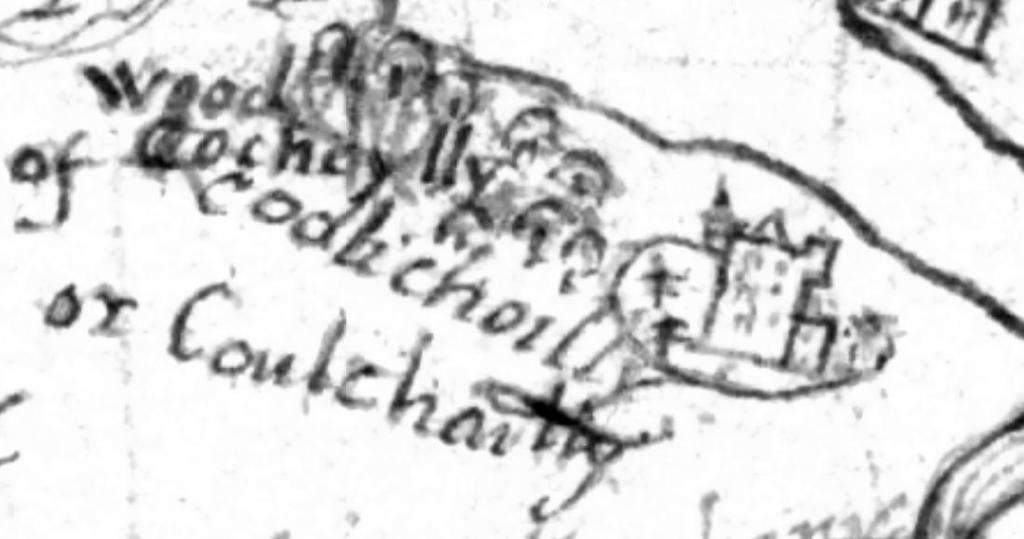
Colquhalzie (also Codhichoilly, Coulchailly, Colquhyllie, and Culquhalie) is unusual in that a building of that name (or variants thereof) appears on some of the earliest maps, from the late 1500s right until the present day.
Used with the permission of the National Library of Scotland.
Possibly the most interesting being Timothy Pont’s map (above) published sometime between 1583 and 1614. The National Library of Scotland notes that: “Pont has used a wide variety of symbols to depict smaller settlements, and larger structures such as Methven Castle are often sketched.“
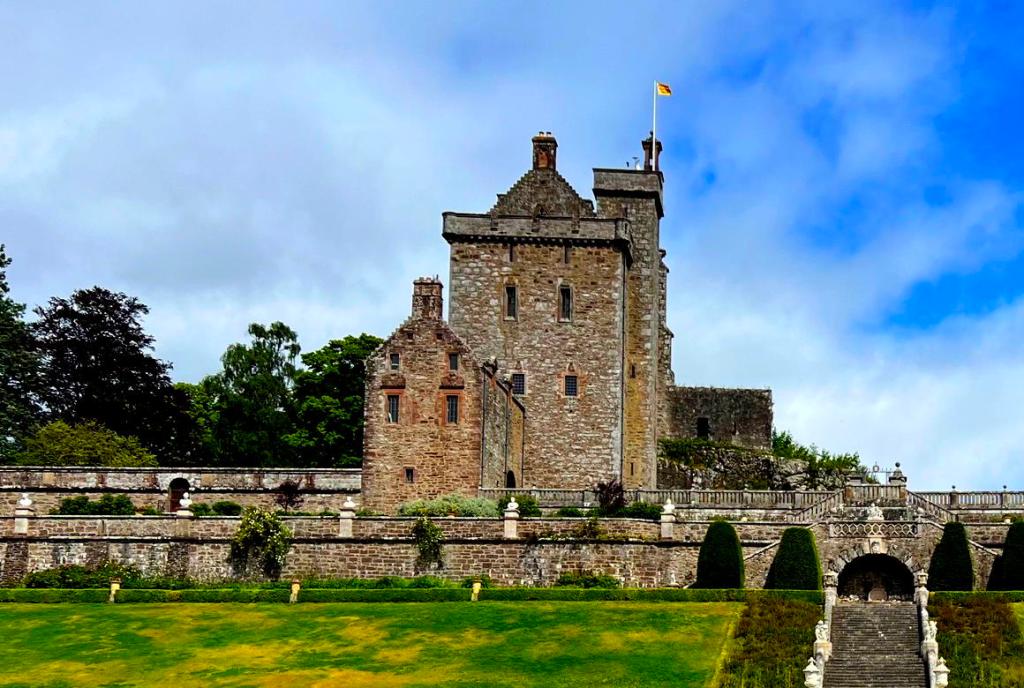
It is interesting to compare the symbol that Pont used for Drummond Castle on his map with modern day Drummond Castle below. The obvious similarities between the tower house and the representation on the map suggest that Pont’s sketch of Colquhalzie may also be an accurate recording of the tower house as it was then.
Used with the permission of the National Library of Scotland.
Used with the permission of the National Library of Scotland.
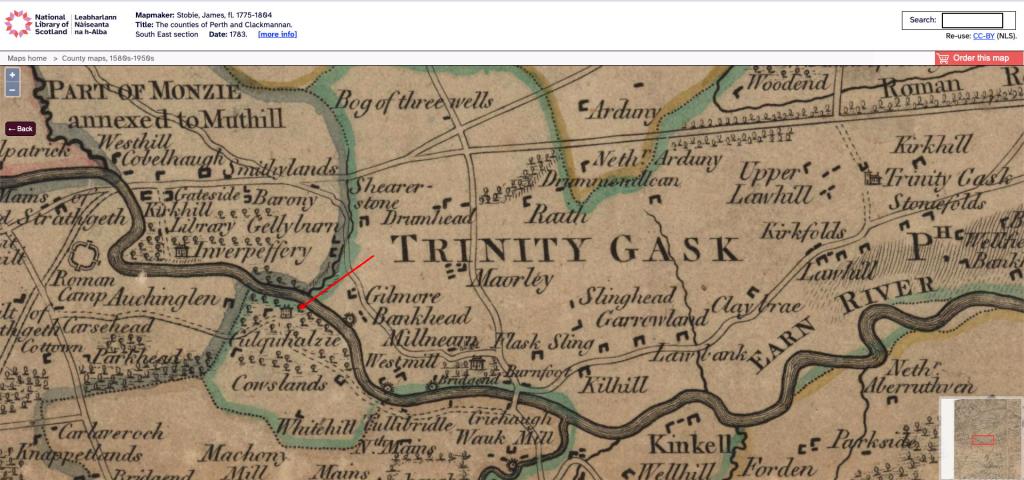
Used with the permission of the National Library of Scotland.
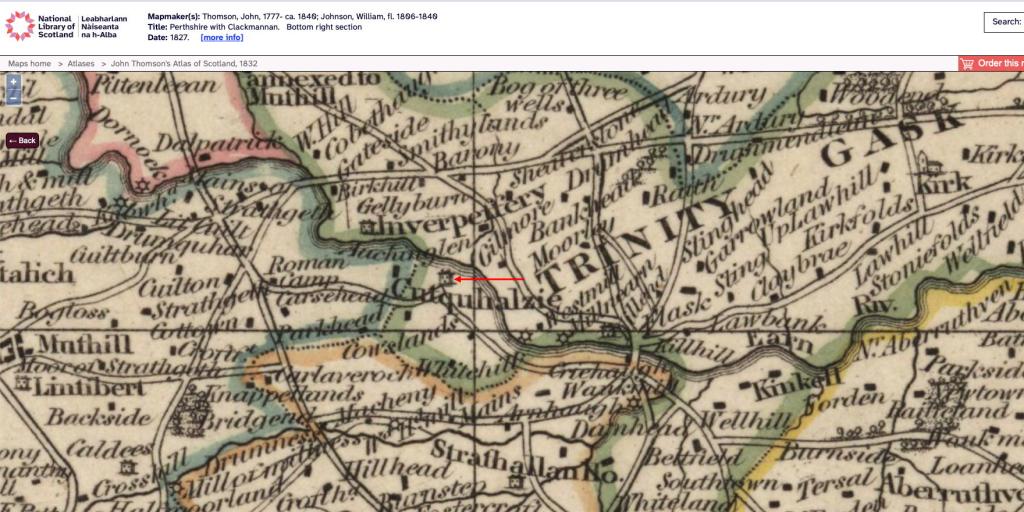
Used with the permission of the National Library of Scotland.
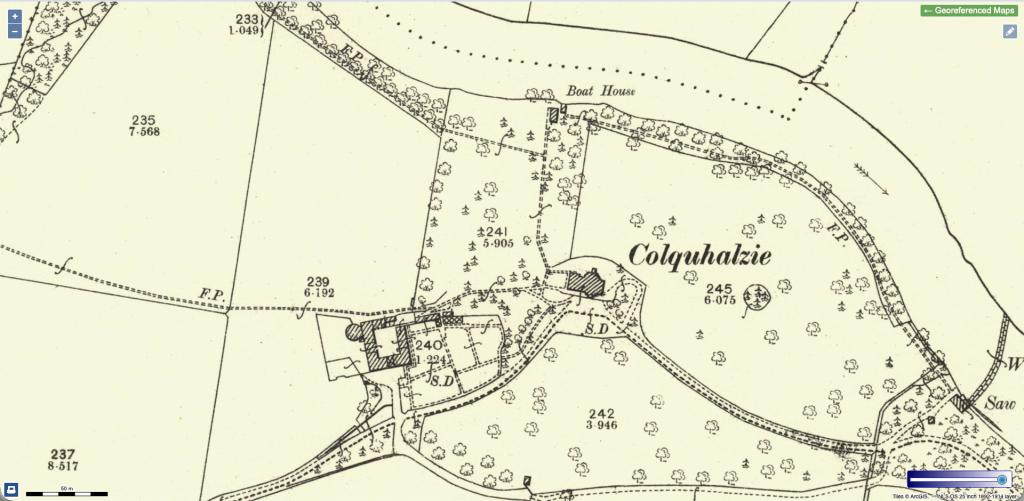
Used with the permission of the National Library of Scotland.
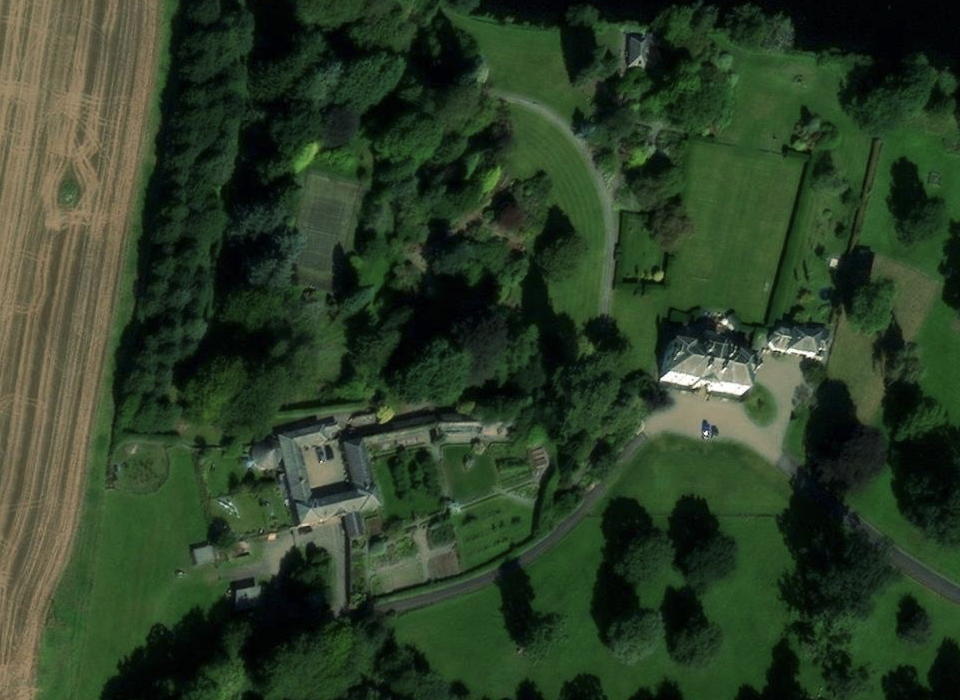
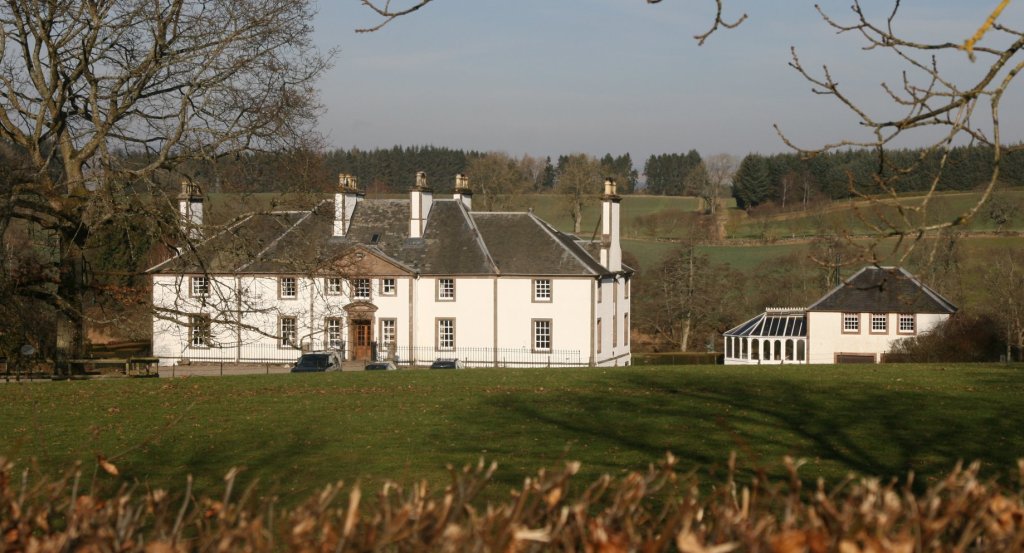
From the most recent map and satellite image it can be seen that an eighteenth century house is present on the site.
Used with the permission of the National Library of Scotland.
Stravaiging states “Colquhalzie was a substantial tower house dating back to at least the 16th century, but nothing of it now remains. The lands of Colquhalzie were owned by the Inglis family in the 15th century and the property is marked on Timothy Pont’s late 16th century map as Codhichoilly or Coulchailly. In the 17th century the estate passed to the Drummond family. The exact site of the castle isn’t known, however a mansion of 1729 is now the focal point of the estate. This house may have replaced or incorporated the older building.“
If we look closely at the farm buildings to the west of Colquahalzie House, there is a round tower on the north-west corner which may be part of the original tower house. There is also an enclosed garden to the east of the farm buildings which may be the walled area represented on Timothy Pont’s map. There is even – perhaps coincidentally but intriguingly – a small tower with a “witch’s hat” roof on the same north west corner of the tower house on Pont’s map. We therefore suggest that the current farm buildings at Colquhalzie may incorporate at least part of the seat of the Drummond lairds of Colquhalzie.
The Misty Origins of the Drummonds
In the past, as today, many desired to have illustrious noble and royal ancestors, if possible dating back to and beyond the Norman Conquest of England in 1066. Nowadays all that is necessary is to search the internet and if you really want royal or ancient ancestry, somewhere or other you will be able to find a tree proving that you do and allowing you to claim: “It must be true – I read it on the internet!”
In her excellent article on Spotting Fake Genealogy, Susan Morris notes that:
“From ancient times, genealogy has been a powerful tool in reinforcing identity, whether personal or political. … This is not a universal motive nowadays; many ancestor-seekers are simply curious, and find that identifying their forbears helps them to understand history. For some, however, the desire to be connected to a famous, titled or wealthy family is a driving force.“
“Inevitably, this has led to false claims and to exploitation. These fall into two categories:
“The accidental ancestor
“Tracing ancestry is not always easy, even with all the modern finding tools, and the pages of websites such as Ancestry are teeming with inaccurate family trees. Moreover, oral history tends to value dramatic effect over accuracy. We humans like to arrange things into patterns, and to fill in any gaps in the facts with borrowed ones. Granny (or indeed Grandad) might not have been consciously fibbing with that story of a fine lady who ran off with the gardener; but the chances are, she didn’t. (Interestingly, plod through the documentation and you might find a grain of truth in the story: there might have been a professional gardener in the family, or the family might have relocated for reasons that appear illogical to their descendants.)
“The unscrupulous genealogist
“Intent to deceive is much rarer, but there have been some notable examples. American genealogy – with the uncertainties of emigrant origins, a vast country, and a lack of early documentation – was particularly ripe for exploitation. …
“To avoid fakes pushing their way into your own ancestry, there are some simple rules to follow. Don’t adopt anyone else’s family tree without checking each connection. Was it is based on guesswork, wishful thinking, idly clicking buttons on a wet afternoon, or on careful research using original records (which includes digitised images of original records)? Are there obvious howlers, such as people having children at an impossibly young age, or simultaneously being in three different parts of the country? Look at each generation carefully, and in full: siblings are important. Occupations are important. If there is a marriage or birth certificate to be had, get a copy. And be wary of those innocent-looking little green leaves or links that the website waves at you. It is not thinking, it is only shuffling its data and showing you a few of its cards.“
The Drummonds were no exception and Viscount Strathallan repeated the, then generally accepted, traditional legend stating that the first Drummond in Scotland was a Hungarian prince and or admiral called Maurice who was made hereditary Thane of Lennox. According to legend, Maurice was shipwrecked on the Scottish coast while helping Saint Margaret, her sister Christina and brother Edgar the Ætheling, the uncrowned king of England, flee William the Conqueror in 1067. The royal fugitives were welcomed by Malcolm III “Canmore”, King of Scots, who married Margaret. According to Viscount Strathallan, “this Hungarian gentleman got his name, either from the office as being captaine, director, or admiral to Prince Edgar and his company—for Dromont or Dromend in divers nations was the name of a ship of a swift course, and the captaine thereof was called Droment or Dromerer—or otherwise the occasion of the name was from the tempest they endured at sea;’ Other Drummond family historians even gave Maurice royal Hungarian ancestry, claiming that he was the son of George Árpád, an illegitimate son of András Árpád (King Andrew I of Hungary) who ruled from 1046 to 1060.
The first documented chief of Clan Drummond was Sir Malcolm Beg de Drummond, who, along with his brother, Gilbert, witnessed charters of Maol Domhnaich, Earl of Lennox, from 1225 to 1270. Sir Malcolm married Ada of Lennox, the daughter of the Earl Maol Domhnaich and wife Elizabeth or Beatrix Stewart. This Malcolm Drummond was the Earl’s chamberlain, rather than, as legend claimed, the hereditary thane or seneschal of Lennox. The Barony of Drymen, or Drummond, which had supposedly been granted to Prince Maurice by Malcolm Canmore way back in 1070, in fact belonged to the Crown up to 1489, when the lands were leased to John, first Lord Drummond, and afterwards granted to him as feu-farm. The earliest charter to the Drummond family of any lands with a similar name was in 1362, when Robert Stewart, Earl of Strathern (late King Robert III), granted Maurice of Drummond the dominical lands, or mains of Drommand and Tulychravin, in the earldom of Strathern. These lands were distinct from the lands and lordship of Drummond later acquired by John Drummond, who sat in Parliament 6th May 1471, under the designation of “Dominus de Stobhall“, and who, 16 years later, was created a Lord of Parliament by King James III.
Genuine Drummond Royal Connections
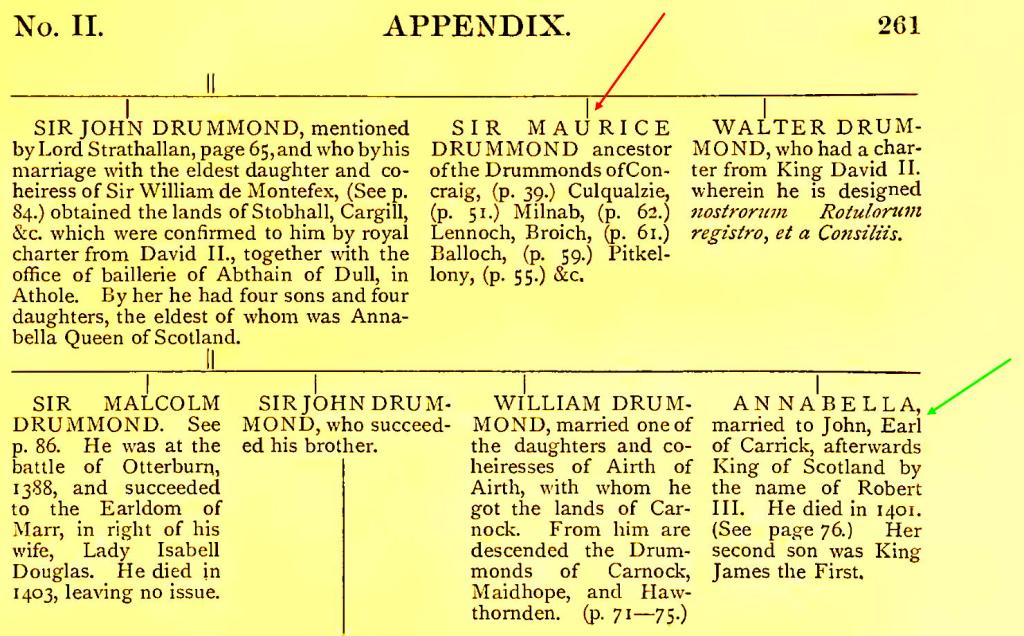
Nevertheless, the Drummonds were very well-connected. Our Colqualzie line was descended from Sir Maurice Drummond – highlighted by a red arrow – younger brother of Sir John Drummond. Sir John’s daughter Annabella – highlighted by a green arrow – married John, Earl of Carrick, who later became the second Stewart King with the regnal name of Robert III of Scots. This couple were the ancestors of every subsequent Scottish Monarch, from 1607, of every British monarch and eventually of the royal families of all European nations. Nor was Annabella the only Drummond to become Queen of Scots: Her aunt, Margaret Drummond, was the second wife of the childless David II (Bruce) and Queen consort of Scots from 20th February 1364 to 20th March 1369.
And What of Professor Colin Drummond?
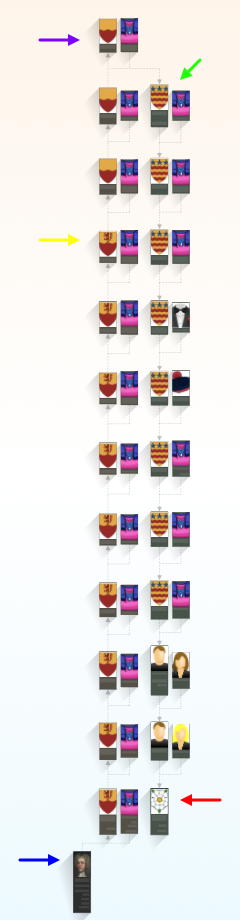
To return to the start of our research, it is perhaps of interest to note that Professor Colin Drummond of Edinburgh University who was conflated with our Colin Drummond turns out to be his tenth cousin once removed!
Blue arrow: Professor Colin Drummond of Edinburgh University.
Red arrow: Colin Drummond of Auchterarder.
Purple arrow: Sir John Drummond, 3rd baron of Concraig.
Green arrow: Malcolm Drummond, 1st of Colquhalzie.
Yellow arrow: John Drummond, 1st Baron of Lennoch.
 Vecchio