
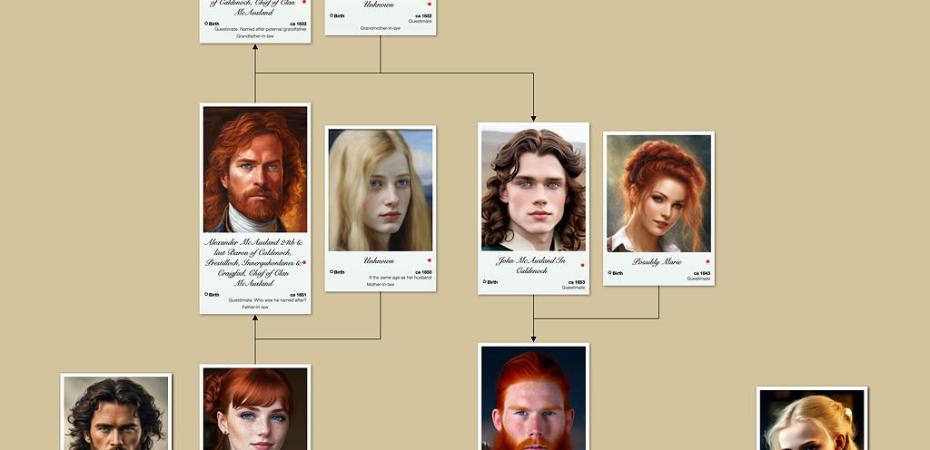
In this, the twelfth article in the series, we suggest that the John McAusland who witnessed the 1690 McAusland Sasine, was the John McAusland in Caldenoch who appears in the 1694 Heath Tax Records and that he was the younger brother of Baron Alexander McAusland, 24th and last Baron of Caldenoch in our reckoning.
We further suggest that the Dougald McAuslane “neirest aire” who signed the 1711 letter to Oliver McCausland of Strabane was John McAusland’s son and the husband of Elizabeth McInturnor.
This would make Dougald the full cousin of Janet McAusland, daughter and heiress of the last Baron.
Who were the Four Witnesses to the 1690 Sasine?

As detailed in previous articles, on 10th June 1690, a Sasine in the name of Janet, daughter of Alexander McCausland of Caldenocht and spouse of Duncan Campbell, son of John Campbell of Kinloch (RS10/2/273(r)-274(r) was witnessed by four people: Dugall McFarland, Malcolme McFarland, John McAusland, and what appears to be Andrew McInturnor.
The McFarlands
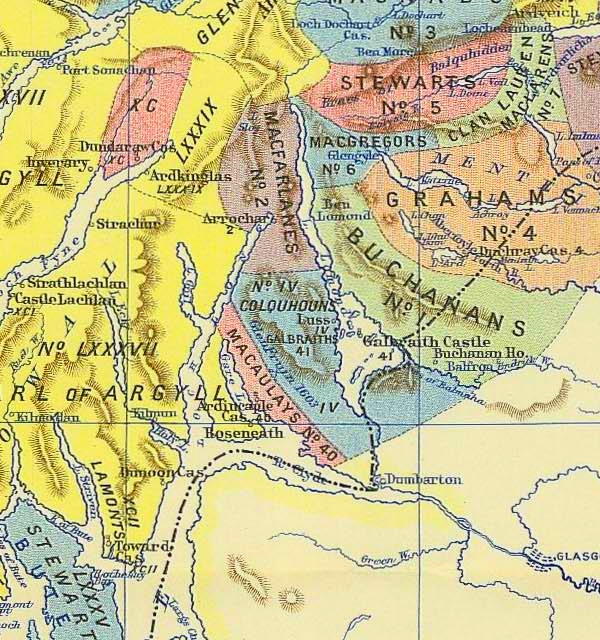
The exact identity and status of the two McFarlands, and their relationship, if any, to the McAuslands is unknown.
The MacFarlanes were reputedly descended from the Earls of Lennox, and they inhabited the area above the McAusland lands, on western shore of Loch Lomond from Tarbet northwards. The MacFarlanes were notorious for raiding cattle from the lands of their neighbours, in especial those of Clan Colquhoun, to such an extent that a full moon was known in the district as “MacFarlane’s Lantern“. Clan MacFarlane was denounced by the Government in 1594 for committing “theft, robbery, murder, and tyranny”, while on 7th February 1603 in the Battle of Glen Fruin the MacFarlanes were on the side of the MacGregors, while the McAuslands were on the side of Clan Colquhoun.
As the most important clan living just to the north of the lands of the McAusland Barons, it is perhaps unsurprising to see the McAuslands seeking to be on good terms with the more powerful MacFarlanes and to find some their neighbours witnessing sasines. There are also a number of McAusland-MacFarlane marriages listed in the Old Parish Registers, and several cases of MacFarlanes marrying into the McAusland Baronial family.
The lands of the MacFarlane clan were, like those of the McAuslands, sold off due to debts, in their case in 1767. The last MacFarlane chief died in 1866 leaving Clan MacFarlane, again like Clan McAusland, as an armigerous clan.
John McAusland

It is believed that John McAusland, witness to the 1690 Sasine, was likely to be the same John McAusland in Caldenoch, who was named in the 1694 Heath Tax Records. He is thought to be the younger brother of Baron Alexander, and as heir presumptive would obviously have a close interest in the affairs and future of the McAusland Barony.
Another possibility is that the witness named John McAusland was the John McAusland in Prestilloch who was named in the 1694 Hearth Tax Records. This John is believed to have been a close relative, possibly the cousin, of Baron Alexander. He is thought to be the same person who was named in the Sasine of 21th May 1678 from Alexander McAusland of Caldenoch to John McAusland in Prestelloch.
Andrew McInturnor and the McInturners (& Turners) of Tombuie
The Andrew McInturner who witnessed the Sasine of 10 June 1690 may have been descendant of the “Duncan Mackinturnour, elder in Lus” also described as “Duncane Mackinturnour, forth of his xxs. land of Glen- makearne” who was one of the victims of the 1602 Glenfinglas Raid.
Another of the Luss papers, entitled “Memorandum for Duncan Mackinturnour, elder in Lus,” records that, in the month of December 1602 years, at the herschip of Glenfinglas, two months before the day of Glenfruin, Duncan Mackewin Macgregor and his accomplices, to the number of fourscore persons, most cruelly reft, spoilzeit and away took from the said Duncane Mackinturnour, forth of his xxs. land of Glen makearne, twenty-five cows, and thirty sheep, the property of the said Duncan.“
The Chiefs of Colquhoun and their Country (Vol I). By William Fraser, Edinburgh (1869).
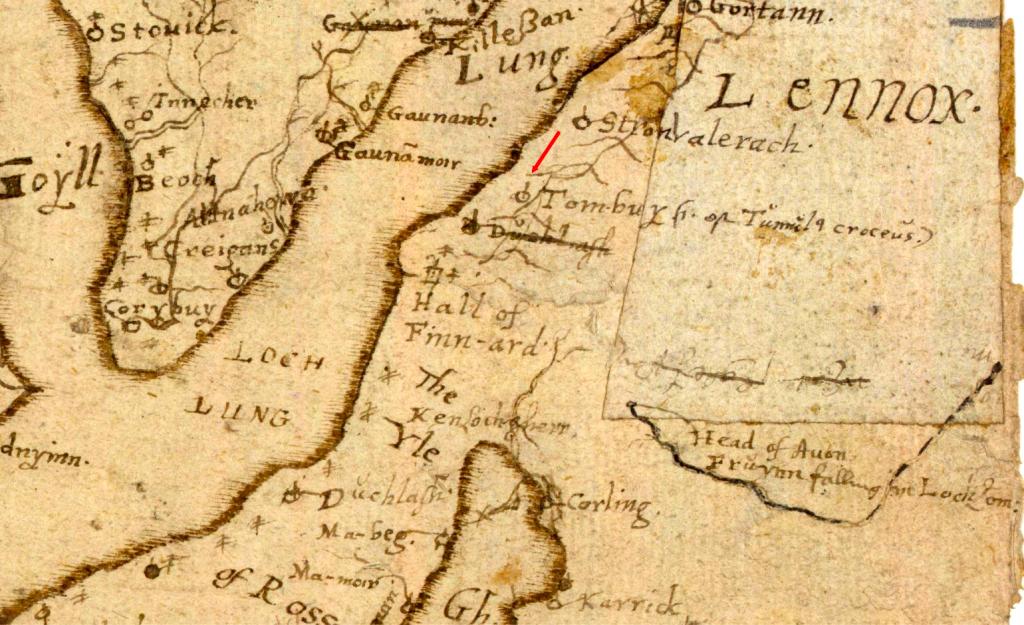
Used with the permission of the National Library of Scotland.
In The history and survey of Sròn Mallanach settlement in Argyll, Alistair McIntyre (History) and Tam Ward (Archaeology) mention a Patrick McInturner, who was tenant at Tombuie in Row parish in 1694:
“1694 Hearth Tax returns for Row Parish list names of persons with hearths, but unfortunately do not give locations. Glasgow-based Norman Easton, whose great grandfather (times 5), Patrick McInturner, was the tenant at Tombuie, has argued convincingly that in fact the list appears to form a progression, working southwards from the northern extremity of the Parish. If so then Stronmallanach might well appear just before the entry for Tombuie, in which case the tenant might be a John McIllheinch, with 1 hearth. However, this is somewhat speculative.“
They also note that a Patrick Turner, tenant at Tombouie, died on 5th April 1785, aged 74.
“A headstone in Luss churchyard records that John Turner, farmer, Crag McShet, died 26 December 1781, aged 66, wife Margaret McFarlane died 15 September 1789, aged 70, erected by son Archibald.
(Note: it may be significant that the adjacent headstone is to another Turner, Patrick, tenant at Tombouie, died 5 April 1785, aged 74. Tombouie lies about three miles to the south. Turner, or McInturner was a common name in and around the Luss area).“
It seems that Tombuie was only two miles south of the McAusland seat of Cullanach:
“1596 Contract between Alexander Colquhoun of Luss and John McCauslane in TOMBOWYS, containing disposition by said Alexander in favour of said John of an annual rent of £20 furth of said lands of Tomboye Parish and Barony of Luss, redeemable on payment of 300 merks. (Note: The reference to Parish of Luss conflicts with the entry under 1639 (q.v.) which states that Tombuie was located within the Parish of Rosneath. It is just possible that both statements are true: adjustments of parish boundaries did occasionally take place. However, simple error seems more likely. Note too that some McCauslans living in the area at this time, for example at Cullanach, about two miles north of Tombuie, were minor landowners, being styled “Barons”.“
The history and survey of Tombuoy settlement in Argyll by Alistair McIntyre (History) and Tam Ward (Archaeology).
All this information points to the McInturnors (later Turners) being neighbours living to the south of the McAuslands, and it is unsurprising to see one of them witnessing a McAusland charter.
The McAuslands & The McInturnours
It is interesting to look in more depth into a number of baptisms of children born to McAuslands and McInturnours and similar names between 1705 and 1721.
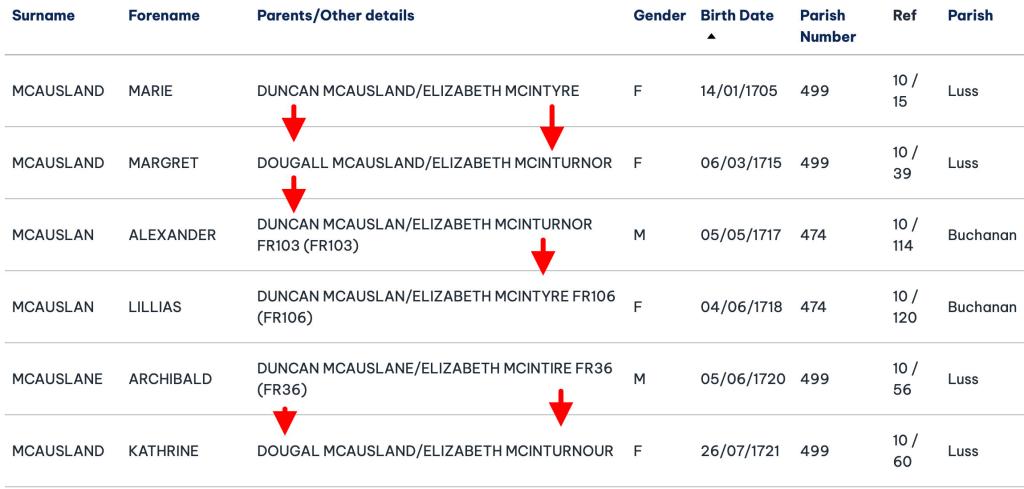
While initially it appeared that there were at least two different couples: Duncan McAusland & Elizabeth McIntyre and Dougal(l) McAusland & Elizabeth McInturno(u)r, with the baptisms of their children recorded in the Luss parish registers. However the discovery of an additional two baptisms in the Old Parish Registers of Buchanan parish in Stirlingshire in 1717 and 1718 led to the suggestion that Duncan & Dougal(l) might be interchangeable as might McIntyre and McInturno(u)r.
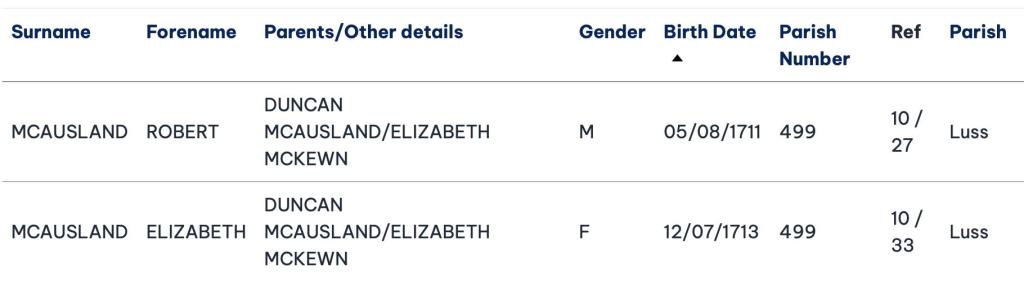
There is also a Duncan McAusland and Elizabeth McKewn who had children baptised in Luss in 1711 and 1713 who might be the same couple as the above.
Looking at the original records:
Marie McAusland, baptised 14th January 1705 was born at “Glenmakerin”.
Margret McAusland, baptised 6th March 1715 was born at “Conglen Bog”.
Robert McAusland, baptised 5th August 1711 was born at “Auchengaven“
Elizabeth McAusland, baptised 12th July 1713 was born at “Dunnmakarin” (?)
Alexander McAuslan, baptised 5th May 1717 was born at “in Doun in Luss”.
(Recorded in the OPRs of Buchanan parish, Stirlingshire)
Lillias McAusland, baptised 4th June 1718 was born at “Auchengaven“.
(Recorded in the OPRs of Buchanan parish, Stirlingshire)
Archibald McAuslane, baptised 5th June 1720 was born at “Auchengaven“.
Kathrine McAusland, baptised 26th July 1721 was born at “Edentagart” (a McInturnor property).
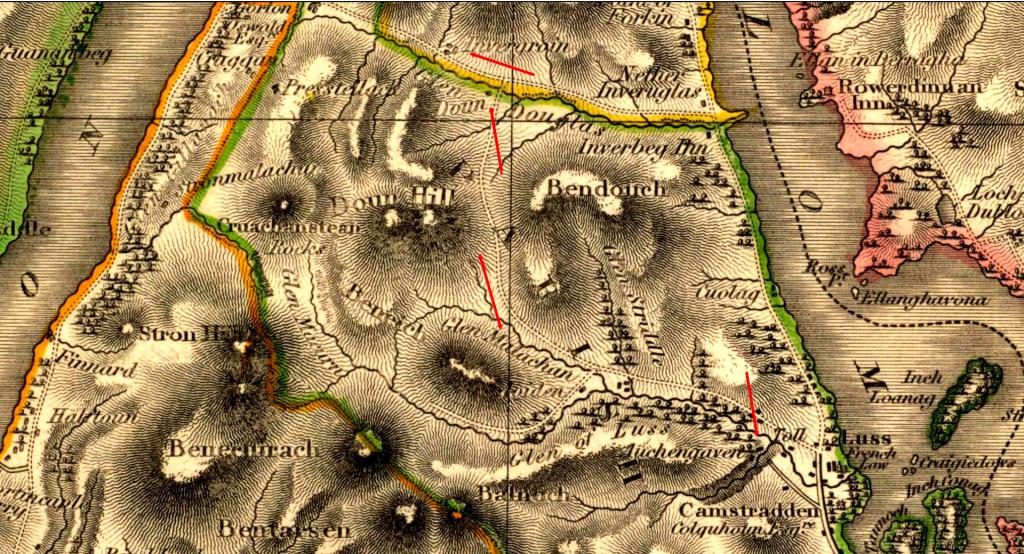
Used with permission of the National Library of Scotland.
This potential family appeared to have moved around a fair bit, but most of the locations associated with them lie along the road from Conglens/Invergroin in Glen Douglas to Doun and Auchengaven at the opposite ends of Glen Malachan.
While merely speculation, it seems possible that the Elizabeth McInturno(u)r who appears to have had children between 1705 and 1721 may have been a daughter or sister of the Andrew McInturnor who witnessed the 1690 Sasine.
The McAusland Baptisms in the Buchanan Parish Registers
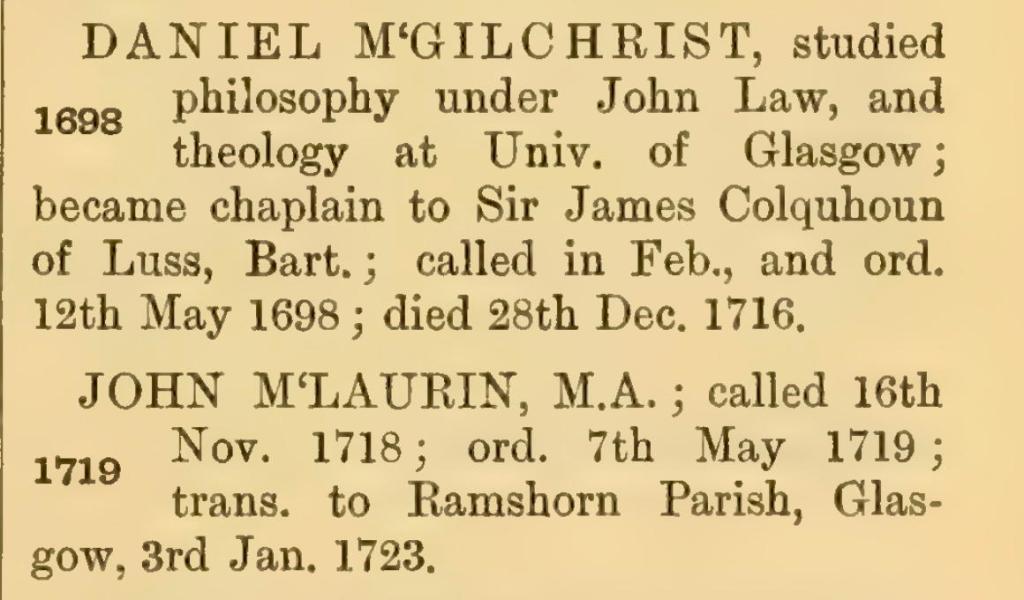
The two McAusland baptisms that appear in the Buchanan parish registers can be explained by the fact that Daniel McGilchrist, Minister of Luss died on 28th December 1716 and his successor, John McLaurin was not appointed until 16th November 1718. In the interim, at least some of the Luss baptisms were performed by the Minister from nearby Buchanan parish in Stirlingshire.
Duncan McAusland, “nearest heir”
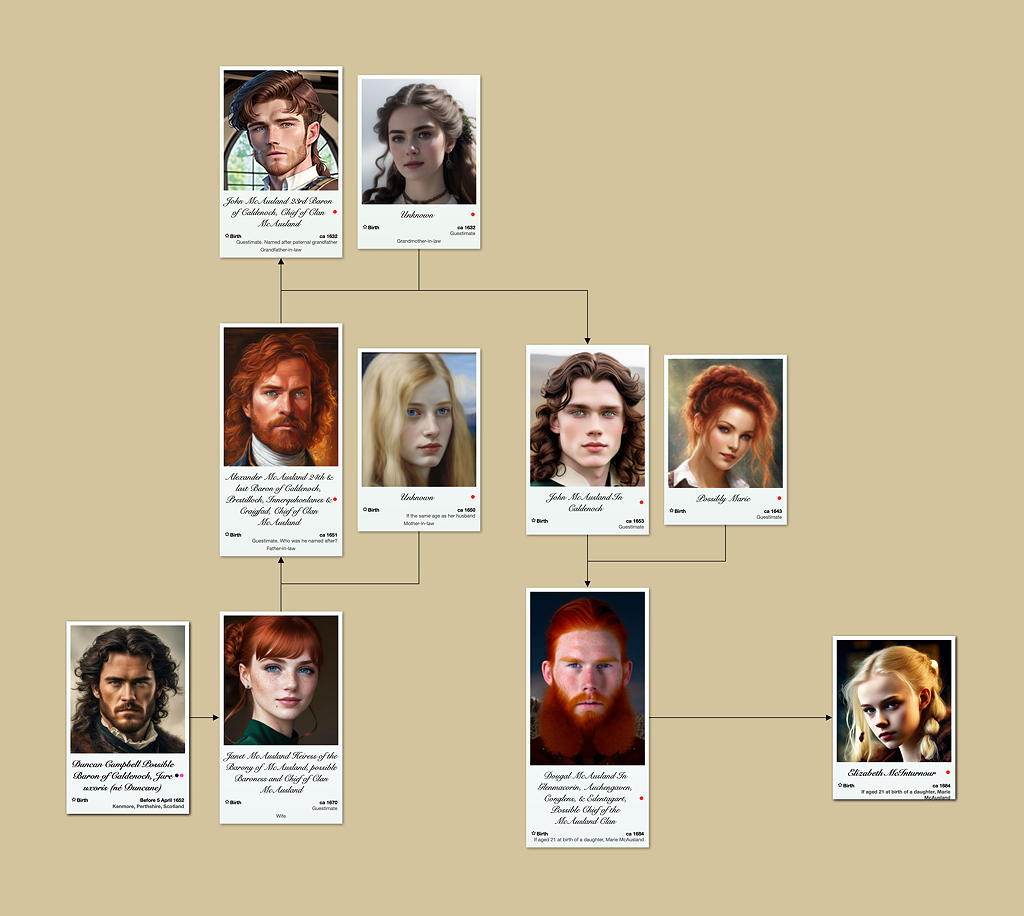
We believe that the the John McAusland who acted as witness in the 1690 Sasine for Janet McAusland and her husband Duncan Campbell was her paternal uncle.

We further believe that the Dougald McAuslane “neirest aire” who signed the 1711 letter to Oliver McCausland of Strabane was the son of the John McAusland who witnessed the 1690 Sasine and husband of Elizabeth McInturnor.
Thanks to Brian Anton, Matthew Gilbert, Michael Barr, Dave McCausland and others for helpful discussions and sharing their research.
 Vecchio