
Our interest in this person is that he married Janet McAusland, daughter of the last Baron McAusland. She was – depending on whether the lands were finally sold by her or her father – possibly the first and only Baroness McAusland in her own right.
Could Women Succeed to Scottish Feudal Baronies?

The Lennox Chronicles on Facebook.
An important question is could Janet McAusland, daughter of the last Baron McAusland, have been Baroness McAusland suo jure (in her own right)?
The answer is clearly yes. Amongst several examples, the Colquhouns inherited the barony of Luss via Isabella, 7th Baroness of Luss, suo jure (in her own right), while the Grants later inherited the baronies of Colquhoun and Luss via Anne Colquhoun.
According to the Scottish Genealogist Journal (2000) Part 2, page 37-38:
“The general rule was that baronies were descendable to “heirs” and it is appropriate that we should consider just how such heirs general were to be determined in different situations.
- Where there were male children the rule of primogeniture was applied and the eldest son succeeded.
- If there was no male child but an only daughter she succeeded to the barony and the lands. This was evidently the case from quite early times for we find that in 1160 Simon Fraser gave certain lands to the monks of Kelso and in 1190 this conveyance was confirmed by Eda, “filia et haeres Symonis Fraser“, i.e. “daughter and heiress of Simon Fraser“.
- If there were no male child but several daughters a complex situation could arise. The general rule with regard to succession when there were daughters only was that all should take equally as heirs portioners (the equivalent of co-heiresses in the law of England). It seems that the will of God indicated that, failing sons, an inheritance should belong to daughters. This was the decision which followed the petition of the daughters of Zelophedad to be allowed to succeed to their father in the absence of male issue. The derivation of this law is charmingly narrated by the great Institutional Writer on the law of Scotland, Sir Thomas Craig of Riccarton. “It wil be remembered that, in view of the difficult question raised by their petition, Moses consulted the Lord, who found that the case made by the daughters was a fair and reasonable one; and laid down, as a perpetual law of succession, that, failing sons, daughters should succeed ot their father. Indeed, it seems contrary to nature that women should be inade to occupy aposition to that of men”. (Craig, 2.16.9)
There was, however, a general rule in feudal law that those things that were indivisible pertained to the eldest daughter. Such elements were:
- The superiority;
- The caput of the barony;
- The baronial jurisdiction;
- The Principal Mansion house (seat of the family);
- Any titles of honour;
- Any heraldic additaments (chapeau and supporters).
With regard to a barony, therefore, where there are only daughters, we might find the following situation. The superiority, the caput, the baronial jurisdiction, titles of honour and heraldic additaments, would pass ot the eldest heir portioner. The lands might be divided equaly between the daughters. The shares of the junior daughters might be held by them as vassals of the eldest daughter in which case the extent of the barony would remain the same, and the daughters would give service at the baron court of their elder sister. The JURISDICTION could not be divided – it was IMPARTIBLE.“

From The Lennox Chronicles.
The Last Baron McAusland’s Daughter Sold Her Interest in the Barony to Sir Humphrey Colquhoun of Luss

According to William Buchanan of Auchmar, Alexander, the last Baron McAusland had an unnamed daughter who married an unnamed gentleman of the surname Campbell, and after his death she sold her interest in the Barony.
If it is true that it was Janet who sold the McAusland Barony, then she was ipso facto (by that very fact or act), the last holder of the title and Baroness McAusland.
The Husband of Janet McAusland is Identified as Duncan, the son of John Campbell, 3rd of Kinloch
A Sasine dated 10th June 1690 names the unknown Campbell as Duncan Campbell, son to John Campbell of Kinloch.


The date of this Sasine is of interest as in 1690, Janet’s father, Alexander McAusland, 24th & last Baron of Caldenoch in our reckoning and last Chief of Clan McAusland was still alive. He is listed in the 1694 Luss Hearth Tax records as “Allexander mccauslane of Caldenah“.
The date of this Sasine does tell us that Duncan Campbell and Janet McAusland were married sometime before 10th June 1690.
Duncan Campbell’s Parents

According to thepeerage.com, citing information from Burke’s Peerage, Duncan Campbell was the son of John Campbell, 3rd of Kinloch and his wife Annabella Campbell, the daughter of (not shown above) Patrick ‘Para Dubh Beag’ Campbell, 1st of Barcaldine.
The Campbells of Kinloch were a junior branch of the Campbell family, but were well connected. They descended from the Campbells of Murchie, and via them from the Campbells of Lawers (ancestors of the Earls of Breadalbane), and the Campbells of Glenorchy who were descended from Sir Neil Campbell. Duncan Campbell was descended from the first marriage, but Sir Neil might have claimed, like the MacGregors, that “My Race Is Royal” as his second marriage was to Mary Bruce, sister of the victor of Bannockburn, King Robert the Bruce.
Duncan Campbell’s First Marriage
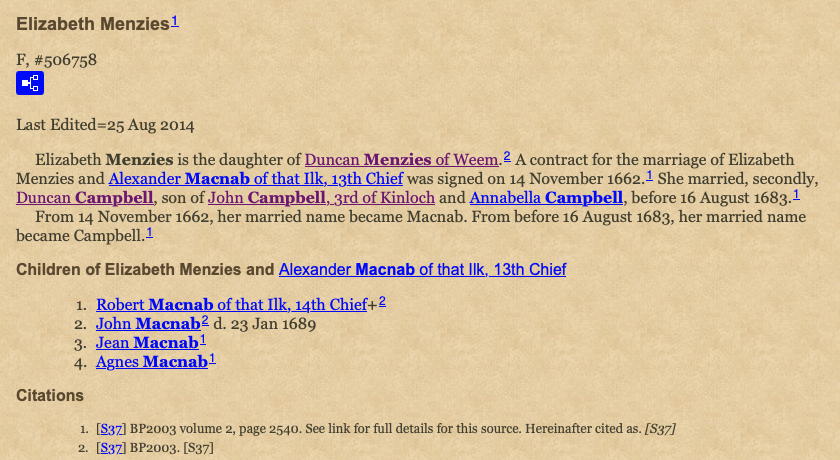
According to thepeerage.com, again citing information from Burke’s Peerage, Duncan Campbell had married, before 16th August 1683, Elizabeth Menzies, daughter of Duncan Menzies of Weem and the widow of Alexander Macnab of that Ilk, 13th chief of the Macnabs.
Elizabeth Menzies must presumably have died some time before the Sasine of 10th June 1690, by which time Duncan Campbell had married Janet McAusland of Caldenoch.
A Different Mother For John Campbell
The peerage.com has Duncan as the son of John Campbell, 3rd of Kinloch and Annabella Campbell, daughter of Patrick Campbell of Barcaldine. However, independent research in a monograph on the Kinloch family, written by a descendant, suggests a different wife from that listed in Burke’s Peerage.
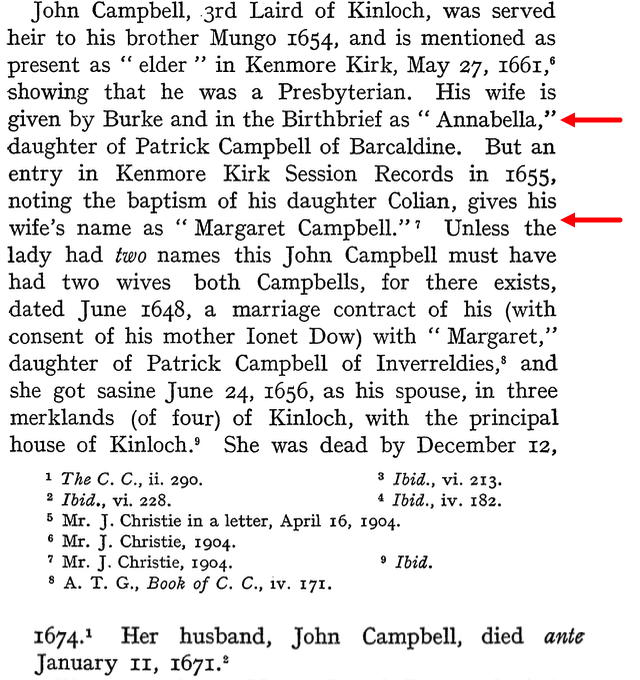
According to this history, in June 1648 there was a marriage contract between John Campbell (3rd of Kinloch), with the consent of his mother, Janet Dow, and Margaret (rather than Annabella) Campbell, daughter of Patrick Campbell of Inverreldies (rather than Balcardine).
Campbell genealogy can be complex and it does seem that The History of the Campbells of Kinloch is more likely to be correct than Burke’s Peerage and that Duncan Campbell’s mother was indeed Margaret Campbell, daughter of Patrick Campbell of Inverreldies.
Duncan Campbell was Baptised in Kenmore Kirk on 15th April 1652

Nothing now remains of the first Kenmore church, which was built in 1579, by Sir Colin Campbell of Glenorchy, itself as a replacement parish church for the medieval church at Inchadney. The 16th century building was entirely rebuilt in 1760 by John Campbell, 3rd Earl of Breadalbane. The cruciform church was again heavily renovated in 1870, when it was reroofed and its landmark square tower at the east end was heightened. Its chancel and and south transept were further reordered in 1923.

We carried out a search in the Old Parish Registers for Kenmore parish in Perthshire, where Duncan’s sister “Coliane” was reported to have been baptised in 1655. This revealed an entry that seems likely to be the Duncan Campbell who went on to marry Janet McAusland:
“1652. Ye fyfth day of Aprile being appointed for public _____ John Campbell and Margaret Campbell their lawful (son?) was baptised and called Duncane.“
This baptism in 1652 fits nicely with our “Guestimate” of circa 1653 for Duncan’s birth.
This would make Duncan aged 38 when he was named in the 1690 Sasine.
We do not as yet know when Duncan Campbell died, when he married Janet McAusland, possible last Baroness McAusland, and when she was born. However, this recent research has filled in a number of gaps regarding a couple whose Christian names were initially unknown.
As always, the McAusland research group is indebted to Brian Anton, Matthew Gilbert, Michael Barr, Dave McCausland and others for helpful discussions and sharing their research.
 Vecchio