The Possible Heirs of the Last Baron McAusland: Part 10 – McAusland: Sept of the Buchanans, or the Colquhouns, or Clan McAusland?
“Today, sept lists are used by clan societies to recruit new members. Such lists date back to the 19th century, when clan societies and tartan manufacturers attempted to capitalise on the enthusiasm and interest for all things Scottish. Lists were drawn up that linked as many surnames as possible to a particular clan, regardless of whether there was an actual historical connection to that clan surname. In this way, individuals without a “clan name” could connect to a Scottish clan and thus feel “entitled” to its tartan.” Sept.
McAusland – Sept or Clan?
In this, the tenth part of our series on the heirs of the McAusland Barons, we re-examine various claims that the McAuslands were either a sept of Clan Buchanan, or indeed of Clan Colquhoun. We conclude, however, having reviewed new evidence, that the McAuslands themselves did not consider that they were a sept of Clan Buchanan or Clan Colquhoun, but rather believed that they were Clan McAusland.
McAusland as a Sept of Clan Buchanan?
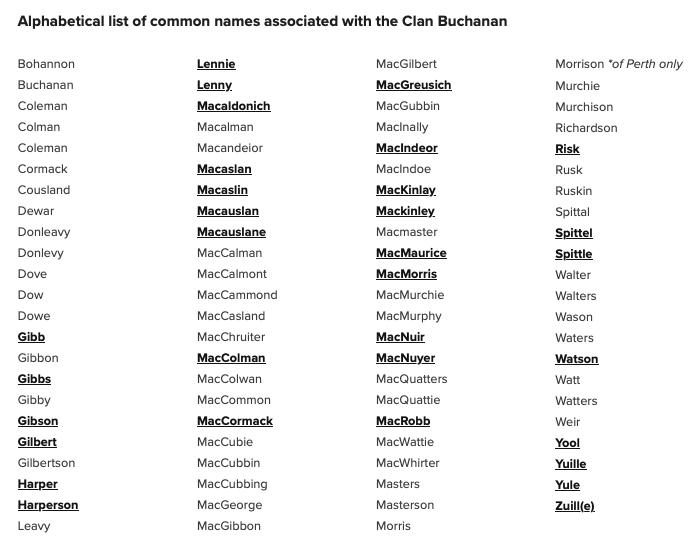
An excellent example of a clan association that appears to be attempting to link as many Scottish surnames as possible to their clan is seen in the list of septs published by the Clan Buchanan Association.
The Clan Buchanan Association lists over ninety surnames and their variants as belonging to septs of Clan Buchanan.
It should be noted that the Clan Buchanan Association is based in the USA and the current Buchanan Chief, Michael Buchanan of that Ilk freely admits that: “fewer than 100of the Clan Buchanan Association’s 4,000 members worldwide actually live in Scotland.“
It also should be noted that the Lord Lyon has ruled that: “While a clan or family association, society or other corporate body may be created thatbody is created only in support of a clan or family. That body is not itself the clan or family.“
In the case of the McAuslands, the claim by Clan Buchanan Association does has some basis in reality. Y-DNA studies prove that the McAuslands and Buchanans are closely related. Indeed, the chiefs of this clan were originally known as McAuslands, before adopting, as their surname, the name of their new territory of Buchanan, in Stirlingshire. This has led many to suggest (as can be seen in the comments) that rather than the McAuslands being considered to be a sept of Clan Buchanan, the Buchanans are really a sept of Clan McAusland.
McAusland as a Sept of Clan Colquhoun?
The Council of Scottish Clans and Associations is a registered public charity incorporated in the state of Delaware, in the United States of America. The organisation was founded in 1976 by Dr. Herbert MacNeal and others to support Scottish Clan organisations and preserve Scottish heritage.
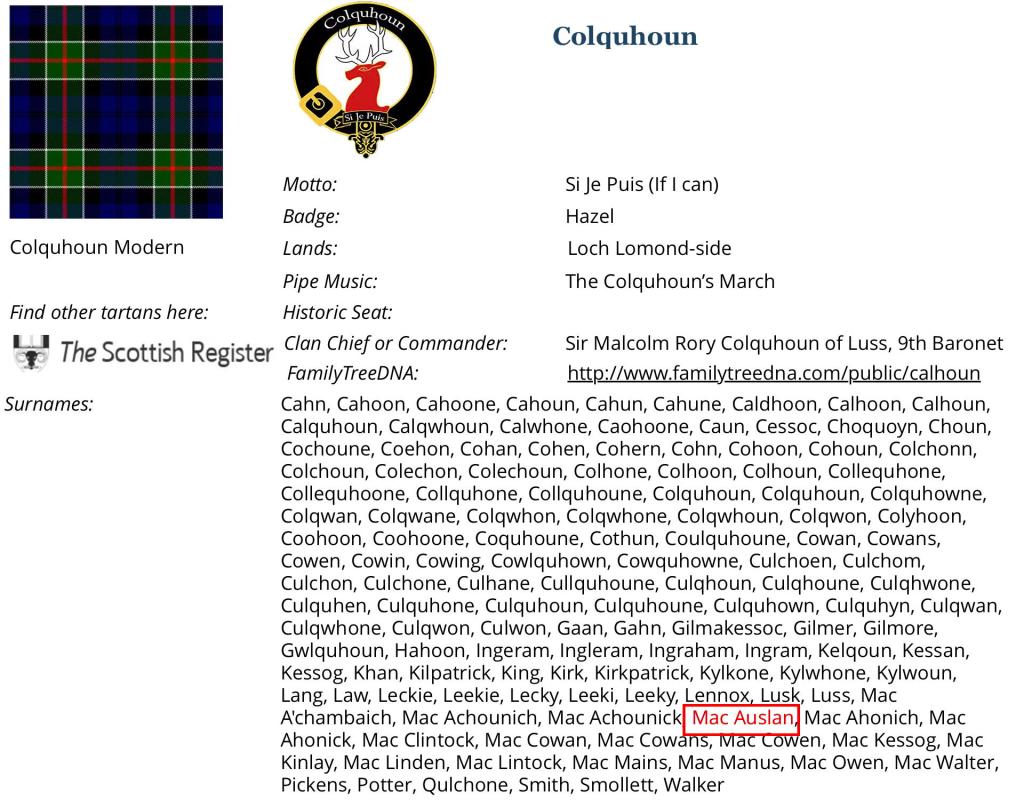
It is interesting to note that according to this organisation, the McAuslands are not a sept of Clan Buchanan, but rather of Clan Colquhoun.
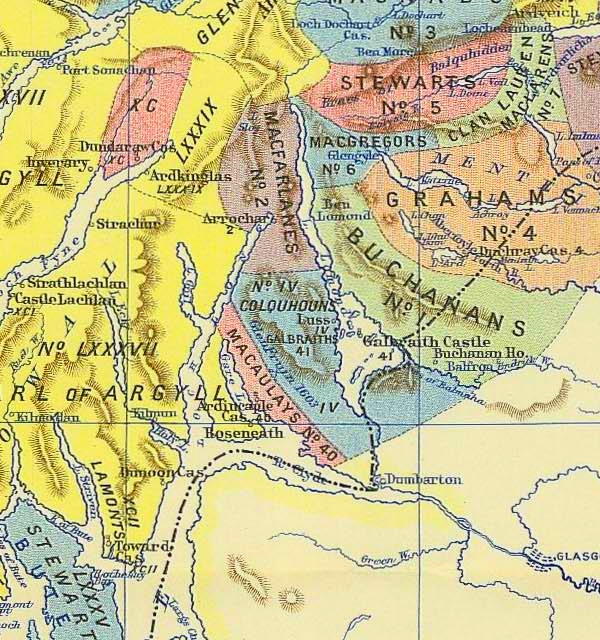
The map “Scotland of Old,” first published in 1956, is believed the most accurate “clan map”. It was created by Albany Herald, Sir Iain Moncreiffe of That Ilk, Baronet, (1919 –1985) and Unicorn Pursuivant of Arms, Don Pottinger (1919–1986), and was approved by the Standing Council of Scottish Chiefs and the Lord Lyon King of Arms. The map notes that the lands indicate “general spheres of influence, usually about the time of King James VI but taking the history of each district or family as a whole”.
The claim that the McAuslands are a sept of Clan Colquhoun, rather than Clan Buchanan, does have a certain logic to it. The McAusland lands were in Colquhoun territory – on the map they were located in Glen Cùlanach and Glen Fruin – along and to the north of the area marked “Glen Fruin, 1603“. The annotation refers to the 1603 battle, which was part of a long-standing conflict between the MacGregors and their allies, and the Colquhouns and their allies, including the McAuslands and the Napiers of Kilmahew. Clan Buchanan, whose lands lay to the east of Loch Lomond, appear to have played no part in this conflict. The feudal superiors of the McAuslands, as demonstrated by numerous charters, were the Colquhouns rather than the Buchanans, and the McAuslands, although undoubtedly related to the Buchanans, seem to have had little contact with that clan.
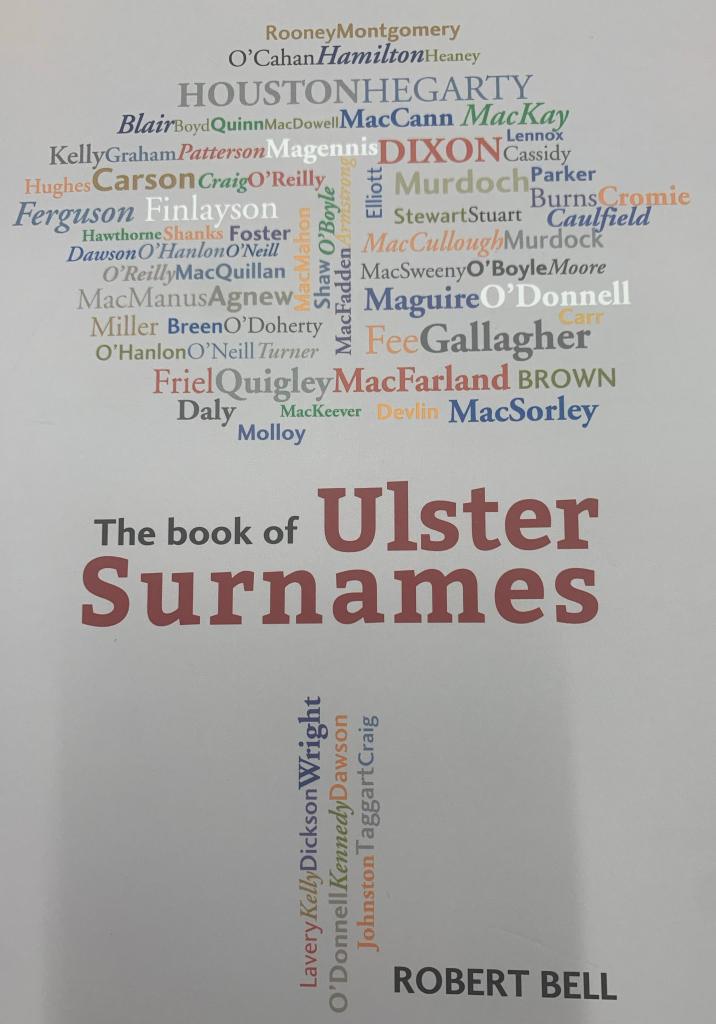
The Book of Ulster Surnames by Robert Bell
However, there is a third possibility that deserves to be considered. While visiting the National Library of Scotland in Edinburgh, I was fortunate to chance upon this book in their family history reference section.
The Book of Ulster Surnames by Robert Bell contains articles concerning over 500 of the most common family names of the nine county province of Ulster, with reference to thousands more.
Bell gives the meaning and history of each name, its original form, where it came from – Ireland, Scotland, England, Wales or France – and why it changed to what it is today. The index is an essential asset to the publication – providing nearly 3,000 surnames and variant spellings, cross-referenced to the main listing.
The book includes notes on some famous bearers of the name and where in Ulster the name is now most common. This new edition by the Foundation also includes an article by the author on the Riding Clans of the Scottish Borders, many members of which came to Ulster during the Plantation.
The result is a reference book which details much about the history of the Ulster Irish as well as the Scottish and English who arrived from the seventeenth century onwards, and is packed with surprising insights into the origins of a complex, turbulent people.
McAusland – Sept or Clan?
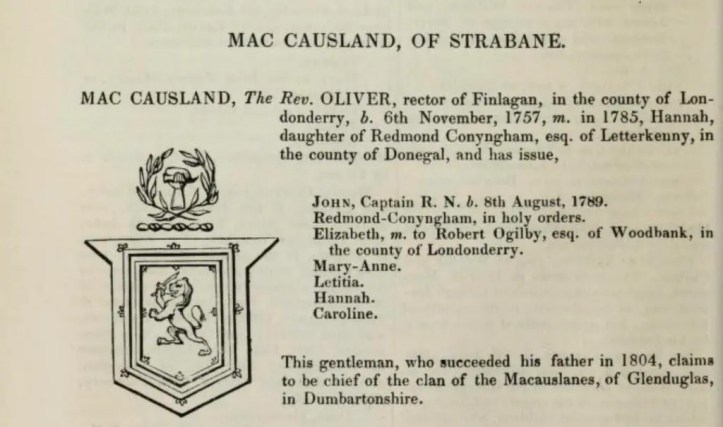
Entry for the Rev. Oliver MacCausland of Strabane, rector of Finlagan. From: A genealogical and heraldic history of the commoners of Great Britain and Ireland enjoying territorial possessions or high official rank, but uninvested with heritable honours, by John Burke (1836).
In response to this claim, in the first article in this series, I wrote:
“The Rev. MacCausland could not possibly be “Chief of the clan of the Macauslanes” for the very simple reason that the McAuslands are not a Clan. They are, in fact, a sept of Clan Buchanan – and a very ancient one as Buchanans were originally McAuslands before gaining lands to the east of Loch Lomond and becoming gradually McAuslands of Buchanan, and then Buchanans over several generations.”
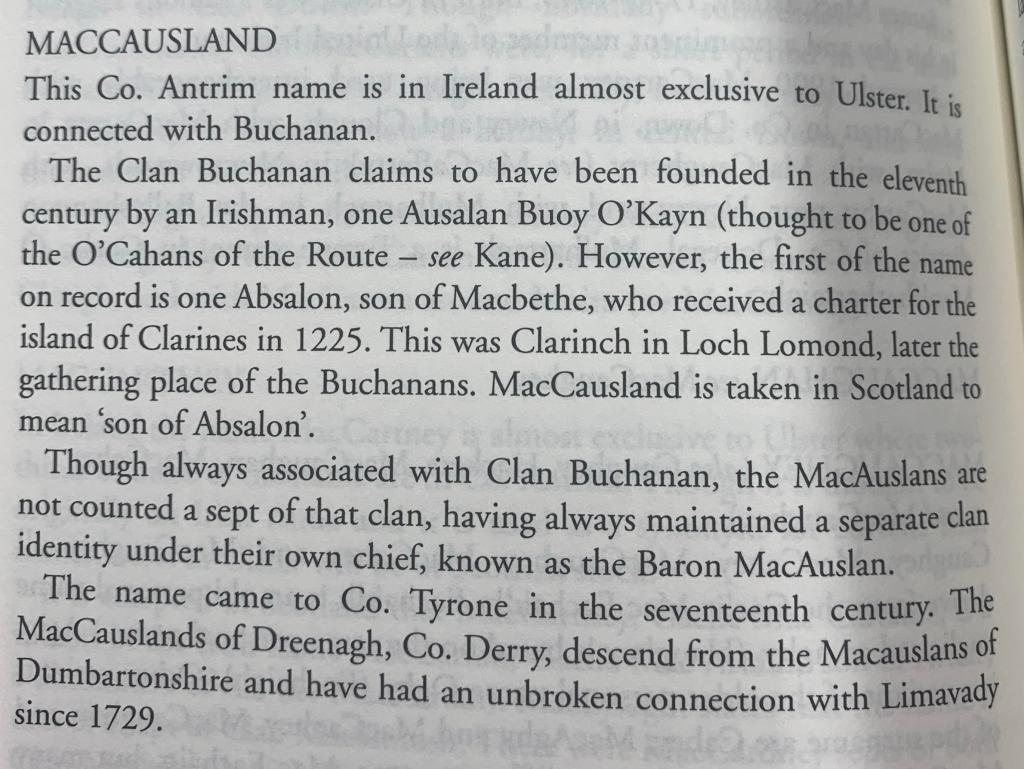
However, Robert Bell agreed with the Rev. MacCausland and declared that:
“Though always associated with Clan Buchanan, the MacAuslans are not counted a sept of that clan, having always maintained a separate clan identity under their own chief, known as the Baron MacAuslan.“
Entry for MacCausland The Book of Ulster Surnames by Robert Bell.
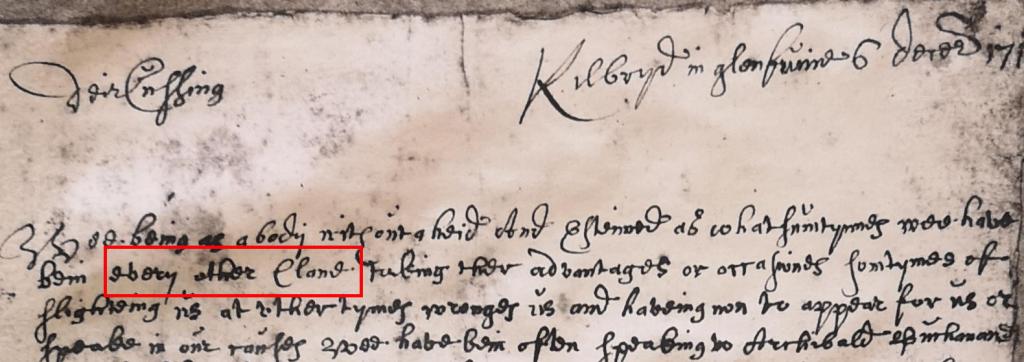
1711 Letter from Senior McAuslands in Scotland to Oliver McCausland in Ireland
The purpose of this blog is to carry out collaborative research into the history of the McAuslands and to challenge accepted dogma where the evidence suggests that there may be errors in popular histories or where the “winners” may have spun a story that does not always conform to reality.
In this case, the McAuslands were undoubtedly on the “losing” side, having been obliged to mortgage their Scottish feudal barony to their superiors, the Colquhoun Barons of Luss and see it disappear in the Colquhoun 1707 document of Tailzie, which legally ended the ancient McAusland Barony and absorbed it into the Barony of Luss (see part 7).
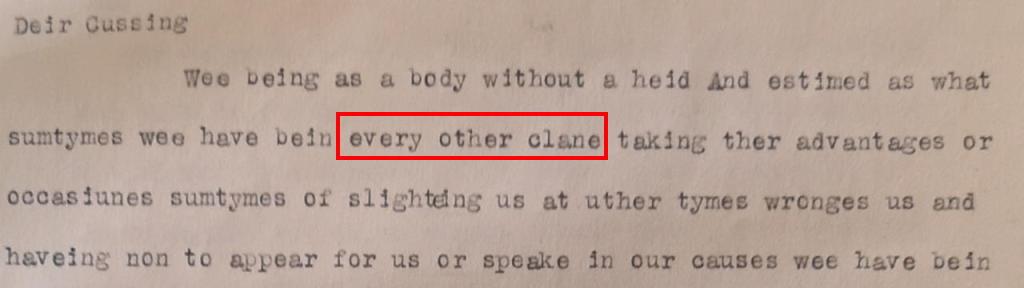
Without a leader, the McAusland family, whether Clan or Sept of Clan Buchanan became, in the words of its leading members in a letter of 1711: “like a body without a head with none to appear for them or speak for them…” They go on to lament that: “every other clane”has taken advantage of them, slighted them and wronged them.
The conclusion is crystal clear. In 1711, the senior McAuslands had no doubt whatsoever that they were a “clane” in their own right, rather than a mere sept.
Extract from 1711 letter from the McAuslands in Scotland to Oliver McCausland of Strabane. Reference T609.1, PRONI.Extract of transcript from a 1711 letter from the McAuslands in Scotland to Oliver McCausland of Strabane. Reference T609.1, PRONI.
1802 Letter from James Hendry to John McCausland in the Isle of Man
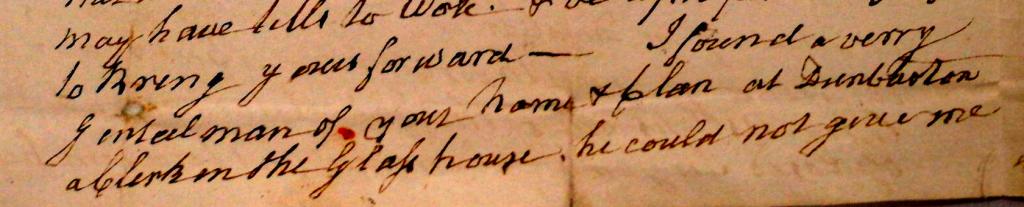
Extract from a letter of June 1802 about the ancient McAuslan lands at Luss, Dumbartonshire, and claims of Sir James Colquhoun to them and to election rights in that area urging John McCausland to claim his rights in the matter, from James Hendry, Sweethop, to John McCausland at Mr Hendry’s, Ramsey, I.O.M. Includes copy of letter to John McAusland from John MacAuslane (piece number 118). Reference D669/117, PRONI
There is also a letter of June 1802 from John Hendry to John McCausland, great grandson of Oliver McCausland to whom the 1711 letter was addressed. This mentions that Mr Henry had “found a verry gentalman of your name & Clan at Dunbarton…” indicating that the author also considered the McAuslands were a Clan.
Summary
In 1711, the senior McAuslands in Scotland clearly believed that they were a “clane“.
In June 1802, James Hendry at Sweethope described the McAuslands as a “Clan“.
In 1836, Rev. Oliver MacCausland of Strabane claimed to be Chief of the Clan of the McAuslanes of Glenduglas in Dunbartonshire.
In 1997, Robert Bell wrote: “Though always associated with Clan Buchanan, the MacAuslans are not counted a sept of that clan, having always maintained a separate clan identity under their own chief, known as the Baron MacAuslan.“
Conclusion
“It is for the Lord Lyon to determine who has legally succeeded and is entitled to bear the undifferenced arms of a clan or family.“ Dr James Morrow, Lord Lyon King Of Arms, 6th December 2021.
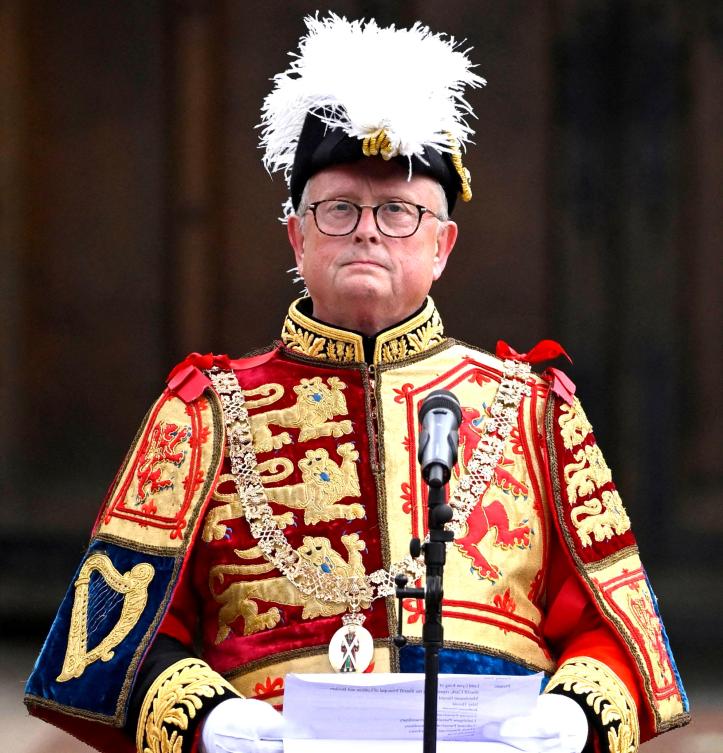
The Lord Lyon King of Arms, Joseph Morrow attending the proclamation of the new King, King Charles III, from the Esplanade of Edinburgh Castle, in Edinburgh, on September 11, 2022. (Photo by Neil Hanna / AFP)
While the final legal decision rests with the Lord Lyon King Of Arms, we believe that we have seen enough evidence, from 1711 through to 1997, to confirm that the McAuslands were considered, both by themselves and others, to be a Clan and not a mere sept of either Clan Buchananof Clan Colquhoun.
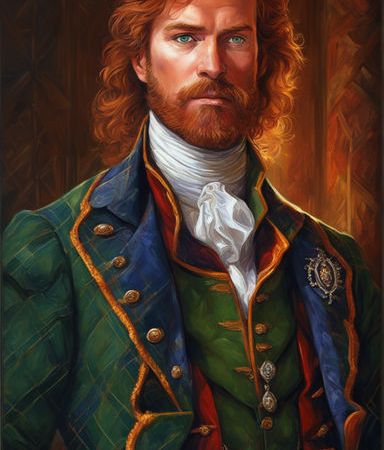
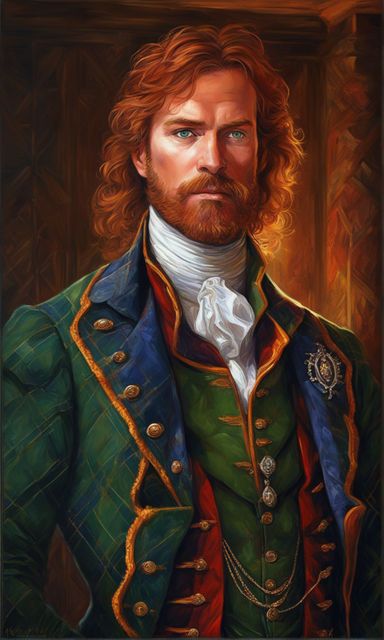
Avatar for Alexander McCauslane of Caldenocht, (flourished 20 May 1664 to 1694)possible 24th & last Baron of Caldenoch, and last Chief of Clan McAusland. Image Copyright Playgroup.
Thanks to Brian Anton, Matthew Gilbert, Michael Barr, Dave McCausland and others for helpful discussions and sharing their research.
This page also states: “McCausland (Mac Ausaláin in Gaelic), meaning “Son of Absolom” is a surname of Irish origin; there is also a clan of this name in Scotland.”
McCausland (Mac Ausaláin in Gaelic), meaning “Son of Absolom” is a surname of Irish origin; there is also a clan of this name in Scotland. The family claim descent from the Cenel Eoghain race in County Londonderry and County Tyrone, a branch of the Ui Neil.
Alternatively, the surname may be an Anglicization from a Gaelic name, as was the case with many Irish surnames, changing to sound more English over the centuries. The surname “Mac Ausaláin” may have an underlying Gaelic personal name, possibly Caisealán, meaning ‘little one of the castle’.
Excellent article. Thanks to you and all your colleagues for your hard work in debunking myths. Rather than the McAuslands being a sept of clan Buchanan, I think it would be much more logical to consider that the Buchanans are a sept of Clan McAusland.

 Vecchio
This page also states:
“McCausland (Mac Ausaláin in Gaelic), meaning “Son of Absolom” is a surname of Irish origin; there is also a clan of this name in Scotland.”
https://en.wikipedia.org/wiki/McCausland
McCausland
McCausland (Mac Ausaláin in Gaelic), meaning “Son of Absolom” is a surname of Irish origin; there is also a clan of this name in Scotland. The family claim descent from the Cenel Eoghain race in County Londonderry and County Tyrone, a branch of the Ui Neil.
Alternatively, the surname may be an Anglicization from a Gaelic name, as was the case with many Irish surnames, changing to sound more English over the centuries. The surname “Mac Ausaláin” may have an underlying Gaelic personal name, possibly Caisealán, meaning ‘little one of the castle’.
LikeLiked by 3 people
Excellent article. Thanks to you and all your colleagues for your hard work in debunking myths.
Rather than the McAuslands being a sept of clan Buchanan, I think it would be much more logical to consider that the Buchanans are a sept of Clan McAusland.
LikeLiked by 2 people