

In Part 1 we noted that, according to Burke’s, the Rev. Oliver McCausland of Strabane claimed to be “Chief of the clan of the Macauslanes, of Glenduglas, in Dumbartonshire”. We demonstrated that:
1) The McAuslands were based not in Glen Duglas, but at Callanach in Callanachglen.
2) In this seres, we initially concluded that McAuslands were a Sept of Clan Buchanan, but having since seen new evidence we have since concluded that the Irish McCauslands were correct to describe the McAuslands as a Clan.
3) As the Rev. MacCausland had not been recognised by the Lord Lyon King of Arms, he was not the Chieftain of the McAusland sect.
In Part 2, we look at sources which suggest that:
1) The Rev. McCausland was the senior male representative of the Irish line of McAuslands, and
2) He was also descended from one of the McAusland Barons.
The PRONI tree showing the descent of the Rev. Oliver McCausland from “Baron McAuslane”

The Northern Ireland Archives (PRONI) are an incredibly useful reference for researchers. In 2018, Dave McCausland from the USA and his wife visited Ireland and Scotland to look into Dave’s McAusland ancestry. They visited PRONI as detailed in their fascinating blog entry. Dave was kind enough to send me a copy of the Irish McAusland tree that is held there and which shows nine generations of the McAusland family. The tree appears to have been compiled in 1814 was extended in 1830, and was certified by the King of Arms for Ireland.
The tree demonstrates that the Reverend Oliver McCausland of Strabane was the great (x3) grandson and senior male-line descendant of Alexander McAuslane, who came to Ireland in the reign of King Charles I and who served with Oliver Cromwell.
The Rev. McCausland was therefore, according to this tree, the senior male representative of the Irish McAusland line and descended from an unnamed McAusland Baron.
The Rev McCausland’s McCausland Lineage in Burke’s Landed Gentry
A similar lineage for the Rev. Oliver McCausland can also be found in Burke’s “A genealogical and heraldic history of the Landed Gentry of Great Britain and Ireland” with the following entries being taken from the 1847 edition.

Source: A genealogical and heraldic history of the Landed Gentry of Great Britain and Ireland, Vol. 2 M-Z by John Bernard Burke Esq. (1847) Henry Colburn, London.
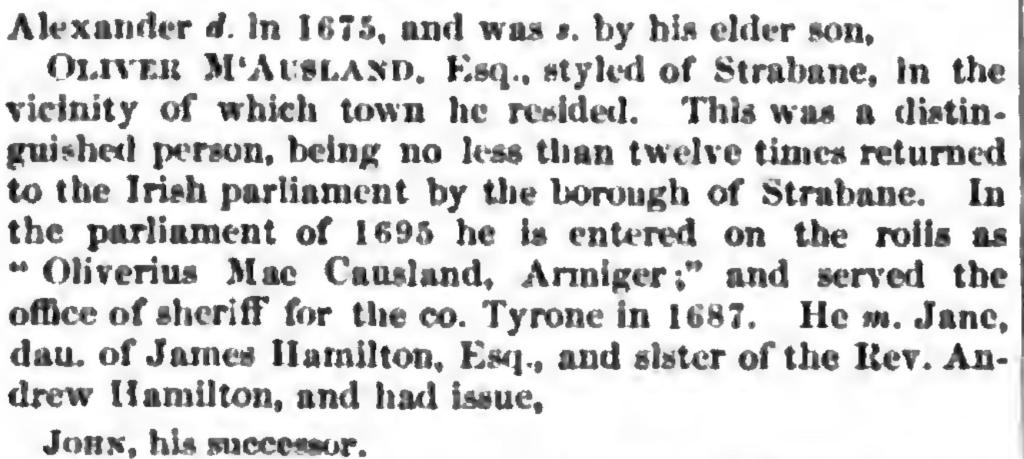
From: A genealogical and heraldic history of the Landed Gentry of Great Britain and Ireland, Vol. 2 M-Z by John Bernard Burke Esq. (1847) Henry Colburn, London.
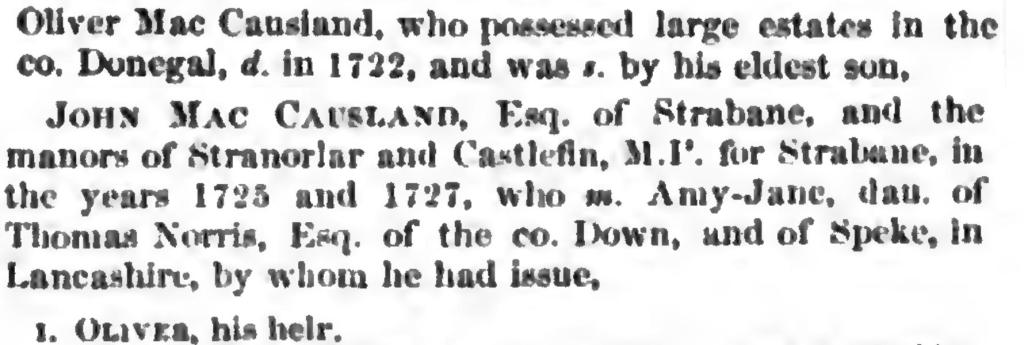
From: A genealogical and heraldic history of the Landed Gentry of Great Britain and Ireland, Vol. 2 M-Z by John Bernard Burke Esq. (1847) Henry Colburn, London.

From: A genealogical and heraldic history of the Landed Gentry of Great Britain and Ireland, Vol. 2 M-Z by John Bernard Burke Esq. (1847) Henry Colburn, London.

From: A genealogical and heraldic history of the Landed Gentry of Great Britain and Ireland, Vol. 2 M-Z by John Bernard Burke Esq. (1847) Henry Colburn, London.
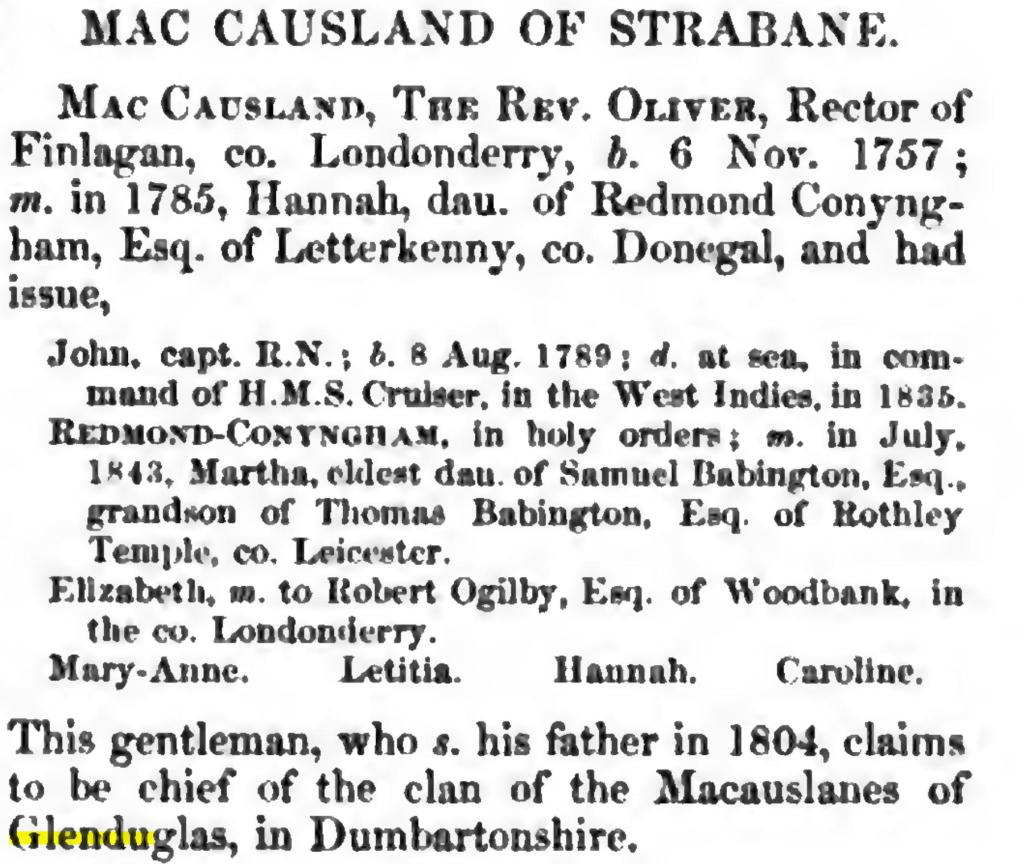
From: A genealogical and heraldic history of the Landed Gentry of Great Britain and Ireland, Vol. 2 M-Z by John Bernard Burke Esq. (1847) Henry Colburn, London.
The Rev. McCausland was also, according Burke’s Landed Gentry, the senior male representative of the Irish McAusland line and descended from one of the McAusland Barons.
However, which McAusland Baron was the progenitor of the Irish McAuslands? We will investigate that in Part 3 of this series.
Thanks to Brian Anton, Matthew Gilbert, Michael Barr, Dave McCausland and others for helpful discussions and sharing their research.
 Vecchio