
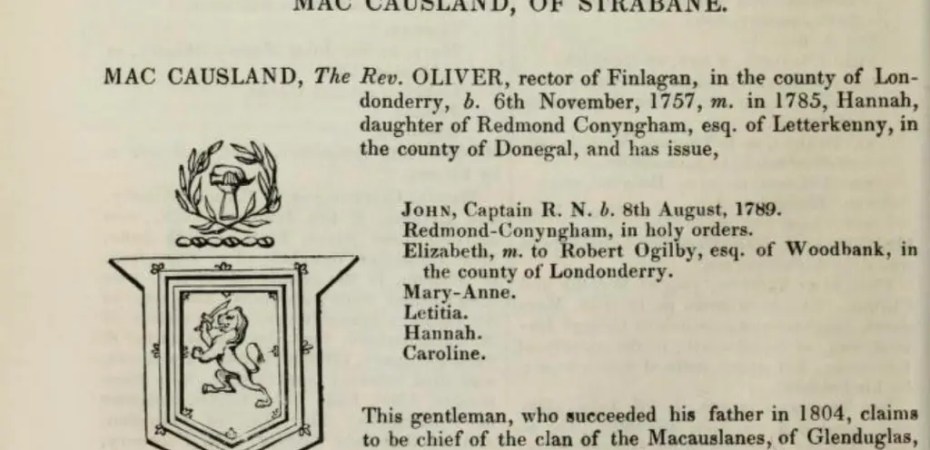
In 1836, John Burke published an article regarding The Rev. Oliver MacCausland, rector of Finlagan, in the county of Londonderry, b. 6th November 1757. The entry states:
“This gentleman, who succeeded his father in 1804, claims to be chief of the clan of the Macauslanes, of Glenduglas, in Dumbartonshire.”
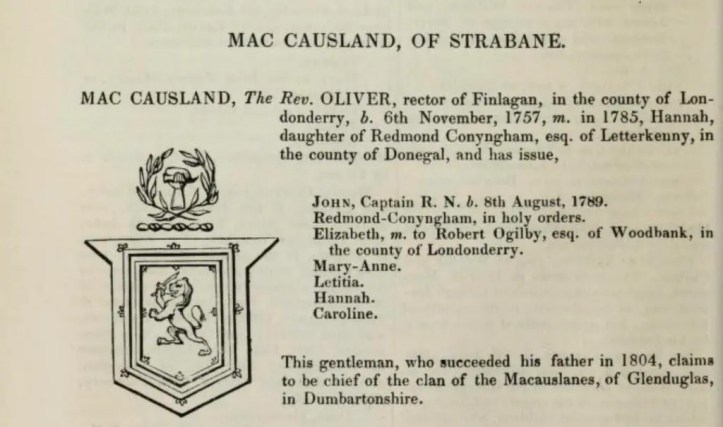
So how did it come about that a Minister of the Church of Ireland, living at Finlagan in County Londonderry, in what is now Northern Ireland, could make the rather extraordinary claim to be “Chief of the clan of the Macauslanes, of Glenduglas, in Dumbartonshire.”?
Before investigating the legitimacy of his claim, it is perhaps worth looking into the accuracy of what, at least according to Burke, the Rev. MacCausland actually claimed.
The McAuslands Barons were not based in Glenduglas but in Callanachglen

The road through Glenduglas follows the magenta arrow, while the road through Callanachglen follows the red arrow. Two of the main McAusland properties, “Callanach” and “Presshellach” (aka Prestelloch) are indicated with green arrows.
Reproduced with the permission of the National Library of Scotland.
It should be noted that the main seat of the McAusland Barons was not in Glenduglas, but at nearby Caldenoch or Cullanach – there are many variants of the spelling. This settlement, the caput of the McAusland barony, lay in a valley that was once known as Callanachglen, and described as Glen Cùlanach on modern OS maps.” It is believed to translate as “place of hazels”.
Glen Cùlanach lies roughly south-west to north-east, parallel to Loch Long, while Glenduglas runs from north-west to south-east between Loch Long and Loch Lomond.
Many McAuslands also lived to the south, in Glen Fruin, which was the site of the 1603 battle between the MacGregors and their allies and the Colquhouns and their allies, including the McAuslands.
How Did the Reference to Glenduglas Arise?
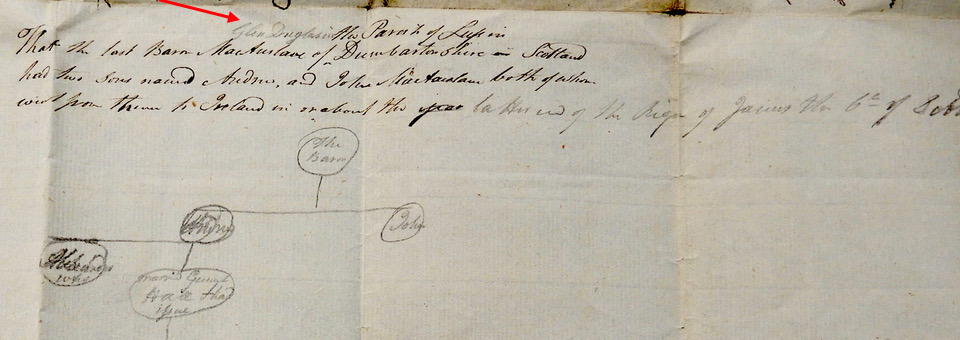
It is interesting to note that there exists what appears to be a draft version of the tree for the Irish branch of the McAuslands. This was presumably drawn up soon after 1802 when it was suggested (see part 13 of this series) that they should investigate their exact relationship to the baronial family. In this draft, “Glen Duglas” appears in faded text, perhaps being a later pencil addition rather than in ink.
As noted elsewhere in this series, it seems possible that before emigrating to Ireland, the progenitor of that line resided at the McAusland property of Conglens (Conaglan on the 1777 map above), which is ideed in Glen Duglas.
The McAuslands: Clan McAusland, or sept of Clan Buchanan?
Initially we stated: “Secondly, the Rev. MacCausland could not possibly be “Chief of the clan of the Macauslanes” for the very simple reason that the McAuslands are not a Clan. They are, in fact, a sept of Clan Buchanan – and a very ancient one as Buchanans were originally McAuslands before gaining lands to the east of Loch Lomond and becoming gradually McAuslands of Buchanan, and then Buchanans over several generations.“
However, as detailed in the tenth article of this series, entitled, “McAusland: Sept of the Buchanans, or the Colquhouns, or Clan McAusland?“, we later concluded that “having reviewed new evidence, that the McAuslands themselves did not consider that they were a sept of Clan Buchanan or Clan Colquhoun, but rather believed that they were Clan McAusland.“
Chiefs of Clans and Chieftains (i.e. Chiefs of Septs)
The Court of the Lord Lyon have produced a very helpful guide (on the use of Crest Badges) which states:
“Much confusion exists about the meaning, use and entitlement to wear Scottish Crest Badges, and it is constantly increased by well—meaning but ill—informed explanations. This leaflet is authoritative in setting out the main facts. Even the popular name “Clan Crest” is a misnomer, as there is no such thing as a “Clan” Crest. The Crest is the exclusively personal property of the Clan Chief, and it is fully protected to him by the law in Scotland. The circumstances in which it may be worn by his clansmen are set out hereafter.“….
The article also explains the differences between Chiefs of Clans and Heads or Representers of Families:
“Chiefs are heads of very large “extended” families, including all of the same surname and probably many “septs” as well. “Septs” are large extended families (i.e. including distant cousins and connections) within a Clan but bearing different surnames from that Clan, usually the result of arbitrary fixing of surnames about the 17th century, prior to which surnames were not general in their modern form in Scotland. Fairly comprehensive lists of sept names and their Clans are given in “The Clans, Septs and Regiments of the Scottish Highlands” by Frank Adam and Sir Thomas Innes of Learney, 6th ed.196O, in two extensive appendices, and also in “The Official Tartan Map” by John Telfer Dunbar and Don Pottinger, Hamish Hamilton 1976.
“Heads or REPRESENTERS of families are those whose claims to be the genealogically senior living persons of their surnames have been Officially Recognised by the Lord Lyon King of Arms, and are recorded as such in the Lyon Register. They are usually heads of extended families too small in number to claim to be “Clans”. But they can be small or Lowland too; “Clan” simply means “family” in the broad sense.”
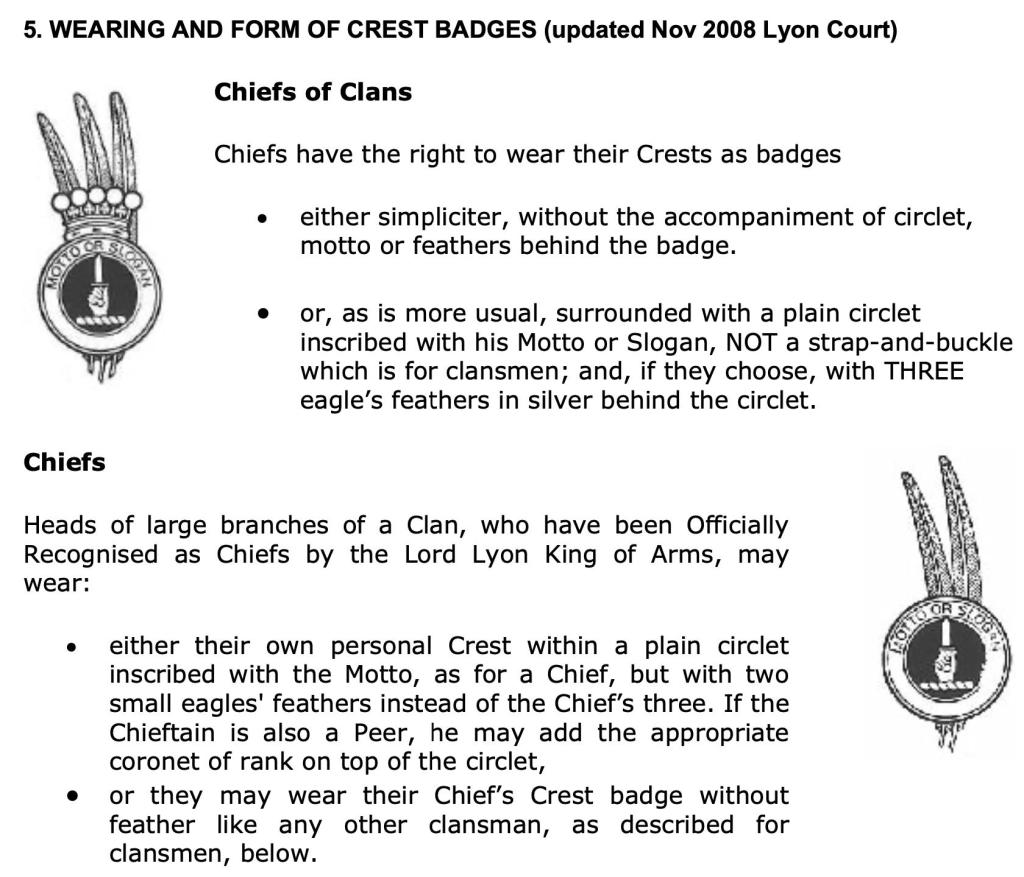
To summarise:
The Buchanans are a Clan and have a newly appointed Clan Chief who is entitled to wear his personal crest along with three eagle’s feathers.
The McAuslands are also a clan, but they are an armigerous one as there has not been a McAusland Chief since the loss of the McAusland Barony in 1690s. Should a new McAusland Clan Chief be recognised by the Lord Lyon, he (or she) would be entitled to wear his personal crest along with three eagle’s feathers.
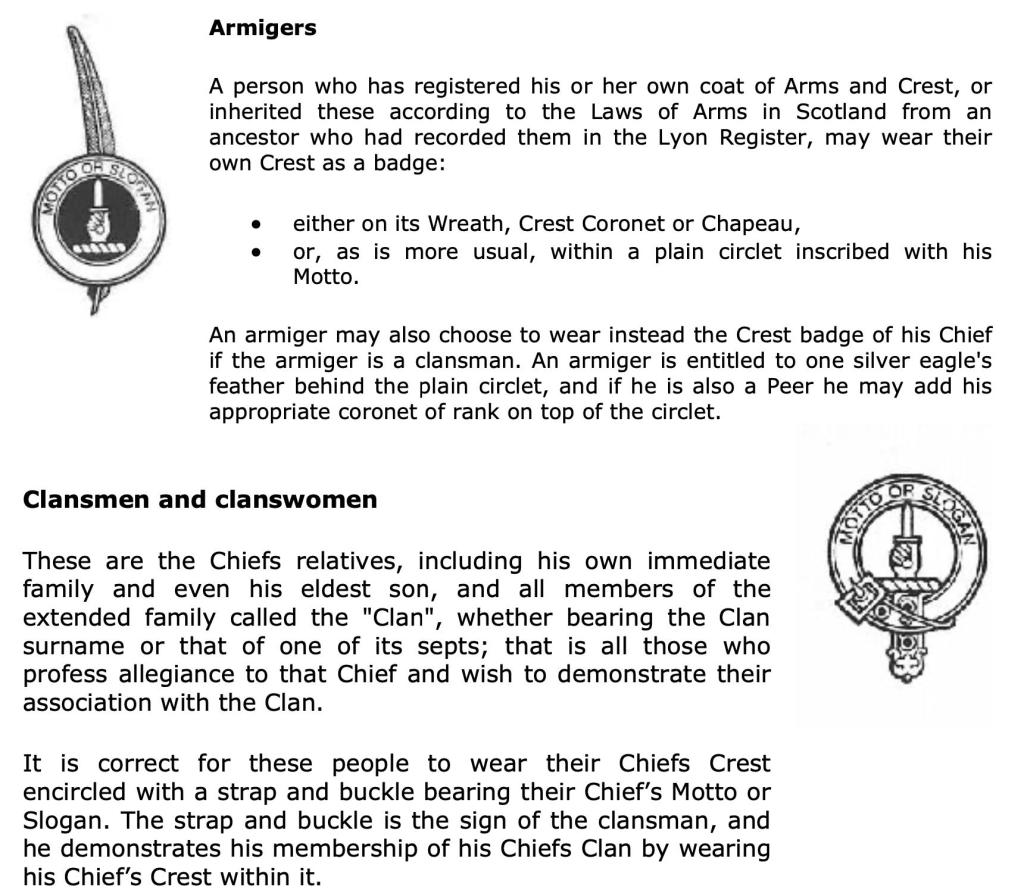
For completeness, it should be noted that there are two additional ranks; Firstly Armigers (those who have their own coat of arms) and who are entitled to one eagle’s feather.
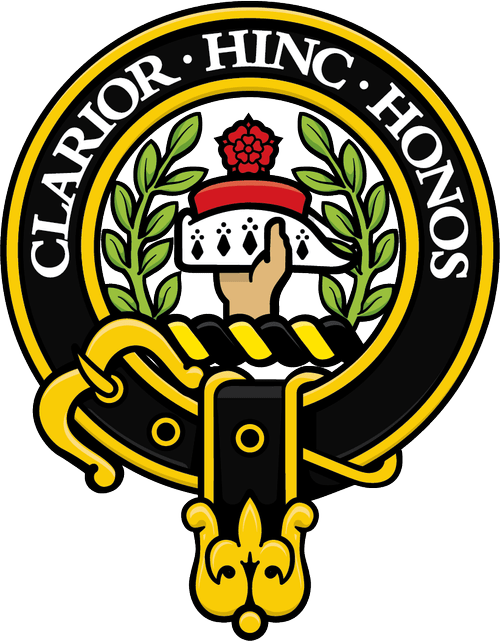
© Copyright 2024 by The Clan Buchanan Society International Inc.
Finally, there are ordinary members of the clan who can wear as a badge their chief’s Crest, but that must be encircled with a strap and buckle bearing their Chief’s Motto or Slogan.)
The Neighbours of the McAuslands
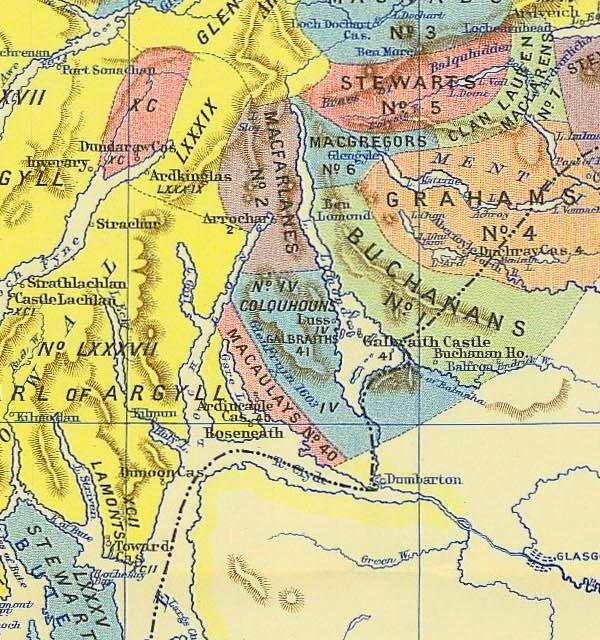
The above map shows the areas of influence of the major Scottish clans in the reign of James VI. As has been noted, the McAuslands are related to Clan Buchanan, whose lands are highlighted in green to the east of Loch Lomond. However, the McAuslands were based in the lands of the Colquhouns, their fueodal superiors, in the territory highlighted in blue to the west of Loch Lomond. The McAusland lived along and to the north of the area marked “Glen Fruin 1603” (the site of the 1603 battle between the Colquhouns and their allies (including the McAuslands) and the MacGregors and their allies).
As noted by The Clan Buchanan Society International: “The first recorded McAusland was Malcolm, Steward to Maldouen, Third Earl of Lennox during the reign of David II (1124-1153 A.D.) Malcolm may have inhabited land in Glen Fruin as well as in Luss, all to the west of Loch Lomond, whereas the current lands of Buchanan are to the east of Loch Lomond. This Malcolm may have been the Baron MacAuselan from whom the bearers of the patronym are descended. The seventh Chief of Buchanan, Gilbert, appears to be the first to permanently assume the surname of Buchanan rather than McAusland.“
Conclusion: The Rev. MacCausland was not Chief of the McAuslands
The Rev. MacCausland’s claim to be Clan Chief had not been recognised by the Lord Lyon King of Arms. As such, he would not have been entitled to wear three eagle’s feathers in his bonnet.
The Rev. MacCausland was, nevertheless, an important member of the Clan McAusland, and an armiger. As such he would been entitled to wear three eagle’s feathers in his bonnet.
But the Rev. MacCausland have a legitimate claim to be Chief of Clan McAusland and wear three eagle’s feathers or to be a Chieftain of the McAusland sept, and two eagle’s feathers?
In order to determine this, in the following article we will next look into Rev. MacCausland’s ancestry.
Thanks to Brian Anton, Matthew Gilbert, Michael Barr, Dave McCausland and others for helpful discussions and sharing their research.
 Vecchio