
In this, the eighth of a series of articles on the McAuslands of Caldenoch, we will examine John McCaslane of Caldenoth, possible 20th Baron of Caldenoch.
John McCaslane of Caldenoth, possible 20th Baron flourished December 1602
Image Copyright Playgroup.
The 1602 Raid of Glen Finglas & 1603 Battle of Glen Fruin
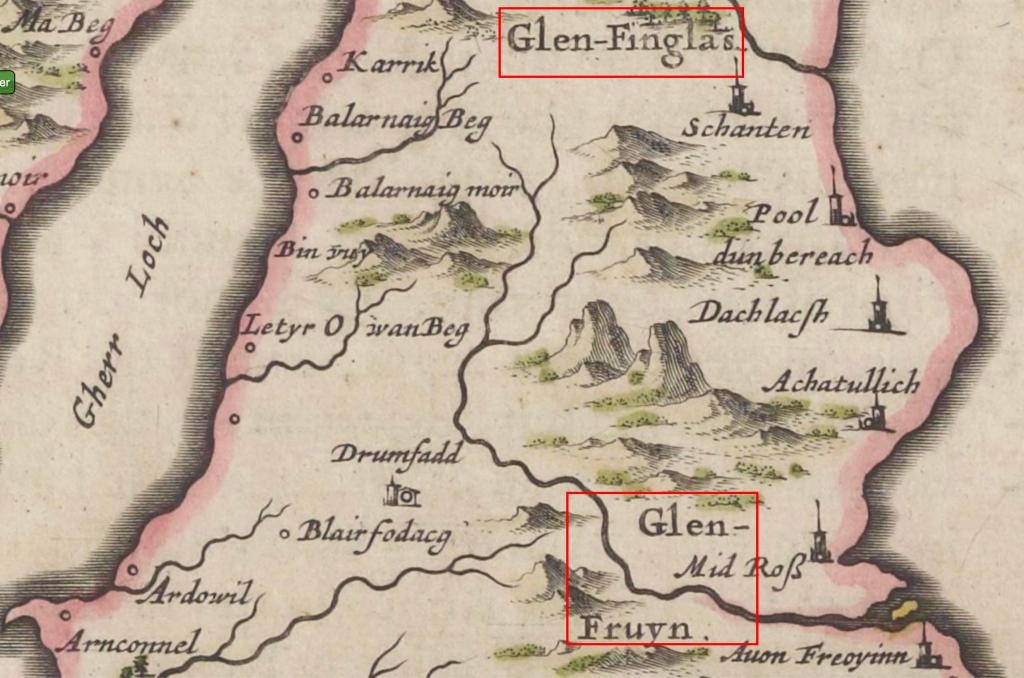
Reproduced with the permission of the National Library of Scotland.
The late 1500s and early 1600s were a time of great conflict in the McAusland homeland and this might, at least in part, explain the seemingly rapid turnover of McAusland Barons in this time period. Incidents included the 1592 murder of the McAusland’s feudal superior Sir Humphrey Colquhoun of Luss at his castle of Bannachra, and the 1602 Glen Finlas raid where the McAusland seat of Caldenoch was sacked by marauding MacGregors. Events culminated in the 1603 Battle of Glen Fruin, which was fought on 7th February 1603 between the Clan Gregor and its allies on one side, and the Clan Colquhoun and its allies on the other. The Colquhouns and their allies, including the McAuslands and Napiers, were comprehensively defeated, with Peter Napier, Baron of Kilmahew one of the most significant casualties. Reprisals included the proscription of Clan Gregor, who were outlawed for the massacre.
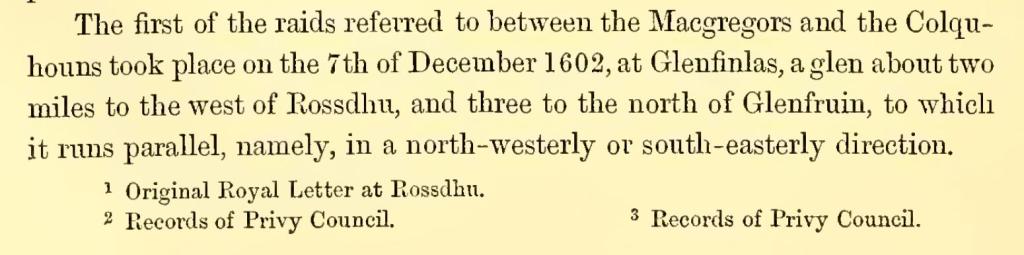
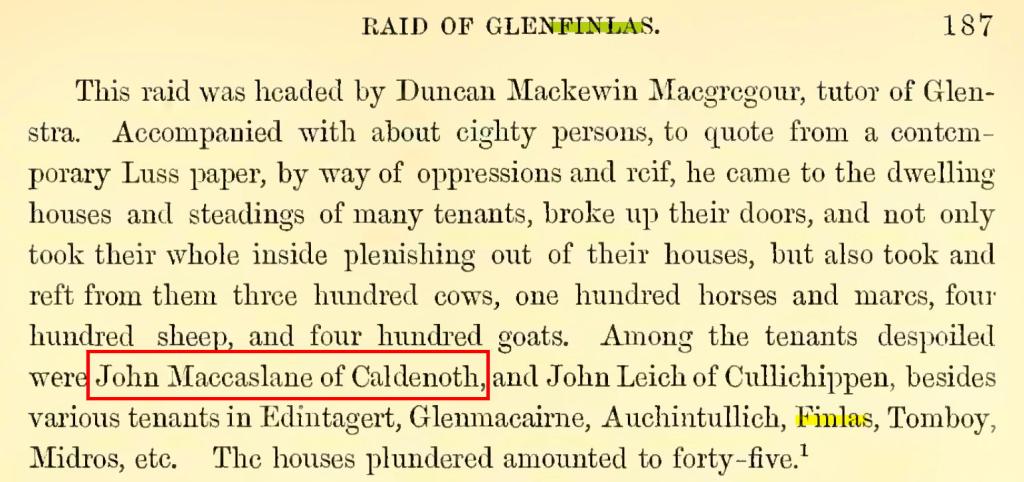
Caldenoth, the property of John McCaslane of Caldenoth, is among the list of places despoiled in the so-called Glen Finlas Raid of December 1602. As well as various properties despoiled on Loch Lomondside, others so treated included places in Glen Luss, Glen na Caoruinn and Glen Mallan, most likely giving an indication of the route taken by the raiders as they made their escape northwards. (Fraser; Chiefs of Colquhoun).
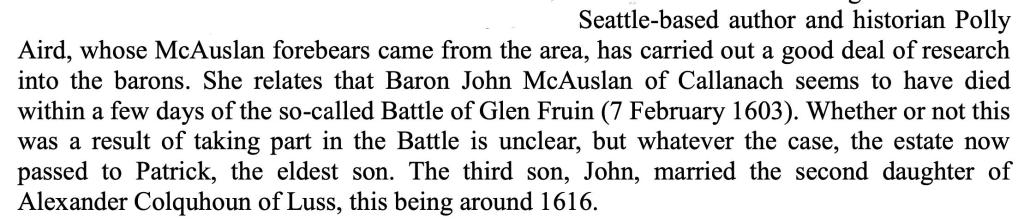
Researcher Polly Aird is the author of an excellent biography of her relative Peter McAusland : Mormon Convert, Mormon Defector: A Scottish Immigrant in the American West, 1848-1861 and, as noted above, she has suggested that John may have died within a few days of the Battle of Glen Fruin which took place on 07 February 1603. Sadly however, the American publishers appear to have had an, unfortunately all too common, somewhat provincial and blinkered attitude and were only really interested in the Mormon part of Peter’s story. According to a 2010 article by Helensburgh Heritage Trust they “required the Scottish part of the work to be greatly condensed“. It would be incredibly useful for family historians if the unknown source for the story of John McAusland’s death “within a few days” of the Battle of Glen Fruin could be discovered.
Whether or not John McAusland was present at the Battle of Glen Fruin is not known. He might have been wounded in the battle, or perhaps when Caldenoth was depoiled in the Glen Finglas raid of December 1602. However, his death might have been unconnected to the violence.
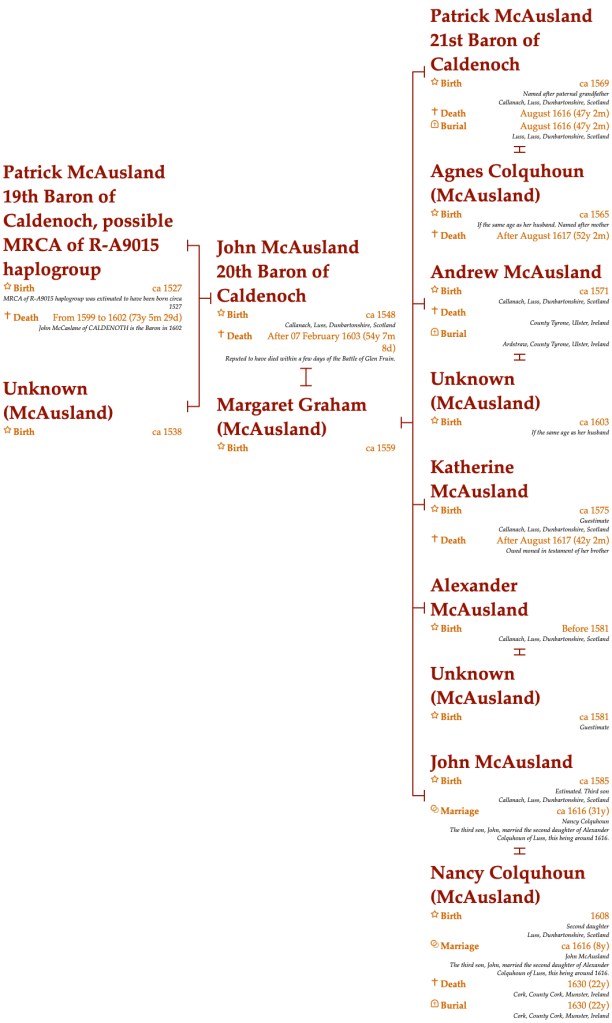
Margaret Graham
John McAusland, the 20th Baron is believed to have married a Margaret Graham, whose ancestry is unknown. In some trees she appears as the daughter of John Graham, 4th Earl of Menteith. The Scots Peerage by Sir James Balfour Paul (1909), pages 160-161, states that the 4th Earl of Menteith and Lady Marion Seton had two sons and a daughter Mary, but there is no mention of a daughter named Margaret.
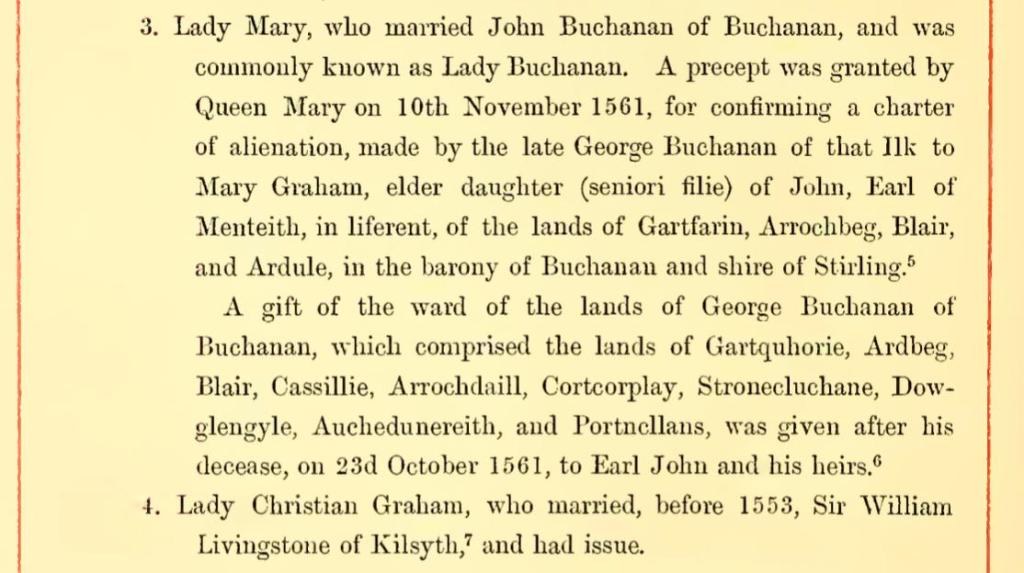
Meanwhile, on page 322 of The Red Book of Menteith, a Lady Christian Graham is also listed as their daughter. It states that Lady Mary married Sir George Buchanan that Ilk, 16th Chief of Clan Buchanan while Lady Christian married Sir William Livingstone of Kilsyth. However, as with the Scots Peerage, this source does not mention any daughter named Margaret. It should be noted, nevertheless that the 4th Earl of Menteith’s mother was Margaret Moubray, while his wife’s mother was Lady Margaret Montgomerie, and as the Scottish naming tradition was to name the eldest daughter after the maternal grandmother and the second daughter after the paternal grandmother, it would make perfect sense for this couple to name one of their daughters Margaret. However, why a daughter from one of the ancient Scottish Earldoms would marry a minor baron is somewhat less clear.
Patrick McAusland, 21st Baron of Caldenoch and his siblings
We know a fair bit about this baron thanks to his testament which he dictated at Caldonoche on 7th August 1616, and the next articles will be devoted to his and his testament.
We do know that Patrick had a younger brother named John as he was nominated in the 1616 testament as one of the four executors. If Scottish naming traditions were followed, it is possible that John was the third son, named after his father.
However, we are less certain about the identity of Patrick and John’s siblings, as much of what has been written comes from documents written over 100 years later which, as discussed elsewhere, appear to be less than accurate.
An Alternative Genealogy
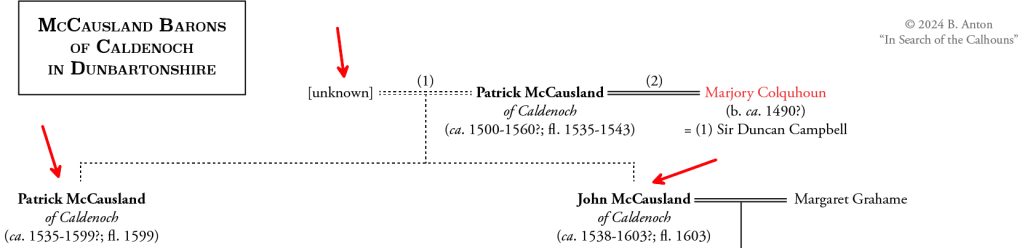
© 2024 Brian Anton. All rights reserved.
Note that there is an alternative McAusland family tree, as proposed in the Genealogy of the Calhoun Family, which has several key differences to our genealogy. Firstly Patrick McAwslane of Caldenache, our 19th Baron, is believed to be the son of an unknown mother rather than Marjory Colquhoun. Secondly, in this tree, our John, 20th Baron is the younger brother of Patrick, 19th Baron, rather than his son.
If this alternative tree is correct, then it clearly has serious implications for the conclusions of our DNA studies as Patrick McAwslane of Caldenache, possible 19th Baron could clearly not be the MRCA of halpogroup R-A9015.
Next Article in the Series
In the next article we will look at Patrik McCauslane of Caldonoche, possible 21st Baron of Caldenoch.

 Vecchio