
In this, the seventh of a series of articles on the McAuslands of Caldenoch, we will examine Patrick McAuslane of Coldynocht, possible 19th Baron of Caldenoch.
Patrick McAwslane of Caldenache, possible 19th Baron flourished 1599 to before 1602
Image Copyright Playgroup.
In 1599 there was a Deed of renunciation by Patrick McAwslane of CALDENACHE in favour of Sir Alexander Colquhoun of Luss of his claim to 2/3 of Stronmaleroch, Parish of Rosneath, Barony of Luss, in return for payment by Sir Alexander of 200 merks. (Colquhoun of Luss Estate papers, deed (box 7)).
Patrick must have died sometime between 1599 and 1602, and was succeeded by John, presumably his son, as in December 1602, “Caldenoth, the property of John McCaslane of Caldenoth, is among the list of places despoiled in the so-called Glen Finlas Raid of December 1602. As well as various properties despoiled on Loch Lomondside, others so treated included places in Glen Luss, Glen na Caoruinn and Glen Mallan, most likely giving an indication of the route taken by the raiders as they made their escape northwards.” (Chiefs of Colquhoun and their country By William Fraser. Edinburgh: Printed by T. and A. Constable, 1869. 2 volumes.)
Patrick McAwslane of Caldenache possible MRCA of members of halpogroup R-A9015
As noted in a previous article, Patrick McAwslane of Caldenache, possible 19th Baron of Caldenoch is a key person in our genealogy of the McAuslands as he may be the MRCA (Most Recent Common Ancestor) of modern McAuslands who are descended from the Caldenoch line.
Although we have yet to find a male McAusland from our own family to take a BigY700 DNA test, others have already taken the plunge and the results are very interesting indeed.
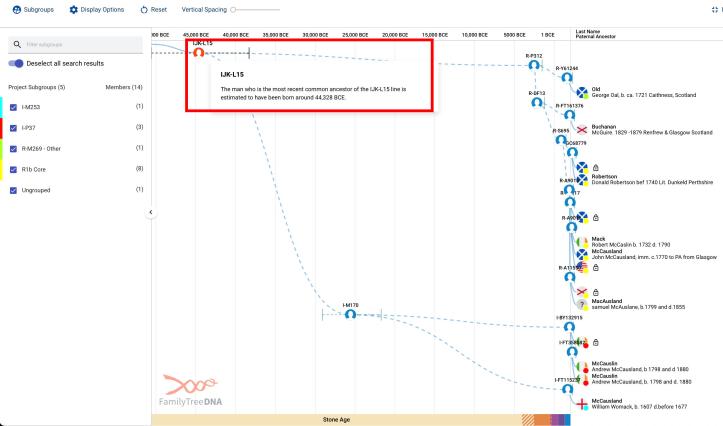
It can be seen from the image above that there are two distinct groups of very distantly related McAuslands. These have an MRCA (Most Recent Common Ancestor) who is estimated to have been born way back in 44,328 BCE.
The lower group (with two distinct subgroups) consists of four members of haplogroup I-M170. The first subgroup consists of three testers with Irish ancestry, and the second subgroup has only one tester with English ancestry. These McAusland lines clearly arose independently from the first. Perhaps the name McAusland was taken in honour of their clan chief, or perhaps there was an adoption or a NPE (Non-paternity event)?
Of more interest to us is the upper and larger group of McAuslands who are members of halpogroup R-A9015. They have an MRCA who is estimated to have been born much more recently, around 1527 CE.
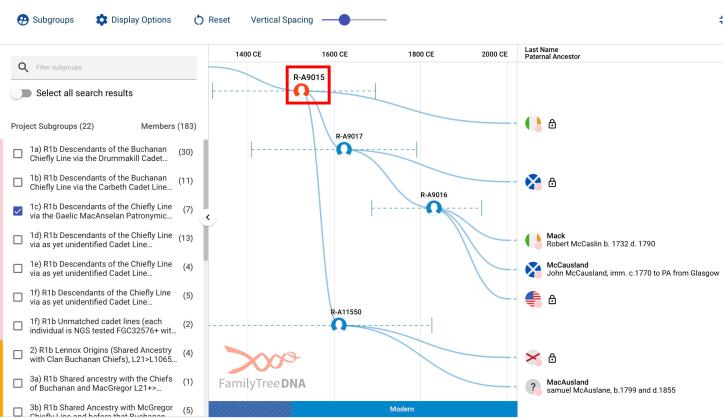
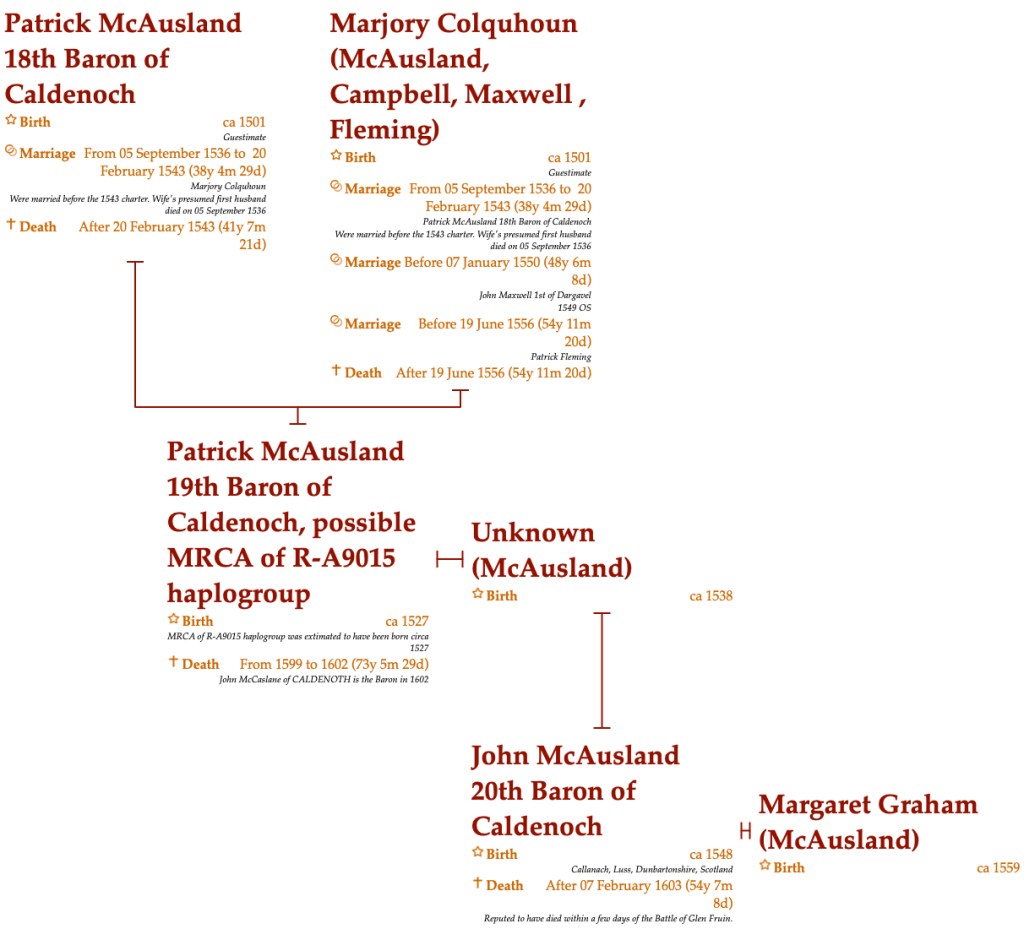
The date of around 1527 CE, if accurate, is of great interest: While the family tree of the McAusland Barons is far from certain, this MRCA could appear to correspond to Patrick McAwslane, 20th Baron of Callenach. Patrick’s presumed father, Patrick, 19th Baron is estimated to have been born circa 1501, while his presumed son, John, who is said, by Polly Aird, to have died within a few days of the 1603 Battle of Glen Fruin, is estimated to have been born circa 1548.
Regarding to the accuracy of the calculating dates, FamilyTreeDNA published an interesting study regarding Sir John Stewart of Bonkyl born circa 1246 CE.
An Alternative Genealogy
© 2024 Brian Anton. All rights reserved.
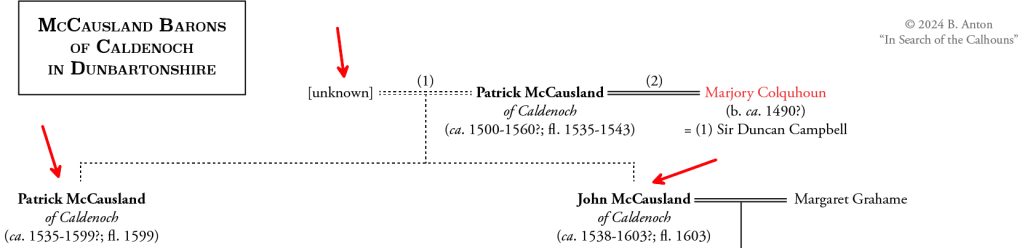
Note that there is an alternative McAusland family tree, as proposed in the Genealogy of the Calhoun Family, which has several key differences to our genealogy. Firstly Patrick McAwslane of Caldenache, our 19th Baron, is believed to be the son of an unknown mother rather than Marjory Colquhoun. Secondly our John, 20th Baron is believed to be the younger brother of Patrick, 19th Baron, rather than his son.
Note that if this alternative tree is correct, then it clearly has serious implications for the conclusions of our DNA studies as Patrick McAwslane of Caldenache, possible 20th Baron could clearly not be the MRCA of halpogroup R-A9015.
Next Article in the Series
In the next article we will look at John McCaslane of Caldenoth, possible 21st Baron of Caldenoch.

 Vecchio