

In this, the second of a series of articles on the McAuslands of Caldenoch, we will examine the possible first ten Barons of Caldenoch. Basically, as described in the previous article, our present theory is that they were the first ten Chiefs of Clan Buchanan.
The Early Barons of Caldenoch

Original image © Copyright 2024 by The Clan Buchanan Society International Inc.
Although the recorded history of the earliest McAuslands and Buchanans is often more legend than fact, it appears that the family only obtained lands in, and to the east of Loch Lomond from 1225 onwards. Prior to that it is possible that the family were based at Caldenoch, but as they obtained the more extensive lands (of Buchanan) the family moved their base from the west, to the east of Loch Lomond, with their original barony of Caldenoch being inherited by a younger son. This theory does seem to be supported, although perhaps not yet confirmed, by BigY700 DNA testing.
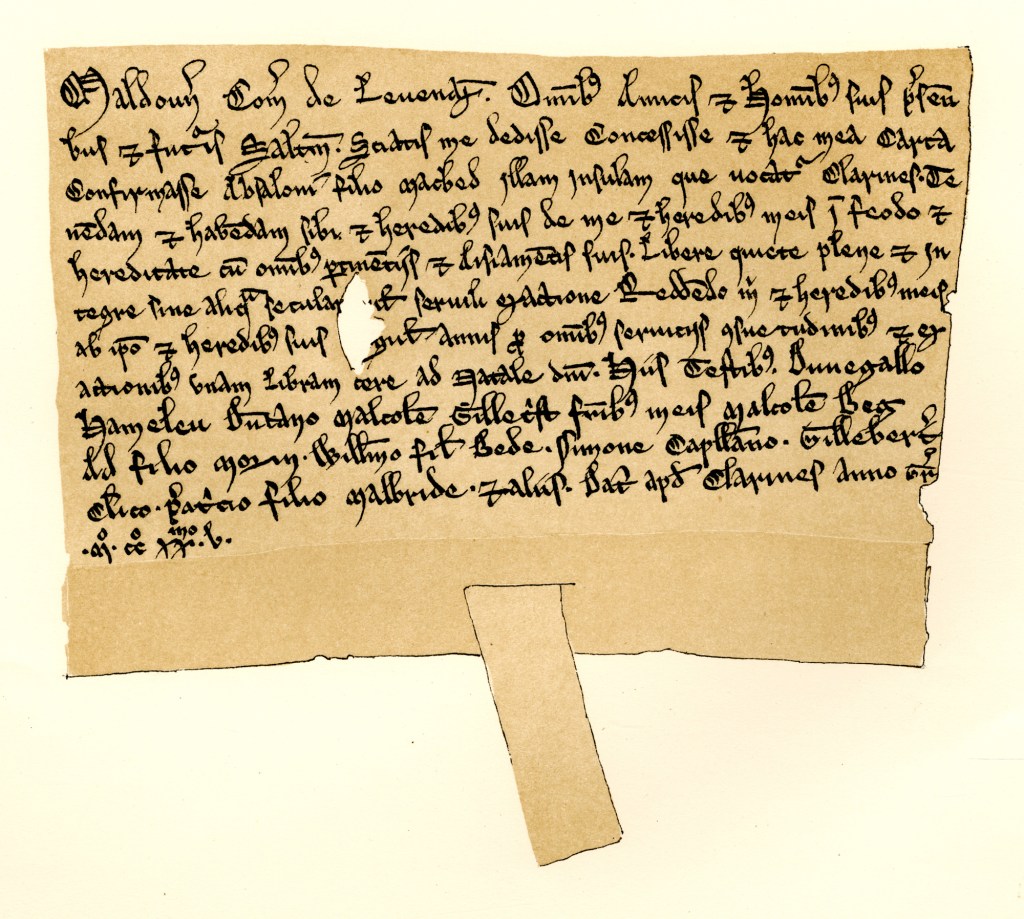
Sir William Fraser Facsimiles of Scottish Charters and Letters, University of Edinburgh.
In 1225, Absalon (aka Anselan), son of Macbed, traditional 7th Chief of Clan Buchanan, obtained a charter from Maldouen, Earl of Lennox granting him the island of Clarine (also shown as Clareinch, Clairinch or Clairinsh). This provided the Buchanan Clan’s war cry of “Clar Innis” and the island became known as The Heart of the Clan.
Clan Buchanan International note that: “The island of Clairinch was held by the Clan Buchanan under Royal Charter, and each new Laird renewed this charter. The charter was granted in 1225 to Anselan/Absalon, third of that name and 7th Laird of Buchanan, the son of MacBed, and his heirs by Malduin/Maldouen, 3rd Earl of Lennox, for the rent of one pound of wax each year. It was witnessed by Dougal, Gilchrist and Amelyn, brethren of the Earl.
“The following is a translation of this charter:
Maldouen, Earl of Lennox – to all his friends and man, present and to come, Greetings:
Know ye that I have given, granted, and by this my charter have confirmed to Absalon, son of MacBed, that Island which is called Clairines: To be held by him and his heirs of me and my heirs in fen and heritage, with all its pertinants and easments, freely, quietly, fully, and entirely, without any secular or servile exaction: the reddendo to me and my heirs, by him and his heirs, being each year, for all services, customs and exactions, one pound of wax at the nativity of our Lord:
Witnesses, Dunegal, Hamel, Duncan, Malcolm Gilchrist, my brothers; Malcolm Beg; Adam, son of Morin; William, son of Bede; Simon, chaplain; Gilbert, clerk; Patrick, son of Malbride; and others; given at Clarines, in the year of grace 1225.
“The charter was confirmed by King Alexander the Second by a charter dated at Linlithgow on the 6th of September, and in the seventeenth year of his reign (1231 ), and at the same time granted the licence of fishing in his lake of “Lochlomne”.
“In 1564, Sir George, second of the name and 16th Laird of Buchanan, was granted a charter in his favour by King Henry and Queen Mary of lands of Buchanan, “Ifles of Clareinch and Kepinch. with bell and alms of St. Keffig.” (this was the period when Mary Queen of Scots and her husband Henry Stewart – Lord Darnley were enthroned).“

Clareinch is often described as “the flat island” – indeed, “Clàr” means “flat” in Scots Gaelic. The island is just 13 metres above sea level at its highest point. While the island is now uninhabited, there appear to have been at least seven buildings there during Medieval times. There is also evidence of a crannog, which is a man-made island, at the north end of the island. This crannog may have been the new caput baroniae (Latin, for “head of the barony“) where the chief lived and where the Buchanan clan’s parliament was held.
Clareinch belonged to Clan Buchanan’s chiefs until 1681, when the estate of Sir John Buchanan, 21st and last chief of Clan Buchanan (at least for 337 years until August 2018), was dissolved. Clareinch was purchased by the James Graham, then the 4th Marquis (and later the 1st Duke) of Montrose. It was the property of the Montrose family for over 250 years, until 1934 when it was bought by William George Buchanan, a prominent businessman who wanted to see the island restored to the Buchanan family.
He passed away in 1939 and in his will, stated that the island should be given to the Buchanan Society, on the condition that it should remain in the care of the society forever, and that the island should be used as an animal and bird sanctuary. Since 1958, it has been part of Loch Lomond National Nature Reserve. It was the first part of Loch Lomond to be declared a National Nature Reserve, and since then the reserve been extended to cover 430 hectares of land and water.

Around the same time, around 1225, Absalon, as seneschal of the Earl of Lennox, along with his sons Gilbert and Matthew, were witnesses to a charter by Maldoune, earl of Lennox, granting to Gillemore, son of Maldouen, of the lands of Luss. This Gillemore was the great (x3) grandfather of the unknown heiress known as “The Fair Maid of Luss” who married Sir Colquhoun, 5th Baron of Colquhoun. Gillemore, son of Maldouen was thus the ancestor of the Colquhoun Barons of Luss. (“Charter by Maldouen, Earl of Lennox, to Maldouen, son of Gilemore, of lands in Luss, c. 1225,” School of History, Classics and Archaeology Teaching Collections, accessed May 25, 2024.)
Buchanan clan history claims Anselan/Absalon had three sons. The eldest was Gilbert, who reputedly first assumed the name of Buchanan. The second son Methlin or Matthew) was the reported to be the ancestor of the MacMillans, while the third son, Colman, was the ancestor of the MacColmans. However, the Buchanan Y-DNA project demonstrates that there is no close relationship between Buchanans and the MacMillans.
Clan Buchanan International report a similar story, to that above, only 100 or so years earlier ((1124-1153 A.D.) with a Malcolm rather than Anselan/Absalon McAusland:
“The MacAuselan first actually to be recorded was Malcolm, Steward to the Maldouen, Third Earl of Lennox during the reign of David II (1124-1153 A.D.) Malcolm may have inhabited land in Glenduglas on Loch Lomond as well as in Luss, all on the western shore. This Malcolm is believed to have been the Baron MacAuselan from whom the bearers of the patronym are descended. The seventh Laird of Buchanan, Gilbert, was the first to assume the surname of Buchanan.“
North Clyde Archeology Society make the interesting observation that: “Interestingly, the author of the section dealing with Luss in the Old Statistical Account of Scotland (1793), informs us that in the mid-17th Century, in order to compensate for Luss Parish lands lost in consequence of the formation of certain new parishes, the lands of Caldanach, Prestellach and Conglens, once belonging to the Parish of Inchcailloch, were now annexed to the Parish of Luss. Note that the Parish of Inchcailloch later came to be known as the Parish of Buchanan. This later name is appropriate in that it represents the heartland of the Clan Buchanan. The McAuslans are usually described as a sept of the Clan Buchanan, and it seems at least possible that the McAuslan barons stemmed from elite members of that clan.“
Although the various accounts are not always coherent, DNA testing does support, though not confirm, the possibility that the first Buchanan chiefs were Barons of Caldenoch before they obtained the rich lands of Buchanan, and that the Caldenoch title passed to a younger son once the family had moved to the east of Loch Lomond.
Next Article in the Series
In the next article we will examine MacBeath, possible 11th Baron of Caldenoch, who may have been the son of Sir Maurice Buchanan of that Ilk, 10th Chief of Clan Buchanan & possible 10th Baron of Caldenoch. Sir Maurice may also be the MRCA of the R-FGC32576 Haplogroup of whom many Buchanans and McAuslands are members.

 Vecchio