
An earlier version of this article (lacking the images) was published in the Caithness Family History Society newsletter 75
If your direct male-line ancestors were from Caithness (or anywhere else for that matter), there has never been a better time to research your father-line. Y-DNA testing has evolved from looking at a small number of repeated regions on the Y-chromosome to investigating more than 1.2 million positions that permit the determination of your precise location on the global Y-DNA tree. So, if you are interested in the ancestry of your direct male line, please consider testing with BigY700 and joining the Caithness Y-DNA projects.
Our research has revealed that individuals with direct male-line ancestry from Caithness with the surnames Auld, Begg, Henderson, Oal, Old, Rosie and Ross share more recent common ancestry with each other than with others with the same surnames from the rest of Scotland.
Our Most Recent Common Ancestor?
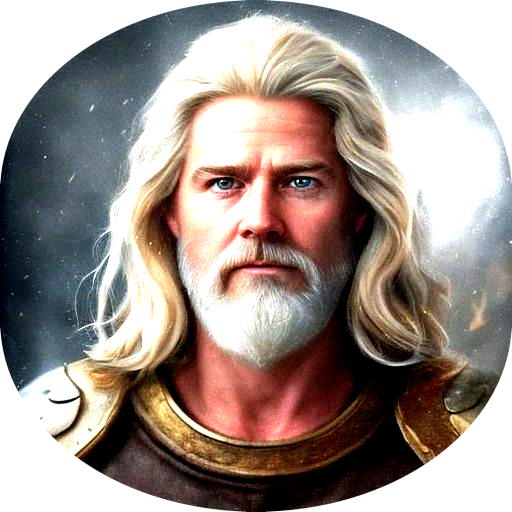
Although the life of no such person as Leif Ågeson, was recorded for posterity, the character is not entirely fictional; this avatar, created with AI, is, in fact, based on our unknown, but real 22nd great grandfather who was originally estimated to be the Most Recent Common Ancestor of various Caithness families including individuals with the surnames Auld, Begg, Henderson, Oal, Old, Rosie and Ross.
Two different types of analysis of the Y-chromosomes of his descendants have given similar estimated dates of birth for this man; circa 1243 or circa 1257.
DNA Glossary & Basics
In order to understand Y-DNA testing there are a few common abbreviations that you may encounter:
DNA: Deoxyribonucleic acid. The Building Block of life.
MRCA: Most Recent Common Ancestor.
SNP: Single Nucleotide Polymorphism.
STR: Simple Tandem Repeat.
CE (Common Era) is the secular version of AD (Anno Domini – Latin for in the year of the Lord).
BCE (Before Common Era) is the secular version of BC (Before Christ).
Either designation is acceptable by the international standard for calendar dates, although in scientific circles it is more usual to use the BCE/CE format.
Haplogroup: These have complicated names such as R-Y61244, which can be confusing. However these are simply the equivalent of a postal code, which helps position us on the global Y-DNA tree.
There are several types of DNA. Humans all possess two copies of each of the 22 autosomal chromosomes, (one from our father and one from our mother) and this is what most DNA companies look at in their autosomal DNA tests.
In addition there are the sex chromosomes, named X and Y. Girls get an X from their father and a second from their mother, while boys get their X from their mother and their Y from their father. Therefore the Y chromosome is an excellent marker for researching the direct male line.
There is also mitochondrial DNA, which is passed down from a mother to her male and female children, but only passed on via her daughters. It is not quite as good a marker as Y-DNA, as although mitochondrial DNA is female-line specific, it is fairly stable and the lack of frequent mutations makes it less useful for studying closer relationships.
Compared to mitochondrial DNA, the Y-chromosome does mutate relatively frequently and historically companies have looked at short tandem repeated sequences or STRs. Companies traditionally offered tests looking at banks of 11, 25, 37, 67 or 111 STR markers, and while the results can be quite useful, the various repeated regions mutate at different rates from relatively slowly to relatively rapidly, making it difficult to estimate a time to the MRCA (Most Recent Common Ancestor) unless you are an expert.
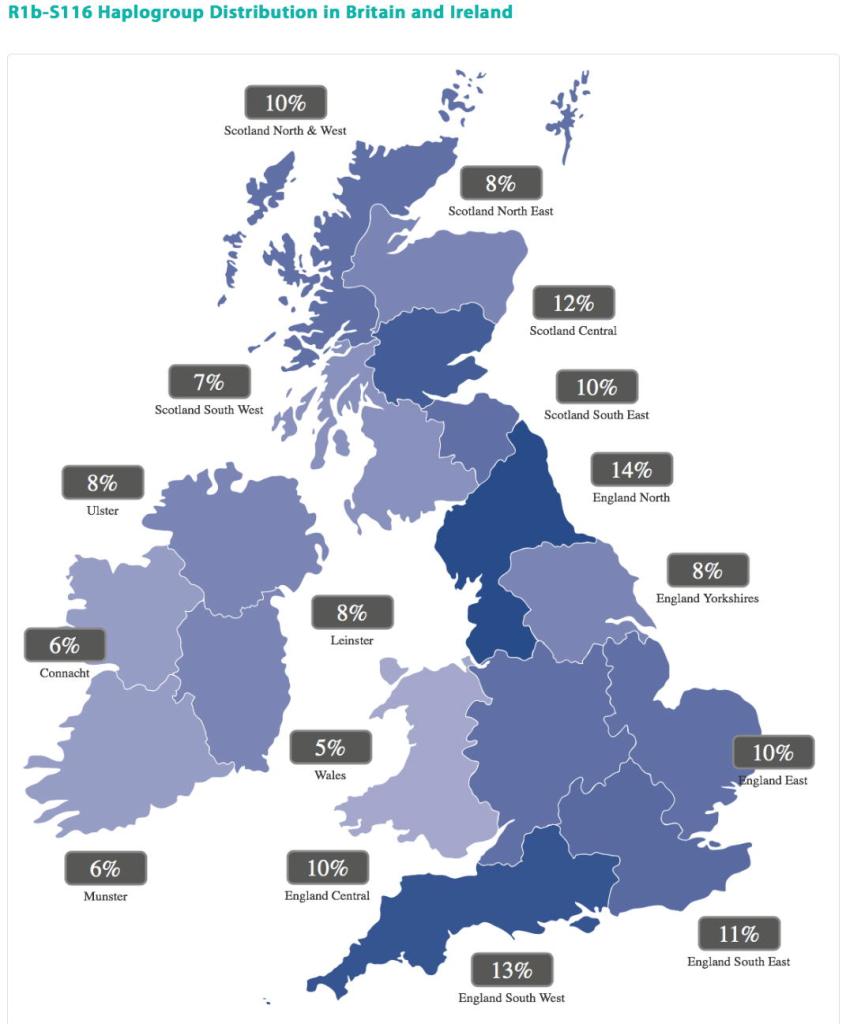
A decade or so ago, scientists including Professor Jim Flett Wilson of Edinburgh University and ScotlandsDNA pioneered the use of Single Nucleotide Polymorphisms, or SNPs for public Y-DNA testing. This is where, in a single position in the DNA strand, the wrong building block is added: There are four of these known as A, C, G, and T. SNP testing is now the method of choice.
Is the new BigY700 SNP test worth doing? It can perhaps be likened to having one of the first telephones. If you were the first to buy one, who could you call? But just as phones have become an almost essential part of modern life, as more BigY700 tests are performed, more and more information will become available about the global tree and how our paternal ancestors are related to each other. One thing is certain, looking at over 1.2 million SNPs can provide better predictions at how we are related than 111 (or even 700) STRs and gives us a far more accurate idea of where we are located on the global Y-DNA tree.
In years gone by, people often purchased an 11 or 37 marker STR test then gradually upgraded, with some eventually taking the plunge of FamilyTreeDNA’s “BigY700” test which looks at over a million SNPs. However, nowadays most experts suggest diving straight in to the BigY700 test as it is now the gold standard. Although Y-DNA testing is relatively expensive, there are no unexpected hidden costs such as expensive subscriptions. The frequent sales are also well worth looking out for.
In addition to our own small and specialised R-Y61244 Caithness group, there are many useful more general surname, area and haplogroup user groups with knowledgeable and helpful volunteer administrators including a dedicated Caithness and Sutherland counties group with over 1,000 members.
Common Caithness Roots of the Aulds, Beggs, Hendersons, Oals, Olds, Rosies & Rosses
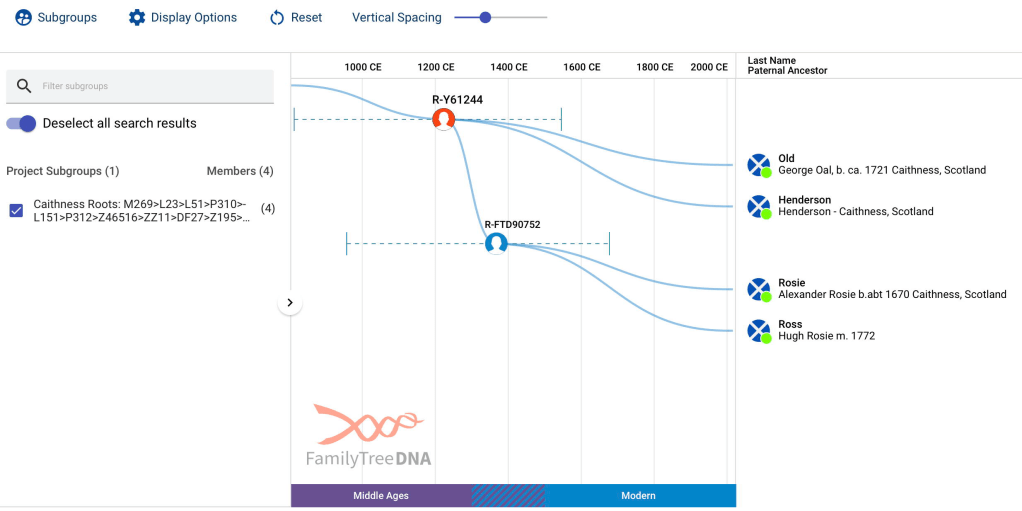
Our seemingly unconnected male lineages had various origin myths or stories. Although these theories can not be completely discarded, some have not stood up to detailed genetic investigation. Surprisingly, rather than sharing a common ancestry with others of the same surname, our R-Y61244 group members appear to share a common origin – around 780 years ago, circa 1243 – in Caithness, the ancient and most northerly county in the Kingdom of Scotland, which had strong links to the Kingdom of Norway.
Old, Oal and Auld
For the Olds, it was believed by some, including the late Dr David Cossar Old, that they were related to the Olds from Dorset.
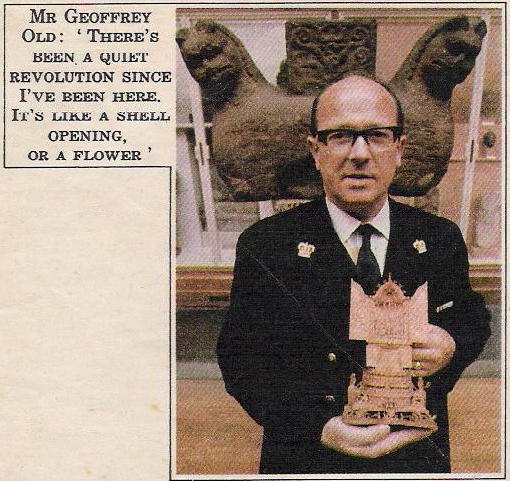
Meanwhile the late Mr Geoffrey Old, of the British Museum, had an even more exotic theory that his Old line might be descended from the Danish King Gorm the Old.
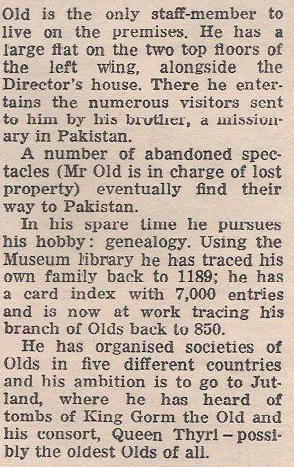
Walter Richard Old, the English astrologer and Theosophist, who was known by his pen name of Sepharial, officially changed his name to Walter Richard Gornold on April 19, 1895, incorporating the name Gorn (also spelled Gorm), a Danish king from whom he believed he was descended.
More recently, Dr Iain Graeme Old suggested that the Caithness Oals, Olds and Aulds might be Vikings or descendants of survivors of the wreck of El Gran Grifón during the flight of Spanish Armada.
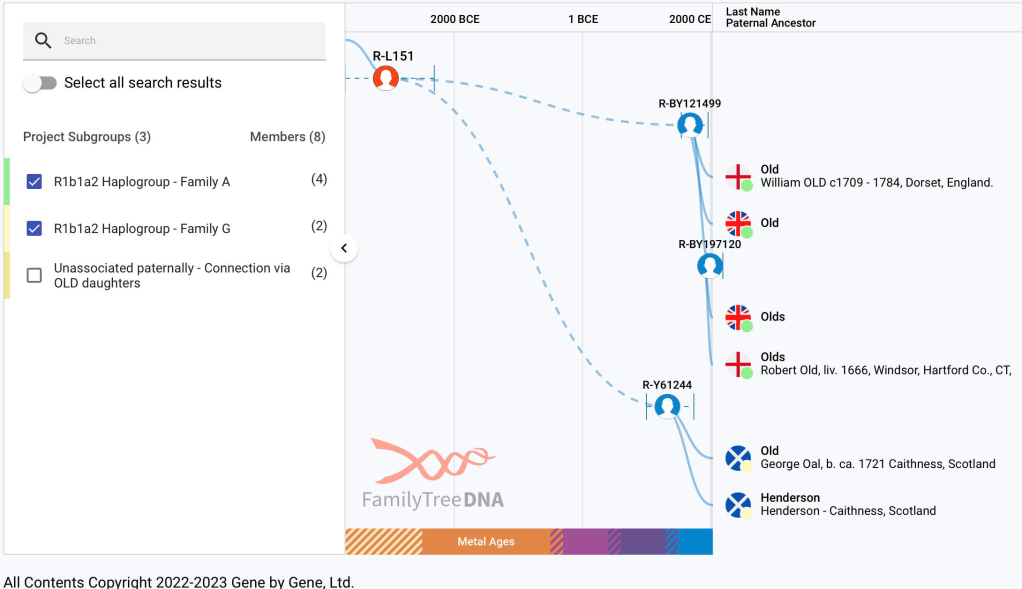
In fact, BigY700 testing has revealed that the Dorset Olds are members of the R-BY121499 haplogroup and that they are only very distantly related to the Caithness Olds, sharing a MRCA (R-L151) who was born some five thousand years ago, circa 2990 BCE.
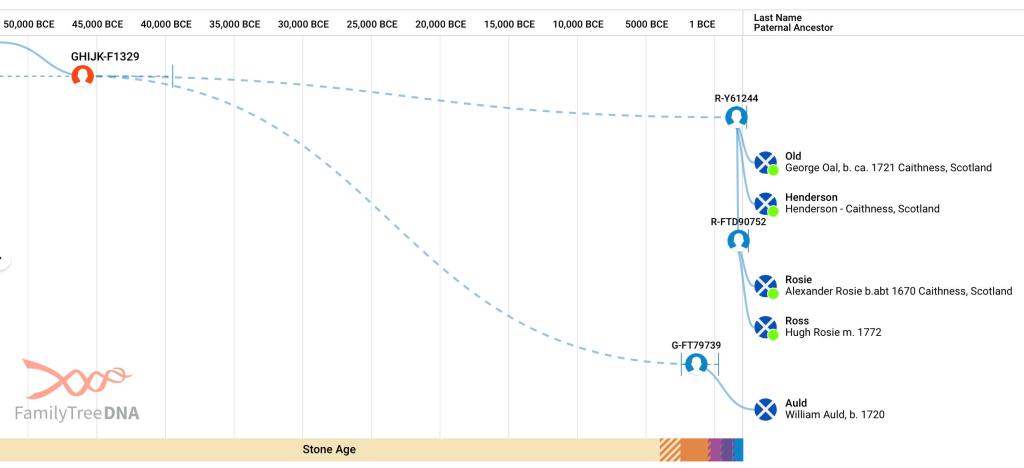
Similarly, the surname Auld appears to have evolved independently in different areas. Our Caithness Aulds and Aulds from Ireland (haplogroup I-F16721) appear to share a MRCA (GHIJK-F1329) who was born around 45,679 BCE, way back in the Stone Age.
Rosie and Ross (ancestral surname Rosie)
As Caithness Family History Society members will be aware, veteran researcher Mrs Evelyn Andrews has carried out extensive research into medieval charters and heraldic grants and has traced Rosie lines back to Roses who came to England with William the Conqueror. Some of her articles can be found on the private section of the Caithness Family History Society website.
A common theory, that was repeated as recently as CFHS newsletter 75 (in which this article appeared) is that our Caithness Rosies might be descended from the Rose Barons of Holme and of Kilravoc in Nairnshire: “Rosie: first recorded as the name of a man in Freswick in 1653 – Alexander Rosie, who accused of something akin to witchcraft. No derivation is offered for the name but I wonder if it could be derived from Ross or from Rose of Kilravock.”
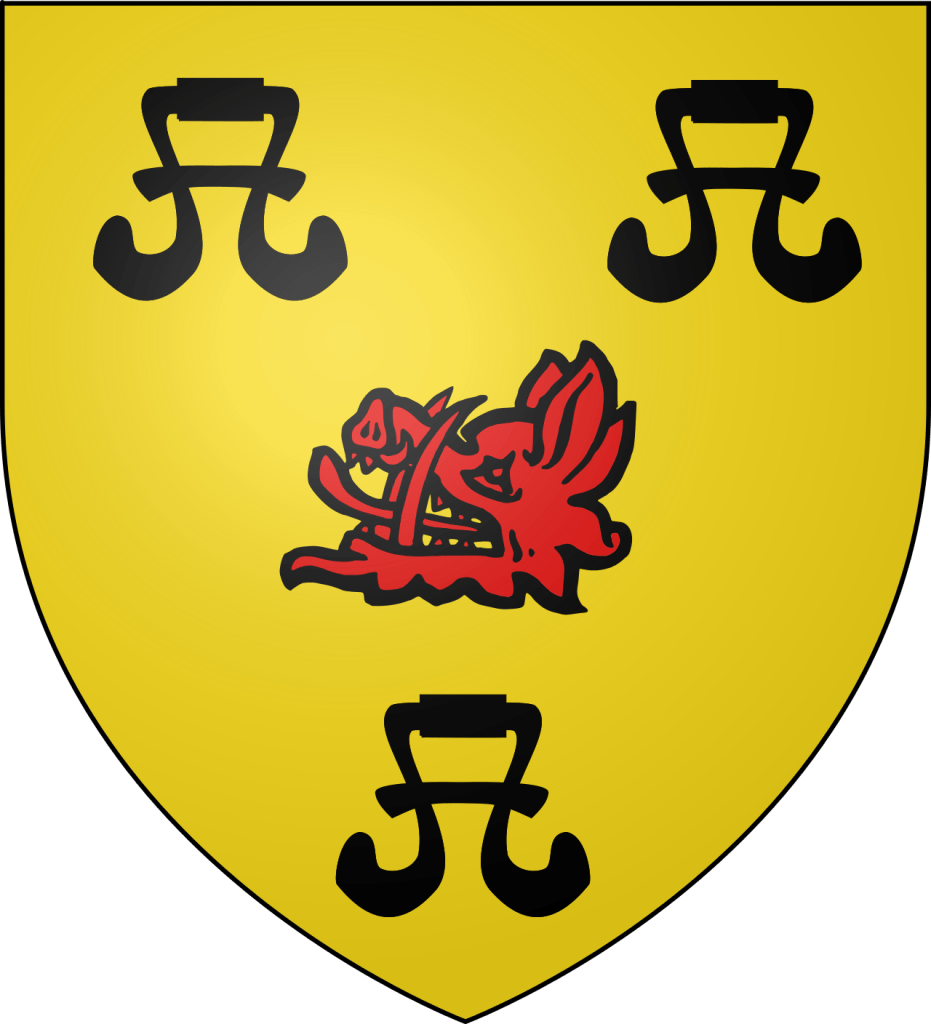
Two males of the Rose of Kilravock line have taken a BigY700 test, however, they are members of haplogroup FGC32620.
This means that our Rosies and Rosses from Caithness and the Roses of Kilravoc are only very distantly related as they share a MRCA (haplogroup P312) who was born almost 5,000 years ago, circa 2,800 BCE.
Another big surprise in our Caithness study has been that a male Rosie and a male Ross, with the ancestral name of Rosie shared a MRCA (haplogroup R-FTD90752) born around 650 years ago, circa 1367 CE. This is rather more distant than we had expected from their common Caithness ancestry and ancestral Rosie surname.
Henderson
Henderson (son of Henry) is a distinctive Scottish surname with diverse origins. Until relatively recently, some of our USA-based Hendersons believed that they were descended from a younger son of one of the Henderson Barons of Fordell in Fife who had emigrated to America.
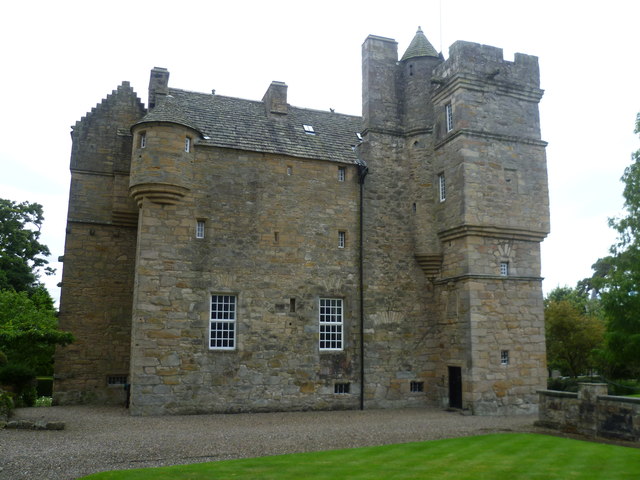
According to the Henderson DNA Project, “pre-15th century Henderson Scottish family groups … settled in the areas of Glencoe, Caithness, the Shetlands, Upper Liddesdale and the Middle Marches, and finally Dumfriesshire where the family Henderson was established as a barony at Fordell. As a bit of background, the five geographic origins in ancient Scotland named in Clan Henderson’s history are based on documented concentrations of Henderson bloodlines thought to have settled in these regions. Here’s the take-away that everyone should understand. —- It is improbable that there was an original, single Henderson bloodline at any one of these locations. For this reason, several unrelated Henderson bloodlines may claim their family origin at the same location identified in clan history.”
For our Caithness Hendersons, their closest relative in the Henderson DNA project was a descendant of John Henderson, (born Dunrossness in Shetland circa 1740 and died 1784). They share a MRCA (haplogroup R-Z195) who was estimated to be born over 4,500 years ago, circa 2553 BCE.
Begg
The MRCA of the Hendersons and Beggs has, as yet, only been estimated using STR analysis as no Begg has yet taken a BigY700 test. The current estimate is that our Beggs and Hendersons may share a relatively recent MRCA who was born circa 1508 CE.
MacKay
STR analysis also suggests that at least one individual with the surname Mackay could be related to our Hendersons with an MRCA of circa 1100 CE.
Other Surnames
It is expected that many people with male-line Caithness ancestry will be members of our extended Y-DNA family.
Future Research
We are hoping to recruit many additional members to the project as the more people who take a BigY700 test, the more detailed and accurate our branch of the global Y-DNA tree will become and we will obtain more information about our shared Caithness roots and how we are related.
Our Current Caithness Roots Family Tree
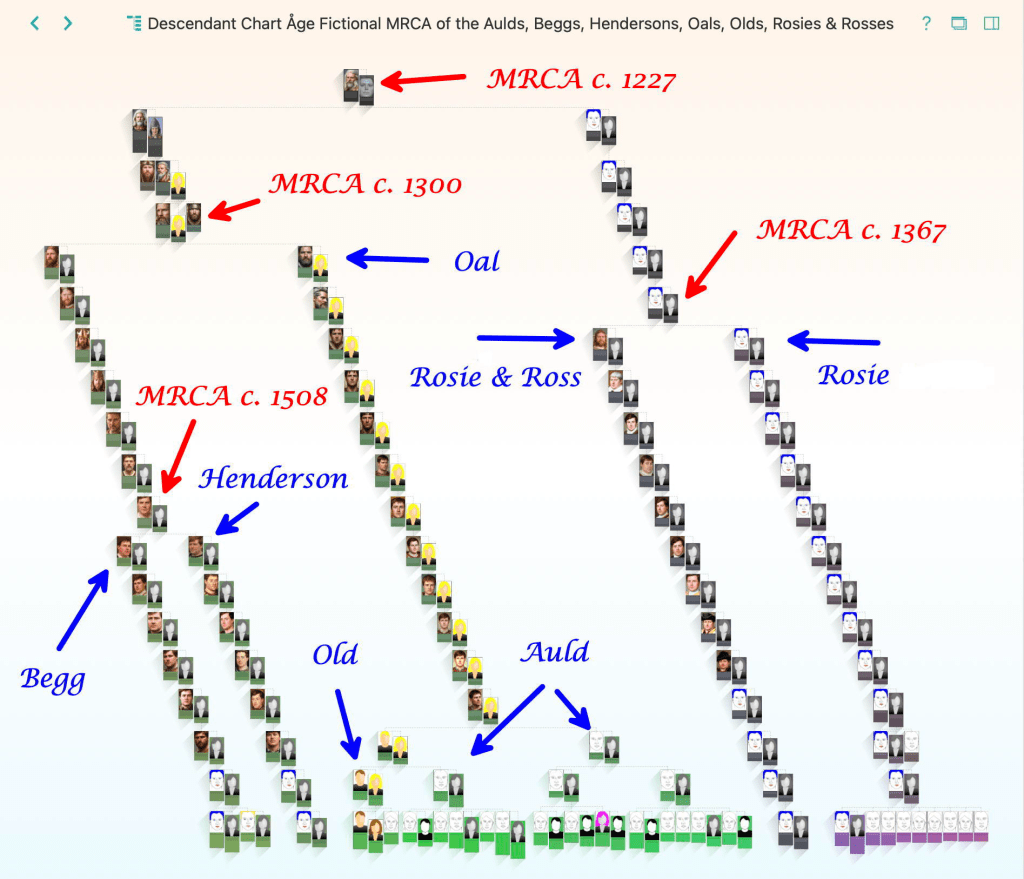
Our latest working draft of the R-Y61244 family tree from our Most Recent Common Ancestor born circa 1227 to the 1700s shows the descendant lines of Beggs, Hendersons, Olds, Aulds, Rosies and Rosses. Note that this is a dynamic tree and the MRCAs and relationships have and will change as new people take a BigY700 DNA test.
Timeline, Notable and Ancient Connections
The Y chromosome is passed from father to son remaining mostly unaltered across generations, except for small traceable changes in DNA. By tracking these changes, FamilyTree DNA have constructed a family tree of humankind where all male lineages trace back to a single common ancestor who lived hundreds of thousands of years ago. The human tree allows us to explore lineages through time and place and to uncover the modern history of our direct paternal surname line and the ancient history of our shared ancestors.
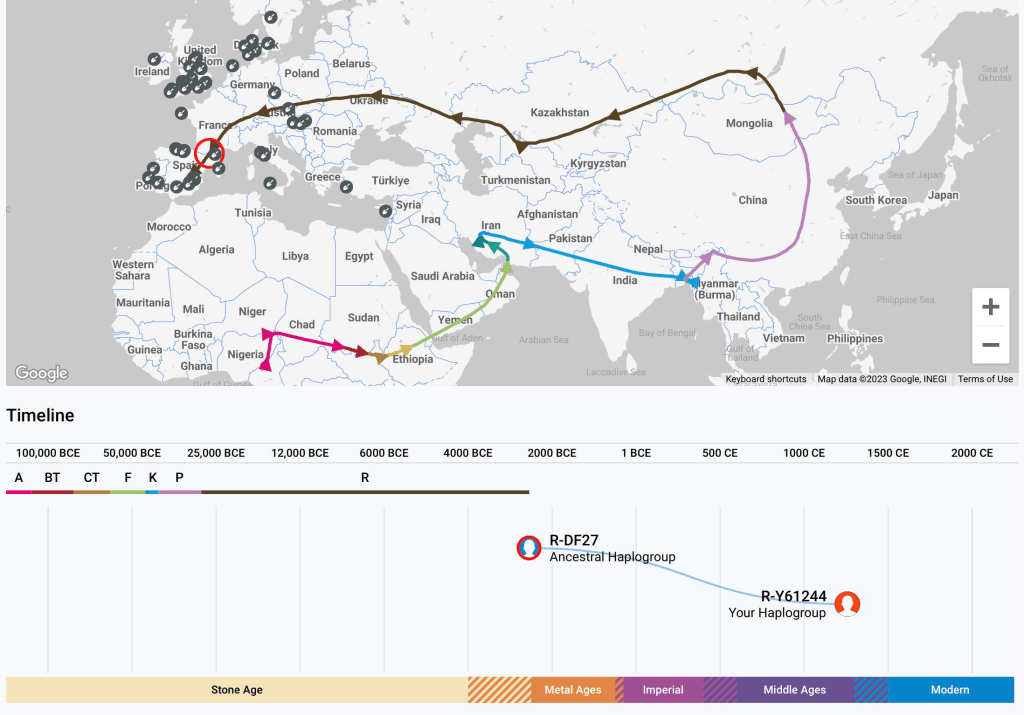
All human male lineages can be traced back to a single common ancestor in Africa who lived around 230,000 years ago, nicknamed Y-Adam. The image above details the estimated migration route from Y-Adam to our ancestral haplogroup R-DF27 (estimated to 2550 BCE) and his descendants found in ancient DNA from archaeological remains.
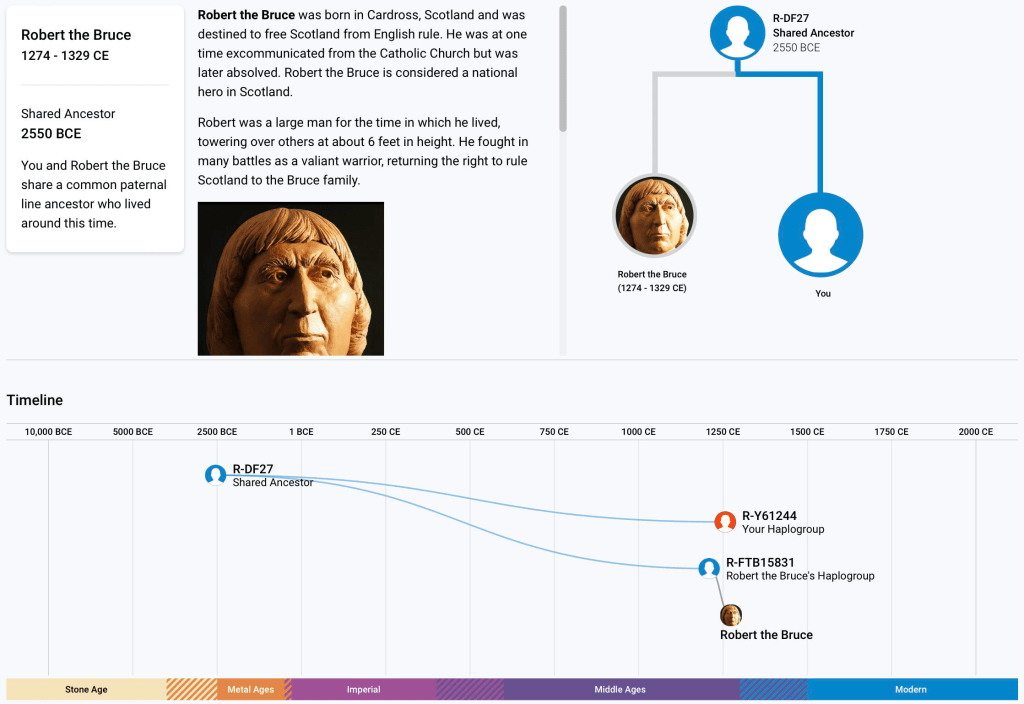
Meanwhile, amongst our notable connections, we share an MRCA with King Robert the Bruce circa 2550 BCE;
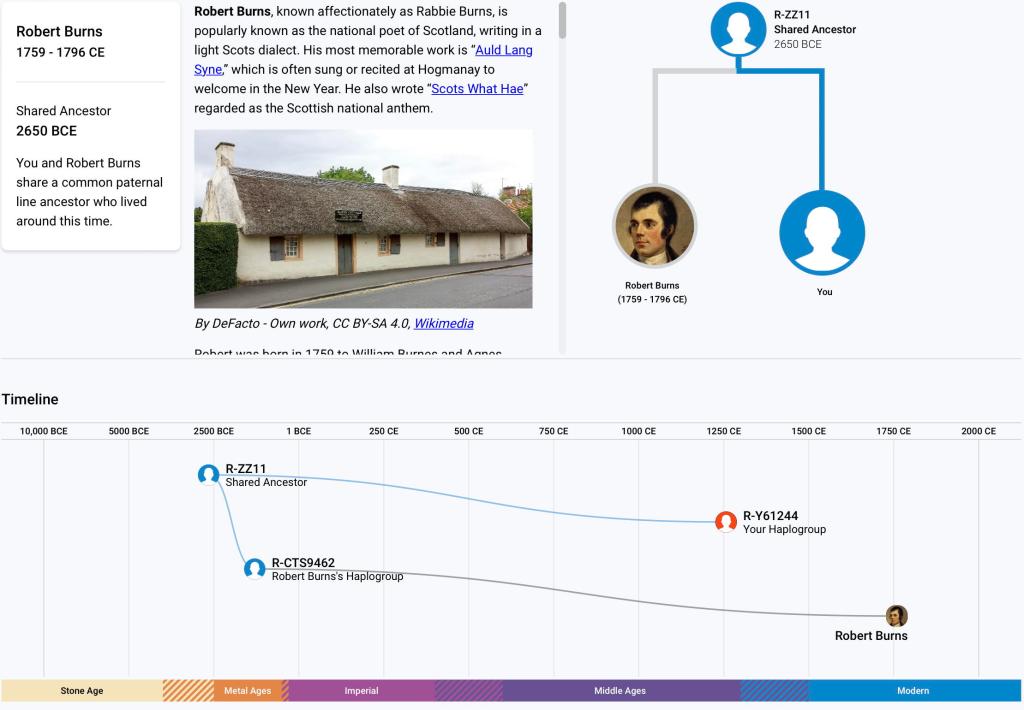
with Robert Burns circa 2650 BCE;
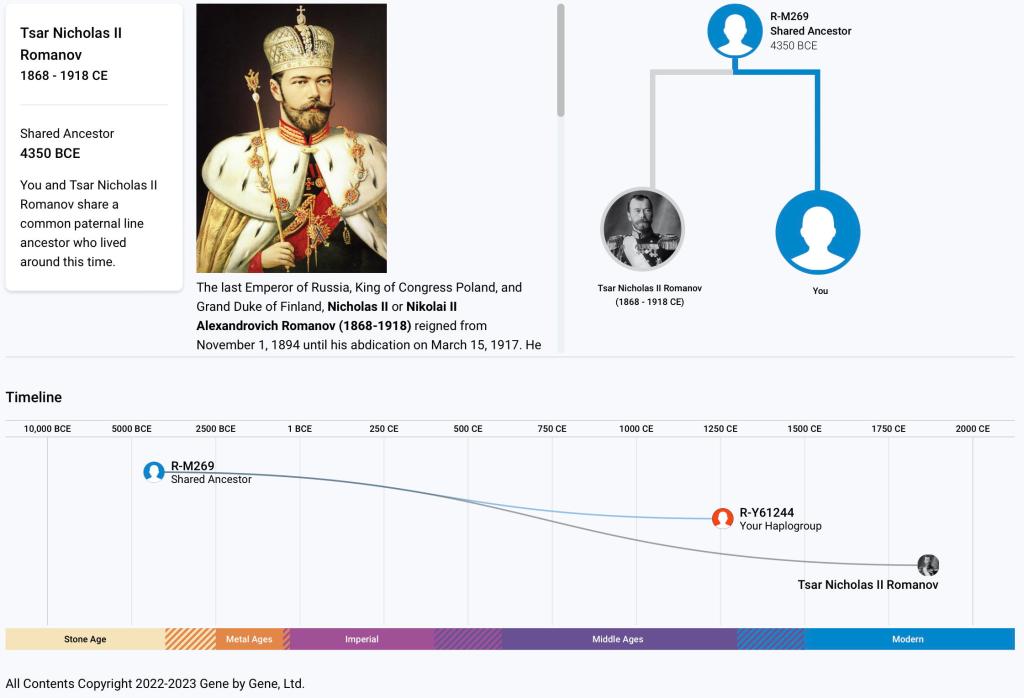
and with Tsar Nicholas II circa 4350 BCE.
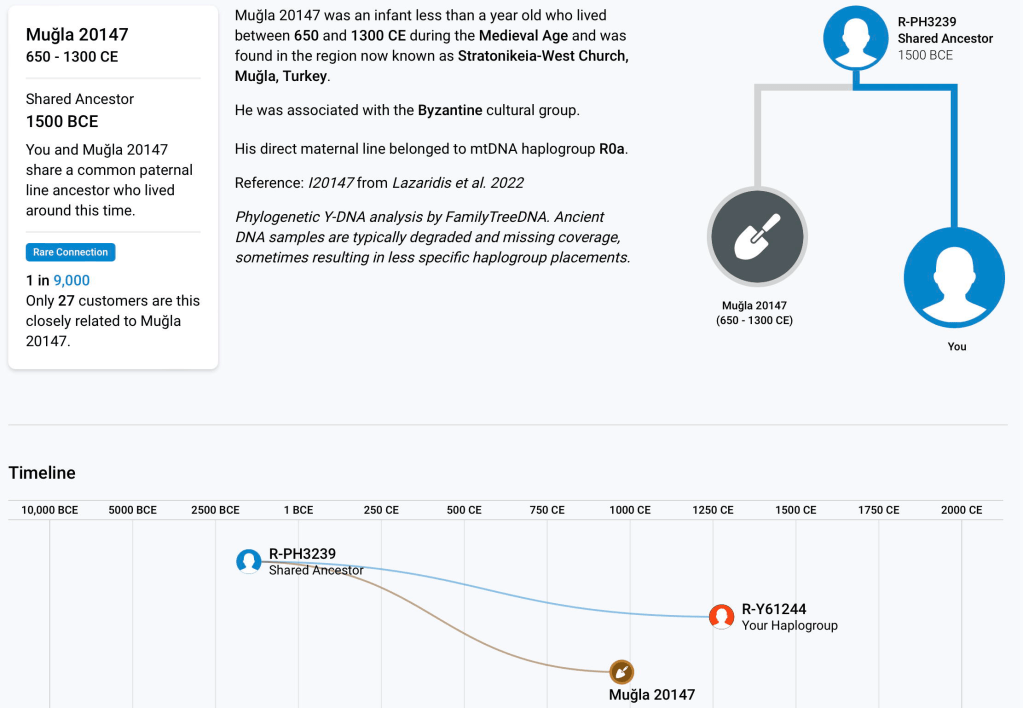
Amongst our ancient DNA connections, our closest relative is an infant from Mugla in Turkey who was born between 650 and 1300 CE, with whom we share a relatively recent MRCA of circa 1500 BCE.
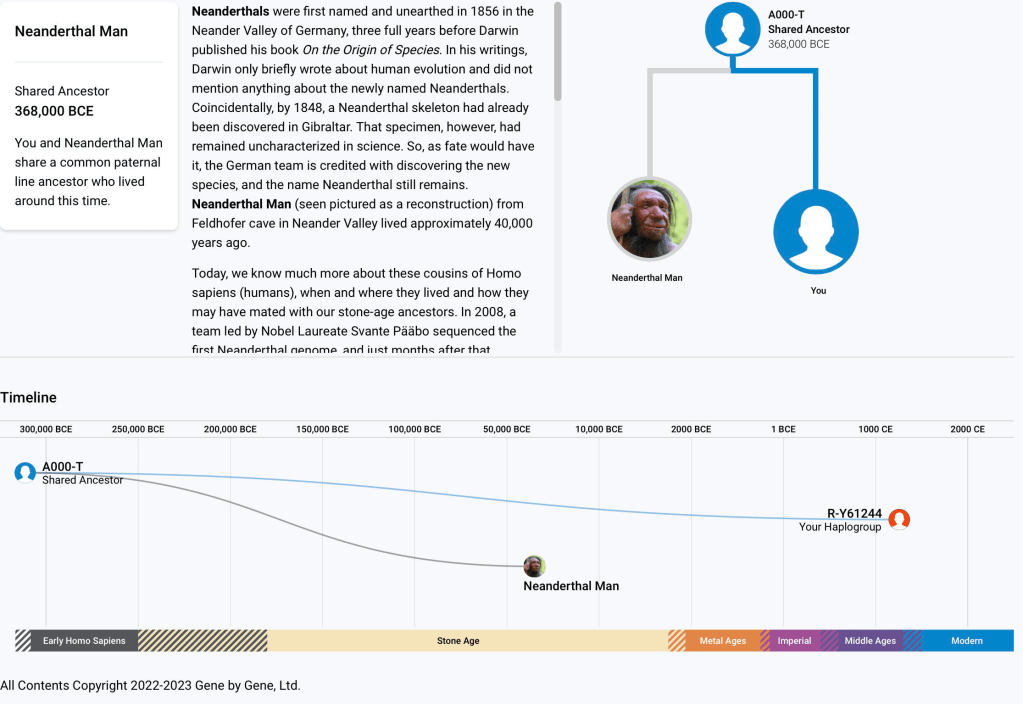
We also share a MRCA with the Neanderthals circa 368,000 BCE, although there was much more recent interbreeding between the species and non-African modern humans can carry from 1% to 4% of Neanderthal DNA.
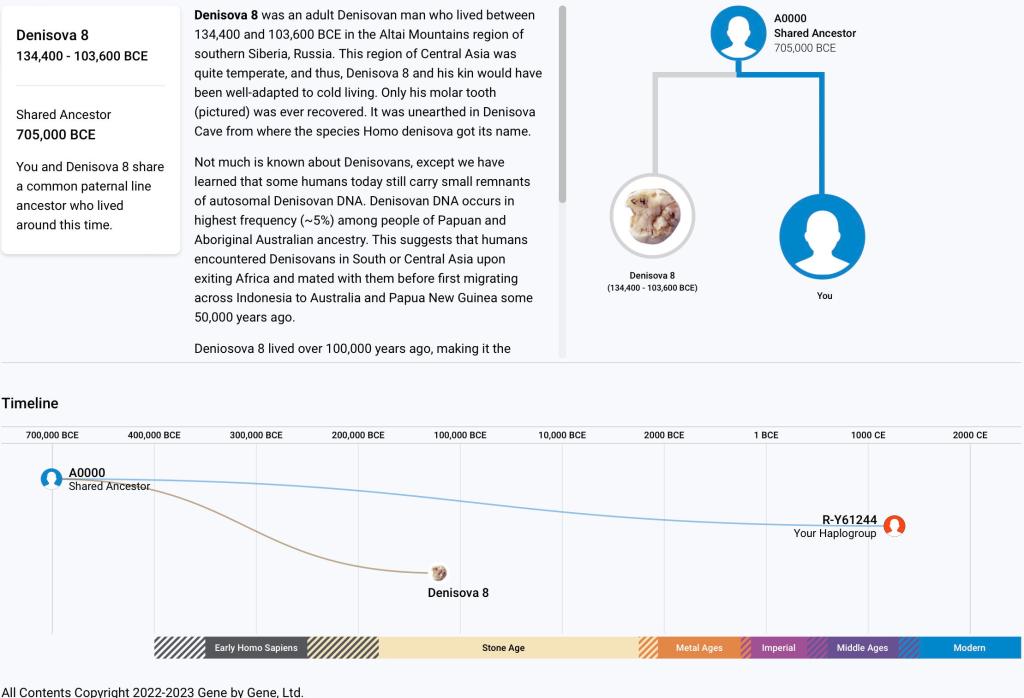
Further back, we share a common ancestor with a Denisovan male hominin, circa 705,000 BCE.
To find out how you and your family fit in to the global tree, please join us on our BigY700 journey.
Links
R-Y61244 story:
https://discover.familytreedna.com/y-dna/R-Y61244/story
R-FTD90752 story:
https://discover.familytreedna.com/y-dna/R-FTD90752/story
R-Y61244 Caithness project:
https://www.familytreedna.com/groups/r-y61244-caithness-scotland/activity-feed
Caithness Roots and the R-Y61244 project:
https://craigengelt.wordpress.com/caithness-roots-and-the-r-y61244-dna-project/
Project administrators:
Dr. Iain G. Old (mm4tb@rocketmail.com) and
Mr William Daniel Henderson (Henderson Family Genealogy).
Acknowledgements
Past and present project members:
Mr William Daniel Henderson (Group co-administrator),
the late Mr Robert Bruce Begg,
the late Mr Allan Old,
the late Mr Aeneas Murdoch Rosie,
the late Mr Alfred John Ross,
Mrs Jane Harris (Caithness Family History Society member),
Mrs Evelyn Andrews (Caithness Family History Society member, and
Mr Rod Patten.
Volunteer FTDNA group administrators:
Mr Wayne Townsend,
Mr John Templer Harper,
Mr Alasdair Macdonald,
Mr Gareth Henson and
Ms Lucy Nelson.

 Vecchio