

The Youngs in Meadhope

In 1674, Alexander Young, a great (x2) grandfather of Elder Samuel who married Hon(e)yman Oal/Old, was living at a place called Meadope in Abercorn parish in Linlithgowshire (West Lothian) when his son Alexander was baptised. I was not familiar with Meadope so decided to research it. I found Midhope and its castle in Abercorn parish on an 1818 map of West Lothian.

The Youngs are likely to have lived at the castleton rather than in Midhope Castle itself. On 7th January 1659, Midhope was occupied by Ro(bert) Drummond of Midhope, who was one of several witnesses to the baptism of Robert Ross, son of the local Minister Robert Ross. However, by 1664, Midhope appears to have been in the possession of George Livingston, 3rd earl of Linlithgow, who carried out extensive work on the castle.
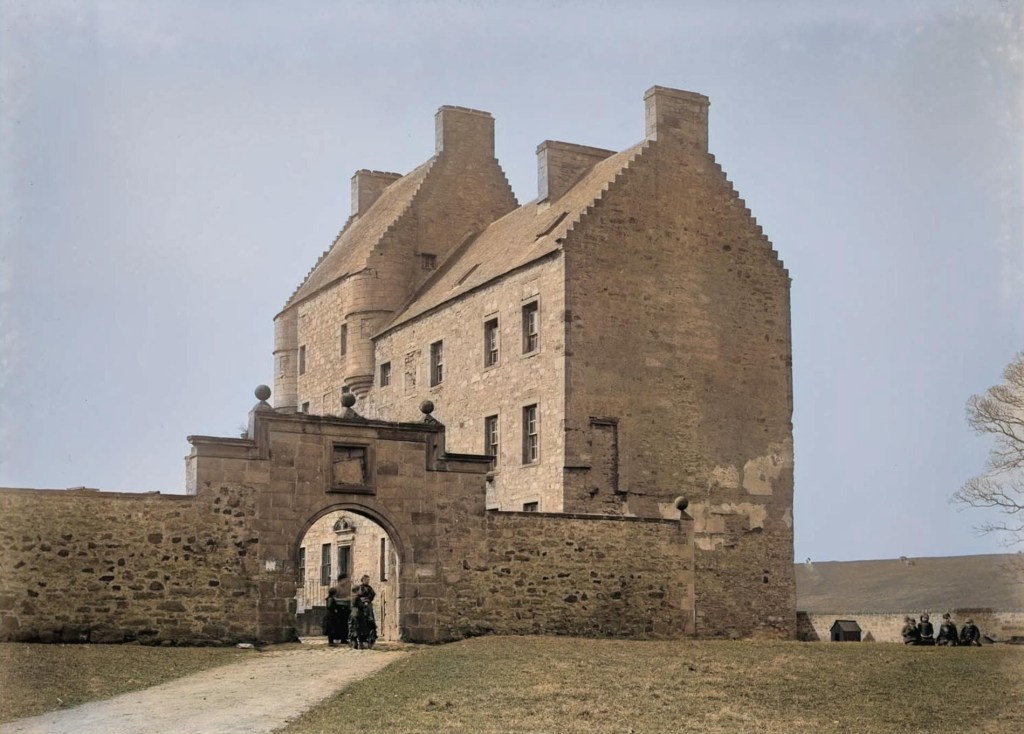
Midhope Castle

Midhope Castle is a 15th-century tower house in Scotland. It is situated in the hamlet of Abercornon the Hopetoun estate, About 4 kilometres (2.5 mi) to the west of South Queensferry, on the outskirts of Edinburgh. It is a Category A listed building.
The derelict tower house that can be seen today represents the much-altered 5-storey, oblong tower house.
In the 14th century the lands of Midhope were owned by Henry Graham of Mannerstoun. When he died without leaving a male heir Midhope passed to his two daughters. One of the daughters married Robert Livingstone of Drumry and Mannerstoun. The other daughter, Christian, married John Martin of Midhope, with Martin holding Midhope from the Livingstones of Drumry.
In the 15th century Midhope belonged to the Martin family. In 1438, John Martin of Midhope was the laird, and he is thought to have built the original tower house. John Martin’s widow, Lady Christian Martin, retained the right to occupy Midhope according to contract she signed with James Livingston of Mannerston.
In 1537 Sir James Hamilton of Finnart received a grant of half the lands of Midhope, half the lands of Mannerstoun and half of the mill of Abercorne from Elizabeth Martin, Lady of Falscastell, who held the lands from John Lindsay, 5th Lord Lindsay of the Byres.
During the latter 16th century, the castle belonged to Alexander Drummond of Midhope, brother to Robert Drummond of Carnock, Master of Work to the Crown of Scotland. A stone inscribed “AD 1582 MB” commemorates Alexander and his wife Marjory Bruce, daughter of Robert Bruce of Airth.
Alexander Drummond was a servant of the Earl of Huntly. On 7 August 1573, on behalf of the Earl of Huntly, Drummond returned jewels belonging to Mary, Queen of Scots to Regent Morton at Holyrood Palace. Drummond was buried at Airth Old Kirk.
A painted ceiling from the tower survives in the care of Historic Scotland at Edinburgh; it is planned to be put on public display at the Palace of Holyroodhouse. It includes cinquefoil motifs and probably commemorates the marriage of Sir Robert Drummond, who became laird in 1619, to a Hamilton heiress. The family motto was “ad astra per ardua” and fragments from another painted ceiling had gold stars on a blue blackgound, represented in the crest of the coat of arms.
In 1678, Midhope was given a facelift when an entrance tower was removed and the extension to the east was heightened and extended. A new doorway was added along with a small courtyard, measuring 114 by 61 feet (35 by 19 m), to the south.
A large, two-chambered, oblong, late 17th century dovecot sits about 140 metres (150 yd) to the southeast.
Midhope Timeline
1458 – The first reference known ‘Medhope’ in a document concerning a boundary dispute between Henry Levingstone and John Martyne, laird of Medhope. John Martyne then built Medhope Castle where he remained as laird until his death in 1478.
1478 – Midhope passed over to a Henry Levingstone.
1582 – Midhope is passed to Alexander Drummond and his wife Marjorie Bruce.
1587 Alexander Drummond rebuilt the tower and turrets and a date stone containing their initials commemorates this. Originally located in the lintel of the front door this stone can now be seen on the gateway.
1664 – The present doorway and lintel are the work of ‘G. L.’ George Livingston, third earl of Linlithgow. It was during his lifetime the castle took the shape which we see today.
1678 – The castle was acquired by John Hope and given a facelift when an entrance tower was removed and the extension to the east was heightened and extended. A new doorway was added along with a small courtyard.
1710 – Sir Robert Sibbald described ‘Meidhope’ as a ‘fine tower house with excellent gardens, one of the seats of the Earls of Hopetoun’.
1851 – The census reveals there are 53 people in 10 families living around Midhope, including 4 game keepers, 4 foresters, 2 labourers, a groom, a carter, a gardener, a joiner, and a number of paupers.
1926 – Records describe the Castle as deteriorating including a fine oak staircase with twisted balusters ‘now sadly dilapidated’ rising in the East Range from the first to fourth floors.
1988 – Restoration work commences including the replacement of the roof on the East Range, a new roof for the West Tower as well as the insertion of new window frames into existing openings.
2013 – Midhope is chosen as a film location for TV series Outlander.
Midhope Castle in Outlander
I was astonished to discover that Midhope, like Preston Mill in East Linton, had been used as a location in Outlander. Fans of the series may recognise it as Lallybroch, home of Jamie Fraser.

On Claire’s first journey to Lallybroch with Jamie, she finds the house is larger than she had expected:
“...a handsome three-story manor of harled white stone, windows outlined in the natural gray stone, a high slate roof with multiple chimneys, and several smaller whitewashed buildings clustered about it.“
Lallybroch, also known as Broch Tuarach, is the small estate that belonged to Brian and Ellen Fraser, and whose ownership passed to Jamie Fraser after his father’s death. According to Jamie, the land is fairly rich and offers opportunity for fishing and hunting. Lallybroch supports about sixty crofts, as well as the small village, Broch Mordha. Jamie’s family home is the tower house on the estate.
Upon Ellen MacKenzie’s marriage to Brian Fraser, Ellen’s brothers, Colum and Dougal, insisted that she not be a tenant on Fraser lands, but instead live on a freehold. The estate of Broch Tuarach, situated along the border between the Fraser and MacKenzie lands, was thus deeded to Brian Fraser, but a clause in the deed stipulated that ownership of the estate must pass to Ellen’s issue only. If she had died without bearing children, the land would have passed back to Lord Fraser of Lovat, and not to any children Brian may have had by another woman. However, Ellen did have two children that lived to adulthood – her son Jamie and daughter Jenny – and so Jamie inherited the estate upon his father’s death.

Named for an old broch on the land, Broch Tuarach means “north-facing tower” in Gaelic. Lallybroch, as the estate is known among those who live there, in turn means “lazy tower”. Jamie explains to Claire, who fails to see how a cylindrical structure could face a particular direction or be called lazy, that the door of the structure faces north, and the nickname comes from the fact that the tower leans slightly to the north – owing to its falling down and being rebuilt many times over the years.
After Jamie was arrested by Captain Randall, his father, Brian, died suddenly, and the running of the estate fell to Jamie’s sister, Jenny, the last of his immediate family. While Jamie was away, Jenny married Ian Murray, and the two of them managed the estate in Jamie’s absence, until he returned a few years later with his new wife, Claire.
During the rising in an effort to protect Lallybroch and his family if he should be tried for treason, Jamie signs the property over to Young Jamie, with signatures from Claire and Murtagh as legal witnesses.
Built in 1702, the tower of Lallybroch was modern for its time, equipped with porcelain stoves for heating and a brick oven built into the kitchen wall.

 Vecchio