

Scottish Barons, from Genealogical Notices of The Napers of Kimahew in Dunbartonshire John Carfrae Malcolm, Glasgow, (1849)

The degrees of hereditary dignity in England, are six, — Baronet, Baron, Viscount. Earl, Marquis, Duke ; — in Scotland, they are seven — Baron, Baronet, Lord, Viscount, Earl, Marquis, Duke. Prior to the reign of James VI., the nobility of Scotland consisted of three grades, — Earls, Lords, and Barons. The latter, styled sometimes free barons, small barons, and lesser barons, formed the most numerous, and not least powerful section of the Proceres Regni. They had hereditary seat and voice in Parliament inter magnates; were styled “Lovit Cousin,” by the King; were called ” noblemen” in Acts of Parliament had ascribed to them the courtesy style “right honourable” had the right of pit and gallows” within their respective baronies ; and enjoyed, by statute, Parliamentary robes and ornaments of estate, similar to those of the ranks above them. They also carried de jure supporters to their arms.
Before the Union, Parliament was composed of three estates, viz. : — the Clergy, the Nobility, and the Burgesses. These all sat in one house, according to their respective ranks, whether ecclesiastical, territorial, or municipal. The term comprehending the second estate, “the nobility,” and the modern word “peerage,” are not to be confounded with each other. The latter now implies only those hereditary classes that rank above the baronetcy, which was a rank invented by James VI., and originally conferredfor a certain price.
The Statutes of Robert I bear to be made in his Parliament, with – “Earls, Barons, and others, his noblemen of his realm;” and so late as 1592, the 134th Act of James VI begins, “the Nobility, Earls, Lords, and Barons, &c.” In the 87th Act, 6th Parliament of James V, it is ordained that ” everie nobleman, sic as earle, lorde, knight, and barone,” &c. Sir George Mackenzie, Lord Advocate of Scotland under Charles II and James II (& VII), in his celebrated work on Precedency, observes “Under the word baron, all our nobility are comprehended. and he states: - ”I find by the old records, as particularly in October, 1562, that noblemen and burgesses are called, but no barons – the barons and noblemen being then represented promiscuously.” By the 101st Act, 7 Parliament of James I., the barons of each shire were allowed to choose two of their number to represent them, “which,” continues Sir George (who died 1691), “is the custom at this day.” “Yet,”say she,”it is observable, that though by that act the barons may, for their conveniency, choose two, yet they are, by no express law discharged to come in greater numbers.”
This was James I. of Scotland, not James I. of England; accordingly, in the reign of Queen Mary, when the estates assembled for ratification of the Confession of Faith, in 1560, the barons claimed their right to have seat and voice in Parliament, intimating their desire to exercise the same, which was unanimously allowed.
The titles of hereditary dignity in Scotland were originally territorial. Thus lands were erected into baronies, giving the title of baron; into lordships, giving the title of lord ; and into earldoms, which gave the title of earl. Barony was truly and strictly, however, the only feudal dignity conferred on territorial proprietors ; lordship, earldom, &c, being only nobler titles for a barony, as connected with personal dignities. (Stair, II., 3, 60. Erskine, II. 3, 46, and 6, 18.) As these were the constituent portions of the second estate of the realm, it does not appear how the barons allowed their rights to fall into disuetude. No act of the legislature was ever passed by which they were disfranchised; for the consent given by James I., that the barons of each shire should be represented by two of their number, merely relieved them from the great trouble, and very grievous expense, occasioned by their attendance in Parliament. It was, in fact, on a representation of the hardship of this expensive honour, that the King allowed the barons to appear by representatives; or rather agreed, as Pinkerton says that a baron should “not be constrained to attend, except his estate amounted to a certain sum.”
These noble deputies were even paid for their attendance in the Legislature ; and perhaps one of the most curious and interesting documents among the Kilmahew Papers, (especially now-a-days, when payment of members is so much scouted, sneered at, and despised, as one of the six points of the Charter,) is the ” Horning and Poynding, Sir John Colquhoun and John Napier, Members of Parliament, chosen for the shire of Dumbartane, against the free-holders of the said shire, for the £5 scots, daylie allowance, modified by Parliament, which is signet at Edinb. 22 feb. 1662,” accompanied by the ” Certificate for the saids Commissioners Their Sitting in Parliament 1661, Extracted furth of the Rolls of Parliament by Hamilton.
Rights of blood do not prescribe, and it is, therefore, somewhat remarkable, that the barons of Scotland, numbering even at this day, (1848,) perhaps 400, should have allowed their rights, privileges, and distinctions, to remain so long unrecognised, and even unknown, while the comparatively modern baronetcy has never ceased an agitation, as yet fruitless, for a recognition of its claims to certain shadowy baronies in Nova Scotia, and valueless rights to trifling personal decoration.
The Acts of Union and of the Scottish Legislature, regulating the elections of the Representative Peers and Commissioners for Scotland, made no express provisions beyond those of 5 Feb, 1707; when it was enacted that of the forty-five members to be sent to .the House of Commons, thirty should ” be chosen by the shires or stewarties, and fifteen by the Royal Burrows and that the sixteen Peers and forty-five Commissioners for Shires and Burghs, who shall be chosen by the Peers, Barons, and Burghs, respectively, in this present Session of Parliament, and out of the members thereof, in the same manner as Committees of Parliament are usually now chosen, shall be the members of the respective Houses of the said first Parliament of Great Britain.
Against the articles of Union, and pending their discussion, the Earl of Buchan protested for the privileges of the Peers, the Duke of Argyll for those of the Peerage, the Baronage, and the Burgesses, and George Lockhart of Carnwath, that neither votes, conclusions, nor articles, should “prejudge the Barons of this kingdom from their full representation in Parliament, as now by law established, nor any of their privileges, and particularly their judicative and legislative capacities &c.
These “judicative” capacities were swept away by the act, abolishing heritable jurisdictions, passed immediately after the vindictive and bloody suppression of the rising in 1715 ; a measure, which, however politic in the then state of Scotland, wise in a national point of view, and fortunate in its results, was at least somewhat unjust, so far as regarded the personal rights of the Barons. The power of “pit and gallows” was happily gone, but the crown vassals, infeft cum curiis, may still hold a court for pleas not exceeding 40s. fine to the amount of 20s.; and imprison in the stocks five hours in the daytime within their own feudal jurisdictions.
Their ” legislative” capacities, since the Union, were, till the Reform Act, exercised by the “freeholders” in the counties, electing commissioners to Parliament as before and the debates in the House of Commons of 1832, as well as of previous years, prove how extensive was yet their political influence.
These electoral privileges, however venerable or respectable, were then committed to every proprietor, whatever might be his tenure, of property yielding him £10 sterling yearly. The justice of that change, as affecting the personal interests of the freeholders, has often been controverted. Freeholds, from having been a sacred trust for the people at large, had become marketable property, of great value, and in constant demand. This had long been sanctioned by law. Yet, without reservation or compensation that property was at once swept away, and, in some counties, what had been eagerly sought at the price of £2000, in 1830, ‘was, in 1832, worth nothing! The policy of the new mode of representation is best judged of by its results, on which, be it remarked, scarcely two men can be found to agree ; and it is, perhaps, not going too far to remark, that although the embittered, and all but extinguished free-holder may now sneer to see the immuni- ties of a “lovit cousin” of Majesty vested in the presiding lord of a village whisky shop ; the parish ” Stultz,” profound only in fustians, ruminating on the newly-acquired privilege, held formerly by those only who had “robes of estate;” or the master weaver holding out to the laudable ambition of shoeless apprentices their future possession of the franchise, conferred by the occupancy of a floor-less loom-shop, and the chance of thereby wielding the rights of the former Proceres Regni ; still it can by no one (however fervent his hopes of the new constitution) be denied, that the classes, who acquired the legislative capacities of the ancient Barons, were the first to raise their voice against that political party who had bestowed on them their new electoral powers, and that, in 1843, many not only will not exercise the rights so conferred, but even fervently desire to be unpossessed of what is to them a troublesome privilege. Whatever may be thought, however, of this great political change in the constitution of the country, it is earnestly to be hoped that the franchise will never again become property, as it was in the time of the Barons, and their representatives, the Freeholders, nor be made the subject of barter or sale, in any shape whatever.
In the words of a learned commentator on the Laws of England : — “It was the stern task of our forefathers to struggle against the tyrannical pretensions of regal power to us, the course of events appears to have assigned the opposite care, of holding in check the aggressions of popular licence, and maintaining inviolate the just claims of the prerogative. But, in a general view, we have only to pursue the same path that has been trodden before us, — to carry on the great work of securing to each individual of the community as large a portion of his natural freedom as is consistent with the organization of society, and to increase to the highest degree, that the order of divine Providence permits, the benefits of his civil condition. A clearer perception of the true nature of this enterprise, of the vast results to which it tends, and of the obligations by which we are bound to its advancement, has been bestowed on the present generation, than on any of its predecessors. May it not fail also to recollect, amidst the zeal in- spired by such considerations, that the desire for social improvement degenerates, if not duly regulated, into a mere thirst for change ; that the fluctuation of the law is itself a considerable evil ; and that however important may he the redress of its defects, we have a still dearer interest in the conservation of its existing excellencies.”
Scottish Baronies post 2004
In the year 2000 the Scottish new parliament voted to abolish the feudal tenure and judicial power of the Barons of Scotland, but it was careful to state in it’s section 63 the dignities and offices of the Barons:
63. Baronies and other dignities and offices.
Any jurisdiction of, and any conveyancing privilege incidental to, barony
shall on the appointed day cease to exist; but nothing in this Act affects
the dignity of baron or any other dignity or office (whether or not of feudal
origin).
Therefore preserving the ancient office and dignity of the Barons of Scotland.
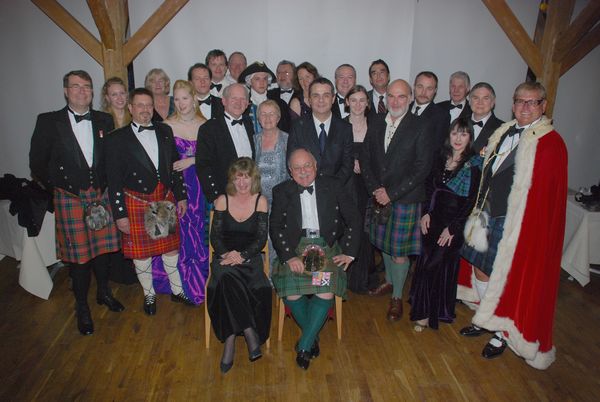
28th November 2004 was the precise date when feudal land tenure in Scotland finally ended and Barons by statute lost all their rights save their territorial titles and the Dignity per se as a Noble of Scotland with its ancient heraldic entitlements. At the final session of any Scottish Baronial Courts, held at The Prestoungrange Gothenburg in July and October 2004, the Courts declared November 28th to be known as ‘Barons’ Day’ henceforth and required that it should be properly celebrated with all other members of the Baronage invited.
The third Annual Banquet to celebrate the Baronage of Scotland, inaugurated in 2004 in Prestonpans by Prestoungrange and Dolphinstoun, took place on November 28th 2007 in the Jacobite Room at Edinburgh Castle. More than 40 Barons and their Ladies attended with another 50 guests. It was the largest gathering since the Act of Union with the Sassenachs brought them all together three hundred years ago just 150 yards down the Royal Mile in the Auld Parliament. 2008 would see them banqueting on the Royal Yacht Britannia on even date.
Lyon Clerk Elizabeth Roades is on public record as reminding all Scotland’s Barons that if they wish to gain and sustain respect in their own communities and Scottish society at large, they must without fail honour their territorial origins. It was from Scotland’s lands that their titles are derived. The Poet Laureate, John Lindsay, followed this sentiment through with his customary wise advices:
DIGNIFIED BARONS A-PLENTY
From Inneryne to Plenderleith
There’s Barons Scots a-plenty
From Gigha west to Cluny east
Here number Barons twenty
Come all ye honoured Barons now
Of Scotia’s rain-swept land
We’ll take a trip down History Lane
Then view the state-in-hand!
The Declaration of Arbroath
Was signed by thirty-eight
When Barons were a source of strength
Which moved this nation’s fate
Our Barons stinted not their lives
To fight usurpers ill
For dozens died at Halidon
And more on Flodden Hill
You may have lost your feudal rights
But titles you’ve retained.
Above all, use those Dignities
For which you once were famed.
A Baron-free millennium
Was what the Parliament planned
Yet here you are as Barons still –
On Dignities you stand.
Our world has need of folk like you,
Barons bold and Barons true!
Look then to the future
For there’s much that you could do!
Your feudal days have long-since gone –
Kinship and loyalty grow less strong
But Baron’s still can show the way
In this materialistic day
By taking interest in the place
From whence their ancient titles came
Like Dolphinstoun and Prestoungrange
Who’ve worked great wonders bright and strange!
So now we leave you with this thought –
There are some things that can’t be bought
This present time –
Blaze Barons, blaze in worthy cause
And make your titles shine!
Prove to the world there’s life there yet
To justify your line!
From Ardgowan east to Ormiston,
North to Braemar then Pitcruivie,
Finlanrig, Blackhall,Holydean
Auchternunzie thence to Comrie …
Think on Bathgate, Lag, Kilmarnock too,
Rachane Delvine and Biggar,
Kilpunt Dunira Duddingston,
Cushnie-Lumsden and Corstorphine-
Not forgetting Prestoungrange and Dolphinstoun!
Let Our Dear Lord in His Wisdom
Make them glitter in their fiefdom –
Make a difference in this Godless age –
The new proactive Baronage!
Barons are deeply committed to honouring their Titles and Dignity and gladly reaffirmed it
The great majority of Barons in attendance in 2007 are recorded in the poetry above. Many more sent apologies. But all cried Aye aloud as by tradition the Baron most recently infeft in Scotland, Duddingston, took his ancient Oath of Allegiance to HM The Queen as his feudal Sovereign Lord before his peers, and pledged to honour and support as best he might those living today on the lands from which his title derives.
The Barons of course brought family and friends as their guests. Amongst local guests were East Lothian singers The Laverocks, Dr Lindsay Davidson – Piper and Master of Musick in the Courts, Arran Johnston – HRH Prince Charles Edward, Adam Watters – Agitant The Alan Breck Prestonpans Volunteers and Trustees from the Battle of Prestonpans Heritage Trust. The last man in Scotland to be punished in the stocks in 2004 in Prestonpans – Dr Andrew Crummy – was also present as was the Editor in Chief of Burke’s Peerage Hugh Peskett. The Laverocks particularly enjoyed offering the Baronage the love song O Gin I Were a Baron’s Heir.
Apologies were received from the Earls and Barons of Arran, Ballencrief, Ballindalloch, Balquhain, Bognie, Bombie, Braemar & Breadalbane, Craighall, Cromar, Delgaty, Duncrub, Easter Gordon, Elie & St Monans, Fairholm & Kirkton, Fulwood & Direlton, Gala, Gleneig, Glenfalloch, Grandhome, Holydean, Keith Marischal, Kilmaurs, Lathallan, Lauriston, Lochnaw, McDuff, Melgand, Mordington, Octhtercoull & Dinet, Urquart and Wormiston.
Links
List of Scottish Feudal Baronies (created before 1707 – incomplete)
 Vecchio