

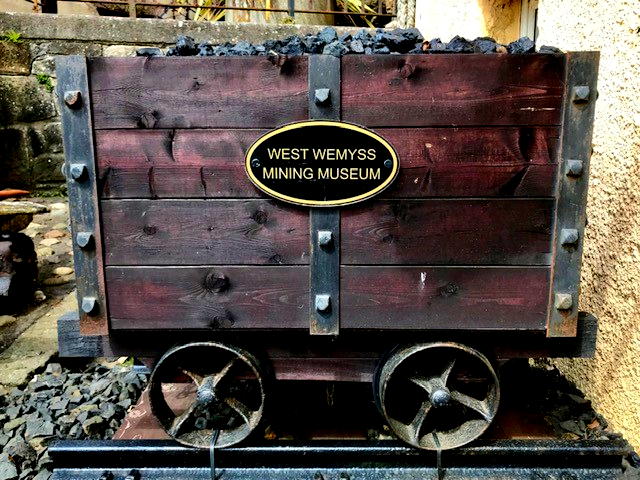
The Kirk Session Minutes
The addition of Kirk Session Minutes to the ScotlandsPeople website on 16th March 2021 has been a godsend to family historians. Although they are not indexed and can sometimes be difficult to read, with a little effort they can reveal surprises about our ancestors that we would not have discovered from more traditional sources such as births/baptisms, banns/marriages, deaths/burials and census reports.
“Although The Old Parish Records In Scotland (OPRs) help us to trace our ancestors, it is the church court records that give us specific information about the daily lives of our ancestors and the lives of the individuals within their community. They document the behavior of social classes which do not usually appear in written records.
“The records of the Kirk Sessions make up a significant part of Scotland’s recorded history. They are used by a wide range of academic professional and amateur researchers, especially genealogists. The Kirk Sessions, which dealt with spiritual, moral, and social matters within the local parish, documented all parish disciplinary matters which often detailed accounts of the discipline the minister and kirk elders handed out to parishioners for their immoral behaviors. They would listen to cases within the church regarding such matters as pre-marriage fornication, blasphemy, irregular marriages, and working on the Sabbath.
“The Kirk Session also administered poor relief, promoted education, regulated marriage, baptism, and burial, supervised building works, directed communion, and liaised with the higher courts.“
Scotland’s Kirk Session Records: A Hidden Gem
Robert Burns in the Kirk Session Minutes
Amongst those who fell foul of the Kirk was, perhaps unsurprisingly, the poet, Robert Burns. Robert and his wife, Jean Armour Burns, had nine children, while he had at least an additional three children by three other women – Ann Park, Elizabeth Paton and Janet Clew. The latter was a maid who worked for Burn’s “Clarinda”, Agnes Maclehose, the inspiration for his “Aye Fond Kiss”. There was also Mary Cameron, who may have borne Burns a son. So, it is unsurprising to find the bard is mentioned in the Kirk Session Minutes of Mauchline parish.
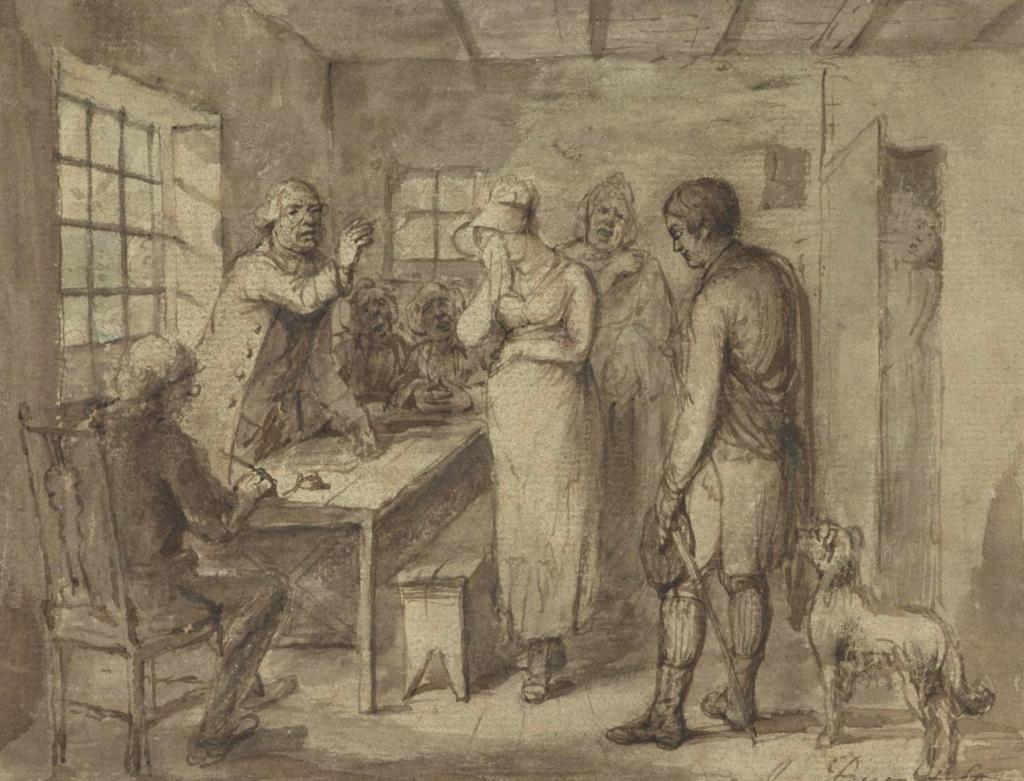
Robert Burns appeared before the kirk session of Mauchline in 1786 to admit that he was the father of Jean Armour’s twin children, and underwent public repentance during June to August.
Mauchline Kirk Session minutes. CH2/896/12 pages 162-173.
In 1788 it came to the attention of the kirk session that Burns and Jean Armour had been irregularly married, ie in a civil ceremony and not by a minister. As was usual in such cases, the session summoned them and rebuked them on 5 August, impressing on them that they were bound together as husband and wife.
Mauchline Kirk Session minutes. CH2/896/12 OPR604/2 p235.
Prides in the Saltpreston (Prestonpans) Kirk Session Minutes
Until relatively recently it has been unclear where our ancestors James Pride and Helen Selkirk came from, as discussed in a previous article. Helen Selkirk was originally thought to have been the daughter of a merchant from Leith, however it is now believed that she was more likely to have been born in Prestonpans in East Lothian, where a gap in the Old Parish Register of Births & Baptisms would mean that had she been born and baptised in the parish, this would not have been recorded.
However, James Pride’s origins remained a mystery. Although it has been demonstrated through BigY700 DNA testing at FamilyTreeDNA that the Lothian and Fife Prides do share a common ancestor, this man is estimated to have been born around 1404 CE.
On 23rd July 2022, we achieved a breakthrough when we discovered that John and Christian Pride were mentioned in the Saltpreston (Prestonpans) Kirk Sessions minutes of 1693. It was not known how this couple are related to our ancestor James Pride, but they were believed to be close relatives, possibly his sibling(s) or cousins. The information about John and Christian Pride contained in these records proved to be extremely interesting indeed as they revealed that John and Christian Pride had recently arrived in Saltpreston (Prestonpans) parish in Haddingtonshire (East Lothian) from Wemyss parish in Fife.

The entry above for 19 March 1693 reads:
“John Pride and Christian Pride compearing and confessing mutual fornication:
Item. The foresaid day, Compeared together before the session according to citation, John Pride, Collier, and Christian Pride, Coal Bearer to the Laird of Preston Graing, and after confessed and acknowledged their mutual fornication, and in regard they were both strangers and wanted testamonials, they were referred and delayed until the next Session day and appointed to get certificates from the respective Parochins, where they last resided betwixt and that time.”
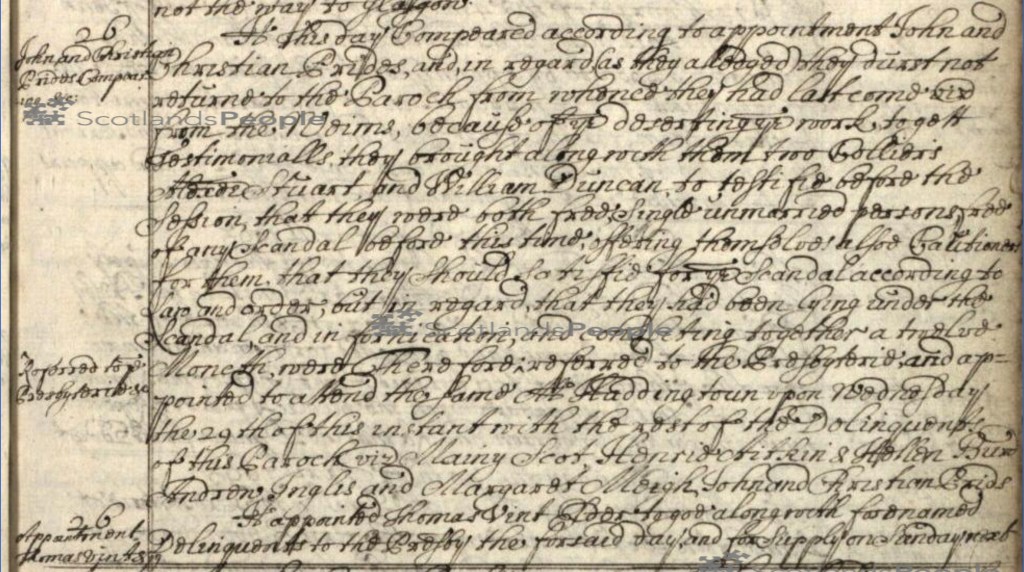
The entry above for 26 March 1693 reads:
John and Christian Prides Compeared:
Item. This day compeared according to appointment John and Christian Prides, and, in regard, as they alleged they durst not return to the Paroch from whence they had last come, wiz from the Weims (Wemyss) because of their deserting their work to gett testimonialls they brought along with them two Colliers, Alexder Stuart and William Duncan, to testifie before the Session that they were both Free single unmarried persons, free of any Scandal, before this time, offering themselves alsoe Cautioners for them, that they should satiffie for their Scandal according to law and order, but in regard, that they had been lying under the Scandal, and in fornication, and cohabiting together a
Proposed to the Presbyterie:
Moneth. Therefore referred to the Presbyterie and appointed to attend the same at Haddingtoun upon Wednesday 29th of this instant with the rest of the Delinquents of this Paroch, viz Mainy Scot, Henrie Aitkin, & Hellen Burd, Andrew Inglis, and Margaret Meigh, John and Christian Prids.
Appointment Thomas Vints:
It appointed Thomas Vints to go along with forenamed Delinquents to the Presby. the foresaid day and for Supply. on Sunday next.
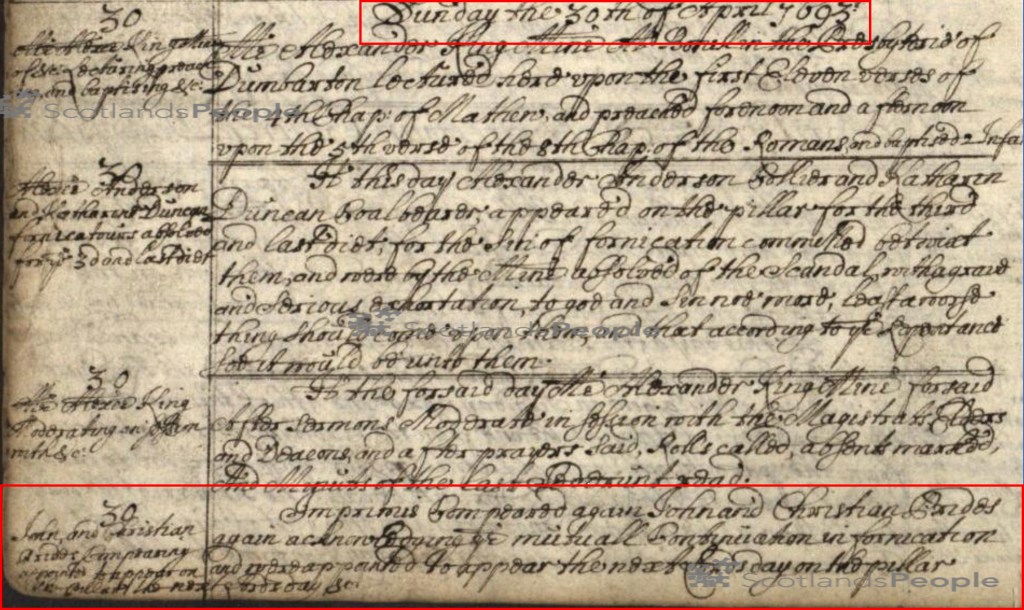
The entry above for 30 April 1693 reads:
John and Christian Prides Compearing. Appointed to appear on the pillar the next Sunday ser.:
Imprimus Compeared again John and Christian prides again acknowledged mutuall Consinication in fornication and were appointed to appear the next Sunday on the pillar.

The entry above for 07 May 1693 reads:
John and Christian Prids, fornicators on the pillar for the first diet:
Item. This day, John and Christian Prides appeared upon the Pillar according to appointment the last sederunt for the sin of fornication committed betwixt them and that for the first diet and were grasely and seriously exhorted by the Minr. to a deep sense of their sin and appointed to continue in their repentance accorder to order, this being only the first diet.

The entry above for 14 May 1693 reads:
John and Christian Prids fornicators for the first diet:
This day, John and Christian Prides appeared upon the publick place of repentance for the continuation in the sin of fornication betwixt them for the second diet.
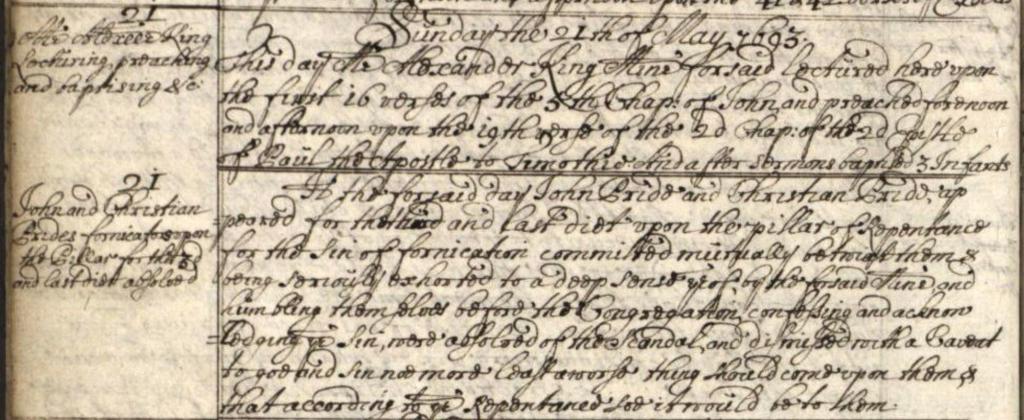
The entry above for 21 May 1693 reads:
John and Christian Prides fornicators upon the pillar for the 3rd and last diet, absolved:
Item. The foresaid day, John Pride and Christian Pride appeared for the third and last diert upon the pillar of Repentance for the sin or fornication committed mutually betwixt them & being seriously exhorted to a deep sense thereof by the said Minr. and humbling themselves before the Congregation, confessing and acknowledging their sin, were absolved of the Scandal and dismissed with a Caveat to goe and sin no more least a worse thing should come upon them and that according to their repentance so it would be to them.
Haddington Presbytery Session Minutes
Note that John and Christian Pride were ordered to appear before Haddington Presbytery Session. Unfortunately the minutes for the years 1687 to 1693 (CH2/185/8) are not available on ScotlandsPeople.
Summary
On 19 March 1693, John Pride, Collier and Christian Pride, coal bearer in the employment of the Laird of Prestongrange, both single and unmarried, appeared before the Kirk Session of Saltpreston (Prestonpans) accused of cohabitation and fornication.
It turned out that they had only recently arrived in East Lothian from the parish of Weims (Wemyss) in Fife, having deserted their work there. At this time colliers were bound to their masters like serfs and were unable to quit their unemployment without the permission of their master. However, if they evaded capture for a year and a day, they were granted immunity from prosecution and did not have to return to their previous employment.
As John and Christian Pride were unable to provide testimonials from Wemyss parish, they appeared with two colliers, Alexander Stuart and William Duncan, who vouched for them.
They were ordered to attend Haddington Presbytery Session along with other “sinners” but the decision of this body is unknown.
Back in Prestonpans they appeared on three successive Sundays upon the “Pillar of Repentance” and after the third session they were “absolved” of their sins.
This couple went on to marry in Prestonpans parish on 05 June 1693. Their eldest child, a daughter named Marie, was born on 15 January 1694 and baptised on 25 January 1694 by the Minister Mr John Reid. A note was added that Marie was “Begotten in fornication betwixt them before marriag.“
Note that the then Laird of Prestongrange, and owner of Prestongrange colliery, was William Morrison, 3rd feudal Baron of Prestongrange, who had been elected as Member of the Scottish Parliament for Haddingtonshire (East Lothian) in 1690. He has a detailed biography on the History of Parliament website.
Conclusions
The fact that John and Christian Pride, two of the first known Prides to be documented in Prestonpans parish had arrived there from Wemyss in Fife, a parish where the Earl had extensive mining interests, was extremely significant. But had John and Christian Pride been born in Wemyss?
To be continued in part II.

 Vecchio
Still no part two?
LikeLiked by 1 person
Apologies. It was largely written up, but before we got a chance to add it we were asked to stop as someone wanted to use our research in a book that, as far as I know, still remains unpublished.
Perhaps one day we might be allowed to continue this series, but in the meantime there are plenty of other interesting tales to tell.
LikeLike
I can perhaps add that a few months ago I was very privileged to be able to spend a fascinating and very enjoyable evening with a member of the Wemyss family. As I have often mentioned to friends and family, she was able to correct a number of my misconceptions.
LikeLike