
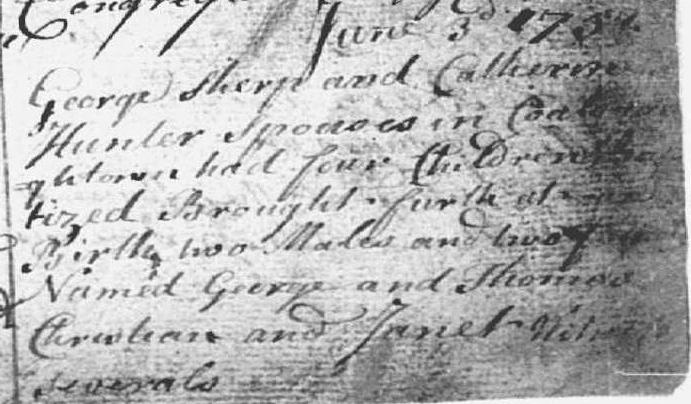
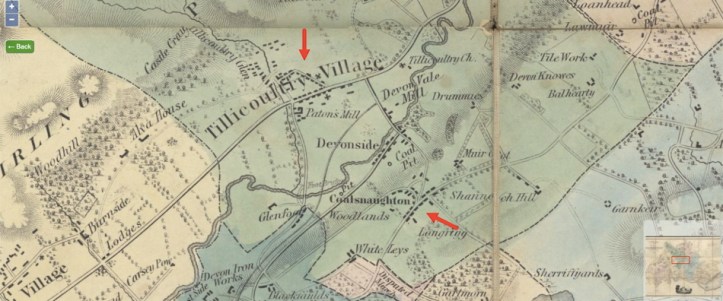
Even today, multiple live births are rare and it has been estimated that only one in 15 million births is quadruplets. In 1919, as reported by ScotlandsPeople below, Scotland witnessed only the fifth set of live quadruplets since the Statutory Birth Registers were initiated in 1855. We were therefore surprised to find that quadruplets had been born in our family, way back in 1752 in the small village of Coalsnaughton in Tillicoutry parish in Clackmannanshire.
From “Our Records: Scottish Births in 1919” ScotlandsPeople, 6th January 2020
For the first time in over ten years, The Registrar General’s report recorded that 1919 had witnessed the birth of quadruplets ‘all four alive at birth’. It went on to note that ‘This is the fifth time such an event has been registered since 1855’ (the dates being 1857, 1867, 1903, 1907 and 1919).
The proud parents of the quadruplets were Andrew and Elizabeth Lucas who lived at 5 Guthrie Street, Hamilton. Elizabeth was 28 years old when the quadruplets were born, and was a native of Londonderry. Andrew, 27 years old, was a coal miner. The couple already had two children – a three year old daughter Annie and 21 month old son John. The new arrivals, three boys and one girl, were born on 29th November 1919. Mary arrived first, followed by James, Andrew and Charles. The British Medical Journal reported that ‘the heaviest of the babies weighed about 2495g [2.49kg or 5.5lbs] and all three others around 2270g [2.27kg or 5lbs].’

National Records of Scotland, Statutory Register of Births, 1919, 647/1322 page 441.

National Records of Scotland, Statutory Register of Births, 1919, 647/1320 page 440.
The local press interviewed Andrew Lucas senior and reported that he was ‘most grateful for the kind attention from his neighbours’ who had been helping by taking turns to bottle feed the babies. Gifts of clothing and money had been sent from across Scotland and England.
Newspapers also reported that Andrew ‘remarked jocularly that the miners would not have to have many strikes in the future, otherwise he would be in “a bonnie pickle”.’ It was also noted that the Town Council of Hamilton would be arranging for the Lucas family to have a preferential claim on the first completed house in the new housing scheme that was under construction.
News of the excitement surrounding the birth reached senior members of the local area. A cheque for £10 from Lord Newlands was sent through the Lord Provost Keith of Hamilton. The Lord Lieutenant of the County of Lanark and Mrs Keith, the wife of the Lord Provost, had also gifted a cot for the children.
Unfortunately joy turned to tragedy as three of the children did not survive their first month. Just ten days old, James died at home on 9th December. His cause of death was noted as ‘birth debility. Abscess of lip two days.’ His brother Charles died two days later from ‘birth debility’ and was followed two days later by his sister Mary from the same cause.
Andrew, the only surviving quadruplet, became a merchant seaman. He died in Glasgow in 1980.
In the modern day, quadruplets are still rare, but are usually all born alive. The vast majority of these babies survive infancy and grow up to become healthy adults. The latest quadruplets to be born in Scotland were born in 2017.
The Sharp (or Sherp) Quadruplets
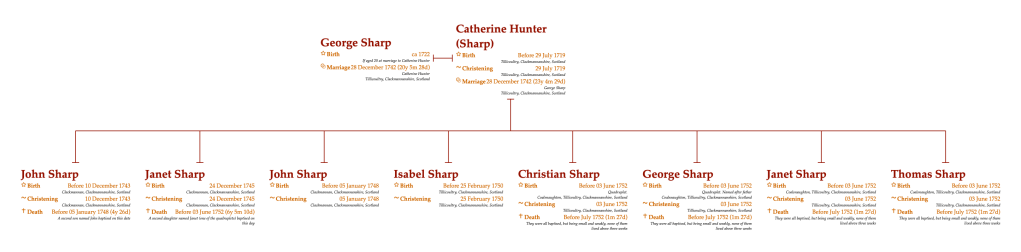
Our great (x7) aunt Catherine Hunter and her husband George Sharp had eight children, with four of them being born together in 1752 in the village of Coalsnaughton in the parish of Tillicoultry in Clackmananshire.
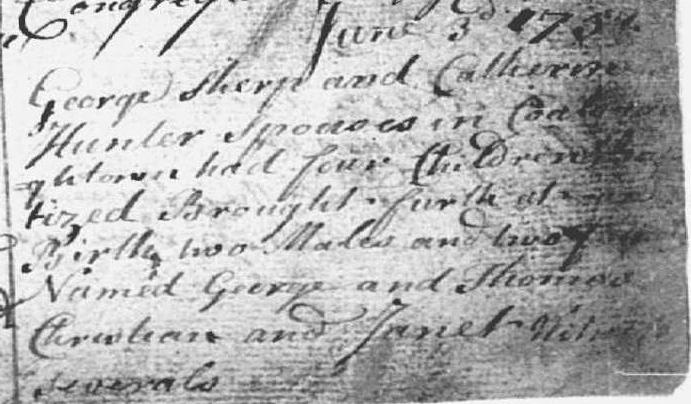
A little gem from the Tillicoultry OPRs of 1752. At Coalsnaughton, George Sherp (aka Sharp) and Catherine Hunter, after having four children baptised between 1742 and 1750, had quadruplets baptised – two boys and two girls, named George, Thomas, Christian and Janet.
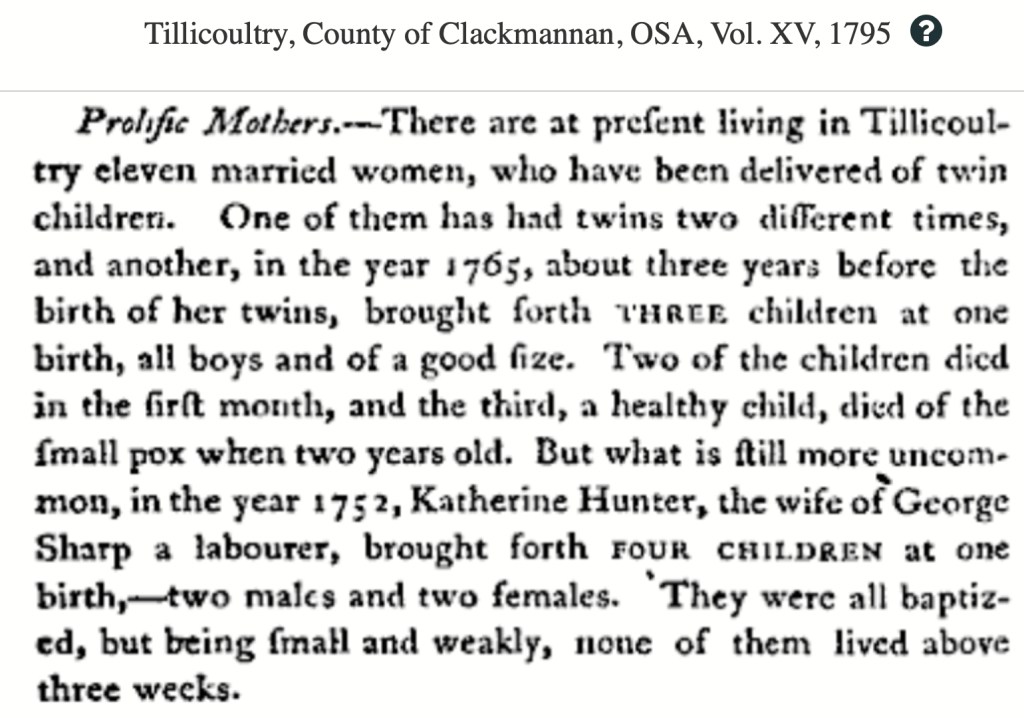
Sadly, it was reported in the Old Statistical Account for the parish that “They were all baptized, but being small and weakly, none of them lived above three weeks.“
 Vecchio