

Concorde
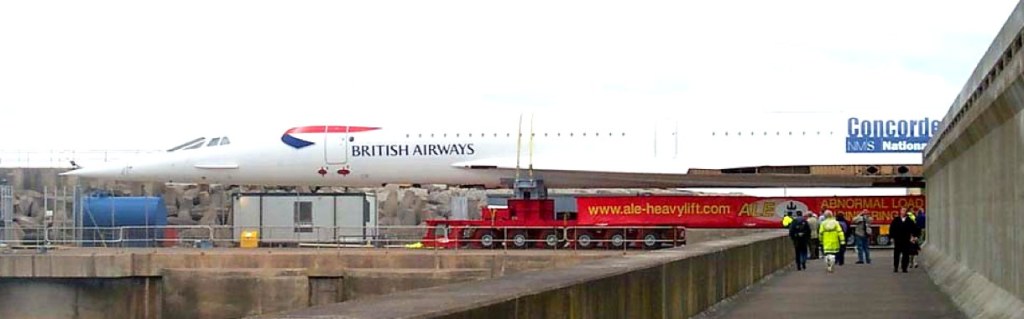
The Aérospatiale/BAC Concorde was a Franco-British supersonic airliner jointly developed and manufactured by Sud Aviation (later Aérospatiale) and the British Aircraft Corporation (BAC). Studies started in 1954, and France and the UK signed a treaty establishing the development project on 29 November 1962, as the programme cost was estimated at £70 million (£1.39 billion in 2020). Construction of the six prototypes began in February 1965, and the first flight took off from Toulouse on 2nd March 1969. The market was predicted for 350 aircraft, and it received up to 100 options from many major airlines. On 9 October 1975, it received its French Certificate of Airworthiness, and from the UK CAA on 5 December on the same year.
Concorde is a tailless aircraft design with a narrow fuselage permitting a 4-abreast seating for 92 to 128 passengers, an ogival delta wing and a droop nose for landing visibility. It is powered by four Rolls-Royce/Snecma Olympus 593 turbojets with variable engine intake ramps, and reheat for take-off and acceleration to supersonic speed. Constructed out of aluminium, it was the first airliner to have analogue fly-by-wire flight-controls. The airliner could maintain a supercruise up to Mach 2.04 (2,167 km/h; 1,170 kn) at an altitude of 60,000 ft (18.3 km).
Delays and cost overruns increased the programme cost to £1.5-2.1 billion in 1976, (£9.44 billion-13.2 billion in 2020). Concorde entered service on 21 January of that year with Air France from Paris-Roissy and British Airways from London Heathrow. Transatlantic flights were the main market, to Washington Dulles from 24 May, and to New York JFK from 17 October 1977. Air France and British Airways remained the sole customers with seven airframes each, for a total production of twenty. Supersonic flight more than halved travel times, but sonic booms over the ground limited it to transoceanic flights only.
Its only competitor was the Tupolev Tu-144, which carred passengers from November 1977 until a crash in May 1978. Meanwhile, the larger and faster Boeing 2707 was cancelled in 1971.
On 25 July 2000, Air France Flight 4590 ran over debris on its takeoff run and crashed with all 109 occupants in the plane and four people on ground being killed. This was the only fatal incident involving Concorde. Commercial services were suspended until November 2001, and all Concorde aircraft were retired in 2003 after 27 years of commercial operations.
Most remaining aircraft are on display in Europe and America, with one at the National Museum of Flight at East Fortune in East Lothian.
From 100 Years of East Lothian – the 2000s by the John Gray Centre in Haddington
One special moment for the County in the 2000s was the arrival of Concorde at the Museum of Flight, East Fortune, on 19 April 2004.
The supersonic airliner completed its lengthy journey from London to East Lothian after being transported on road, sea and a metal track laid by the Army over a mile of farmland.
Assigned to the National Museums of Scotland-run airfield after heavy competition from 60 other bidders, the airliner, without its fin, wings and engines, arrived on top of a 48-wheeled bogie normally used for transporting North Sea oil and gas related equipment.
This Concorde, which held the record for the fastest Atlantic crossing by a civil aircraft (2 hours and 52 minutes and 59 seconds from London to New York), was the first to be delivered to British Airways and the last to leave its operational base at London’s Heathrow airport.
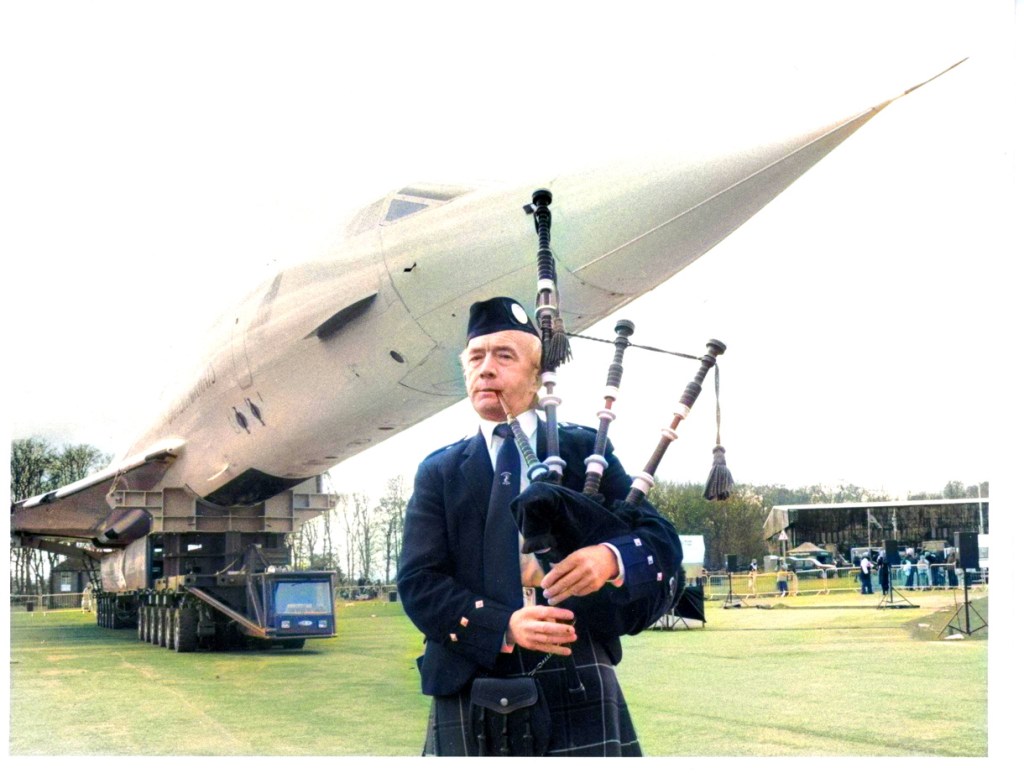
In the pic below we see it being piped in to East Fortune by David Leckie of Haddington Pipe Band.
Concorde facts from SCRAN.
Thanks to scran.ac.uk for the following concorde facts –
• It was the first civil aeroplane to go into scheduled service that was able to carry passengers faster than the speed of sound.
• It could fly at twice the speed of sound – almost 1,400 miles an hour – or 23 miles every minute. Which meant that if you were to pass over Edinburgh at 10 o’clock, by 10.15 you’d be over London.
• Concorde could fly almost twice as high as other airliners, at 60,000 feet. That is 11 miles above the Earth’s surface.
• It’s one of the few aircraft in which you could see the sun rise in the west. If you took off after sunset and flew west, because Concorde can fly faster than the earth’s rotation, it “catches up” with the sun and so it appears to rise over the western horizon.
• Concorde flew passengers for British Airways from 1976 to 2003. Its final scheduled day of operational flights in October 2003 saw one aircraft, G-BOAE, fly into Edinburgh’s Turnhouse airport. It then returned to Heathrow and landed in a stream with two other Concordes, making a truly memorable sight to anyone who witnessed it.
Concorde at the National Museum of Flight at East Fortune
Concorde can be seen at the National Museum of Flight at East Fortune in East Lothian.


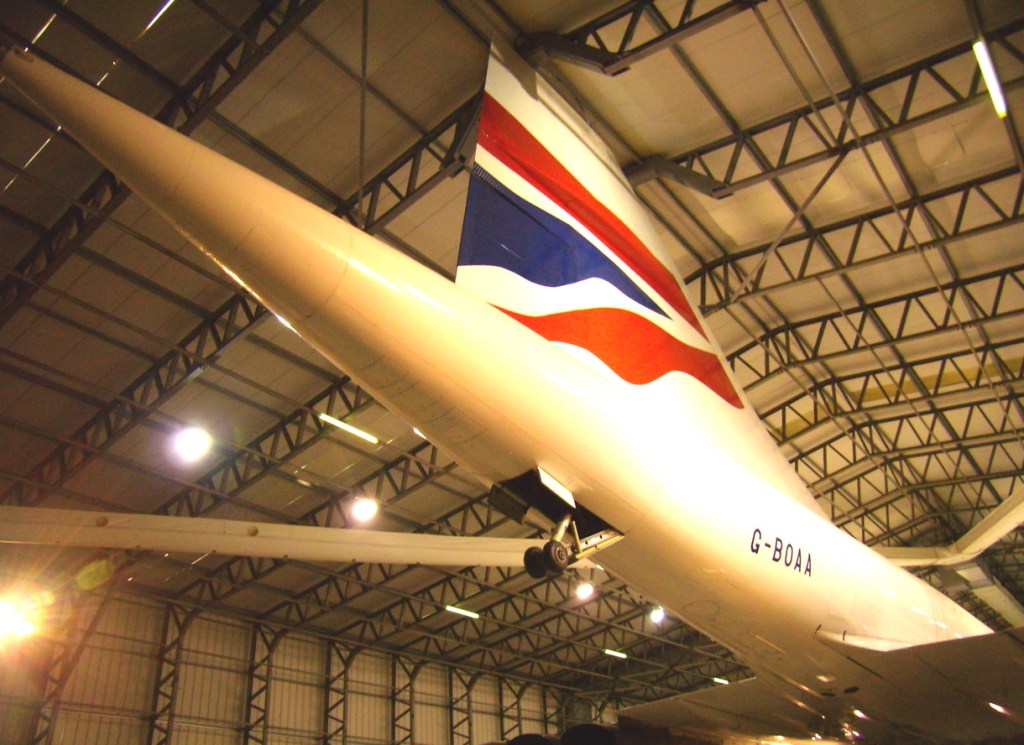

Concorde commemorated

 Vecchio