
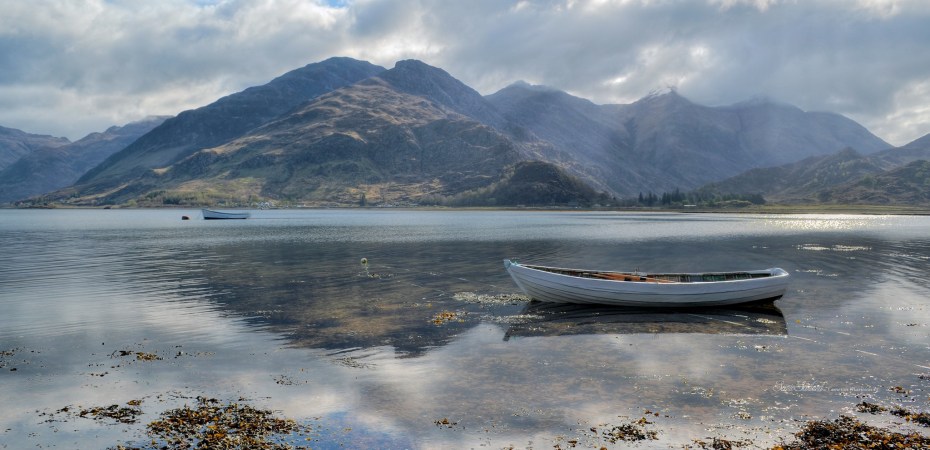
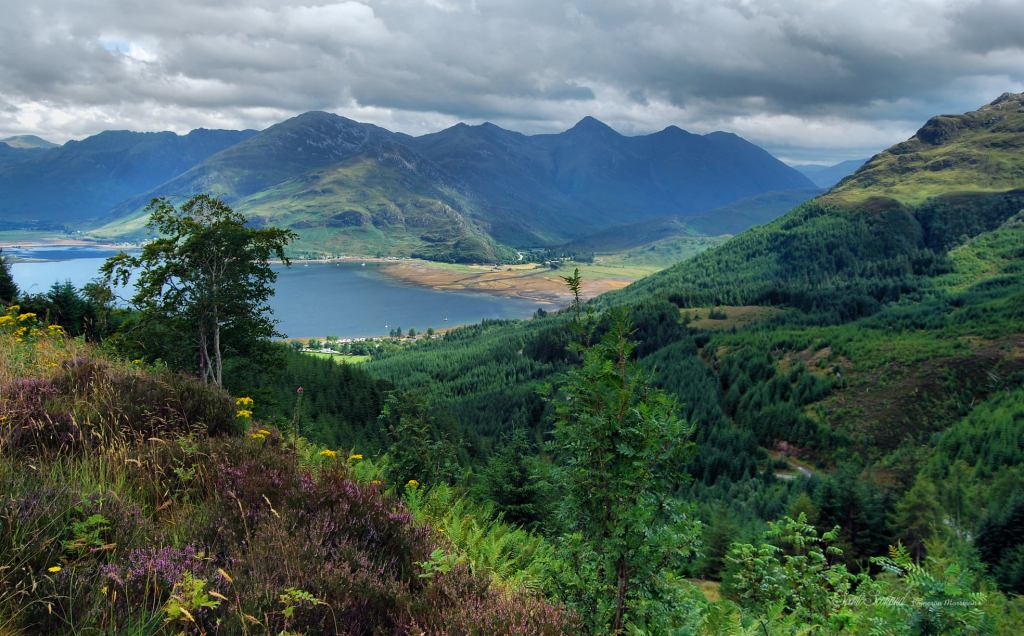
This view of the mountain range known as the “Five Sisters of Kintail”, part of the Kintail Forest (Forest of Mountains) was taken from the Bealach Ràtagain, the road that crosses the mountain pass above the tiny hamlet of Ràtagain on the southwest shore of Loch Dubhthaich (Loch Duich) which then continues on to the village of Glenelg.
The mountains rise above Glen Shiel at the head of Loch Dubhthaich and are from left to right, Sgurr Moraich 876m, Sgurr nan Saighead 929m, Sgurr Fhuaran 1068m, Sgurr na Carnach 1002m and Sgurr na Ciste Duibhe 1027m.
The collective name, the “Five Sisters of Kintail” given to these five peaks comes from a legend originating during the Celtic Iron Age of northwest Scotland.
The Legend
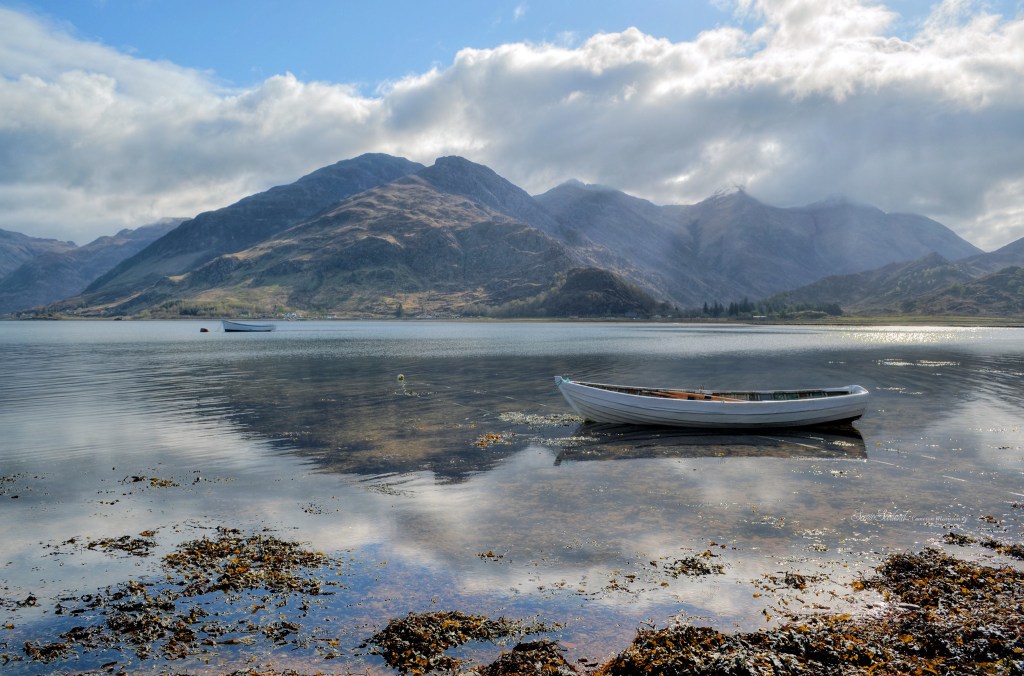
This Legend tells us of how these mountains called The Five Sisters came into being by the hand of the Draoidh Liath (Grey Magician) of Coire Dhunnid.
The Mormaer (King) of Kintail had seven daughters, the two youngest were very much in love with two Irish Princes who had been washed ashore after the ship they had been travelling on was sunk in a terrible storm out on Loch Duich, after the King had given his blessings the couples were soon married.
Now this left the king with five still unwed daughters, but the two Irish Princes already had a solution to the Kings problems, for they had five older brothers back in Ireland all of whom were still bachelors. So it was arranged that the Princes should return to Ireland and fetch back their five brothers to Kintail so they could wed the other princesses.
The two brothers set out on their journey back to their homeland in order get the other brothers, but the route they chose took them through the treacherous waters of western Scotland where high above their heads a great storm began to fill the skies and deep below their ship a giant Maelstrom began to form, once more they found themselves overwhelmed by giant waves and howling winds that caused their ship to capsized and sink in the depths of the foaming sea, the princes were never seen again.
The five maiden sisters waited and waited for their betrothed brothers to arrive, they hoped that one day soon they would sail up Loch Duich in a great ship ready to sweep them off their feet but as the days months and years passed them by they finally decided it was time to take the matter to a higher authority.
The five sisters then went to see the Draoidh Liath, a local magician who lived in the nearby hills to ask him if he could help them with their vigil.
At first he wasn’t sure what to do as he could not materialise the brothers out of thin air, eventually he decided that in order to preserve the sisters youth beauty for the arrival of their promised husbands he should take the matter beyond life itself, the magician began to prepare a spell that he could cast upon the women enabling them to continue with their vigil throughout time everlasting, the Draoidh Liath then turned the Five Sisters into the five mountains we see here today.
The 1719 Battle of Glenshiel
The Battle of Glen Shiel (Scottish Gaelic: Blàr Ghleann Seile) took place on 10 June 1719 in the West Scottish Highlands, during the 1719 Jacobite Rising. A Jacobite army composed of Highland levies and Spanish marines, was defeated by British troops, reinforced by a Highland Independent Company.
The rising was backed by Spain, then engaged in the 1718 to 1720 War of the Quadruple Alliance with Britain. It was intended to support a landing in South-West England, which was cancelled several weeks before; contemporaries on both sides viewed its failure as having fatally damaged the Jacobite cause.
Glen Shiel was the only battle of the 1688 to 1746 Jacobite Risings where the Jacobites remained on the defensive, rather than employing the Highland Charge. The battlefield is included in the Inventory of Historic Battlefields in Scotland, and protected by Historic Scotland.
The mountain where the action was fought is called Sgurr na Ciste Duibhe; a subsidiary peak named Sgurr nan Spainteach, or ‘Peak of the Spaniards’, commemorates the Spanish marines. It is one of three Munros which make up the Five Sisters of Kintail group of hills (the others being Sgùrr Fhuaran and Sgùrr na Càrnach).
 Vecchio