
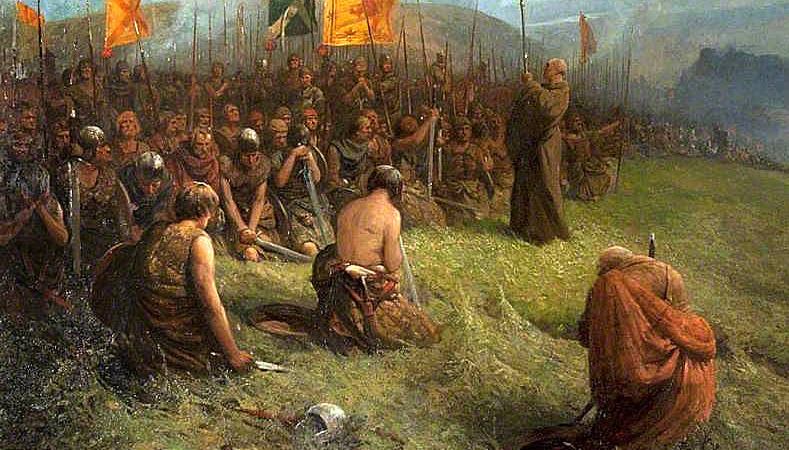
Based on a post by Jim Gilhooly of THE SOCIETY OF KING ROBERT THE BRUCE

I always assumed it would have been Saint Andrew or Saint Columba – or Saint Serf, that Bruce would have prayed to for victory at Bannockburn, (or all three in order to cover his bases). However there is an alternative option. Bruce was said to have prayed to Saint Kessog who was the local Saint of the Luss area on the western shore of Loch Lomond where he and his beleaguered force were given refuge after rowing the width of Loch Lomond to escape from the disaster at the Battle of Dalrigh.


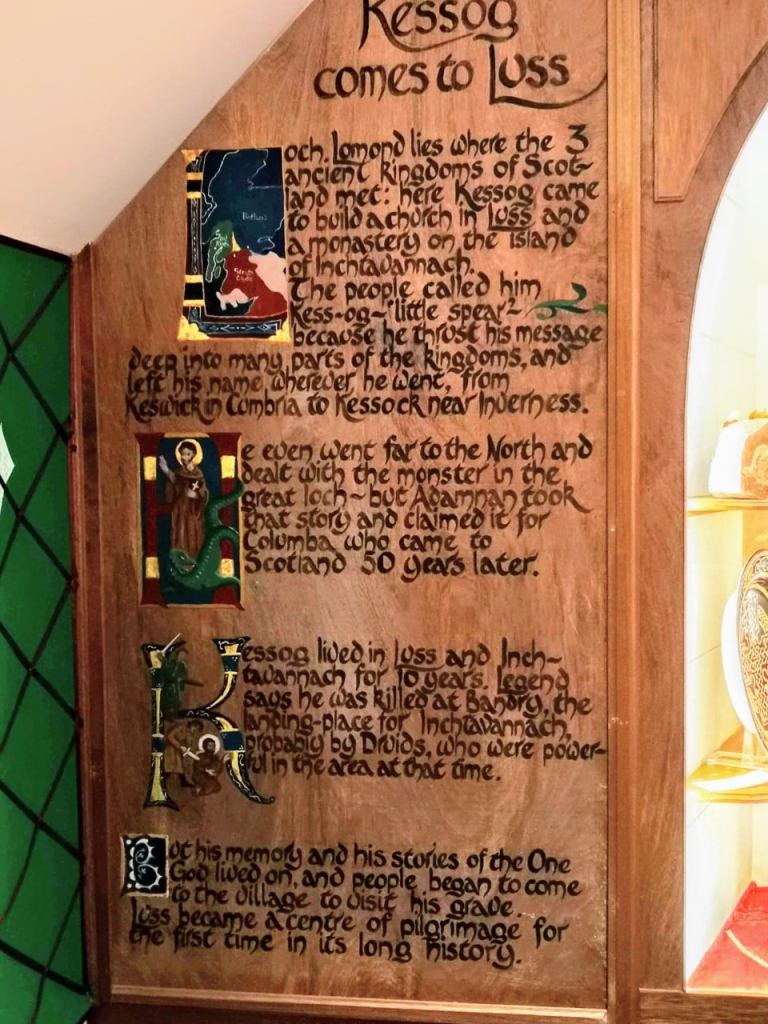
The following script is taken from pictures I took of 2 panels at the Heritage Centre in Luss , (where the TV series ”Take the High Road” used to be filmed), turns out some of the stories attributed to Columba, (Nessie for example), should be attributed to Saint Kessog:-

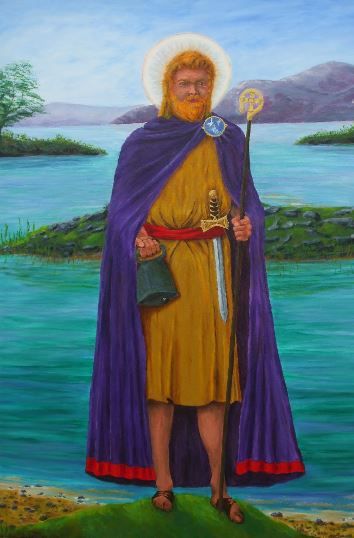
Saint Kessog
https://www.findagrave.com/memorial/185823300/kessog
| BIRTH | 460 Cashel, County Tipperary, Ireland |
|---|---|
| DEATH | 10 March 520 (aged 59–60) Luss, Argyll and Bute, Scotland |
| BURIAL | Luss Parish Churchyard Luss, Argyll and Bute, Scotland |
| MEMORIAL ID | 185823300 · View Source |
Roman Catholic Saint. He is remembered as one of the first Christian martyrs of Scotland. He probably was the son of Óengus mac Nad Froích, King of Cashel and Munster. Saint Kessog is said to have worked miracles even as a child. He was martyred some claim at Bandry where a heap of stones was known as St. Kessog’s Cairn, and others abroad. Part of the cairn at Bandry was removed in the 18th century to clear the way for a road. At that time, a stone statue of Kessog was found inside it. Luss was the principal center of his following with a sanctuary granted by Robert the Bruce. St. Kessog was reputed to be of Roman army descent, his father being in the Roman army as he was himself. He was known as the “soldier saint “ or “Priest-Soldier” as he went about with a sword tied to his waist. He frequented the Lennox area from the Firth of Clyde inland to Callander, Stirling and Glasgow. There are even references to him having a session with “Brude” Pictish King at Inverness, and the ferry to the Black Isle was called St. Kessog’s ferry. A church at Callander was called St Kessog’s. There is a well at the Honey Home between Balfron and Fintry called “St. Kessog’s Well” where he baptized his converts. Local legend supposes that he was found dead at this well where he had gone to quench his thirst and rest after walking some considerable distance. The Loch Lomond area is certainly the district that he most frequent and there are many monuments in his memory. In Luss Church there is an effigy of St. Kessog and his cell was near the top of Luss Glen. In the parish, St Kessog’s well forms the division between Leddriegreen and Ballewan estates. The well is located in the private grounds belonging to Kessog Bank between St. Kessog and the Blane Valley Inn. The surname “McKissick-Kissick” is derived from the Gaelic “MacIosaig” meaning “son of Isaac”. The original meaning of the surname comes from Sixth Century “Saint Kessog”. St. Kessog was born into the royal family of Munster in Southern Ireland 460 A.D. He left Ireland and came to the highlands of Scotland as a missionary and settled on Monk’s Island located near Loch Lomond in County Dumbarton in Scotland. It was once the site of a monastery, giving rise to its translated name of ‘Monk’s Isle’. A large house has stood on the site of the monastery. The island is predominantly wooded. It is here that the monks rang the bell to the call of prayer. Saint Kessog was martyred, and is buried at Luss where a church bears his name. His coat of arms shows a soldier’s habit, holding a bow, bent with an arrow in it.
Bio by: Walter C. Burgner, Jr.
“His coat of arms shows a soldier’s habit, holding a bow, bent with an arrow in it.” Quite appropriate when you think that Bruce grew Yew Trees for his archers locally. I have gone over the Kessock bridge at Inverness many times and never knew the connection with Saint Kessog.
 Vecchio