
Second cousin twice removed
Back in 2010, the motivation behind researching the Selkirk family was that my father had a woodwork teacher at school who was nicknamed “Daddy” Selkirk. My grandmother told my father that Daddy Selkirk was a relative, but given the teacher-pupil divide in those days my father had never broached the subject with him.
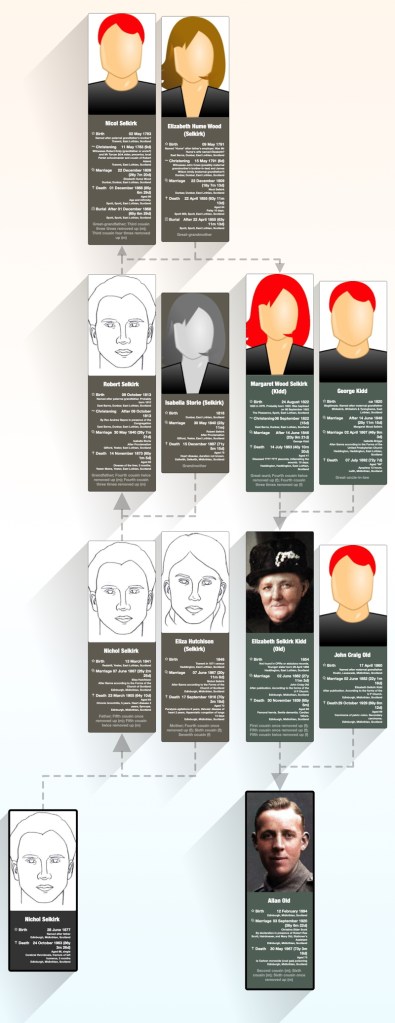
I looked into all our relations on the Selkirk side of the family and eventually, after much searching, I believed I might have traced him. My father’s “Granny Old” (Elizabeth Selkirk Kidd) had an uncle, Robert Selkirk (b 9 October 1813) who, as detailed in an earlier entry, became Land Steward at Yester Mains Farm for the Marquis of Tweeddale.
His eldest son Nicol Selkirk (b. 13 March 1841) had four daughters and a son Nicol Selkirk who was born on 28 June 1877 at 4 Gray’s Place, 31 St Leonard’s Street in Edinburgh.
This younger Nichol was a “House carpenter and joiner” in the 1901 census. He died in 1963, aged 86 in Morningside, so while I did not yet have online access to the death certificate, I suspected he was likely to be “Daddy” Selkirk.

When the 1911 census become available in 2011, I was be able to confirm that he became a teacher. He was listed as a “Manual Training Teacher”, so the theory appeared correct and Nicol Selkirk was “Daddy Selkirk”, my father’s teacher.
Interestingly, there was a Nichol Selkirk who was a witness on 27 October 1920 at the marriage, in Edinburgh, of Georgina Kidd, who was his first cousin once removed. He was also at witness on 01 June 1922 in Edinburgh to the marriage of his second cousin, Susan Selkirk Kidd Brown to George Scott.
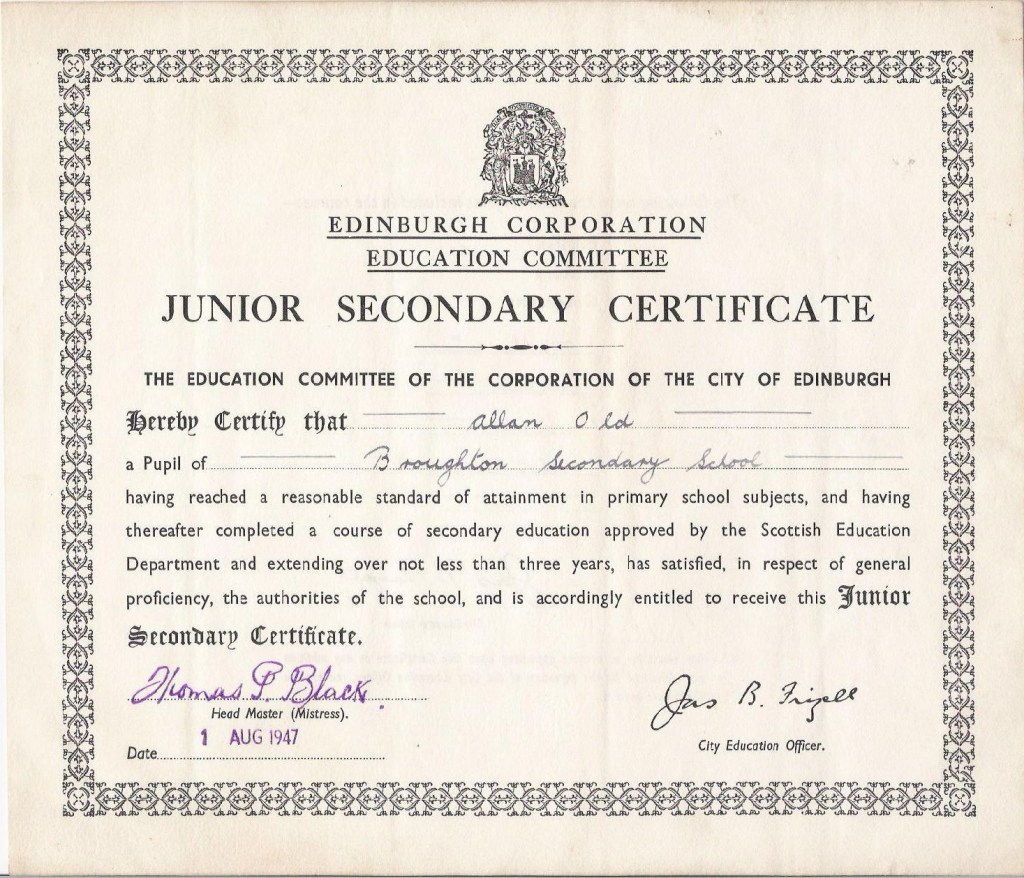
Our grandparents Allan Old and Christina Scott were married in Edinburgh on 3 September 1920. Georgina Kidd was Allan Old’s aunt, Susan Selkirk Kidd his cousin, and Nichol Sekirk was his second cousin. It seems likely that they were all at the various weddings and my grandmother may have met Nichol Selkirk at one of these events – if she did not already know him.

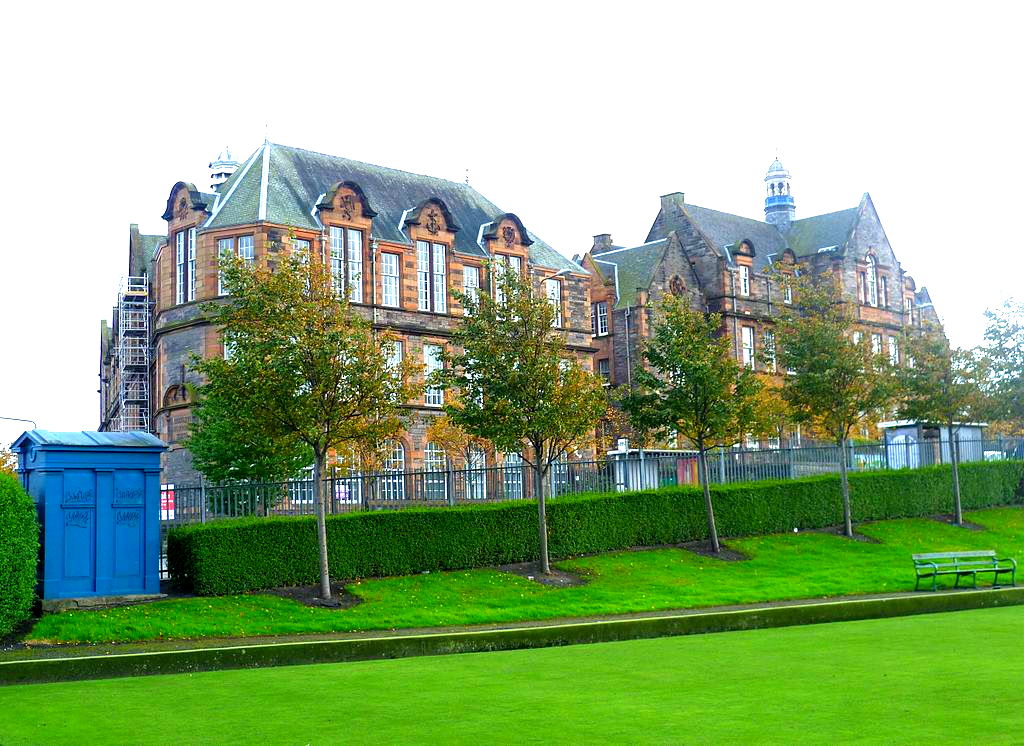
Broughton High School
History
“On 20 February 1899 the decision was made to build a Higher Grade department in two of Edinburgh’s schools, and Broughton was chosen as the school for the site on the north of the city, thus Broughton High school was born. The site of the primary school and the Higher Grade dept, McDonald Road, was at that time a comparatively rural location.
The first pupil enrolled was Christina Mackenzie of 24 Beaverhall Terrace.
The first Headteacher was Alexander Hutchison. He was appointed Head at the early age of 37.
By 1904 the Primary school site was hugely overcrowded so it was decided that a new Higher Grade school be built alongside the old one.
The site was bought from the Heriot’s Trust for £600.
The new building was constructed very quickly, in 16 months.
The school was officially opened by Flora Stevenson, Chairwoman of the Edinburgh School Board on 3 February 1905. The total roll stood at 1735: 271 infants, 950 juniors, 389 higher grades and 125 pupil teachers.
Over the next 20 years, the golden age of Broughton, there emerged two major poets in Christopher Murray Grieve (better known as Hugh MacDiarmid) and JK Annand, 130 names were placed in the Open Bursary list at Edinburgh University and every major scholarship within Edinburgh University was secured by Broughton former pupils in the faculties of Arts, Science, Law and Medicine.
MacDairmid studied under George Ogilvie who introduced him to the magazine The New Age. He left the school on 27 January 1911, following the theft of some books and postage stamps; his father died eight days later, on 3 February 1911.
Following Grieve’s departure from Broughton, Ogilvie arranged for Grieve to be employed as a journalist with the Edinburgh Evening Dispatch. Grieve was to lose this job later in 1911, but on 20 July of that year he had his first article, “The Young Astrology” published in The New Age. In October 1911.

The school song is called “Broughton for Ever” and was written and composed in 1917. The words were written by George Ogilvie, an English Master and the music was written by George Hume from Broughton Elementary School. The song was “dedicated to the memory of the teachers, students and pupils who died for their country in the Great War”.
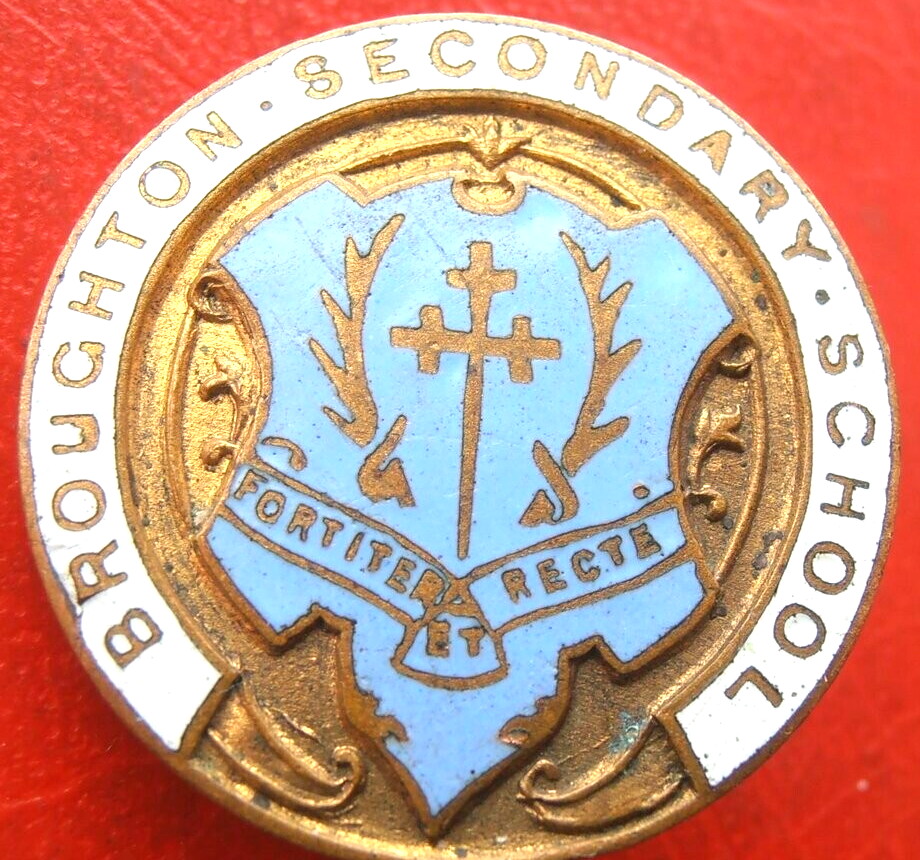
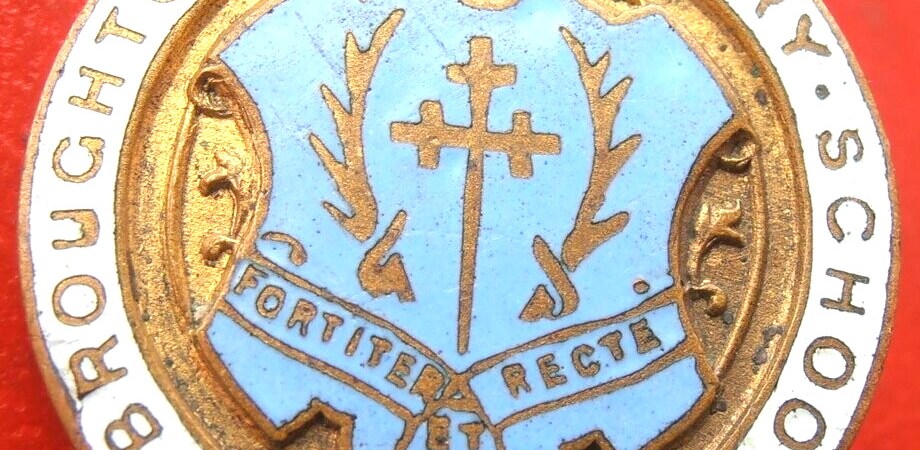
The school badge was designed in 1924 by JG Sinclair and the motto was selected by the Headmaster of the time, Mr Blacklaws. The motto “fortiter et recte” means “bravely and uprightly”.
Broughton moved from McDonald Road to Carrington Road in 1972 and thus Broughton became a Comprehensive Secondary school. The Head Teacher at the time was Dr Shepherd. The building had been long promised and pupils and staff were astonished at the space and size of the new building. In the years that followed, the school roll rose due to an influx of pupils from Drummond High.
The City of Edinburgh Music School, situated in Broughton High, was established in 1980. It was originally named The Lothian Specialist Music School but was renamed when the Regional Councils were reorganised.
In 1986 there was a fire in the Library, destroying everything. The Library was reopened on 5 May 1987 by author Joan Lingard.
In March 1990 the school was struck by tragedy when five senior pupils were killed in a car accident. A memorial garden on the school grounds was created in their honour.
In 1991 a major change in the history of the school took place – Ainslie Park merged with Broughton… and the roll rose even further – at its peak there were 1600 pupils enrolled at Broughton. The Head Teacher at the time was Jack Scott.
The specialist Dance unit was founded in Broughton in January 1998 after the resident dance teacher Ms Pender saw there was a demand for extra dance coaching.
Broughton has a huge tradition of creating pupil-led school magazines: in the Library, there are copies of the Broughton School Magazine going back to 1911 and The High has been running since 1991.
Notable Former pupils:
- Christopher Murray Grieve (best known by his pen name Hugh MacDiarmid) – poet.
- Alan Bold – poet and critic.
- Tommy Smith – international jazz saxophonist.
- Martyn Bennett – piper and composer.
- Darren Dods – footballer.
- Sir David Edward Murray – business entrepreneur.
- Shirley Ann Manson – lead singer of Garbage.
- Angus Robertson Member of the Scottish Parliament and previous member of the Westminster Parliament.
- Mary Fee previous Member of the Scottish Parliament.
In 2004 the decision was made that Broughton High was to have a new building under the PPP2 scheme, and the new state of the art building was completed in February 2009.
 Vecchio