

In Conversation with…… Christina de Kéroualle Translated from L’Histoire, January 2004.

L’Histoire is a monthly mainstream French magazine dedicated to historical studies, recognized by peers as the most important historical popular magazine (as opposed to specific university journals or less scientific popular historical magazines).
L’Histoire was founded by Michel Winock. Jean-Noël Jeanneney, president of the National Library of France since 2002, and Jean-Michel Gaillard are part of the editorial board. Many historians who write for L’Histoire also teach at the Paris Institute of Political Studies, better known as Sciences Po.
Armand Piat: You are known as something of an expert on history, especially relations between France and Scotland, which is France’s oldest ally, something that many French people are unaware of.
Christina de Kéroualle: I am hardly an expert, but, yes, indeed. Philippe le Bel of France signed what is now known as the “Auld Alliance” with King John Balliol of Scotland in 1295. The Scots patriot William Wallace, perhaps best known to the French through the film “Braveheart” was actually at one time Scots ambassador to the French and to the Pope while seeking help for the cause of Scottish independence.

AP: Braveheart is a true story?
CdK: It was based on fact. Braveheart was greatly criticised for some of the inaccuracies. One was the role of Sophie Marceau, who played Princess Isabelle, the wife of Prince Edward, later Edward II. I think that at the time of the film she was about six years old and in Paris. Another problem was the first battle in the film – although it was the “Battle of Stirling Bridge”, and the role of the bridge was decisive in the Scots victory, it was totally absent in the film. One of the local worthies asked Mel Gibson, who played Wallace, about this at the film’s World Première in Stirling. “Oh, the bridge would have seriously got in the way of the action,” quipped Gibson. “Aye,” commented the local historian, “The English found that out too!”
AP: So the film was seen as a travesty?
CdK: Oh, no! Don’t get me wrong. On the contrary, it was a highly successful, entertaining and inspirational film. It was clearly not a documentary. But those who were interested in ‘what really happened’ could always read up about it afterwards. To be honest, after 700 years of Scots and English propagandists, it’s very difficult to be sure exactly what happened. But many of the amateur critics might be surprised to hear that many of the events portrayed in the film can be traced back to Blind Harry’s “The Actes and Deidis of the Illustre and Vallyeant Campious Schir William Wallace“. ‘Blind Harry’ wrote about the events many years after they occurred, but his writings are the closest we have to a contemporary account.
AP: But where did the French connection come in?
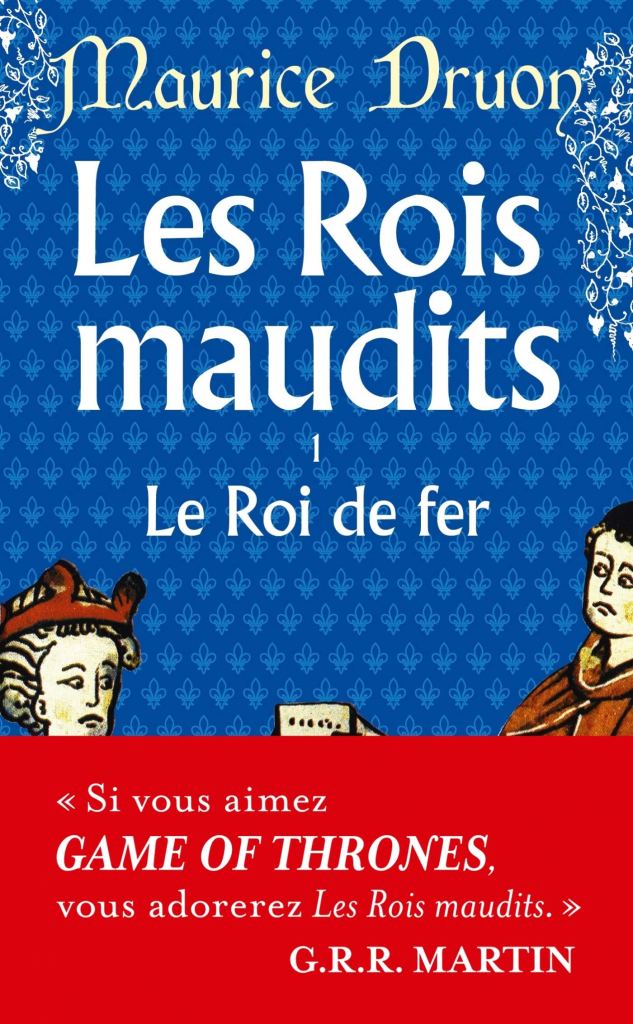
CdK: Philippe ‘le Bel‘ had three sons: Louis X ‘l’Hutin‘, who succeeded him, Philippe ‘le Long‘ and Charles ‘le Bel‘. The death of Louis X, and then his posthumous son, Jean, who died at the age of 4 days, posed a problem for the French succession. Louis had a daughter, Jeanne, with his first wife, Marguerite of Burgundy. She inherited the Kingdom of Navarre, which Louis had gained from his mother, but France was another story. In a rather arbitrary fashion, the legal experts of the time declared that as the French crown had always passed in the direct male line that it could not pass to a female, citing the so called “Salic law” from one of the Frankish tribes as precedent.
AP: So Philippe succeeded his brother rather than the rightful heir, Jeanne?
CdK: It has to be said that the law of primogeniture did not always result in the best person becoming king. The old Scots law of Tanistry, where the most able member of the royal family, rather than the eldest, was elected as heir, was perhaps not such a bad system. Many disputed the succession of Philippe V, but probably at the time France needed a stronger ruler than an innocent young girl whose paternity was disputed.
AP: So King Philippe had no heirs?
CdK: Ironically, he did. But only daughters. However, as he had become King in place of his niece, he could not leave the throne to his daughters and upon his death, the third brother Charles became King. When Charles died, the next heir was his cousin, Philippe VI, Count of Valois.
AP: And this started the Hundred Years war?
CdK: It was somewhat more complicated than that. But, yes, the Valois succession was contested by Edward III of England, who was a grandson of Philippe IV (Le Bel) of France, through his mother, Princess Isabelle. Edward claimed he was true heir to France and invaded to promote his claim. He declared that, although his mother, Princess Isabelle could not become the monarch, she could transmit her rights to her son. This claim could have been fairly argued in a French court. However, Edward’s own argument invalidated his own claims: Between them, Louis X, Philippe V and Charles IV had six daughters, and they all had precedence over the Princess Isabelle.
AP: But that didn’t stop Edward III of England?
CdK: No. Having no legal right to Wales, Scotland and Ireland hadn’t stopped his grandfather Edward I of England from invading these sovereign territories and attempting to conquer them. The Hundred Years Wars happened because of pure and simple greed on the part of Edward III and his attempts at empire building. And as France and Scotland were allies, Scots troops were called upon to defend France all throughout the Hundred Year war.

AP: You said there were Scots troops at Orléans?
CdK: Yes, in fact – I am sorry to destroy your history lessons – but Scots troops formed the major part of the garrison that held Orléans for seven months against the English siege, until the town was relieved by Jeanne d’Arc.
AP: So why is the Scots part in our history so little known?
CdK: Good question. Think about it. It is common for any nation to concentrate on the efforts of their own compatriots in the defence of their country rather than the help of “foreigners”. But Scots are still given a warm welcome in France, even if people do not always remember the events themselves. However, it must be stressed that the Scots troops were not, as they have been often described “mercenaries”; they were soldiers engaged in the service of their country’s oldest ally. The number of Scots who gave their lives for France is unknown, but in the 1400s, the Earl of Buchan (grandson of King Robert II), the Earl of Douglas and Stewart of Darnley all became Marshals of France and were, at one time or another, in supreme command of the French forces. All three died for France, along with thousands of their fellow Scots.
AP: And the Scots won many battles against the English in France?
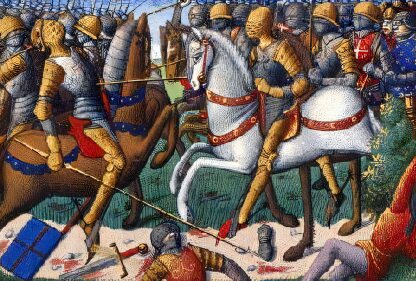
CdK: They won many battles but they also lost a few. For example, few Scots realise that after Bannockburn and Stirling Bridge, Scotland’s greatest victory was the Battle of Baugé in Normandy in 1421. The Scots troops were led by the Earl of Buchan, Archibald Douglas, Earl of Wigtown, Sir Alexander Buchanan, Sir John Swinton, Sir Hew Kennedy and Sir John Stewart of Darnley. They faced the English invaders under the command of the Duke of Clarence, the younger brother of the English King, Henry V. The Duke of Clarence and 1,700 English soldiers were killed at Baugé for the loss of just a few Scots troops. And for his part in the battle, Sir John Stewart was given, in addition to the lordship of Concressault, and later the County of Evreux, the lordship of Aubigny.
AP: And what can you tell us about Louise de Kéroualle?
CdK: Her full name was Louise-Renée de Penancoët de Kéroualle, and she was born at the manor of Kéroualle in September 1649. Louise was the daughter of Guillaume de Penancoët, Count of Kéroualle and of Marie de Plœuc, who were married in February 1645. The family was old nobility and Louise’s grandfather had received the Order of St Michael from King Henri IV of France for his part in the defence of Brest against the League and the Spanish.
AP: She was reputed to be a great beauty?
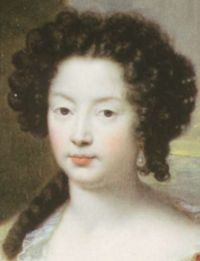
CdK: Yes, a courtesan once wrote of her, “I have just seen this famous beauty. In my opinion she has the figure of a little girl, a naive figure, child-like.” Indeed, in England, she went by the nick-name of “baby- face”.
AP: She came to the attention of the King of England, Charles II?
CdK: He nicknamed her “Fubby” and was said to enjoy to “conversing” with the little blonde French girl who appeared to him to be so sweet and so sad.
AP: Blonde? But in her portraits, her hair is brown.
CdK: It was the fashion at the time to wear a wig, but her own hair was blonde, or perhaps very light brown…
AP: But she was not popular with the English people?
CdK: Goodness, no! Her biggest rival was Nell Gwynn, another mistress of the King, who nicknamed her “Squintabella”. Because she was French, and also a Catholic, she was also very unpopular with the common people who believed, perhaps not without some justification, that she was a spy for the French King Louis XIV. The more polite people called her “Madame Carwell” as they could not pronounce her name properly. The less polite repeated scurrilous rhymes about her and the other mistresses of the king.
AP: She was Duchess of Pendennis, I believe?
CdK: Only very briefly. In February 1673, Charles II made Louise de Kéroualle Baroness of Petersfield, Countess of Farnham and Duchess of Pendennis; but the latter title was almost immediately changed to Duchess of Portsmouth.
AP: The Scots were disinherited then when Louise was granted Aubigny?
CdK: No, the Stewarts held Aubigny for many years. The lordship was inherited by Esmé Stewart, who was created Earl of Lennox in 1580, and first Duke of Lennox in 1581 by his distant cousin, James VI of Scots, whose father, Lord Darnley, was the son and heir of the previous Earl of Lennox. When the 6 th Duke of Lennox and 11 th Seigneur d’Aubigny died in 1672, the heir to Aubigny was none other than the King of England and Scotland, Charles II, grandson of James VI. However the French King, Louis XIV was unwilling to allow a foreign sovereign to own fiefs in France, and refused to acknowledge the inheritance.
AP: So Charles II transferred Aubigny to his mistress?
CdK: Exactly. Charles II wrote to Colbert de Croissy stating his desire for Louise de Kéroualle to be installed in Aubigny and agreed that “every precaution will be taken to ensure that these lands will not leave the Royal House of England and that it will remain the property of the children which I have or will have with this lady.”
AP: So Louise became Duchess of Aubigny in France as well as Duchess of Portsmouth in England?
CdK: In December 1673, she received “the funds and the property of the land of Aubigny, along with its rights, entails, and dependencies”. The lands were sequestered by the French Crown during the war of the Spanish succession, but were were restored in 1713. In 1684 Aubigny was transformed unto a duchy-peerage by letters patent. However, the letters were not registered by parliament until 1787, so Louise was never, in the strictest of legal terms, Duchess-Pair of Aubigny.
AP: And the line died out with Louise?
CdK: Not the line, but the duchy of Aubigny did. Louise de Kéroualle died on the same date, the 14 th of November, as her rival Nell Gwynn, who died exactly 47 years earlier. Louise’s son with Charles II, the first duke of Lennox and Richmond, died before his mother. On the Duchess of Aubigny’s death in 1734 at the age of 85, the title should therefore have passed to her grandson, the second duke of Lennox and Richmond, who introduced FreeMasonry to France, however the necessary Letters patent were not issued within the required delay of a year and the title became extinct.
AP: Then there was never a Duke of Aubigny?
CdK: The history is rather complicated. Louis XIV re-granted the duchy to Louise’s grandson in 1777, but the estate was sequestered for the second time upon the outbreak of war between France and Britain in 1792 and was not returned until 1803. With a new outbreak of war, the estate was finally confiscated in 1806. The duchy of Aubigy, which had not been officially registered by parliament until 1787, was the only lay peerage of the Old Regime not to be confirmed upon the restoration of the monarchy in 1814.
AP: The end of the line for the Dukes of Aubigny?
CdK: The lands were restored later in 1814, but there were a series of conflicting court cases between the 5 th duke and his aunts over the inheritance of the estates under French law, which he finally lost in 1839. In 1840 the town acquired the castle of Aubigny and turned it into their town hall. Louise’s descendant the 10 th duke of Lennox and Richmond and 5 th Duke of Gordon inherited the titles in 1989 and the Dukes of Richmond and Lennox continue to use the style of “Duke of Aubigny”.
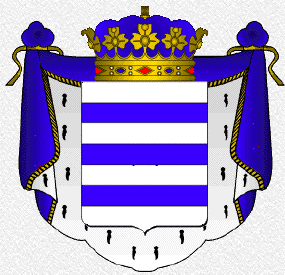
AP: And, you share a common ancestor with your husband.
CdK: Yes, he descends from Charles II and his mistress Louise de Kéroualle, while I descend from Charles II and his mistress Lucy Walters; But – I only recently realised, that I also descend from Louise de Kéroualle – so I am a de Kéroualle by marriage, but also by descent.

AP: You are The Woman Who Would Be Queen?
CdK: (Laughs). When I was a child, one of my favourite films was Kind Hearts and Coronets (Editor’s note – a noble family snubs one of their members who marries a commoner and her son murders a number of relatives, all played by Sir Alec Guinness, in order to take revenge and inherit the title). Actually, Charles II had fifteen mistresses and he acknowledged fourteen illegitimate children so you can imagine how many descendants he must have. Just to give one example, the late princess Diana was descended not only from Charles II and three of his mistresses – Barbara Villiers, Lucy Walters, and Louise de Kéroualle – but also from his brother James VII and his mistress Arabella Churchill.

AP: But one of Charles II’s illegitimate sons thought he should be king?
Yes, Lucy Walter’s son, James, Duke of Monmouth was Charles II’s favourite son but he was assumed to be illegitimate, and so he was excluded from the succession. When Charles died, he rebelled against his uncle, James VII, but the coup d’etat was crushed. The Duke of Monmouth counted on his popularity – his uncle was known as ‘Dismal Jimmy’ – and the fact that he was a Protestant, while his uncle James was a Catholic, but in reality he was a weak man who was easily manipulated. Several years later, James VII was successfully deposed by his daughter Mary and another, legitimate, nephew, William, Prince of Orange. I always wondered what would have happened if Monmouth’s rebellion had succeeded. Monmouth was said to be illegitimate, but then so, as we’ve only recently rediscovered, was Edward VI of England. And that means the true heir to the throne of England is not Elisabeth Windsor but the Earl of Loudoun, who now lives in Australia.
AP: Tell us about the story of the forgotten marriage contract?
CdK: As you know, one of the reasons that Monmouth’s rebellion failed was that he was believed to be illegitimate, which meant that most supported his uncle, James, Duke of York and Albany, as the legitimate heir. However, there is evidence that Charles II secretly married his mistress Lucy Walters when he was in exile in Holland and a restoration of the monarchy looked unlikely. We know that Louis XIV secretly married his mistress Françoise d’Aubigné, the Marchioness of Maintenon, in 1683, soon after the death of his queen, Marie-Thérèse of Austria, and it is not so difficult to believe to speculate that the young and exiled Charles II may have also married for love rather than dynastic reasons.

AP: Which would have meant that Monmouth was really the rightful king rather than James VII?
CdK: Exactly. It is said that during the reign of Queen Victoria, one of the dukes of Buccleugh, the direct descendants of Monmouth, found the marriage certificate between Charles II and Lucy Walters, which proved that he was the rightful heir. He was a frequent visitor to Balmoral and is reported to have said “That could cause a great deal of problems” before consigning the document to the fire. It makes a nice story. Anyway, the two families became linked by marriage again when Alice Montagu Douglas Scott, a daughter of the 7 th duke of Buccleuch, married the present queen’s uncle, the Duke of Gloucester. She is the oldest surviving member of the British Royal Family. (Princess Alice died nine months after this article was published.)
AP: And what of the line of the Duchess of Orléans?
CdK: That was when the Stuart King James VII was deposed because he was a Catholic and many legitimate Stuart heirs were excluded from the succession by the English Parliament. The line of Savoy should have succeeded before the Hanovarians, but the former were Catholic while the latter were Protestant. Actually, a number of Protestants with a better claim – descendants of the Electress Sophia’s brothers – were also excluded from the succession. There are probably hundreds of people throughout the world with a greater right to the throne of Great Britain than the current occupant!
AP: So do you believe the curent Queen Elisabeth has a right to the British throne?
CdK: (Laughs) None whatsoever! Her family just happened to be descended from one of several very far out German protestant descendants of James VI. Our so called “Royal Family “have very little legitimate claim to the thrones of either Scotland or England. But given the privilege and wealth of the Royal Family I don’t imagine the descendants of that Wee German Lairdie will simply give up and retire without a fight.
AP: You would be in favour of a republic like in France then?
CdK: Goodness, no, not at all! I’m not a great fan of the monarchy, but I most certainly would not describe myself as a republican. If you look at the shady politicians who are running my own country…
AP:… Tony Blair?
CdK: Ugh! Quite…. so you can see a very good reason why Britain should keep the monarchy rather than elect a president. Our current Queen may be the heir of a wee German Lairdie, but unlike Westminster politicians, she works hard to represent every one of her subjects, rather than just the fortunate.
AP: So your own choice would be…?
CdK: I believe that if Scotland becomes independent, it has been suggested that we should have a Guardian who would act as head of state while the monarch was not resident in the country. To me, that seems an ideal compromise.
AP: And our President Chirac?
CdK: (Laughs) I am going to get into trouble here. I’ve only ever spoken to him once, but I found him to be charming. I have never involved myself in politics here in France, but I did admire the fact that Jacques Chirac had the courage to stand up to George Bush and Tony Blair and not support an illegal and immoral war which was fought under false pretences. Will Bush and Blair sort out North Korea? No because they could hit back. But how about Zimbabwe? Perhaps a better way to put it would be, is there any oil in Zimbabwe?
AP: Extremely strong words! So, you are not a supporter of the current British and American governments. But would you replace our President by a King, or an Emperor?
CdK: That is not my decision. It would be for the French people to decide. Realistically however, I think the day of the monarchy in France is gone forever. And of course, if you did restore somebody to the throne, who do you choose? The direct Bourbon line became extinct with the death of the Count of Chambord in 1883. So do you choose the heir of the House of Orléans, the Prince Napoléon, or is there still a direct Bourbon claimant?

AP: Are you at all familiar with our House of Orléans?
CdK: Not really, I have to admit. Only with Diane de France, the “rebel princess.” But as she stated, “Rebel does not mean vulgar.” I think she is real natural who has sparkling personality that would grace any Royal Family.
AP: You like to think of yourself as a working woman?
CdK: (Laughs). Are you joking? I am a working woman. I wasn’t born into a family with castles and chauffeur driven limos. (Laughs) Well, actually, when I think about it, I was, but I am a very poor very distant cousin! I can assure you that I’ve worked all my adult life. I first started earning money for myself by picking strawberries. I’ve also worked as a grouse beater, as a lifeguard, I’ve served tables in a restaurant, worked as a barmaid, in a bank and am now a simple researcher in biology hoping my team can do their best help to eradicate poverty-related diosases. I bought my own flat in Paris with a mortgage, I do the shopping myself, I hardly ever travel by taxi, I prefer to walk if possible, and I generally fly economy class. I live a very ordinary life, no different from any of my friends and colleagues. The titles that I prefer (but rarely use), are those that I’ve earned myself, rather than the styles I gained from marriage.
AP: I am told you have a rather unusual hobby?
CdK: I am passionate about Fantasy Rôle Playing Games, but perhaps you are referring to our research into non-native cats in Scotland?
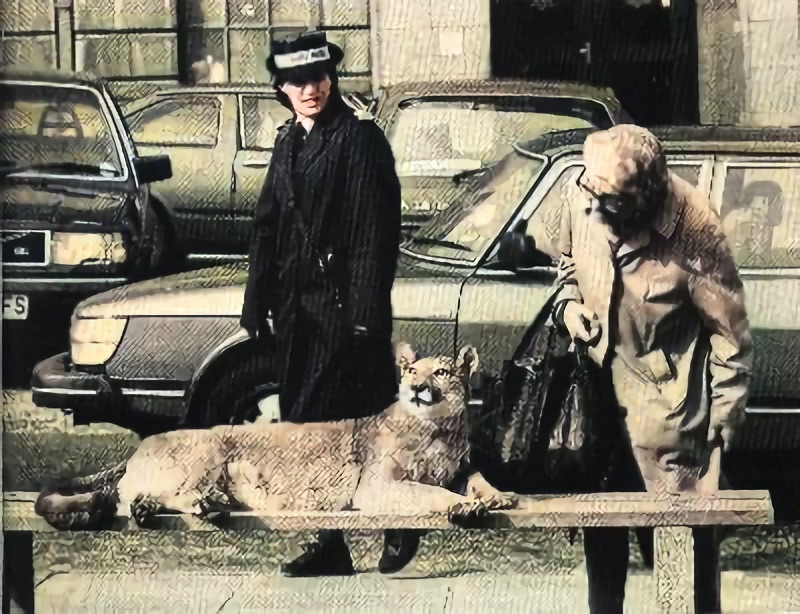
AP: Indeed, yes. But are they not fantasy too, like the Beast of Gévaudan, or your own Monster of Loch Ness?
CdK: (Laughs). Not at all. We are talking about genuine flesh and blood animals not flights of fancy. While there are a few rather weird individuals who also investigate UFOs, ghosts and yetis, the majority of big cat researchers are normal, sane individuals, many of who have scientific training, or who have lived all their lives in the countryside and know the difference between a black feral cat and a melanistic leopard.

AP: You really believe there are black panthers in Britain?
AP: You mean black leopards? Absolutely! And also pumas, lynx and smaller exotic cats such as leopard cats and jungle cats. Very recently some hairs were found which were positively identified by two laboratories as coming from a member of the Panthera family, possibly a black leopard.
Puma and lynx have been captured, while leopard cats and other smaller cats have been trapped and killed. There are not many around, but there are certainly a small population, and there is evidence that in certain areas, they have been breeding.

AP: Where do the big cats come from?
CdK: I think many people now accept that we have many species of exotic animals living and breeding in the British Countryside and the question is no longer if but which species and where they came from. Sightings of exotic cats have increased dramatically since the Dangerous Wild Animals Act was passed in the 1970s, prohibiting the keeping of animals such as leopards and pumas without a licence.
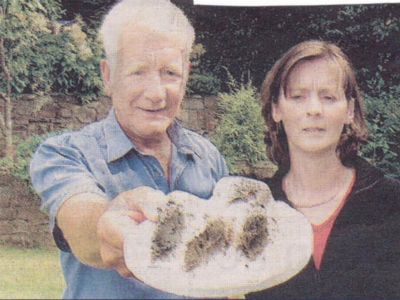
AP: So these big cats were released in the 1970s?
A lot probably were, but you should consider that pumas and leopards live up for up to 20 years in captivity, – and geneally much less in the wild. Therefore, unless there have been continuing releases, the cats must have been breeding to maintain their population. Indeed we have solid evidence that this is the case.
However, releases in the 1970s is not the whole story as an examination of historical records reveals sightings dating back hundreds of years, e.g. three lynx were reported to be killed in Inverness hire in the 1920s. Many of the cats may have escaped from the travelling menageries that were common in the 18 th and 19 th centuries. Another theory is that there is a British Big Cat as yet unknown to science, but this has little hard evidence to back it up. However, it is not impossible that animals like the lynx, which are thought to have become extinct sometime after the first or second century AD, may have persisted much longer than believed, and perhaps into modern times.
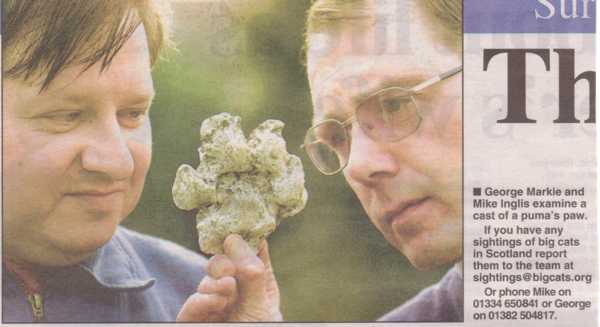
AP: Why is this not better known?
CdK: An excellent question. To be quite frank, many people would be somewhat uneasy to realise that there is a family of lynx living quite happily within a few miles of their home. Some of these cats are native animals which are quite happily re-establishing themselves in their own native environment. Others are introductions, which are quietly establishing themselves as new cogs in our ecosystem. Who has the right to say if that is a good or a bad thing? I try to keep a very open mind.

AP: But surely these big cats are very dangerous animals?
CdK: Another excellent question. Any strange animal can be dangerous. You only have to look at the tragic number of children that are attacked by dogs to realise that even so called pets can pose a danger. You have to realise that certain species of cat pose significantly more of a danger than others. Few would like to come face to face with a leopard, and even pumas have caused a number of fatalities in the USA and Canada, while at the opposite extreme I am aware of no cases of lynx – a native British species – attacking humans without provocation. Even females, according to experts, can be pushed off their young without risk to humans, although lynx will attack dogs. All these dangers have to be made relative. Bee and wasp stings can be fatal. And if we were really concerned about safety, we would undoubtedly ban cigarettes and motor cars tomorrow.
AP: Fascinating thoughts. Christina de Kéroualle, thank you.
CdK: Thank you.
Dr Christina Anne Montagu Douglas Scott has a Ph.D. in molecular biology and biochemistry and a M.Sc. in Information Technology. She is the wife of Armand de Kéroualle, Viscount d’Aubigny.
 Vecchio