

Robert Selkirk (09 October 1813 – 14 November 1873)
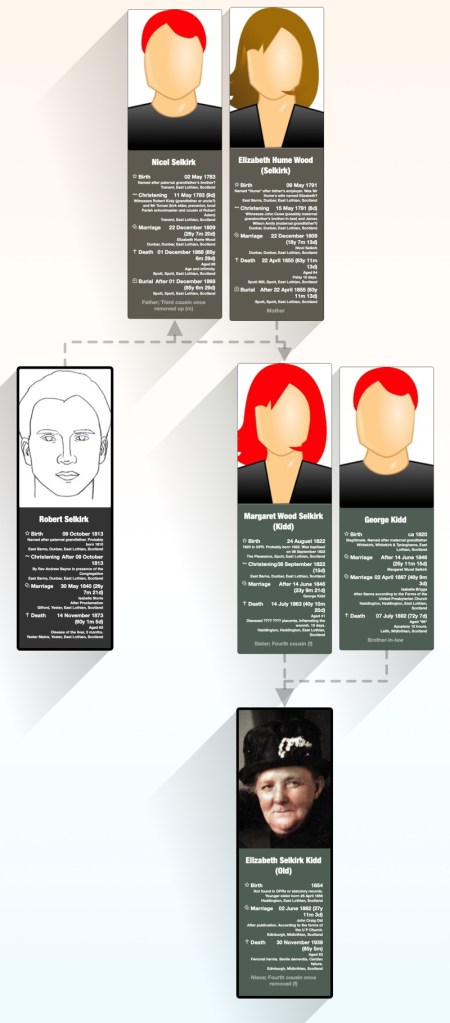
According to the Old Parish Register of Births and Baptisms for the parish of Dunbar, our great (x3) uncle Robert Selkirk was born on 09 October 1813 at East Barns in the parish of Dunbar in East Lothian and he was baptised “By Rev Andrew Bayne in presence of the Congregation“. However, the entry records that the births of the Selkirk children were “inserted here 03 January 1855“. As discussed elsewhere the Selkirks were members of a dissenting church, the Associate Congregation of East Barns, and it seems that by 1855, more than 40 years after the event, memories were hazy and that the wrong years of birth were given. In Robert’s case his original baptism record has not been found, but it seems likely that he was actually born in 1810.
At the census of 06 June 1841, Robert was recorded as aged 25 and living at Meiklerigg in the parish of Stenton in East Lothian where he was working as an Agricultural Labourer. By 30 March 1851, he was aged 36 and living at Broadwoodside in the parish of Yester in East Lothian, and was again working as an Agricultural Labourer.
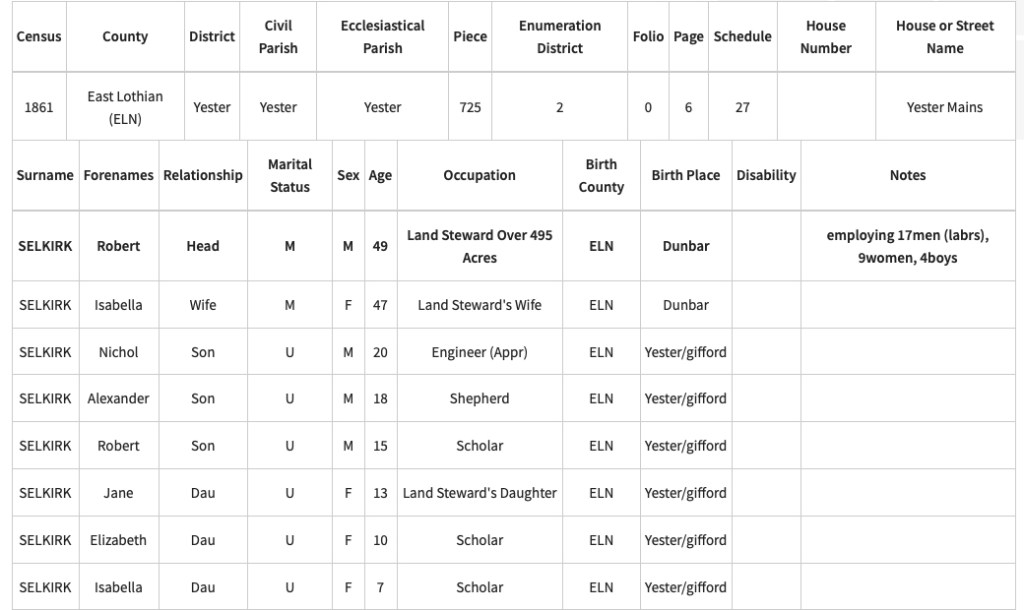
However, much had changed by 07 April 1861, when Robert was recorded as aged 47 and living at Yester Mains in the parish of Yester in East Lothian. Then he was recorded as “Land Steward over 495 acres. Employing 17 men (Labourers), 9 women, 4 boys.“
Yester Mains was the Home Farm of the Hays of Tweeddale and was not tenanted, but run by a Land Steward. The history section of nearby Broadwoodside farm, which is now run as a garden notes:
“The 8th Marquis of Tweeddale (1787–1876), between fighting in the Napoleonic Wars and serving as Governor of Madras, set about the improvement of his farmland with characteristic energy. His achievements are recorded in The Yester Deep Plough Culture, published in Edinburgh in 1855, which records how ‘he led the way in tile-draining, in deep ploughing, and in other agricultural experiments, which he conducted at a considerable expense’.“
As Land Steward, Robert Selkirk would undoubtedly have been very much involved in these farmland improvements.
At the time of the 1861 census, the Hay family appears to have been elsewhere as Yester House itself was only occupied by Richard Ronals, the House Steward and another ten servants.
Also living at Yester Mains were some of those who presumably made up part of Robert Selkirk’s workforce of 17 men, 9 women and 4 boys:
- Thomas Hills, Shepherd and his wife and three children.
- William Dickson, Agricultural Labourer, his wife Jane, Poultry Keeper, their daughter Jane, Assistant Poultry Keeper and three other children
- William Neillans, Ploughman, his wife and son
- Andrew Dickson, Ploughman, his wife, Janet, son William, Agricultural Labourer and four other children.
- Robert Wright, Ploughman, his wife Isabella, son James, Agricultural Labourer and three other children.
- Hamilton Steele, Ploughman, his wife Ann, sons James, Ploughman, William, Agricultural Labourer and a daughter.
- Robert Combe, Ploughman, his wife and two children.
- Alexander Michie, Foreman Blacksmith, his wife and four children.
Meanwhile, at Yester South Port there was:
- George Burns, hedger, his wife and two children.
While at Yester North Port there was:
- James Bathgate, Agricultural Labourer, his wife, four children and father George, a former Agricultural Labourer.
Several Agricultural Labourers and Shepherds lived nearby and were likely supervised by Robert Selkirk.

On 01 December 1868, when he registered the death of his father, Nicol, who had lived to the grand old age of 86, he was a Land Stewart. It is believed that it was likely to have been Robert Selkirk who paid for the gravestone for his father, mother and sister in Spott churchyard.
At the census of 02 April 1871, Robert Selkirk was aged 59, living at Yester Mains and working as a Farm Steward.
Robert Selkirk died on 14 November 1873 when he was living at Yester Mains, and working as a Farm Steward. He was aged 62 and died of Disease of the liver, 3 months as certified by F. A. Fairweather, M.B. & M.C. His death was registered by his son Nicol who was living in Edinburgh at the time.

Robert Selkirk died intestate and when his affairs were reviewed at Haddington Sheriff Court on 05 April 1875 he had left an estate valued at £1002 16s 1d, a considerable sum in those days, especially for someone who had started his career as an Agricultural Labourer.
A study of national income in 1867 showed that 70% of working or ‘productive’ Scots – young, female and unskilled – had an annual income of less than £30 a year, whereas, skilled workers might expect to earn between £47 and £50 a year at this time. (W.W. Knox. A History of the Scottish People. Poverty, Income and Wealth in Scotland 1840-1940.)
The Hays of Yester
When Robert Selkirk was Land Steward for the Hays of Yester, the head of the family was George Hay, 8th Marquis of Tweeddale. It seems likely that he would have reported to the Marquis, and to his sons, George, who was Earl of Gifford until his death in 1862, Arthur, who became Earl of Gifford in 1862 and Marquis of Tweeddale in 1876, and possibly William who succeeded as Marquis of Tweeddale in 1878.

George Hay, 8th Marquis of Tweeddale (1 February 1787 – 10 October 1876)

Field Marshal George Hay, 8th Marquess of Tweeddale KT GCB (1 February 1787 – 10 October 1876) was a Scottish soldier and administrator. He served as a staff officer in the Peninsular War under Arthur Wellesley and was with Wellesley at the Second Battle of Porto when they crossed the Douro river and routed Marshal Soult‘s French troops in Porto. Hay also saw action at the Battle of Bussaco and at the Battle of Vitoria. He later served in the War of 1812 and commanded the 100th Regiment of Foot at the Battle of Chippawa when he was taken prisoner of war. He went on to become governor of Madras and, at the same time, Commander-in-Chief of the Madras Army, in which role he restored the discipline of the army, which had been allowed to fall into a relaxed state.
Life and military career
Born at Yester House the eldest son of George Hay, 7th Marquess of Tweeddale and Lady Hannah Charlotte Maitland (a daughter of James Maitland, 7th Earl of Lauderdale), Hay was educated at the Royal High School in Edinburgh and commissioned as an ensign in the 52nd Light Infantry in June 1804. After succeeding to his father’s title as Marquess of Tweeddale in August 1804, he was promoted to lieutenant on 12 October 1804 and, having received his first training under Sir John Moore at Shorncliffe, he served as an aide-de-camp in Sicily in 1806. He transferred to the Grenadier Guards with the rank of lieutenant in the regiment and captain in the Army on 12 May 1807.
Hay served as a staff officer in the Peninsular War under Arthur Wellesley. Hay was with Wellesley at the Second Battle of Porto in May 1809 when they crossed the Douro river in a daylight coup de main and routed Marshal Soult‘s French troops in Porto. He was deputy assistant quartermaster general and was wounded at the Battle of Bussaco in September 1810 and, having been promoted to major in the 41st Regiment of Foot, he was assistant quartermaster general at the Battle of Vitoria in June 1813. He was immediately promoted to lieutenant colonel.
Hay also served in the War of 1812 between Britain and America, and commanded the 100th Regiment of Foot at the Battle of Chippawa in July 1814. As the redcoats of the 1/1st (Royal Scots) Foot and 100th Regiments moved forward, their own artillery had to stop firing in order to avoid hitting them. Meanwhile, the American gunners switched from firing roundshot to firing canister, with lethal consequences for the British infantry. Once the opposing lines had closed to less than 100 yards apart, General Winfield Scott of the United States Army advanced his wings, forming his brigade into a “U” shape which allowed his flanking units to catch the British advancing troops in a heavy crossfire. Hay made an attempt to fight to the death but was taken prisoner of war by the Americans. He was appointed Companion of the Order of the Bath in 1815. After the War he returned to Scotland and improved his family estate at Yester. From 1818 to 1820 he served as Pro-Grand Master of the Grand Lodge of Scotland. He was elected a representative peer for Scotland in July 1818, appointed Knight of the Thistle in 1820 and became Lord Lieutenant of East Lothian in February 1823. He was also promoted to colonel on 27 May 1825 and to major-general on 10 May 1837. Meanwhile, on his estate, he developed an improved method of making tiles for draining which was patented in October 1839.
In 1842 Hay returned to public service when he was appointed governor of Madras and also, by special arrangement of the Duke of Wellington, Commander-in-Chiefof the Madras Army. In that role he restored the discipline of the army, which had been allowed to fall into a relaxed state. Promoted to lieutenant general on 9 November 1846, he retired from active service and returned to his estate in Scotland again in 1848. He was promoted to full general on 20 June 1854 and invited to join a Royal Commission established in July 1858 to inquire into the organization of the army then serving under the East India Company. He was advanced to Knight Commander of the Order of the Bath on 9 November 1862 and to Knight Grand Cross of the Order of the Bath on 13 March 1867 before being further promoted to field marshal on 29 May 1875.
Hay also served as colonel of the 30th Regiment of Foot, then of the 42nd Regiment of Foot and finally of the 2nd Regiment of Life Guards. A strong man, he once drove the mail coach from London to Haddington without a halt or a rest. He died, following injuries sustained during a fire at his home, at Yester House on 10 October 1876 and was buried in the family burial vault at the Church of Saint. Cuthbert at Yester in Scotland.
Family
In 1816 he married Lady Susan Montagu, a daughter of the 5th Duke of Manchester: they had six sons and eight daughters:
- Lady Susan Georgiana Hay (13 March 1817 – 6 May 1853), married the 1st Marquess of Dalhousie and had issue
- Lady Hannah Charlotte Hay (12 Apr 1818 – 10 November 1887), married Simon Watson Taylor and had issue
- Lady Louisa Jane (29 Jul 1819 – 9 September 1882), married Robert Ramsay and had issue
- Lady Elizabeth (27 September 1820 – 13 August 1904), married the 2nd Duke of Wellington
- George, Earl of Gifford (22 April 1822 – 22 December 1862)
- Lady Millicent (1823–1826), died young
- Lord Arthur, later Earl of Gifford and later 9th Marquess of Tweeddale (9 November 1824 – 29 December 1878)
- Lord William Montagu, later 10th Marquess of Tweeddale (27 January 1826 – 25 November 1911)
- Lord John (23 August 1827 – 4 May 1916)
- Lady Jane (1830 – 13 December 1920), married Sir Richard Taylor and had issue
- Lady Julia (1831–1915)
- Lord Charles Edward (1833–1912)
- Lord Frederick (1835–1912)
- Lady Emily (1836 – 4 April 1924), married Sir Robert Peel, 3rd Baronet and had issue.
George Hay, Earl of Gifford (26 April 1822 – 22 December 1862)

In 1861, when Robert Selkirk was Land Steward for the Hays of Yester, George Hay, 8th Marquis of Tweedale was aged 74, and I imagined that his sons would likely have placed an active part in managing the estate. This appeared to be confirmed as I discovered that George Hay, Earl of Gifford and heir to the 8th Marquis of Tweedale died on 22 December 1862 “following an accident with a falling tree“. Robert Selkirk was Land Steward for the Hays at this time and one wonders whether Robert Selkirk was present when the fateful tree fell, perhaps as part of improvements to the estate?
I discovered an entry on Wikipedia which states:
“George Hay, Earl of Gifford (26 April 1822 – 22 December 1862) was a British Liberal Party politician.
“Lord Gifford was born at Yester House, the eldest son of the 8th Marquess of Tweeddale. He was educated at Trinity College and Trinity Hall, Cambridge, where he was president of the University Pitt Club. In 1850, he was a Captain in the East Lothian Yeomanry Cavalry and became Private Secretary to the Secretary of State for War (The Duke of Newcastle) in 1854. A year later, he entered Parliament as MP for Totnes (a seat he held until his death).
“In 1862, Lord Gifford was involved in an accident whilst rescuing a workman about to be crushed by a tree the latter was cutting down in the grounds of Yester Castle. Because of the accident, the Dowager Baroness Dufferin and Claneboye (a close friend of his who previously refused his proposals) agreed to marry Lord Gifford and they did so at Dufferin Lodge on 13 October 1862. As a result of the accident, Lord Gifford died two months later and as he and his wife did not have any children, his brother, Lord Arthur became the heir to their father’s titles and estate.“
Arthur Hay, 9th Marquess of Tweeddale (9 November 1824 – 29 December 1878)

Following the death of his elder brother on 22 December 1862, Arthur Hay, the next eldest brother became Earl of Gifford and heir to the Marquis of Tweeddale.
Colonel Arthur Hay, 9th Marquess of Tweeddale FRS FRSE FZS (9 November 1824 – 29 December 1878), known before 1862 as Lord Arthur Hay and between 1862 and 1876 as Viscount Walden, was a Scottish soldier and ornithologist.
Life
He was born at Yester House near Gifford, East Lothian, the son of General Sir George Hay, 8th Marquess of Tweeddale and his wife, Lady Susan Montague. He was sent to university in both Leipzig and Geneva.
Training in the military he received a commission in the British Army in 1841. He rose to be a Colonel in the Grenadier Guards. He served as a soldier in India and the Crimea. He succeeded his father in the marquessate in 1876. He died at Chislehurst, and was succeeded by his brother.
Hay purchased a lieutenancy in the Grenadier Guards in 1841. He purchased a captaincy in 1846 and was promoted lieutenant-colonel without purchase in 1854 and Colonel in 1860. In 1866 he transferred to the 17th Lancers.
He was president of the Zoological Society of London from 16 January 1868. He had a private collection of birds, insects, reptiles and mammals and employed Carl Bock to travel to Maritime Southeast Asia and collect specimens. Tweeddale described about 40 species collected by Bock for the first time and was elected a Fellow of the Royal Society in 1871.
His ornithological works were published privately in 1881 by his nephew, Captain Robert George Wardlaw-Ramsay, with a memoir by Dr W. H. Russell, and the attribution Walden is used in taxonomic listings.
He died at Walden Cottage in Chislehurst, London on 28 December 1878.
Family
He married twice: firstly in 1857 to Helene Kilmansegge (d.1871) and secondly in 1873 to Julia Mackenzie of Seaforth, daughter of Lt.-Colonel Keith William Stewart Mackenzie (9 May 1818 – June 1881) and of Hannah Charlotte Hope Vere. After Hay’s death she married secondly Sir John Rose, 1st Baronet; and thirdly after his death William Evans-Gordon, MP. (All without issue).
William Hay, 10th Marquis of Tweeddale (29 January 1826 – 25 November 1911)

William Montagu Hay, 10th Marquess of Tweeddale KT DL (29 January 1826 – 25 November 1911), known before 1878 as Lord William Hay or Lord William Montagu Hay, was a Scottish landowner, peer and politician. He was born at Yester House, near Gifford, East Lothian, and served in British India as a member of the Bengal Civil Service and later as a Liberal Member of Parliament.
In 1878 he succeeded his brother as Marquis of Tweeddale and as owner of some 40,000 acres in Scotland. He went on to become Lord High Commissioner to the General Assembly of the Church of Scotland and was appointed a Knight of the Thistle.
Early life
Hay was born at Yester House on 29 January 1826. He was the third son (of six sons and eight daughters) born to Lady Susan Montagu and George Hay, 8th Marquis of Tweeddale (1787–1876). Among his many prominent siblings were Lady Susan Hay (wife of James Broun-Ramsay, 1st Marquis of Dalhousie), Lady Hannah Hay (wife of Simon Watson Taylor), Lady Elizabeth Hay (wife of Arthur Wellesley, 2nd Duke of Wellington), George Hay, Earl of Gifford, Lord Arthur, later Earl of Gifford and later 9th Marquess of Tweeddale, Lord John Hay, Lady Jane Hay (wife of Sir Richard Taylor), and Lady Emily Hay (wife of Sir Robert Peel, 3rd Baronet).
His paternal grandfather was George Hay, 7th Marquis of Tweeddale and Lady Hannah Charlotte Maitland (a daughter of James Maitland, 7th Earl of Lauderdale). His maternal grandparents were William Montagu, 5th Duke of Manchester and Lady Susan Gordon (third daughter of Alexander Gordon, 4th Duke of Gordon).
As the third son of a Marquess who was not expected to inherit the title, Hay was educated at the Imperial Service College and prepared for a career in the Civil Service.
Career
From 1845 to 1862, he served in the Bengal Civil Service, including some years as Deputy Commissioner of Simla and then as Superintendent of the Hill States of Northern India.
Following his permanent return from India Hay was Liberal Member of Parliament for Taunton from 1865 to 1868, and was elected again for Haddington Burghs in 1878. He also became Chairman of the North British Railway Company.
After succeeding his brother Arthur as Marquess of Tweeddale on 29 December 1878, he became the owner of estates totalling some 40,000 acres in Scotland. In 1881 he was created Baron Tweeddale of Yester in the peerage of the United Kingdom, giving him a seat in the House of Lords.
As well as being Hereditary Chamberlain of Dunfermline, he was Lord High Commissioner to the General Assembly of the Church of Scotland from 1889 to 1892 and, again, from 1896 to 1897.
Honours
On 26 October 1898 Tweeddale was appointed a Knight of the Thistle and was invested at Windsor Castle on 8 December. He was also a Deputy Lieutenant for the counties of Haddingtonshire (now called East Lothian and Berwickshire) and a Brigadier-General of the Royal Company of Archers, a ceremonial unit that serves as the Sovereign’s Bodyguard in Scotland.
Personal life
On 18 May 1878, Lord Tweeddale was married to Candida Louise Bartolucci (1854–1925) at Saint Augustine’s Church, London. Candida was a daughter of Signor Vincenzo Bartolucci of Cantiano, Italy. Candida’s sister, Evelyn Bartolucci, was the second wife of Adm. Sir Astley Cooper Key. Together, William and Candida were the parents of:
- Lady Susan Elizabeth Clementine Hay (1879–1964), who married Walter Waring, MP, son of Charles Waring, MP, in 1901.
- Lady Candida Louisa Hay (1882–1882), who died at birth.
- William Hay, 11th Marquess of Tweeddale (1884–1967), who married Marguerite Christine Ralli, daughter of Alexander Ralli and step daughter of Lewis Einstein, in 1912.
- Lord Arthur Vincent Hay (1886–1914), who was killed in action in the First World War during the First Battle of the Aisne. He married Menda Ralli, only daughter of Ambrose Ralli, in 1911. After his death, she married Col. Robert Edward Kennard Leatham.
- Lt. Col. Lord Edward Douglas Hay (1888–1944), who married Violet Florence Catherine “Bridget” Barclay, only daughter of Maj. Cameron Barclay, in 1917.
He died on 25 November 1911 at his house in London, 6 Hill Street, and was succeeded by his eldest son, the Earl of Gifford (born 1884). He is buried at Yester Parish Church in Gifford, East Lothian, close to his family home at Yester House.
Descendants
As his eldest son died without male issue, David George Montagu Hay, the son of his youngest son Lord Edward Douglas Hay, became the 12th Marquis of Tweeddale in 1967.
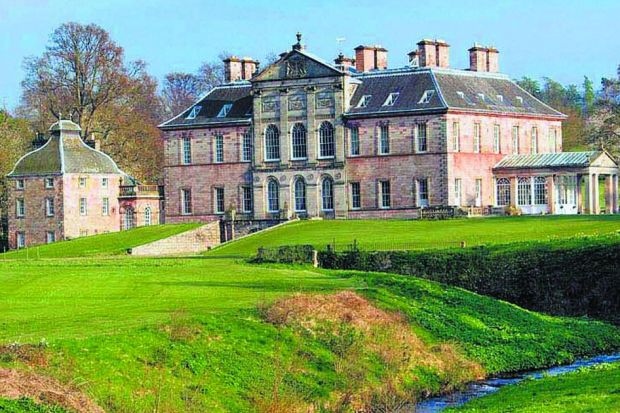
Yester House, the magnificent Palladian mansion at Gifford in East Lothian, passed from the family after the death of the 11th Marquis in 1967.
Marquis or Marquess?
In England, and historically in Ireland, the usual spelling of the aristocratic title of this rank is marquess.
In Scotland, on the European mainland and in Canada, the French spelling of marquis is used.
In Great Britain and historically in Ireland, the title ranks below a duke and above an earl. A woman with the rank of a marquis, or the wife of a marquis, is called a marchioness in Great Britain and Ireland, or a marquise elsewhere in Europe. The dignity, rank, or position of the title is referred to as a marquisate or marquessate.
 Vecchio