
The lands of Craigie were designated as such before 1534. (The Scottish feudal Barony of Craigie)
However, on some maps it was described as “Kragy” – e.g. see Pont’s map from circa 1583–1596. (Lower Angus and Perthshire east of the Tay map,” by Timothy Pont, circa 1583–1596-)
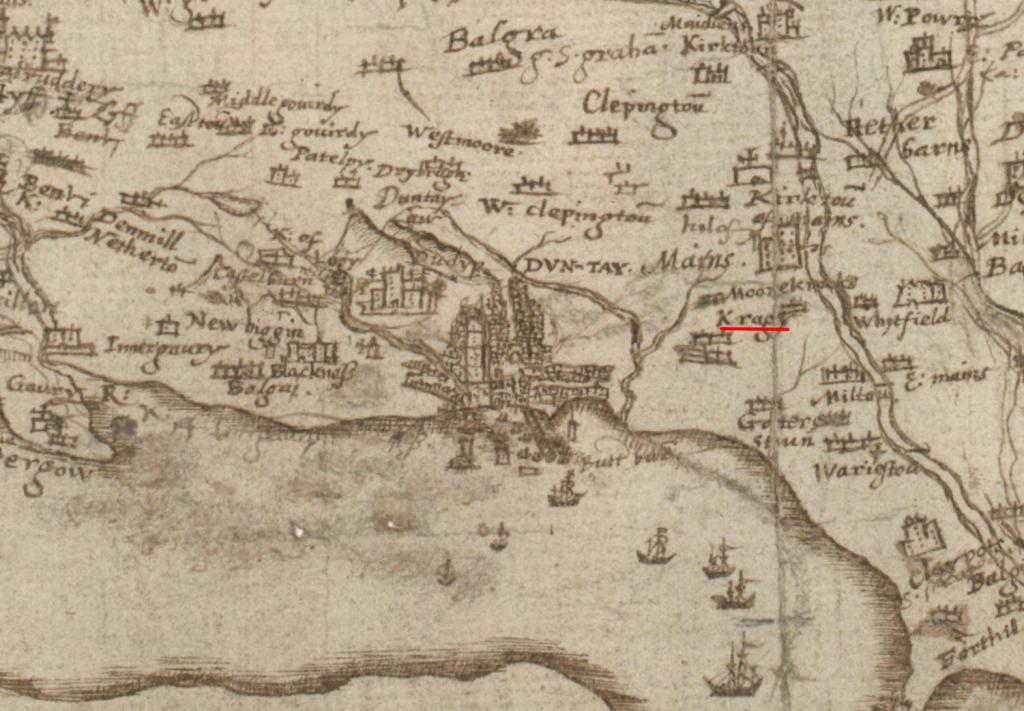
The name Craigie is likely to be descriptive, probably referring to craggy or hilly terrain. Indeed, the title of Hiltoun of Craigie and other lands, is used to describe James Guthrie in a crown charter dated 12 February 1729. (The Scots Peerage, Founded on Wood’s edition of Sir Robert Douglas’s Peerage of Scotland containing an historical and genealogical account of the Nobility of that kingdom. With Armorial Illustrations. Edited by Sir James Balfour Paul (1846–1931) Lord Lyon King of Arms. Published by David Douglas, Edinburgh, 1904-1914) (Barony of Craigie)
The hill in question can be discerned in maps such as Robert Gordon’s map of “Anguss” (sic), circa 1636–1652. (National Library of Scotland, “Anguss [(sic) / R.G.,” by Robert Gordon (1580–1661), circa 1636–1652)
The lands of the Barony lay to the east of old Dundee, beside the A929 to Forfar and the A972 Kinsgway East. The A930, Broughty Ferry Road and Dundee Road West, begin in what was once part of the Barony of Craigie. Other lands, particularly from the Barony of Barry and Woodhill, were later incorporated into the Barony of Craigie. (The Scottish feudal Barony of Craigie).
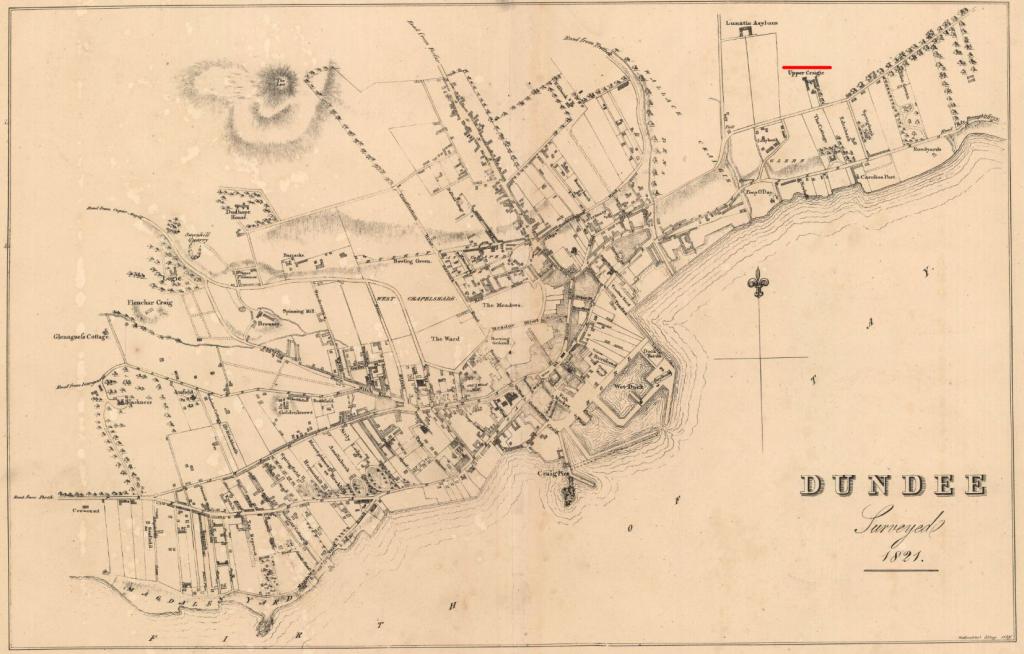
While much of Craigie is now in a built-up area of Dundee City and is covered by housing and supermarkets, parts of Craigie remain practically unchanged since the creation of the Barony. In 1881 the lands of Craigie were described in idyllic terms, such as “Craigie, (property of) Kid, excellent land, a good house, with a new little park;” (Angus or Forfarshire. The Land and People. Descriptive and Historical. By Alex. J. Warden FSA Scot. Author of “The Linen Trade” and “The Burgh Laws of Dundee. Vol III. Dundee. Charles Alexander & Co. 1882), (The Scottish feudal Barony of Craigie).
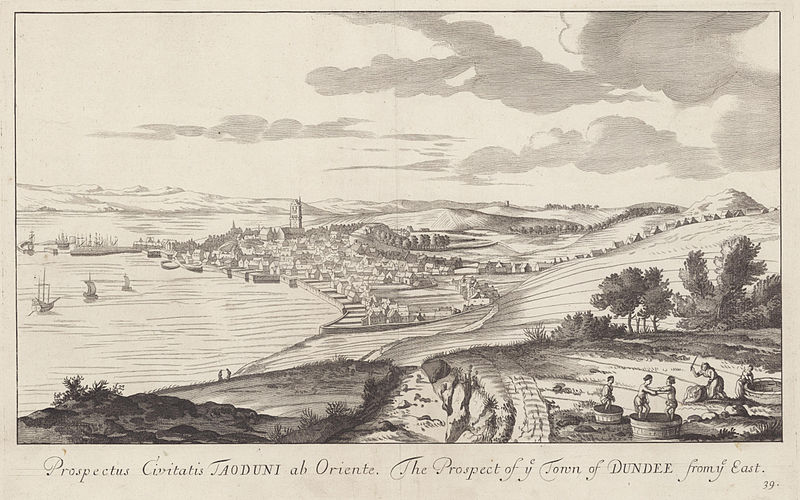
The lands of the Barony of Craigie, which included Craigie House and the farms of Craigie, can be found on maps on the ScotlandPlaces web site. An entry from the National Library of Scotland, includes a wonderful vista of the lands of Craigie. (“Northern Part of Angus Shire. Southern Part.,” by Edinburgh : J. Thomson & Co., in 1825])
Craigie is located just to the east (right) of Dundee, just north of the coastline, and west (left) of the Broughty Castle. (ScotlandPlaces web site, National Library of Scotland, Edinburgh (1825). Northern Part of Angus Shire. Southern Part. J. Thomson & Co.)
Additional historical references to Craigie include citations in 1678 in the Angusia Provincia Scotiae sive The Shire of Angus, by Janssonius Waesberghe, Moses Pitt and Stephanus Swart of Amsterdam. (Waesberge, Janssonius; Pitt, Moses; Swart, Stephanus (1678). Angusia Provincia Scotiae sive The Shire of Angus.)
The exact boundaries of the Barony of Craigie remained fluid, with numerous exchanges of territory taking place between abbeys, merchants, towns, and nobles. According to Warden in 1884, the property of Craigie was a large and valuable estate five or six centuries ago, but it was at an early period cut up into several sections, and these were again sub-divided into smaller portions, which makes it impossible to give a correct continuous account of either the sections or the smaller portions into which they were divided… (Angus or Forfarshire. The Land and People. Descriptive and Historical. By Alex. J. Warden FSA Scot. Author of “The Linen Trade” and “The Burgh Laws of Dundee. Vol III. Dundee. Charles Alexander & Co. 1882), (The Scottish feudal Barony of Craigie).
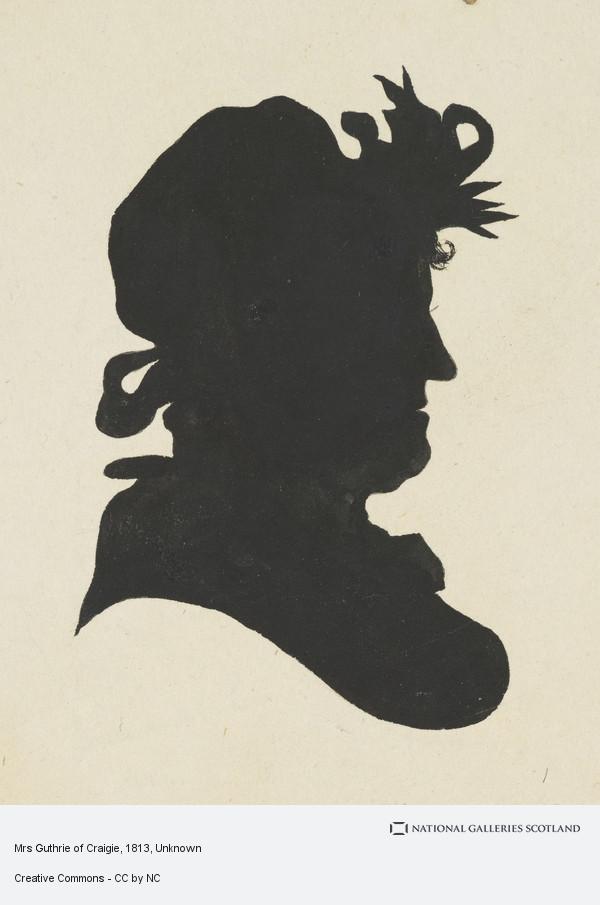
The Barony of Craigie was passed down from father to son by the descendants of the 4th Baron until 2000 when the Abolition of Feudal Tenure etc. (Scotland) Act 2000 abolished feudalism in Scotland. While this act did not abolish the title of Baron, per se, any estate held in barony ceased to exist as a feudal estate. (Abolition of Feudal Tenure etc. (Scotland) Bill).
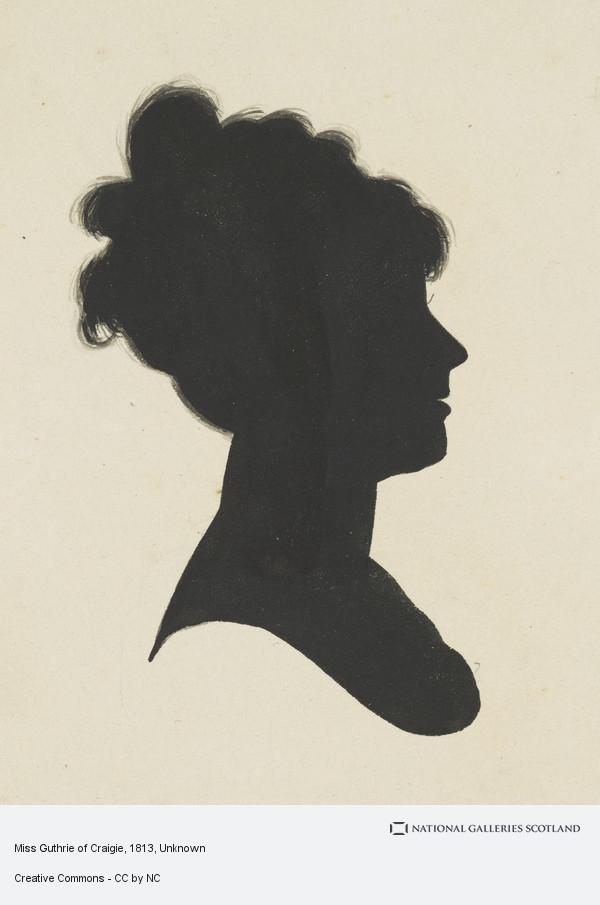
The 7th Baron of Craigie, David Charles Guthrie, died in November 2003. His eldest son Stephen Patrick Guthrie does not appear to have been infeft or to have used the title, although he would have been de facto and de jure, the 8th Baron of Guthrie.
In February 2011 the Barony of Craigie was passed by assignation to Robert Owen Thomas, III, who has been described as The Much Honoured Rabbi Robert Owen Thomas, III, 8th Baron of Craigie. (Barony of Craigie)
However, the office of the Lord Lyon have confirmed that as Rabbi Thomas purchased the barony but not the lands, he would not be regarded as other than the first of his line. (Personal communication from the office of the Lord Lyon to Dr Julie Anya Guthrie, 5 September 2017.)
Guthries of Craigie and DNA
When people think of the Guthrie surname and its Scottish origins, they think of the Guthries of Guthrie and the builders of Guthrie Castle near Forfar, Angus, Scotland. The Guthrie DNA project results have revealed that people of Guthrie ancestry come from a variety of genetic origins, and that all are not genetic descendants of the Guthries of Guthrie. Of the sixteen identified genetic groups of Guthries, that which has a connection the Guthries of Guthrie is GFG1A. The Guthrie DNA project is fortunate to have a direct descendant of the Guthries of Craigie as a participant. As explained in a previous article, this family descends from the Guthries of Guthrie.
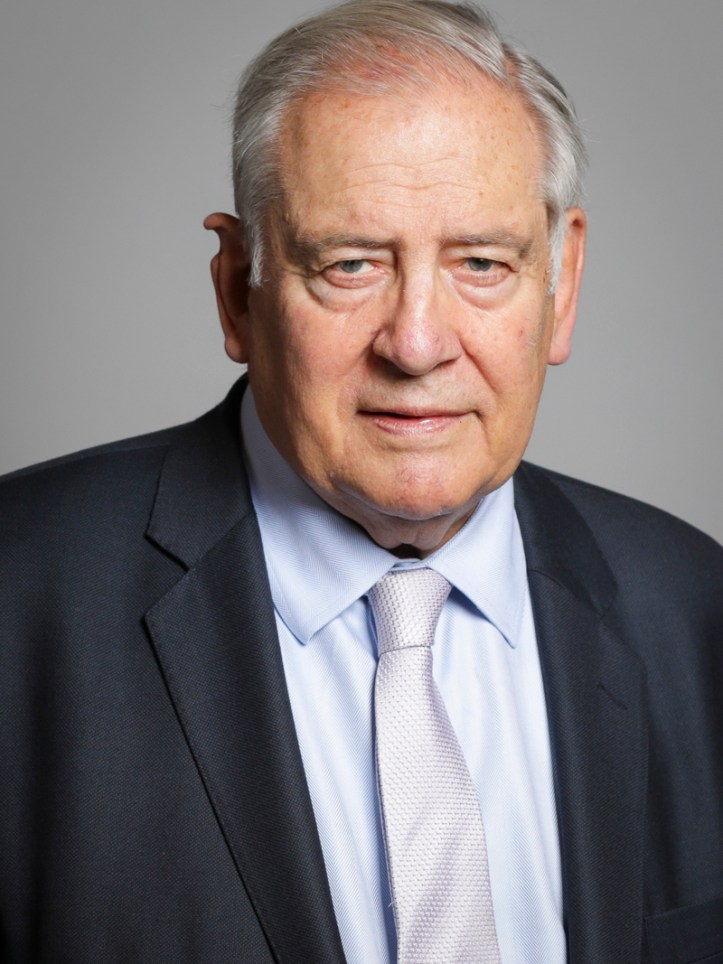
Charles Ronald Llewelyn Guthrie, Baron of Craigiebank. Born into a Scottish landed family in 1938, Guthrie was the elder son of Ronald Guthrie and Nina Guthrie (nee Llewelyn). During his military career he served with the Welsh Guards and the Special Air Service, and was closely involved in military operations in Northern Ireland and provided advice to the British Government during the Bosnian War and the Kosovo War. He was created a Life Peer (appointed members of the peerage whose titles cannot be inherited), as Baron Guthrie of Craigiebank, in the City of Dundee, in June 2001, and sits as a cross-bencher in the House of Lords.
The Guthrie DNA project is fortunate to have Lord Charles Ronald Llewellyn Guthrie, Baron of Craigiebank, as a volunteer participant in the Guthrie DNA Project. His Y-DNA is a match for Guthrie Family Group 1A. The baron’s title is a modern one, and gives homage to his ancestors who lived at Craigie. The paper trail of his ancestral line is that of the Guthries of Craigie, which are in turn connected to the Guthries of Guthrie.
The Guthrie DNA project notes:
The theory about Guthrie Family Group 1A is that it descends from the original Guthrie lineage stretching back to Alexander Guthrie 1st of Kincladrum who in 1446 obtained a charter to the lands of Kincaldrum in the Barony of Lower Leslie and the Sheriffdom of Forfar. This line is (for the most part) well documented, and the lands and titles purchased, obtained or granted are traceable to those who have inherited them.
This is the lineage connected to the Guthries of Guthrie, the Guthries of Gaigie, the Guthries of Taybank, and the Guthries of Craigie spelled out in that ancient rhyme. One must keep in mind that there is potentially a difference between historical documentation and genetic ancestry. Through paper trails and research, we have an historical ancestral tree for Guthrie Family Group 1A. The DNA Project reveals a genetic profile for those Guthrie families who share a common ancestry, and in the case of GFG1A, proves a genetic connection to a man with a documented historical ancestry with the Guthries of Craigie.
The generous donation of a DNA sample by a direct descendant of the Guthries of Craigie, has allowed other members of GFG1A to prove that they share a common paternal line ancestor.
Another Y-DNA match within GFG1A has proven a genetic connection within this line going back to James Guthrie (Merchant) 1669 Dundee, Angus Scotland – 1711 & Christian Scott. Their son James Guthrie was the first Baron of Craigie. The second participant descends from their son Patrick Guthrie.
Other lineages within the group share common ancestors somewhere on the same tree. The challenge is in discovering that exact connection. High quality YDNA testing (Y-111 markers) can narrow the estimated number of generations between two Guthrie men and their most recent common ancestor.
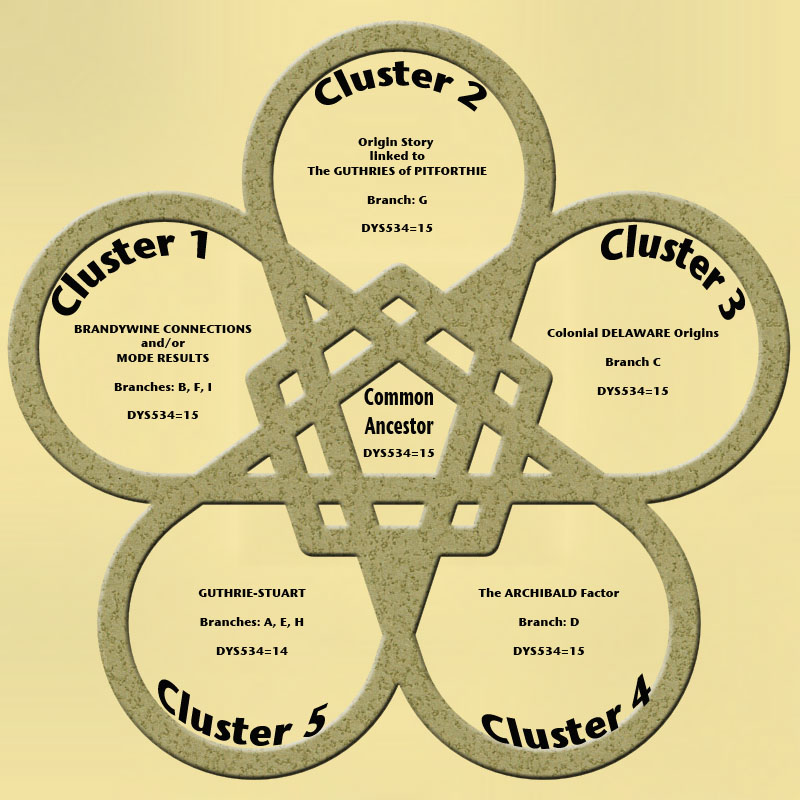
MISTAKEN IDENTITIES, UNPROVEN ASSUMPTIONS, & WRONG STUFF
Use caution when tracing lineages in online trees and published works. The convenient information you find may also have inconvenient errors. Some resources can also look very official, yet have no original data to back it up. There is a huge difference between collecting random data and conducting actual research that includes original or secondary sources.
If you’re a Guthrie with roots in Colonial America, especially in the South, chances are that you’ll find information connecting your family line to the Guthrie family of Middlesex County, Virginia. It is one of the earliest family lines in America, and one that has frequently been co-opted by eager folk looking to find some ancestors whether or not there is documentation to prove it.
DNA testing has already proven that many of these conclusions were false. There are a lot of gaps in Virginia records for certain counties, and it is so tempting to latch on to a person with the same name in a county nearby whose records are better if not entirely intact.
The same thing goes for Descendants of proven GFG1A lines in trying to establish ties from America back across the water to Scotland. Historical records have gaps. Barking up the wrong branch of the right tree is still wrong.
Chopping branches off a family tree should never be taken lightly, but neither should we arbitrarily add branches simply because they seem to be the best option. Family trees should be founded on good, solid evidence, which sometimes requires digging around in records that are not (horrors!) online.
Julie
Ancestral Findings. How do you know your genealogy research is accurate? Use these five tips to be as sure as you can be in the world of genealogy.
 Vecchio