
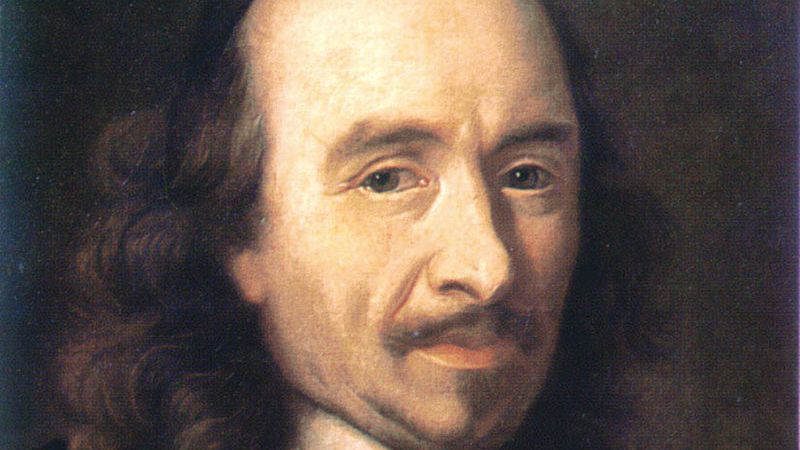
Ô rage ! Ô désespoir ! Ô vieillesse ennemie !
Pierre Corneille, Le Cid, Acte I, scène IV.
N’ai-je donc tant vécu que pour cette infamie ?
Guest Article
Sixteen years after seeing Pierre Corneille’s groundbreaking play, Le Cid at the Comédie Française in Paris, genealogist and Medieval historian Dr Julie Anya Guthrie asks:
Were the de la Carneille family the ancestors of the Guthries?
One of my research interests is the de la Carneille family, who the late Professor Geoffrey Barrow of Edinburgh University believed were the ancestors of the Guthries of Guthrie.
I also believe that it is possible this family may share common ancestry with the French playwright, Pierre Corneille – although I am probably biased as attending a performance of his Le Cid at the Comédie-Française in Paris was an experience that I will never forget.
The de la Carneille family – possible ancestors of the Guthries?
There is evidence that suggests that the Guthries of Guthrie may have once been known as de la Carneille. The de la Carneille family originated from Normandy (Stringer, Earl David Acta, no. 49 p130, p170) and the surname, like that of Guthrie, appears to be derived from a place. The village of La Carneille is located in the modern department of Orne in the French region of Basse-Normandie.
The family were followers of David, Earl of Huntingdon (1152 – 17 June 1219). Earl David was a younger son of Henry of Scotland, Earl of Huntingdon (1114 – 12 June 1152). He was thus the grandson of David I, King of Scots (ca. 1084 – 24 May 1153) and the younger brother of two kings, Malcolm IV, King of Scots (1141 – 09 December 1165) and William I “the Lion”, King of Scots (ca. 1143 – 04 December 1214).
David, 8th Earl of Huntingdon was the great (x2) grandfather of King Robert the Bruce and therefore, according to the generally accepted tree (but see my previous article), a maternal ancestor of the Guthries.
It is believed that one branch of the de la Carneille family settled in Earl David’s lands in Huntingdonshire in England, while a second settled in his lands of Guthrie in Scotland. (Stringer, Earl David Acta, no. 49 p130, p170).
According to the late Professor Geoffrey Barrow, this second branch of de la Carneille family (de la Kernelle in Latin) took the name of their Scottish lordship as their own and became the Guthries. (Barrow, Kingdom of the Scots, p293-4.)
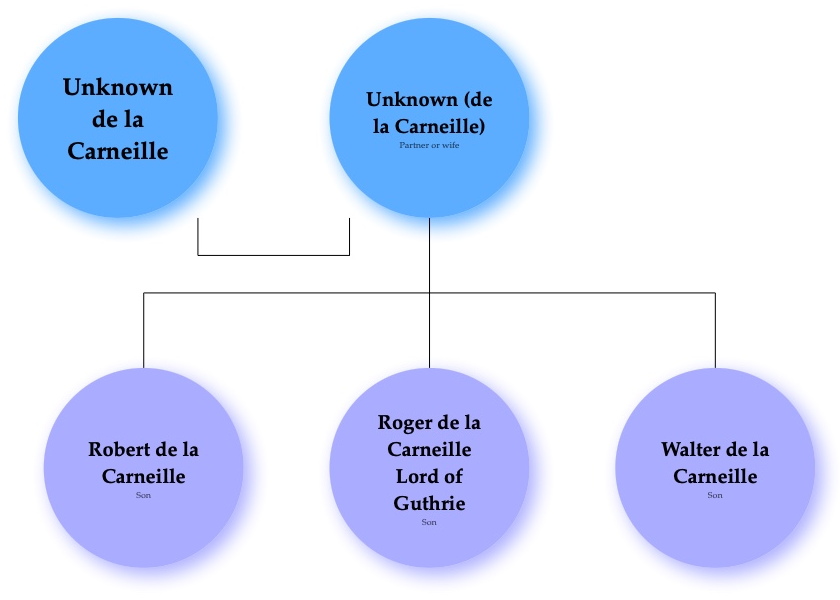
One member of the family, Robert de la Carneille, witnessed charters for Earl David of Huntingdon in the late twelfth century. Roger de la Carneille, Lord of Guthrie in Scotland, was probably the brother of Walter and Robert de la Carneille. (Regesta Regum Scottorum, ii, Acts of William I, ed. G.W.S. Barrow (Edinburgh, 1971), p 50, 348, 376, 389, 392, 394, 398, 403, 405, 436).
Some caution is required regarding the interpretation of the place Gutheryne in charters as it seems that there were two different places of this name. One of of these became Guthrie and the other became Guynd: The writings in question are also interesting, as shewing how little material changes in pronunciation the names of towns, farms, streams, muirs, &c., have in general undergone during the last seven centuries. Such transformations or changes when they do occur, are not less curious. Thus, soon after the foundation of the Abbey (of Arbroath), two places at several miles distance from one another are mentioned under the name of Gutheryne. One of these names, by losing the central letter “e” and the last consonant, has in course of time become Guthry or Guthrie. The other name, by a very different process, lost its middle syllable, and had its last consonant hardened the letter ” and by d,” appears in the following consecutive forms Gutheryne, Guthyn, Guyn, Gund, Guynd.” ( Arbroath and its abbey, or, The early history of the town and abbey of Aberbrothock. by David Miller, Edinburgh, 1860).
The arms of the Guthries of Guthrie
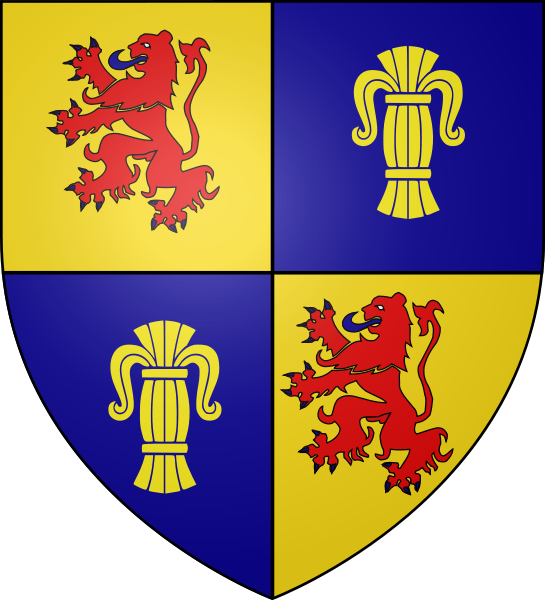
It is interesting to note that the Guthrie arms include two yellow quarters with a red lion rampant and two blue quarters with a golden wheatsheaf – or in heraldic terms Quarterly, 1st & 4th, Or, a lion rampant Gules armed and langued Azure; 2nd & 3rd, Azure, a garb Or.
Both quarters have elements that were closely associated with early members of the Royal House of Scotland.
The Arms of Alexander II, King of Scots

Or a lion rampant Gules armed and langued Azure is present in the royal arms of Scotland that were used by King William I of Scots. His nickname of The Lion came from his use of a red lion rampant with a forked tail (queue fourchée) on a yellow background. This, with the substitution of a ‘double tressure fleury counter-fleury’ border instead of an orle, went on to become the Royal Banner of Scotland. King William I was the elder brother of David, 8th Earl of Huntingdon (1152 – 17 June 1219) and both were closely associated with the de la Carneille family.
The Ancient Arms of the Earls of Chester
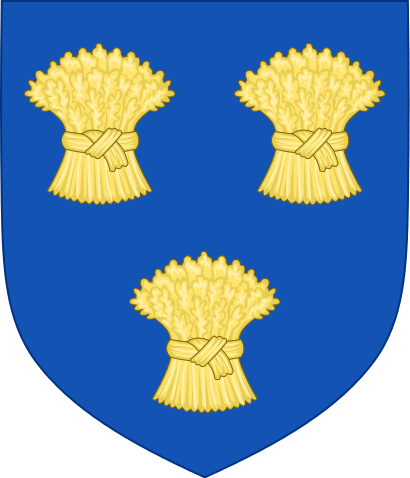
Azure, a Garb Or, was the ancient arms of the Earls of Chester; visible on the sigil of the sixth earl (1170-1232). After the sixth Earl’s death, his nephew, John the Scot, was formally invested by King Henry III as Earl of Chester on 21 November 1232. (David, Earl of Huntingdon and Lord of Garioch (1152–1219), Oxford Dictionary of National Biography, Oxford University Press, by Keith Stringer, 2004; online edn, Jan 2008).
John the Scot was the son of David, eighth Earl of Huntingdon and the sixth Earl of Chester’s eldest sister Matilda, or Maud of Chester.
The early Guthries
What do we know about the earliest Guthries? Alex. J. Warden, in Angus or Forfarshire. The Land and People. Descriptive and Historical. By Alex. J. Warden FSA Scot. Author of “The Linen Trade” and “The Burgh Laws of Dundee. Vol III. Dundee. Charles Alexander & Co. 1882 states:
“In the time of Wallace Squire Guthrie played a prominent part in the defence of Scotland against the rapacious and ambitious Edward of England. So much was he held in esteem by his contemporary patriots for his valour in war, and wisdom in council, that he was deputed by them to proceed to France, to invite Scotland’s hero, Wallace, to return to his native land, and again assume the command of the Scottish army. Wallace had resigned the guardianship of Scotland and gone to France after the defeat of his army at the fatal battle of Falkirk, a defeat caused by the treachery of some of the barons immediately prior to, and during the battle. The Squire proceeded to France, was successful in his mission, and returned with his chief to Scotland.
“There can be little doubt that Squire Guthrie was lord of the barony of Guthrie, and that the surname had been assumed from the lands, as was then the usual practice. Adam of Guthrie is a witness to a charter in 1348. He was an Angus man, in friendly communion with the Maules of Panmure, the proprietor of Guthrie, and was very probably the son, or a descendant, of Squire Guthrie of half a century previous. (Reg. de Pan., 170.) Alexander of Guthrie was one of the bailies of Forfar between 1395 and 1434. (M. of A. and M., 17.)
“It is very probable that the lands of Guthrie belonged to the Crown when King William the Lion bestowed the Church, with the patronage thereof upon the Abbey of Arbroath, as no record of any very early proprietor has been met with. Robert of Ramsay, the Sheriff of Forfar, in his returns for 1359 states that there is nothing to be charged against him out of the propart of the lands of Sir Henry de Ramsay, within the barony of Guthrie, because the ward of these lands was sold by Thomas, Earl of Mar, the Lord Chamberlain, as appears by his charging himself with two pounds thirteen shillings and fourpence sterling for the propart of Guthery. Sir Henry de Ramsay was therefore a portioner in the barony of Guthrie, but when he acquired an interest in it, or from whom, is unknown to us. King Robert III., in 1398, granted a confirmation charter of sundry baronies, including Guthrie, to David, Earl of Crawford (In. to Ch., 142-84.), but it is not said from whom he had acquired the barony.
“On 18th March, 1400, John of Guthrie witnessed a charter at Dundee. He had probably acquired the barony from the Earl of Crawford. In 1440, George Guthrie, designed of that Ilk, grants a charter to Sir John Ogilvy of Lintratlien of his half of the lands of Eroly (Airlie). On 13th October, 1450, Walter Carnegie of Guthrie was on the inquest anentthe marches of Menmuir between John of Collace and the Bishop of Brechin. On 21st July, 1450, he was a witness, and Master Alexander of Guthrie on same day.
“These notices of the proprietors of Guthrie are very obscure, as the succession cannot be satisfactorily traced from the Earl of Crawford in 1398 to Walter Carnegie in 1450.“
Alex. Warden concludes:
“The (Guthrie) family is of very old standing in this country, but their ancient writs being lost, they can only be traced by authentic documents from the reign of James II., though they must have been of considerable rank and property before that period. Master Alexander of Guthrie is witness to a charter by Alexander Seaton, Lord of Gordon, to William, Lord Keith, 1st August, 1442. He purchased the lands of Kincaldrum same year. He was succeeded by his eldest son, David, afterwards Sir David Guthrie, baron of Guthrie, who, during the life of his father, was designed of Kincaldruui, and was Sheriff- Depute of Forfar in the year 1457, and armour-bearer to King James III. Malcolm of Guthrie is mentioned in Reg. Ep. Br., 10th September, 1457.“
Possible links with the Corneille family
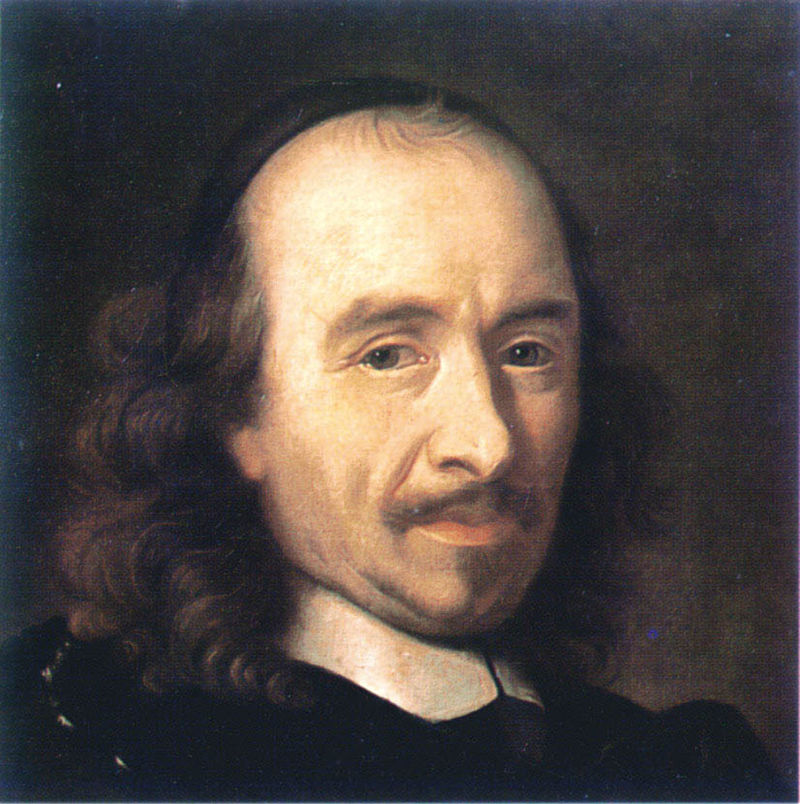
I have an unconfirmed theory that the de la Carneille family who emigrated to Guthrie in Scotland may be related to the celebrated French playwright Pierre Corneille, who was born at Rouen in Normandy in 1606.
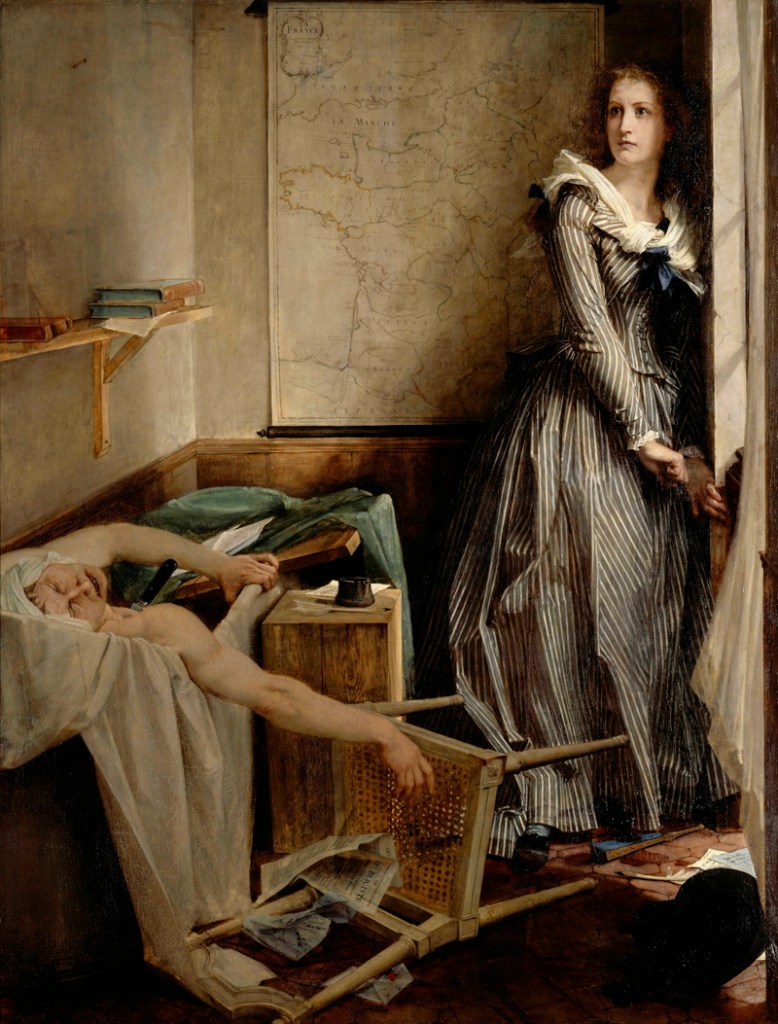
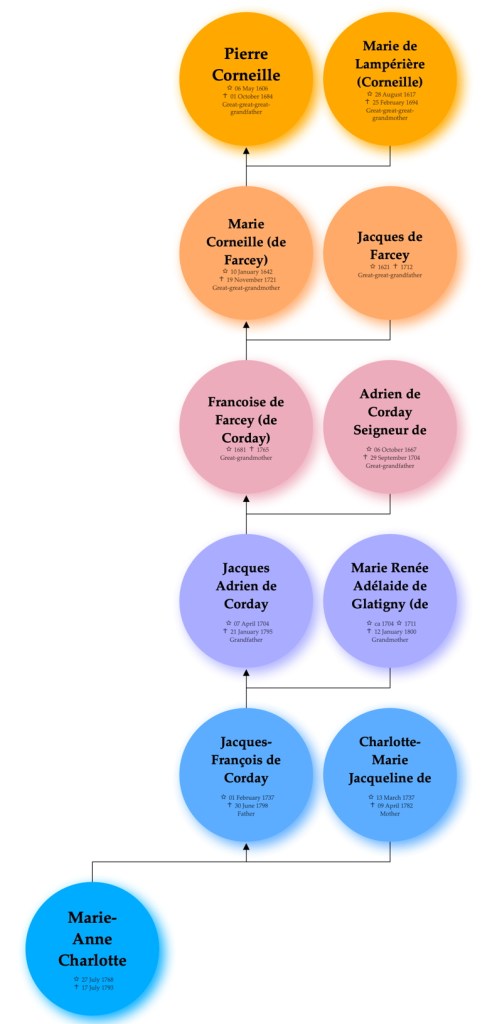
Pierre Corneille was the great-great-great grandfather of Charlotte Corday, who is best remembered for assassinating the revolutionary French journalist and politician Jean-Paul Marat in his bathtub. Marat was one of those responsible for the “September massacres“.
Corrections to People of Medieval Scotland (PoMS) Database
I have obtained confirmation from fantastic People of Medieval Scotland (PoMS) database that my belief that there were actually two different people named Robert de la Carneille signing charters in 1172×1225 rather than one as they originally believed, was correct:
Many thanks for your recent comment on the PoMS database website. It turns out the Robert, son of William de la Carneille who witnessed source 3/258/1 is clearly a different person from the earlier Robert de la Carneille. This has been corrected in the database but unfortunately it will not be visible on the public site until the database is next republished.
In the meantime note that the floruits for Robert, son of William are 1207×25, while the floruits now for the older Robert de la Carneille are 1172×74.
About The Author

Julie Anya Guthrie is from a small hamlet on the west coast of Scotland. She has Scottish, French and Russian ancestry and is married to an Italian. After graduating from Edinburgh University, she worked in France and Switzerland before returning to her native Scotland. Her influences include William Wallace, Gaetano Donizetti and Rosa Luxemburg.
El Cid 1961 Trailer. Legendary 11th Century Spanish patriot El Cid, who fights to drive invading Moors from Spain. He has a seductive but duplicitous lover Chimene. However, their love is tested to its limits when he kills her father, she vows vengeance and he sets out on a crusade to rid Spain of its aggressors. Starring: Charlton Heston Sophia Loren Director: Anthony Mann.
The Legend Of El Cid | Official Trailer | Prime Video. History will always remember his name. #ElCid, Coming 18th December on Prime Video
 Vecchio