

Winterfield Promenade, gift of Mrs James Baird, daughter of Admiral Hay of Belton

A popular walk in Dunbar is along the clifftop esplanade beside Winterfield Park, with wildlife such as seals and occasionally dolphins being spotted from the path. At one end is the view to the west looking over to Winterfield golf club – closed due to Covid-19 when the photo was taken.
There is a favourite seat at the point to the far right which gives great views of May Island, Bass Rock, North Berwick Law and the fort at Traprain Law – which can be see just to the right of Winterfield House – the Law was reputedly the seat of King Lot of Lothian, father of Mordred in Arthurian Legend and grandfather of Saint Mungo, or Kentigern.
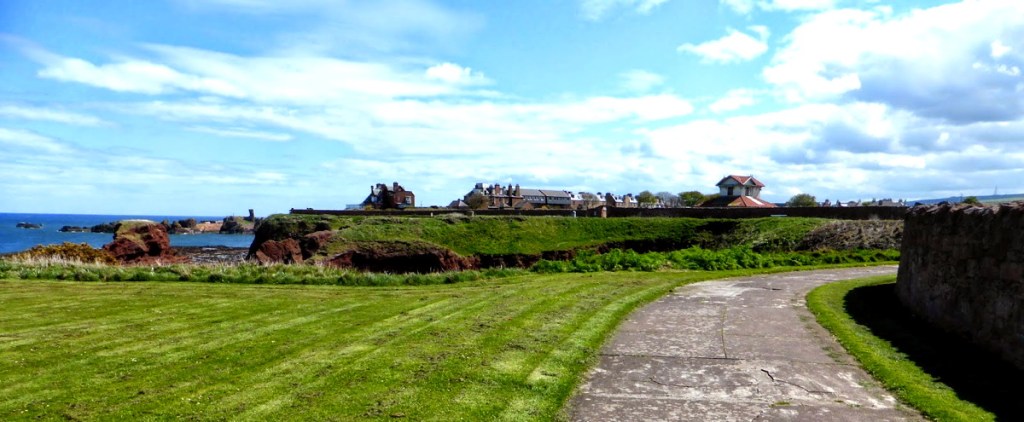
The second view towards the east and Dunbar Castle is different today. The clifftop path has since been tarmaced and they have made a great job of it. The pagoda in Winterfield Park was in a very poor state of repair and was demolished in 2019.

The inspiration for this Family History exercise is the plaque stating that the esplanade was gifted by Mrs James Baird, daughter of Rear Admiral Hay of Belton. Who was she? I initially believed that the information on the plaque was incorrect, but it turned out that I was mistaken.
When we first moved to Dunbar, Belton was a familiar name as the President of Dunbar Rugby club was Douglas Rennie, who farmed South Belton and Douglas Robertson who farmed North Belton was another prominent member.
The Belton lands lie to the west and slightly south of Dunbar. It seems that Belton was once a parish in its own right and there was also a Barony of Belton, which was owned by the Cunninghams until 1468, when Elizabeth Cunningham married Sir John Hay, 2nd Lord Hay of Yester. It was through this marriage that Belton passed to the Hays, and then eventually to the Rennies.
Belton Castle or House


Archaeology Notes by Canmore 64510 76620.
(NT 64510 76620) Belton House (NAT) OS 6″ map (NG)
‘The mansion (Belton) which is situated on the banks of Biel Burn, is an adaptation, effected in 1865, of an old fortified peel to modern requirements. The original structure, however, has had so much additional building incorporated with it as to be almost undistinguishable. Remains of it are traceble on the eastern and northern ends, where the wall as gauged by the arrowslits is six feet thick’. There is an indecipherable inscription on the west gable. In the Park a stone trough, firmly embedded in the foots of an old beech tree, is known as ‘Doo-well’, having been used by pigeons. In a space outside the lodge, where formerly two roads met stands an ash known as the ‘Birlie Tree’, under which the land owner is said to have convened the ‘Birlie Court’. In the east gable of the stables, a stone bearing a shield with the arms of the Hay family is inserted, which had been brought from old stables, that had been formed out of the kind of barn for the reception of rents and dues in kind. A very rudely cut human head has also been transferred from the one structure to the other. This last may have belonged to a chapel of a bypast age’.
J Hardy 1882.
Additions to Belton House have been made at various times, the last being in 1865. ‘The vaulted rooms and thick walls on the north, facing the stream, were evidently built some centuries ago.
The estate of Belton came into the possession of John, second Lord Hay of Yester, in 1468, by his marriage with Elizabeth, sole heiress of George, son of Sir William Cunningham, of Belton, from which time it remained in the Yester family until the year 1687, when a charter of the Barony of Belton was granted by John, second Marquess of Tweeddale, to his second son, Lord David Hay’.
J Small 1883.
The Manor and Castle of Beltoune is the place of enactment of a legal instrument dated 23rd May, 1513. The Place of Beltoun is mentioned in one dated 16th October 1528, the house of Beltoun in one dated – August 1529, the house and place of Beltoun 23rd March 1530-1, the castle and place – 23rd March 1530/1, and the Manor of Beltoun – 3rd and 4th November 1586.
C C Harvey 1930.
Belton House, now a roofless ruin, is generally as described by Hardy and Small. The basement of the NW side consists of three parallel barrel-vaulted chambers, the outer wall being 1.8m thick. These chambers appear to be the only traces of an older building now visible amid the debris. It is possible that the original tower was rectangular and measured c.16.0m by 8.0m.
Visited by OS (WDJ) 22 March 1966.
Belton Castle (Site of) From Stravaiging around Scotland.
“Belton Castle was probably built in the early 16th century, and was later incorporated into Belton House which was subsequently demolished in the 20th century.
“The lands at Belton were owned by the Cunningham family until 1468, when Elizabeth Cunningham married Sir John Hay, 2nd Lord Hay of Yester, and Belton passed to the Hays.
“Legal documents from the 16th century refer to the “Manor and Castle of Beltoune” (23rd May 1513), the “Place of Beltoun” (16th October 1528), the “house of Beltoun” (August 1529), the “house and place of Beltoun” and the “castle and place” (23rd March 1530 or 1531), and the “Manor of Beltoun” (3rd and 4th November 1586).
“This is where the suggestion of a 16th century date for Belton Castle probably comes from, although it’s possible that it replaced, or incorporated parts of, an earlier Cunningham castle.
“The castle was probably a tower house, measuring around 16.0m by 8.0m. At ground level were three parallel barrel-vaulted chambers from, with an outer wall 1.8m thick. Arrow slits in this wall might suggest an earlier origin than the 16th century.
“On the 9th of December 1687 a charter of the Barony of Belton was granted to Lord David Hay, the second son of John Hay, 2nd Marquess of Tweeddale, and so Belton Castle passed from the Hays of Yester to the Hays of Belton.
“In 1699 and again in 1710 Lord David Hay commissioned repairs, alterations and additions to Belton Castle. Later, in the 1820s and 1830s, more work seems to have been carried out, with proposals dated 1821 by James Gillespie Graham. In 1865 substantial additions were made by the architects Brown and Wardrop which left traces of the original tower hard to recognise.
“The basement on the north-west side of Belton House was made up of the three parallel barrel-vaulted chambers from the original tower, and the arrow slits were still visible in thick walls on the north and east sides.
“In 1954 the last of the male line of the Hays of Belton, Major James Hay of Belton, died. The house was bought by the Rennie family, but in 1956 the interior of Belton House was gutted and in the late 1950s the roof was removed in order to avoid paying rates on the property. By 1966 it was a roofless ruin in a dangerous condition, and Belton House was blown up on the 12th of March 1967 by the local Territorial Army.
“Nothing of the house or castle now remains visible, although a late 17th to early 18th century doocot and a 19th century lodge and gate piers still stand within the original grounds.“
The Hays of Belton

The article above states that: “On the 9th of December 1687 a charter of the Barony of Belton was granted to Lord David Hay, the second son of John Hay, 2nd Marquess of Tweeddale, and so Belton Castle passed from the Hays of Yester to the Hays of Belton.“
There is similar information on the Camore site which states: “The estate of Belton came into the possession of John, second Lord Hay of Yester, in 1468, by his marriage with Elizabeth, sole heiress of George, son of Sir William Cunningham, of Belton, from which time it remained in the Yester family until the year 1687, when a charter of the Barony of Belton was granted by John, second Marquess of Tweeddale, to his second son, Lord David Hay’.“
However, Lord David Hay was actually the third son. An elder brother Francis who was baptised on 16th December 1649 had died young making Lord David the second surviving son. Also, Lord David’s father was in reality John Hay 1st Marquis of Tweeddale, with John Hay, 2nd Marquis of Tweeddale being his eldest brother.

I researched the Hays of Belton from Lord David Hay onwards and seemed to find another discrepancy with the published tree, at least according to the Kirk Session records, but that story must wait for another day.

I initially believed that Mrs James Baird was not the daughter, but the daughter-in-law of Rear Admiral Hay, who changed his name to Baird-Hay when he married her.

However, it turns out that the last Hay Baron of Belton had an elder sister, Isabella Agnew Hay, who married James Baird of Auchmeddan and she was the Mrs Baird who gifted Winterfield Promenade to the public.
The Rennies of (South) Belton
In 1954 the last of the male line of the Hays of Belton, Major James Hay of Belton, died. South Belton farm and Belton House were purchased by Douglas Vernon Rennie.

Now, the only titles which can be bought and sold in the UK are Scottish feudal earldoms and baronies. So, when Douglas Rennie purchased the caput of the barony, it is quite possible that he ipso facto became the new Baron of Belton! It seems that many people in Scotland have purchased land in this way and are Scottish feudal Barons without even realising it.
Belton House itself, as noted above, met a sad end. It lay empty and eventually fell into disrepair. As with so many large houses which had become white elephants, the roof was removed so rates could no longer be charged on it. Then finally in 1967, it was blown up by the territorial army!
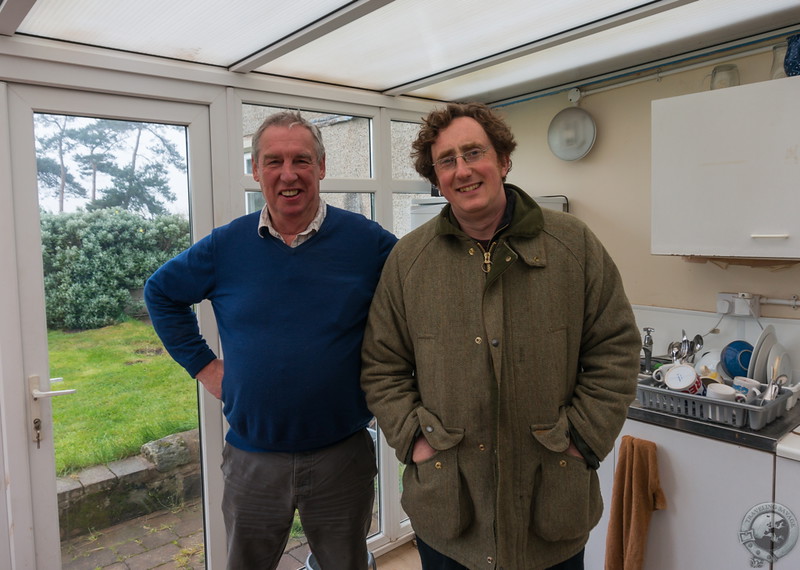
The last time we spoke to Douglas Rennie’s son, Ian, who could well be the current Baron of Belton, was when he was playing golf, just to the right of the first photo. So, right back to the starting point!
 Vecchio