
Storming of the Bastille, 14 July 1789.
The Storming of the Bastille (French: Prise de la Bastille [pʁiz də la bastij]) occurred in Paris, France, on the afternoon of 14 July 1789. The medieval armory, fortress, and political prison known as the Bastille represented royal authority in the centre of Paris. The prison contained only seven inmates at the time of its storming, but was seen by the revolutionaries as a symbol of the monarchy’s abuse of power; its fall was the flashpoint of the French Revolution.
In France, 14 July is the national holiday, usually called Bastille Day in English.
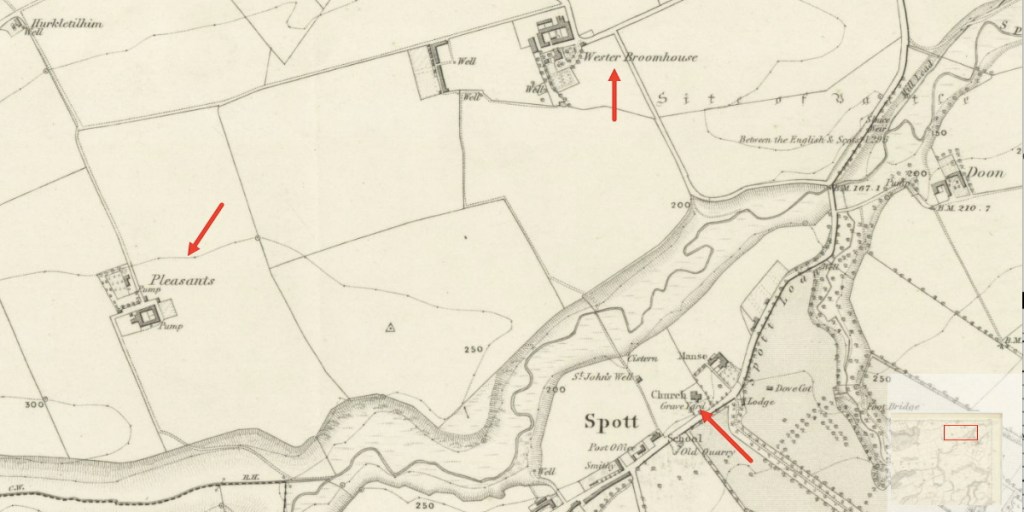
Spott Parish in East Lothian was part of France according to the LDS Church!
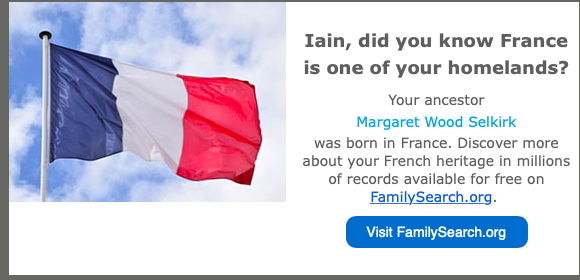
To celebrate the 232nd anniversary of the Storming of the Bastille, the LDS church’s Family Search very considerately informed me that my great (x2) grandmother Margaret Wood Selkirk, was born in France!
Birth of Margaret Selkirk in 1825
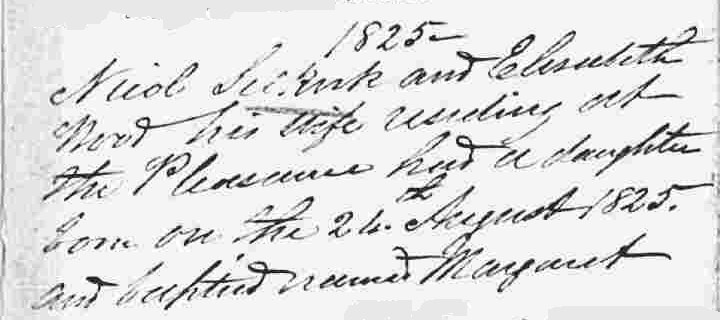
However, according to the Old Parish Register of Births and Baptisms for the parish of Spott in East Lothian, Margaret Selkirk was born at The Pleasance, right here in Scotland, not France.
At the start of Statutory Registration of Births, Marriages and Deaths in Scotland, families who who were not members of the Established Church of Scotland, known colloquially as The Kirk, were given a year’s grace to register any unrecorded children for free. After this period a charge would be made. The Selkirks took advantage of this and no less than six of their children appear together in the same page.
Baptism of Margaret Selkirk in 1823
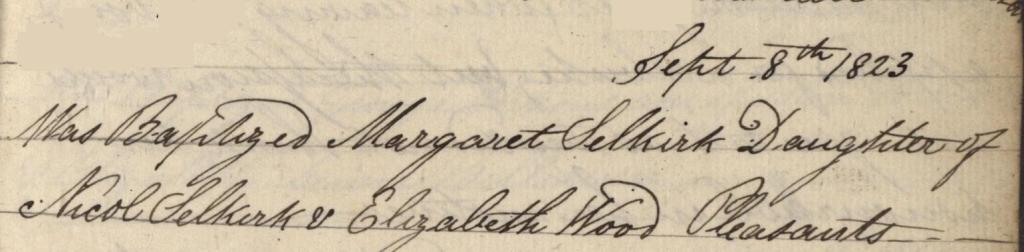
The Selkirks had been members of a dissenting church, the East Barns Congregational church and when their records became available, it became clear that the Selkirk’s memory had not been quite accurate and there were errors in the recorded dates of birth of their children.
In the case of Margaret Selkirk, she had indeed been born at The Pleasance – then known as Pleasants – but she had been baptised on 8th September 1823, suggesting that her date of birth was probably 24 August 1823, rather than 1825.
The Auld Alliance
While Margaret Wood Selkirk may not have been born in France as FamilySearch claim, ironically, she was a French citizen, probably without knowing it, as were all Scots born before 1904 under the terms of the Auld Alliance.
The Auld Alliance (Scots for “Old Alliance”; French: Vieille Alliance; Scottish Gaelic: An Seann-chaidreachas) was an alliance made in 1295 between the kingdoms of Scotland and France for the purpose of controlling England’s numerous invasions. The Scots word auld, meaning old, has become a partly affectionate term for the long-lasting association between the two countries. Although the alliance was never formally revoked, it is considered by some to have ended with the signing of the Treaty of Edinburgh in 1560.
The alliance played a significant role in the relations among Scotland, France and England during those 265 years. The alliance was renewed by all the French and Scottish monarchs of that period except Louis XI. By the late 14th century, the renewal occurred regardless of whether either kingdom was at war with England at the time.
The alliance began with the treaty signed by John Balliol and Philip IV of France in 1295 against Edward I of England. The terms of the treaty stipulated that if either country were attacked by England, the other country would invade English territory. The 1513 Battle of Flodden, where the Scots invaded England in response to the English campaign against France, was one such occasion. Thomas Randolph, Earl of Moray, negotiated the renewal of the alliance in 1326. The alliance played an important role in the Wars of Scottish Independence, the Hundred Years’ War, the War of the League of Cambrai and the War of Rough Wooing.
The Auld Alliance extended into the lives of the Scottish population in a number of ways, affecting architecture, law, the Scots language and cuisine, among other things. Scottish soldiers served within the French army; there were reciprocal dual nationality agreements. ( Kay, Billy (2006). The Scottish World. Mainstream Publishing. p. 80. ISBN 1-84596-021-1.)
France granted privileges to Scottish vintners and many Scots studied at French universities, something which continued up until the Napoleonic Wars. David de Moravia, Bishop of Moray, helped found the Scots College of the University of Paris and among those who studied or taught at French Universities were: the poets John Barbour and George Buchanan; the historian Hector Boece; the founder of St Andrews University, Henry Wardlaw; the founder of Aberdeen University, William Elphinstone; the founder of the Advocates Library, George Mackenzie, and the noted translator of Rabelais, Sir Thomas Urquhart. Scottish castles built with French construction in mind include Bothwell and Kildrummy.
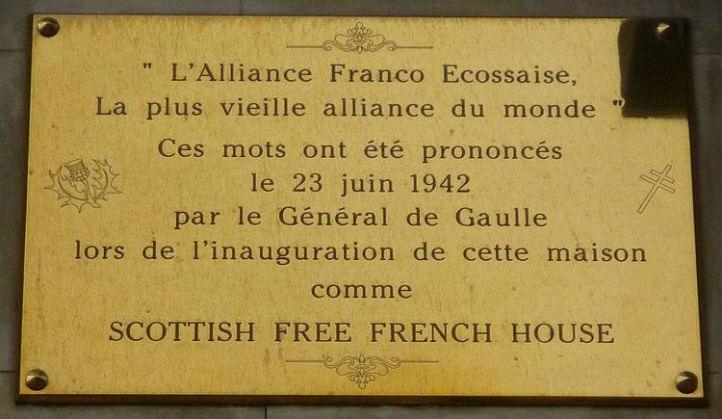
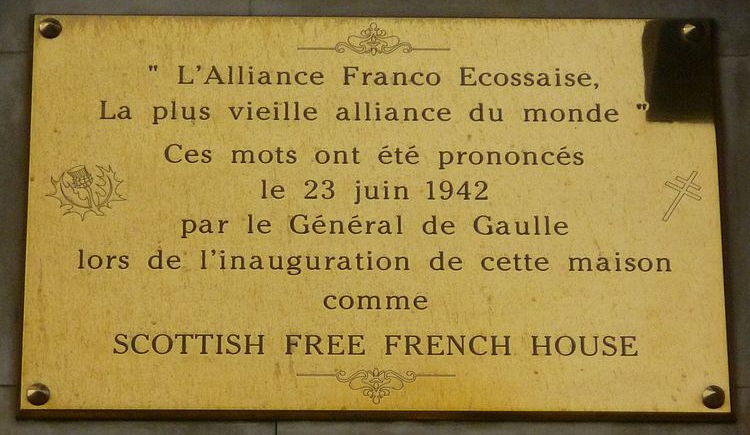
Plaque on the French Consulate, Regent Terrace, Edinburgh, 30 August 2011.
In 1942, Scotland had been a friend and ally of France for centuries and that year, on the 23rd June, while inaugurating the Scottish Free French House in Edinburgh, General de Gaule described the alliance between Scotland and France as “the oldest alliance in the world”
He added: “In every combat where for five centuries the destiny of France was at stake, there were always men of Scotland to fight side by side with men of France, and what Frenchmen feel is that no people has ever been more generous than yours with its friendship.”
The Auld Alliance is believe by some to have been formally ended by the Entente Cordiale of 8 April 1904, which meant that any Scot born after this date no longer had the right to dual Scottish and French Nationality.
In 1995, celebrations were held in both countries marking the 700th anniversary of the beginning of the alliance.
After extensive research, historian Dr Siobhan Talbott of Keele University concluded that the Auld Alliance had never been formally revoked and that it endured and thrived long after the Acts of Union in 1707 and the Entente Cordiale of 1906. (Talbott SM. 2012. ‘The Auld Alliance: Still in Vigour?’).
Conclusion
So, while Family Search may have been wrong in declaring that Margaret Wood Selkirk was born in France, in spirit they were maybe not too far from the mark as legally she was a French citizen, even if she may have been unaware of the fact herself.
“Vive La France!“
Roberto Alagna – La Marseillaise 14 July 2006.
La Marseillaise, Casablanca 1942.
“This scene is so important, especially to the cast and crew since most of them are European and especially French expatriates who escaped the Nazi advance! The woman who yells “Vive, la France!” Vive Lebeau was crying honest to God tears and impulsively cried out that line and it stayed in the film!”
 Vecchio