

James McAuslane Esquire (1855-1915)
James McAuslane was born in 1855 in Dunfermline, Fife, the son of the Rev. Dr James McAuslane, DD, and his wife Margaret Smith.
He had two brothers and a sister:
- Peter McAuslane, born 1856 in Dunfermline, Fife.
- Alexander McAuslane, born in 1858 in Dunfermline Fife
- Julia Christina McAuslane, born in Dunfermline Fife.
In 1879, in London he married Victoria Albertina, who appears to have been named after Queen Victoria and Prince Albert. She had been born in Patras in Greece, but was a British Subject due to her parentage. The couple went on to have five children:
- Margaret E. McAuslane, born 1881 in South Hornsey, Middlesex, England.
- Gladys McAuslane, born 1884 in Battersea, Middlesex, England.
- Edith J. McAuslane, born 1885 in Battersea, Middlesex, England.
- James S. C. McAusland, born 1887 in Battersea, Middlesex, England.
- Alesta McAuslane, born 1893 in Bexley, Kent, England.
At the census of 05 April 1891, the family was living at “Glen Rose”, Ballham Park Road, Battersea and James McAuslane was working as an “Australian Merchant”.
At the census of 31 March 1901, the family was living at 1 Darnley Road in Kensington, and he was working as a Granite Quarry owner & financier (Employer).
At the census of 02 April 1911, he and his wife were boarders at 10 Cornwall Road in Harrogate and he was employed as the Secretary of the Primrose League (see below).
James McAuslane died in the last quarter of 1915 at Saint George’s Hannover Square. He was aged 61.
The Primrose League (1883- 2004)
At the 1911 census, James McAuslane’s occupation was Secretary of the Primrose League. By 1910, the membership was 2,053,019, however, by 1912 the League’s membership had fallen to just over 650,000 as other leagues emerged, such as the Tariff Reform League and the Budget Protest League. In 2004, after 121 years, the Primrose League was finally wound up.

The 1911 Encyclopædia Britannica, Volume 22 contained an entry entitled
Primrose League, The by Henry Drummond Wolff which read:
PRIMROSE LEAGUE, THE, an organization for spreading Conservative principles amongst the British democracy. The primrose is associated with the name of Lord Beaconsfield(q.v.), is being preferred by him to other flowers. On a card aflixed to the wreath of primroses sent by Queen Victoria to be placed upon his coffin was written in Her Majesty’s own handwriting: “His favourite flowers: from Osborne: a tribute of affectionate regard from Queen Victoria.” On the day of the unveiling of Lord Beaconsf1eld’s statue all the members of the Conservative party in the House of Commons were decorated with the primrose. A small group had for some time discussed the means for obtaining for Conservative principles the support of the people. Sir H. D. Wolff therefore said to Lord Randolph Churchill, “Let us found a primrose league.” The idea was accepted by several gentlemen in the habit of working together, and a meeting was held at the Carlton Club shortly afterwards, consisting Lord Randolph Churchill, Sir H. Drummond Wolff, Mr (afterwards Sir John) Gorst, Mr Percy Mitford, Colonel Fred Burnaby and some others, to whom were subsequently added Mr Satchell Hopkins, Mr J. B. Stone, Mr Rowlands and some Birmingham supporters of Colonel Fred Burnaby, who also wished to return Lord Randolph Churchill as a Conservative member for that city. These gentlemen were of great service in remodelling the original statutes first drawn up by Sir H. Drummond Wolff. The latter had for some years perceived the influence exercised in benefit societies by badges and titular appellations, and he further endeavoured to devise some quaint phraseology which would be attractive to the working classes. The title of Knight Harbinger was taken from an office no longer existing in the Royal Household, and a regular gradation was instituted for the honorific titles and decorations assigned to members. This idea, though at first ridiculed, has been greatly developed since the foundation of the order; and new distinctions and decorations have been founded, also contributing to the attractions of the league. The League was partially copied from the organization of the Orange Society in Ireland. In lieu of calling the different subsidiary associations by the ordinary term “Lodges,” the name was given of “Habitations,” which could be constituted with thirteen members. These were intended as a substitute for the paid canvassers, about to be abolished by Mr Gladstone’s Reform Bill. The principles of the League are best explained in the declaration which every member is asked to sign: “I declare on my honour and faith that I will devote my best ability to the maintenance of religion, of the estates of the realm, and of the imperial ascendancy of the British Empire; and that, consistently with my allegiance to the sovereign of these realms, I will promote with discretion and fidelity the above objects, being those of the Primrose League.” The motto was “Imperium et libertas ”; the seal, three primroses; and the badge, a monogram containing the letters PL, surrounded by primroses. Many other badges and various articles of jewellery have since been designed, with this flower as an emblem.
A small office was first taken on a second floor in Essex Street, Strand; but this had soon to be abandoned, as the dimensions of the League rapidly increased. Ladies were generally included in the first organization of the League, but subsequently a separate Ladies’ Branch and Grand Council were formed. The founder of the Ladies’ Grand Council was Lady Borthwick (afterwards Lady Glenesk), and the first meeting of the committee took. place at her house in Piccadilly on the 2nd of March 1885. The ladies who formed the first committee were: Lady Borthwick, the dowager-duchess of Marlborough (first lady president), Lady Wimborne, Lady Randolph Churchill, Lady Charles Beresford, the dowager-marchioness of Waterford, Julia marchioness of Tweeddale, Julia Countess of Jersey, Mrs (subsequently Lady) Hardman, Lady Dorothy Nevill, the Honourable Lady Campbell (later Lady Blythswood), the Honourable Mrs Armitage, Mrs Bischoffsheim, Miss Meresia Nevill (the first secretary of the Ladies’ Council).
When the League had become a success, it was joined by Lord Salisbury and Sir Stafford Northcote, who were elected Grand Masters. Its numbers gradually increased to a marvellous extent, as may be seen by the following figures:—
| Year. | Knights. | Dames. | Associates. | Total. | Habitations. |
| 1884 | 747 | 153 | 57 | 957 | 46 |
| 1885 | 8071 | 1381 | 1914 | 11,366 | 169 |
| 1886 | 32,645 | 23,381 | 181,257 | 237,283 | 1200 |
| 1887 | 50,258 | 39,215 | 476,333 | 565,561 | 1724 |
| 1888 | 54,580 | 42,791 | 575,235 | 672,606 | 1877 |
| 1889 | 58,180 | 46,216 | 705,832 | 810,228 | 1986 |
| 1890 | 60,795 | 48,796 | 801,261 | 910,852 | 2081 |
| 1891 | 63,251 | 50,973 | 887,068 | 1,001,292 | 2143 |
| 1901 | 75,260 | 64,905 | 1,415,473 | 1,556,639 | 2392 |
| 1910 | 87,235 | 80,038 | 1,835,746 | 2,053,019 | 2645 |
See an article in the Albemarle of January 1892, written by Miss Meresia Nevill; and the Primrose League Manual, published at the offices at Westminster. The latter publication is interesting as a history of the organization.
Grant of Arms to James McAuslane, Esquire
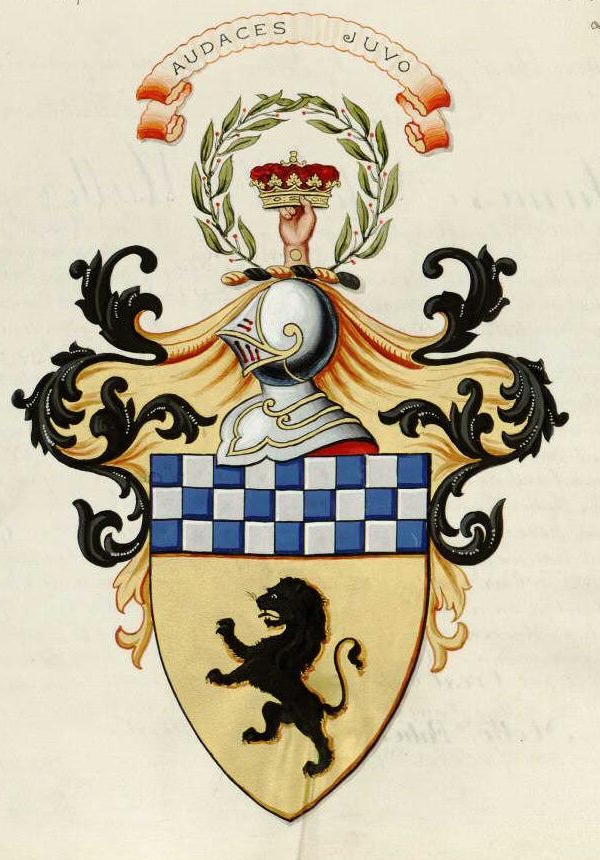
The arms were matriculated of the twenty sixth day of October 1861, following a petition to the Lord Lyon King of Arms by James McAuslane, Esquire on the 30th September 1891, while living at Wandsworth Common. James McAuslane, Esquire stated that he was:
“the son of the Reverend Alexander McAuslane, Doctor of Divinity of Washington and Lee University, United States of America and of Margaret Smith, his wife;
“that the said Alexander McAuslane was the son of Peter McAuslane of Prestalloch in Glendouglas in the county of Dumbarton (who during his lifetime added the terminal e to to name) and Mary MacCallum his wife;
“that the said Peter McAuslane was by family tradition said to be the son of Peter McAuslan, who was the son of Humphrey McAuslan, who was the son of Alexander McAuslan, all of Prestalloch, aforesaid;
“and that the said Mary MacCallum, wife of the first mentioned Peter, was also said by family tradition to have been the daughter of Malcom MacCallum and Mary MacColl his wife, daughter of John MacColl and Isabella Stewart, daughter of Alexander Stewart, fourth laird of Ballachulush.”

The “family tradition” cited in the grant of arms confirms the tree of the McAuslands of Prestalloch that was previously researched. However, of the three brothers mentioned in Donald MacLeod’s 1891 book, it seems that it was Humphrey rather than Peter who was at Prestalloch. It would also seem that Humphrey’s father (and by implication that of the other two brothers) was named Alexander.
Also confirmed was the entry in Donald MacLeod’s 1891 book where it was stated that James’ father was the great granddaughter of “a daughter of Stuart of Ballachulish“. In addition, the document confirms the previous research which suggested that she was likely to be Isabella, daughter of Alexander Stewart, fourth of Ballachulish.
Descent from the Royal House of Stewart
Isabella Stewart of Ballachulish was descended several times from the Stewart Kings.
The Stewarts of Ballachulish were a cadet line of the Stewarts of Invernahyle, who were a cadet line of the Stewarts of Appin.
The paternal line of Dugald Stewart, 1st of Appin can be traced via the Stewart Lords of Lorn and Stwarts of Innermeath to Sir John Stewart of Bonkyl, who was killed at the Battle of Falkirk in 129. Sir John was the son of Alexander Stewart, fourth High Steward of Scotland.
The paternal grandmother of Dugald Stewart, 1st of Appin was Lady Joan Stewart, daughter or Robert Stewart, 1st Duke of Albany, who was the son of King Robert II of Scots.
There are several lines of descent from the Stewart kings with the shortest line of ancestry shown below.


Acknowledgements
The McAusland family is grateful to:
The Stewarts of Balquhidder Research Group for their help in tracing the various Stewart lines.
Family historian Eve Pryde-Roberts, author of A Pride of Prydes, for her assistance with the 1911 census records.
 Vecchio