
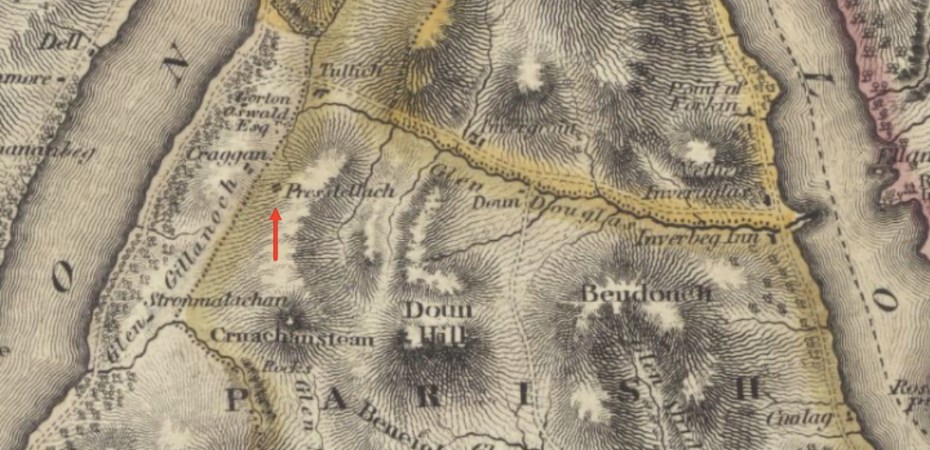
The McAusland Barons held the lands of of Caldenoch, Prestilloch, Innerquhonlanes and Craigfad which were mentioned in a Sasine on 20 May 1664 of land valued at £80 that was granted to Alexander McCauslane, the eldest son of the late John McCauslane on a precept of clare constat by Sir John Colquhoun of Luss. One of the of the witnesses to this was a Duncan McFarlane, son of Robert McFarlane in Prestelloch (Argyll Sasines).
Caldenoch or Cùlanach
Caldenoch, like many ancient settlements, has gone by many spelling variants. Cùlanach is the spelling used on modern Ordnance Survey maps. It may translate as “place of hazels”. Caldenoch was the ancient seat of the McAusland Barons. Anyone interested in learning more about the McAuslane Barons and the lands they once held in the district is referred to North Clyde Archaelogical Society’s essay on “Culanach”, which goes into more detail. All surviving charters show that the McAusland Barons held their lands from the Colquhouns of Luss, and that they had lost possession by the latter part of the 17th century. Thereafter, the lands were held directly by the Colquhouns of Luss.
Innerquhonlanes or Conglens
Innerquhonlanes has been tentatively identified by some with the McAusland farmstead of Innerlauren or Innerlarin near Glen Fruin and Loch Lomond. However, Alistair McIntyre and Tam Ward note that Innerquhonlanes is the scribe’s rendering of “at the confluence of Conglens”…. The settlement of Conglens took its name from the Conaglen, a side-glen of Glen Douglas.
Craigfad
According to Alistair McIntyre and Tam Ward: Craigfad lay about a mile south of Conglens, on the same side of the Douglas Water.
Prestelloch or Preas Seilich
The lands of Prestelloch and the McAuslands who lived there are the subject of the current study.
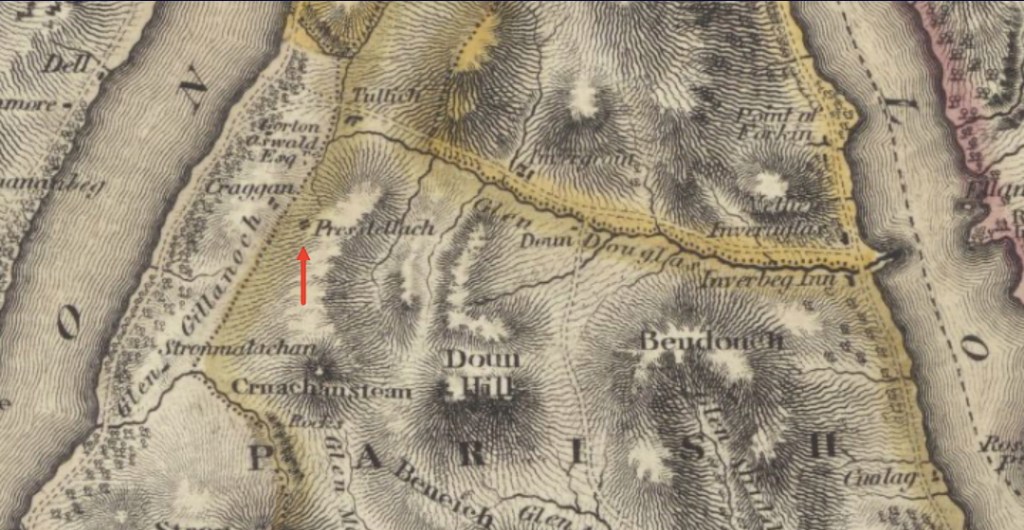
The North Clyde Archaelogical Society have published an excellent history of Prestelloch as part of their series on The history and survey of several settlement sites in Argyll by Alistair McIntyre (History) and Tam Ward (Archaeology) and of this informative text is worth quoting here:
“The lands of Preas Seilich have long formed part of Luss Parish, but this was not always the case. Writing in 1793, the Rev. John Stuart, author of the account for Luss parish in the Old Statistical Account of Scotland, notes various changes that had been made to the boundaries of Luss parish through the course of the 17th century. All bar one of these changes resulted in a reduction in size of the parish, which once stretched on the west side of Loch Lomond from one end to the other, and also included some lands on the east side of the loch. The exception was the addition of the lands of Caldonach, Prestelloch and Conglens, which had previously formed part of the lands of Inchcallioch parish.
“This discourse might come over as relatively arcane, but one interesting aspect of these additions to the parish of Luss is that they correspond to the core territory of lands once held by the McAuslane “Barons”. Here, it should be noted that the term “Baron” in Gaelic parlance is much less prestigious than its Anglo-Norman counterpart but equates rather to the owner of a relatively small estate. Despite this, there are a number of stories, long current in the area, relating to their power and prestige. For example, local historian Joseph Irving, in his magisterial “Book of Dumbartonshire” (1879), quotes the legend about how Luss got its name from the fleur-de-luce plants strewn on the grave of Baroness McAuslan, whose husband had distinguished himself at the siege of Tournay.
“Just possibly, there may be significance in the fact that the core territory that they held, including the lands of Prestelloch, had once formed part of Inchcallioch parish. This parish centred on several of the islands on Loch Lomond, and lands lying on the east side of the loch. These once formed the homelands of the Clan Buchanan, of whom the McAuslanes are a sept. Note too that the name of Inchcallioch parish changed to that of Buchanan, which is actually a place-name, as well as the clan name.
“Be it as it may, anyone interested in learning more about the McAuslane barons and the lands they once held in the district is referred to a companion study to this essay, namely the one entitled
“Culanach”, which goes into more detail. Suffice it to add that virtually all surviving charters show that they held their lands from the Colquhouns of Luss, and that they had lost possession by the latter part of the 17th century. Thereafter, the lands were held directly by the Colquhouns of Luss.”
STORY OF PREAS SEILICH (= PRESTELLOCH). Pl 13. INTRODUCTION
“Preas Seilich, commonly rendered in documentary sources as Prestelloch, or variants, is an abandoned settlement located on the north-western flanks of the hill marked on maps as Cruach an t-sithean (Fairy Hill). It lies close to the northern extremity of Glen Mallan, which is named on O.S. Maps as Glen Culanach, though that name has long been locally extinct. The name Preas Seilich translates from the Gaelic simply as “willow-clump” (or bush). To- day, the most dominant feature of the site, which now lies within the secure compound of RNAD Glen Douglas, takes the form of a substantial stone-built sheep fank, which would have used at gatherings for clipping, dipping and other operations. It is possible that traces of former habitations survive on the site, but it may be that any stonework has been incorporated into the fank, which likely post-dates the settlement- only archaeological examination could determine whether this is so, or otherwise.
“The lands of Preas Seilich have long formed part of Luss Parish, but this was not always the case. Writing in 1793, the Rev. John Stuart, author of the account for Luss parish in the Old Statistical Account of Scotland, notes various changes that had been made to the boundaries of Luss parish through the course of the 17th century. All bar one of these changes resulted in a reduction in size of the parish, which once stretched on the west side of Loch Lomond from one end to the other, and also included some lands on the east side of the loch. The exception was the addition of the lands of Caldonach, Prestelloch and Conglens, which had previously formed part of the lands of Inchcallioch parish.“
“This discourse might come over as relatively arcane, but one interesting aspect of these additions to the parish of Luss is that they correspond to the core territory of lands once held by the McAuslane “Barons”. Here, it should be noted that the term “Baron” in Gaelic parlance is much less prestigious than its Anglo-Norman counterpart but equates rather to the owner of a relatively small estate. Despite this, there are a number of stories, long current in the area, relating to their power and prestige. For example, local historian Joseph Irving, in his magisterial “Book of Dumbartonshire” (1879), quotes the legend about how Luss got its name from the fleur-de-luce plants strewn on the grave of Baroness McAuslan, whose husband had distinguished himself at the siege of Tournay.”
“Just possibly, there may be significance in the fact that the core territory that they held, including the lands of Prestelloch, had once formed part of Inchcallioch parish. This parish centred on several of the islands on Loch Lomond, and lands lying on the east side of the loch. These once formed the homelands of the Clan Buchanan, of whom the McAuslanes are a sept. Note too that the name of Inchcallioch parish changed to that of Buchanan, which is actually a place-name, as well as the clan name.
TIMELINE FOR PREAS SEILICH
1664 Sasine of the £8 land of Prestelloch, Caldenoch, Innerquhonlanes and Craigfad granted to Alexander McCauslane, eldest son of the late John McCauslane on a precept of clare constat by Sir John Colquhoun of Luss….one of the witnesses was Duncan McFarlane, son of Robert McFarlane in Prestelloch (Argyll Sasines).
(Note: Innerquhonlanes is the scribe’s rendering of “at the confluence of Conglens”-see mention of this place-name above. The settlement of Conglens took its name from the Conaglen, a side-glen of Glen Douglas. Craigfad lay about a mile south of Conglens, on the same side of the Douglas Water).
1678 Reference to a John McCauslane in Prestelloch. (Argyll Sasines).

1694 Hearth Tax shows that John McCauslan in Prestilach and his son have 2 hearths (Hearth Tax).
It is interesting that this record appears immediately below the entry for Alexander McAusland of Caldenoch, i.e. the last Baron MacAusland, and directly above a second entry for Caldenoch.
1700 John McAuslan and……have a child named …?.. (entry difficult to read)
(Luss Old Parish Registers 1698-1854- all succeeding births/notices to marry come from the same source, unless otherwise indicated).
1790 George McLellan and Janet McAusland have a daughter, Christian.
1792 George McLellan and Janet McAusland have a son, Duncan.
1794 George McLellan and Janet McAusland have a son Donald.
1797 George McLellan and Janet McAusland have a son George.
1798 George McLellan and Janet McAusland have a son Archibald.
(Note that this couple had three earlier children at Wester Inverlaren – Helen in 1785, John in 1787 and Humphry in 1788 – before they moved to Prestilach)
1831 Headstone at Luss churchyard marks the burial place of George McLellan, farmer, Prestelloch, that of his wife, Janet McAuslan, along with six of their children. This stone carries information about the family which can be tied into a number of the births recorded in the Old Parish Registers. George had been pre-deceased by wife Janet, who had passed away in 1825, aged 67. George himself had died in 1831, aged 82. Of their children, several only have their ages recorded on the headstone: Christian had died aged 30, which means she died c. 1820; George had died aged 27, meaning he died c. 1824; Archibald had died aged 26, meaning his death was c. 1824; Robert had died aged 24, but his birth does not seem to have been noted in the OPR’s. (No son listed named Robert). Two of the children do have their ages (actually years of death) given on the headstone: Duncan’s age is given as 1852, meaning he would have been c. 60 at the time of his death, and likewise Donald, who reached 59 years, must have passed away aged c. 59.
This computation was motivated by the thought that with so many family members being carried off while still young, they had perhaps been visited by one terrible episode of disease or misfortune. However, the exercise does seem to point instead to deaths over a period. This was of course a time when people often failed to enjoy long lives -living conditions generally must have been tough for many, and proper medical care would have been hard to come by.
There is however one mystery. Son George mentioned in the timeline was only born in 1797, yet the 1799 precept of warning above refers to George junior in Drumfad, the most obvious interpretation being that he was the son of George, senior, farmer at Prestelloch. Perhaps, though, that was not the case, although he was presumably a relation. Other possible scenarios may spring to mind, but they must necessarily be of a speculative nature.
 Vecchio