

4 July 2021: Hemingway on BBC4
BBC Four transmitted the first episode of Hemingway:
“An intimate portrait of Ernest Hemingway, considered one of the greatest American writers. The documentary examines Hemingway’s enduring influence on literature and culture and also penetrates the myths surrounding him to reveal a deeply troubled, controversial and ultimately tragic figure. The story begins with his childhood in Illinois, his time with the Red Cross during the First World War, his marriage and his move to Paris, where he started work as a writer.“
That reminded me of our own Guthrie connections to the author.
13 October 2013: Zelda et Scott
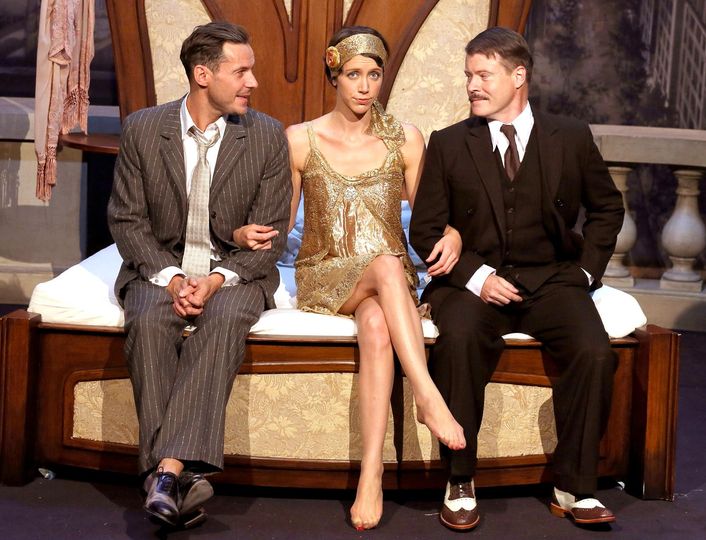
On 13 October 2013, a friend and I had front row seats for the play Zelda et Scott at Théâtre La Bruyère in Paris with Jean-Paul Bordes as F. Scott Fitzgerald, Sara Giraudeau as Zelda Sayre, and Julien Boisselier as Ernest Hemingway, who Zelda disliked intensely. It was quite a wild show and being in the front row, at times we felt we were almost part of the action.
I had never read anything by Fitzgerald or Hemingway, and my reason for going was Sarah Girardeau. It was the second time we had seen her on stage, having loved her performance in La Valse des pingouins by the highly talented actor and writer Patrick Haudecœur at the Théâtre des Nouveautés.

Sara Girardeau is the daughter of Anny Duperey and Bernard Giraudeau. Ann Duperey is one of France’s best-loved actresses, having stared in the massively popular TV family comedy Une famille formidable since 1992. In 2006, she was alone on stage playing all the parts in an adaption of Oscar and the Lady in Pink (Oscar et la dame rose) (2002), a novel written by Éric-Emmanuel Schmitt. I was privileged to have the chance meet Anny Duperey after the show and when I mentioned – in French – that it must be incredibly difficult to play so many different rôles she beamed and her “Ah! Oui!” was so incredibly eloquent!
29th March 2017: The Lost Generation
Move forward three and a half years to 29th March 2017. I had never seen a photo of my great-great grandfather’s cousin, Patrick Stirling Guthrie (04 August 1895 -24 May 1932), and knew very little about him, let alone that he was a friend of Ernest Hemingway!
But there they were sitting together at a cafe in Spain in 1925.

The individuals depicted include Hemingway, Harold Loeb, Lady Duff Twysden; and Hadley Richardson, Ogden Stewart and Pat Guthrie. Original caption is “Ernest Hemingway with Lady Duff Twysden, Hadley Hemingway, Lonnie Schutte and three unidentified people at a cafe in Pamplona, Spain, during the Fiesta of San Fermin in July 1925.” Photo credit: John F. Kennedy Library, Ernest Hemingway Collection,
“And finally, on the far right is Patrick Stirling Guthrie, the one and only utterly lost person in the group. Hemingway immortalized him as “Mike Campbell” in The Sun Also Rises, and depicts some of Patrick’s real-life characteristics. Mike is an undischarged bankrupt. So was Pat. Mike receives an allowance from his family. Pat was indeed a remittance man. His bankruptcy papers list him as having “No occupation.” Mike drinks heavily. That squares with the record. Hemingway calls him “Scotch.” Well, his family was Scottish, although he was born in London and seems to have spent most of his life in England. He was engaged to marry Duff. Hm, unclear. Others believe he was gay and he may just have been a convenient escort. He was a distant relative (fourth cousin) of Duff’s and it seems that they were emotionally close, but the real nature of their relationship is lost to history.”
A lost member of the not-so-lost generation by Parisian Fields.
And who were the others? Parisian Fields could tell us:
“First on the left is Hemingway himself, looking smug and far from lost.
“Next, in the background, with glasses and bow tie, sits an unsmiling Harold Loeb. He later wrote his own account of that trip to Spain. He seems to have risen above Hemingway’s unkind depiction of him in the character of Robert Cohn, who falls for the femme fatale, but is later ejected from the group. Loeb eventually became a successful writer and his only loss was that of the woman he had fallen for. But in the end, he was probably better off without her.
“The femme fatale in question sits beside Hemingway. Lady Duff Twysden looks like a cat who has just polished off a tasty canary. She appears in the book as Lady Brett Ashley, sleek as a Bugatti, breaking hearts wherever she went, accustomed to having men pick up the tab for her. When she left Pamplona in 1925, her friends paid her hotel bill. As usual. Duff was not her real name. She was born Mary Smurthwaite. Early on she realized it wouldn’t do for a femme fatale, so she changed it.
“In 1925, she was in the process of divorcing her second husband, Sir Roger Twysden. They had a seven-year-old son back in England, but she doesn’t seem to have considered him in her plans. Supposedly she was engaged to the man on the far right. But a few years after the photograph was taken, she met an American artist and moved to the United States with him instead.
“Hemingway depicts her as a beautiful but aimless airhead, dependent on the narrator’s strong-shouldered support, but there was much more to her in real life. She had her flaws, but she wasn’t an airhead, and I wouldn’t call her lost.
“Hadley Hemingway, Ernest’s (then) wife, beams in the middle of the photograph. The book was dedicated to her, but she was written out of the narrative – that way, the narrator could openly express his attraction for Duff Twsden / Brett Ashley and still appear to be a swell guy. Hadley was certainly lost to literature in this book. She eventually parted from Ernest (in hindsight, a wise move) and married a well-respected journalist. She may have felt lost at the time, watching her husband dancing attendance on Duff, but she found herself in the end.
“Only just visible beside Hadley is Donald Ogden Stewart, who went on to have a successful career as a screenwriter, and is probably best remembered for The Philadelphia Story. He appears in the book as the narrator’s buddy Bill, an affable fellow with no heartaches and no apparent inner life. He wasn’t lost.“
So what happened to Pat? Parisian Fields continues:
“In 1927, two years after the trip to Spain and a year after the publication of his first novel, Hemingway noted in a letter to F. Scott Fitzgerald that Duff and Pat had parted company. Pat was rescued to some extent by an older American freelance journalist, Lorna Lindsley, who seems to have paid his debts and kept him out of trouble, at least for a while. But he died in 1932, aged 37, either by suicide or from a drug overdose; nobody is sure. And nobody seems to have cared, except his mother, who came to Paris to settle his affairs and pay off his debts. (Apparently his mother was something of a character. When Patrick’s father died in 1911, she remarried, but later divorced, and ended her days living in Torosay Castle in Scotland with a Pekinese and a foul-mouthed parrot.)
“All the other characters have made some kind of mark on literary history, and been written up in various ways, from academic treatises to Wikipedia. Not Pat. He disappeared into oblivion, other than a short memoir about him by a barman who served him at the famous Dingo Bar on the rue Delambre. And most of that document is about Duff. (James Charters, “Pat and Duff: Some Memories,” in Hemingway and the Sun Set, NCR/Microcard Editions, 1972, pp. 241–246.)
“I found a few traces of Patrick in official records. His father was a merchant banker and MP who died in 1911 and his mother was the daughter of an Irish baronet; they were part of high-society London and owned an enormous house in London and a castle on the Isle of Mull. Pat was educated at Eton, Cambridge, and Sandhurst, served in the First World War in the First Life Guards, a cavalry regiment, and became a lieutenant in 1915, when he was 20. The regiment served at Mons, Ypres, and Passchendaele and presumably Pat was there, too. If so, he must have had some appalling experiences. But in those days one didn’t talk about such things. He just drank a lot.
“In a generation of hardy survivors, good-time girls, and emerging writers, most of whom found themselves in Paris, Pat was truly lost, poor fellow.“
The Sun Also Rises (1926 book)

The Sun Also Rises is a 1926 novel by American writer Ernest Hemingway, his first, that portrays American and British expatriates who travel from Paris to the Festival of San Fermín in Pamplona to watch the running of the bulls and the bullfights. An early and enduring modernist novel, it received mixed reviews upon publication. However, Hemingway biographer Jeffrey Meyers writes that it is now “recognized as Hemingway’s greatest work“, and Hemingway scholar Linda Wagner-Martin calls it his most important novel. The novel was published in the United States in October 1926 by Scribner’s. A year later, Jonathan Cape published the novel in London under the title Fiesta. It remains in print.
The novel is a roman à clef: the characters are based on real people in Hemingway’s circle, and the action is based on real events, particularly Hemingway’s life in Paris in the 1920s and a trip to Spain in 1925 for the Pamplona festival and fishing in the Pyrenees. Hemingway presents his notion that the “Lost Generation“—considered to have been decadent, dissolute, and irretrievably damaged by World War I—was in fact resilient and strong. Hemingway investigates the themes of love and death, the revivifying power of nature, and the concept of masculinity. His spare writing style, combined with his restrained use of description to convey characterizations and action, demonstrates his “Iceberg Theory” of writing.
Background
In the 1920s Hemingway lived in Paris as a foreign correspondent for the Toronto Star, and traveled to Smyrna to report on the Greco–Turkish War. He wanted to use his journalism experience to write fiction, believing that a story could be based on real events when a writer distilled his own experiences in such a way that, according to biographer Jeffrey Meyers, “what he made up was truer than what he remembered“.
With his wife Hadley Richardson, Hemingway first visited the Festival of San Fermín in Pamplona in 1923, where he was following his recent passion for bullfighting. The couple returned to Pamplona in 1924—enjoying the trip immensely—this time accompanied by Chink Dorman-Smith, John Dos Passos, and Donald Ogden Stewart and his wife. The two returned a third time in June 1925 and stayed at the hotel of his friend Juanito Quintana. That year, they brought with them a different group of American and British expatriates: Hemingway’s Michigan boyhood friend Bill Smith, Stewart, recently divorced Duff, Lady Twysden, her lover Pat Guthrie, and Harold Loeb. In Pamplona, the group quickly disintegrated. Hemingway, attracted to Duff, was jealous of Loeb, who had recently been on a romantic getaway with her; by the end of the week the two men had a public fistfight. Against this background was the influence of the young matador from Ronda, Cayetano Ordóñez, whose brilliance in the bullring affected the spectators. Ordóñez honored Hemingway’s wife by presenting her, from the bullring, with the ear of a bull he killed. Outside of Pamplona, the fishing trip to the Irati River (near Burguete in Navarre) was marred by polluted water.
Hemingway had intended to write a nonfiction book about bullfighting, but then decided that the week’s experiences had presented him with enough material for a novel. A few days after the fiesta ended, on his birthday (21 July), he began writing what would eventually become The Sun Also Rises. By 17 August, with 14 chapters written and a working title of Fiesta chosen, Hemingway returned to Paris. He finished the draft on 21 September 1925, writing a foreword the following weekend and changing the title to The Lost Generation.
A few months later, in December 1925, Hemingway and his wife spent the winter in Schruns, Austria, where he began revising the manuscript extensively. Pauline Pfeiffer joined them in January, and—against Hadley’s advice—urged him to sign a contract with Scribner’s. Hemingway left Austria for a quick trip to New York to meet with the publishers, and on his return, during a stop in Paris, began an affair with Pauline. He returned to Schruns to finish the revisions in March. In June, he was in Pamplona with both Richardson and Pfeiffer. On their return to Paris, Richardson asked for a separation, and left for the south of France. In August, alone in Paris, Hemingway completed the proofs, dedicating the novel to his wife and son.After the publication of the book in October, Hadley asked for a divorce; Hemingway subsequently gave her the book’s royalties.
The Sun Also Rises (1956 film)

Mike Campbell was based on my first cousin four times removed Patrick Stirling Guthrie.
The Sun Also Rises is a 1957 film adaptation of the 1926 Ernest Hemingway novel of the same name directed by Henry King. The screenplay was written by Peter Viertel and it starred Tyrone Power, Ava Gardner, Mel Ferrer, and Errol Flynn (playing the Pat Guthrie-inspired rôle of Mike Campbell. Much of it was filmed on location in France and Spain in Cinemascope and color by Deluxe. A highlight of the film is the famous “running of the bulls” in Pamplona, Spain and two bullfights.
Ernest Hemingway saw the film but walked out after 25 minutes stating:
I saw as much of Darryl Zanuck’s splashy Cook’s tour of Europe’s lost generation bistros, bullfights, and more bistros… It’s pretty disappointing and that’s being gracious. Most of my story was set in Pamplona so they shot the film in Mexico. You’re meant to be in Spain and all you see walking around are nothing but Mexicans… It looked pretty silly. The bulls were mighty small for a start, and it looked like they had big horns on them for the day. I guess the best thing about the film was Errol Flynn.
Ernest Hemingway
Patrick Stirling Guthrie’s Parents


Patrick Stirling Guthrie’s parents, Walter Murray Guthrie, MP and Olive Louisa Blanche Leslie, will be covered in a later article.
Epilogue: The Sun Continues To Rise!
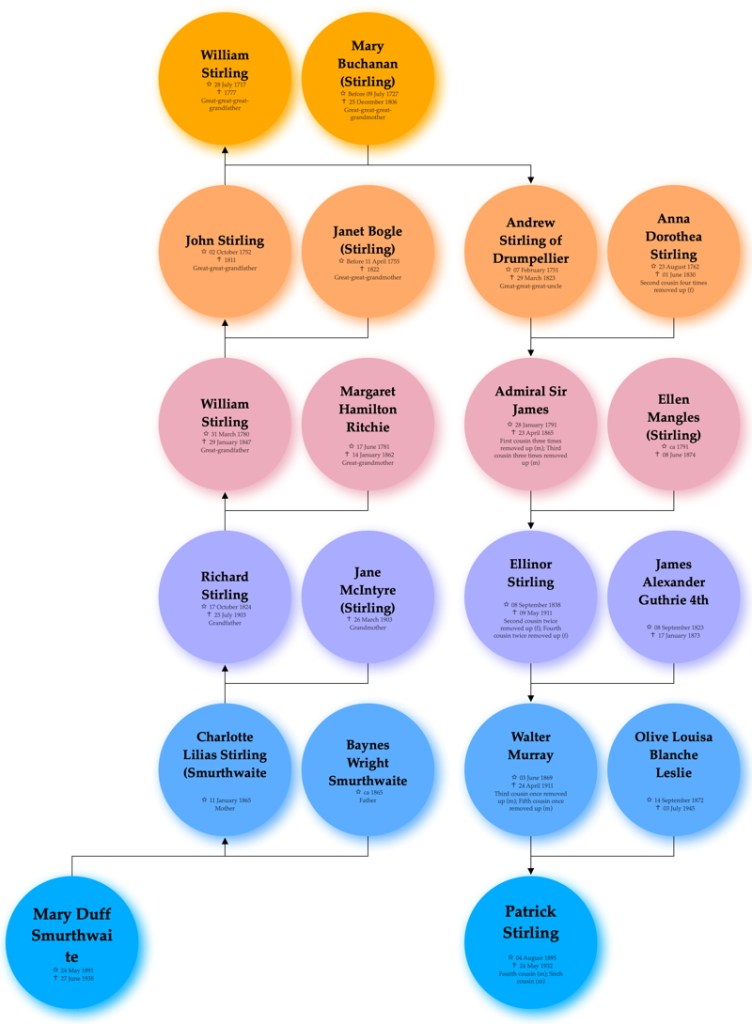
I was able to research the relationship of Mary Duff Smurthwaite and Patrick Stirling Guthrie and confirmed that they were indeed fourth cousins.
My third cousin twice removed, Ken James was also unaware of Pat Guthrie’s friendship with Ernest Hemingway:
“Pat was my paternal grandmother’s brother and I had no idea that Mike Campbell was based on him. I must now get The Sun Also Rises out from the library and re-read it!
Ken James
Ken James also mentioned something that I had been totally unaware of:
Incidentally, another literary connection in the family is that Angela du Maurier “moved in with” Pat’s mother Olive after her husband Walter Murray Guthrie died in 1911. This is described in “Daphne du Maurier and her Sisters” by Jane Dunn (Harper Press 2013) as happening to the consternation of her children, presumably including Pat!
Ken James

I am now the proud owner of a copy of Ernest Hemingway’s The Sun Also Rises, but have yet to read it!
 Vecchio