
The Dowager Countess: If only he would stay inside!
It is now well documented that genomes of all non-sub-Saharan populations share a small percentage of their DNA with Neanderthals and other Hominins. (A Hominin is more or less, but not exactly, what we used to call a Hominid; a creature that paleo-anthropologists have agreed is human or a human ancestor.)
The 2010 Neanderthal genome project‘s draft report presented fascinating evidence for interbreeding between Neanderthals and modern humans. It possibly occurred 316–219 thousand years ago, but more likely 100,000 years ago and again 65,000 years ago.
Neanderthals also appear to have interbred with Denisovans, a different group of archaic humans, in Siberia.
Around 1–4% of genomes of Eurasians, Australo-Melanesians, Native Americans, and North Africans are Neanderthal genes, while the inhabitants of sub-Saharan Africa have either none or possibly about 0.3% Neanderthal genes.
In all, about 20% of distinctly Neanderthal genes survive today. Although many of the genes inherited from Neanderthals may have been detrimental and selected out, Neanderthal introgression appears to have affected the modern human immune system, and is also implicated in several other biological functions and structures, but a large portion appears to be non-coding DNA.
Recent studies revealed that that a long sequence of DNA that is inherited from our Neanderthal ancestors can be linked to severe COVID-19 infection and hospitalisation.
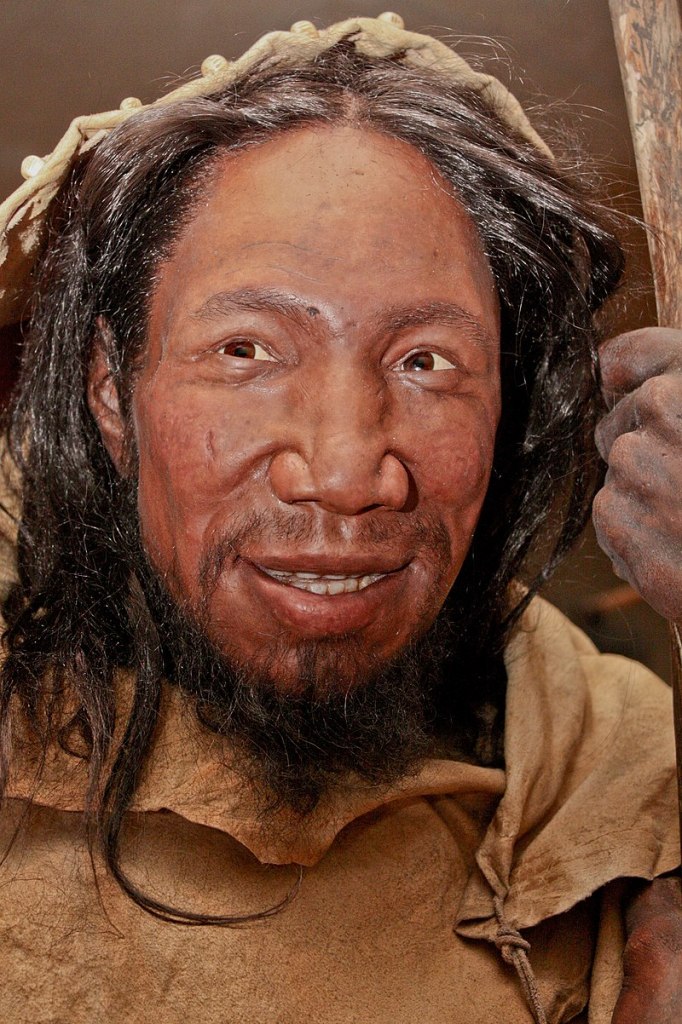
Meet the Hominins
- Toumaï (Sahelanthropus tchadensis)
- Lucy (Australopithecus afarensis
- Selam (Australopithecus afarensis)
- Ardipithecus ramidus
- Flores man (Homo floresiensis – sometimes known as Hobbits)
Guides to Hominin Species
Comparing our DNA with Ancient Samples
Note: In genetics, a centimorgan (abbreviated cM) or map unit (m.u.) is a unit for measuring genetic linkage. It is defined as the distance between chromosome positions (also termed loci or markers) for which the expected average number of intervening chromosomal crossovers in a single generation is 0.01. It is often used to infer distance along a chromosome. However, it is not a true physical distance.
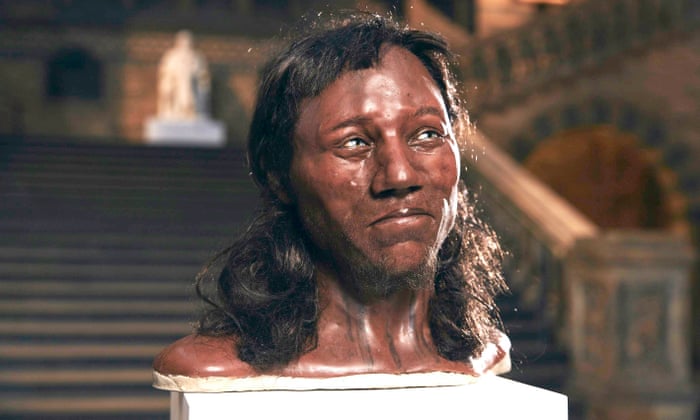
Cheddar Man
There are companies that specialise in matching your DNA with ancient sample. For example, according to MyTrueAncestry I have matches on chromosomes 10 and 21 with an undisclosed sample which was instantly recognisable as Cheddar Man.

Cheddar Man is a human male fossil found in Gough’s Cave in Cheddar Gorge, Somerset, England. The skeletal remains date to the Mesolithic (ca. 9100 BP, 7100 BC) and it appears that he died a violent death. A large crater-like lesion just above the skull’s right orbit suggests that the man may have also been suffering from a bone infection.
Excavated in 1903, Cheddar Man is Britain’s oldest complete human skeleton. The remains are kept by London’s Natural History Museum, in the Human Evolution gallery.
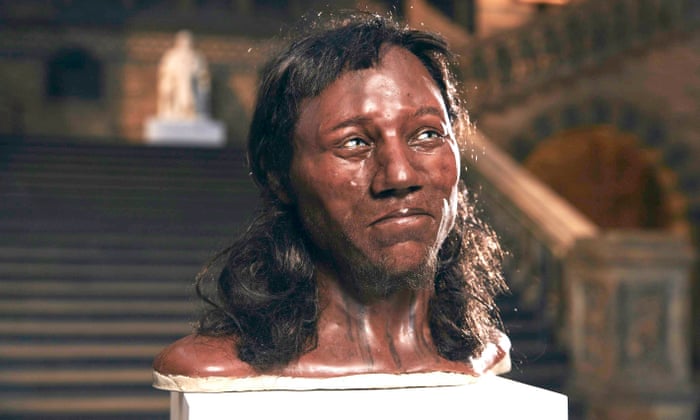
Analysis of his nuclear DNA indicated that he was a typical member of the western European population at the time, with lactose intolerance, probably with light-coloured eyes (most likely green but could be blue or hazel), dark brown or black hair, and dark to black skin, although this analysis has been contested.
DIY Ancient DNA Comparisons
For who are ambitious enough to want to carry out their own comparisons, or for those whose budget is limited, the free tools on GEDMatch provide an excellent way to carry out your own comparisons with ancient DNA.
The Archaic DNA Matches Tool compares your kit with various ancient and archaic samples uploaded to GEDmatch by Felix Immanuel.
Normally I would discount any fragment smaller than 7cM – lower amounts of shared DNA may be very misleading. Due to the random nature of inheritance, two DNA samples may have common pieces of autosomal DNA by chance, rather than by descent. For an explanation of this see Roberta Estes’ excellent blog article: Concepts – Identical by…Descent, State, Population and Chance.
However, here we are not looking at samples with a common ancestor within a few generations, but people who lived thousands of years ago so we need to look at small matching fragments.
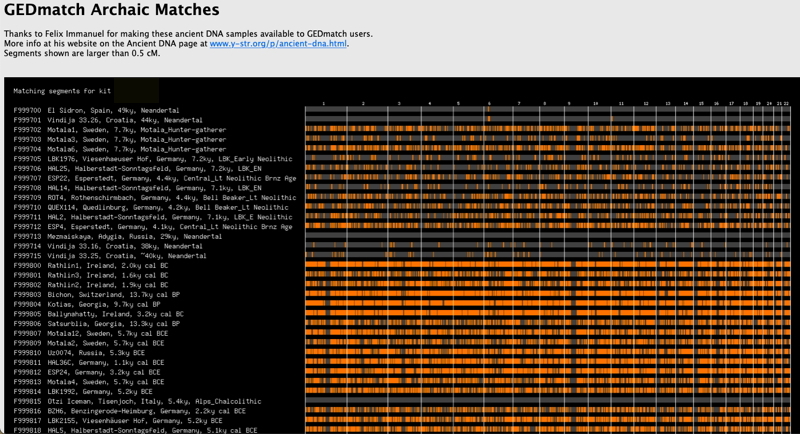
At the basic level of 0.5 cM – see above – unsurprisingly,I had many matches.
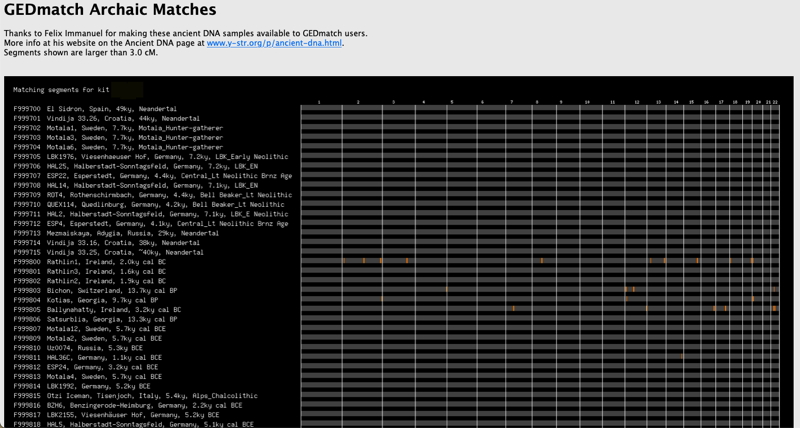
However as I increased the threshold to 3.0 cM and over, the number of matches was reduced considerably and you need to look hard to see the small orange bands of matching DNA on the above screenshot.
You can then use the One-to-one Autosomal DNA Comparison Entry Form. This utility allows you to make detailed comparisons between Autosomal DNA kits. Results may be based on either default dynamically determined thresholds, or thresholds that you provide. You can pick an archaic DNA match (eg F999860, which is a 7,200 year old sample from Hungary) compare it to your kit, and find exactly where and on which chromosome you match the ancient sample.
What does it all mean? Well, it is difficult to be sure. Margaret O’Brien had some excellent advice:
“Fascinating and fun. One genealogy hobbyist asked in a forum – what can I tell from these small shared DNA segments? The best answer, in my opinion, was: “you can tell that you’re human.”
“So, don’t overreach for conclusions when looking at these archaic matches. Just marvel at the fact that we can actually run these comparisons in the present day.“
My Top Matches With Ancient DNA on GEDMatch
I discovered that my closest match, of 5.1 cM on chromsome 1, was with a 7,200 year old DNA sample from Hungary.
For total shared DNA fragments, the winner was a 4,000 year old male from Rathin Island in Ireland (currently Northern Ireland) with five fragments over 3 cM.
Matches of over 5 cM
Kit F999860 Polgar Ferenci hat Hungary 7,200 years ago

Kit F999827 Alberstedt Germany 4,400 years ago

Matches of over 4 cM
Kit F999800 Rathin1 Ireland, 4,000 years ago
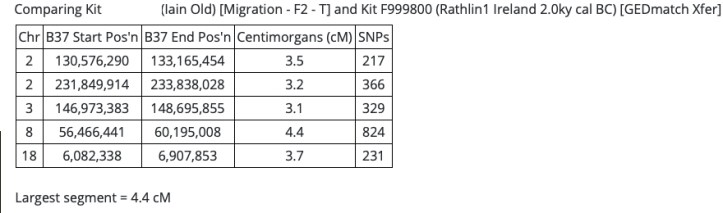
Sample: Rathlin1 / RM127 (Cassidy et al. 2016)
Sex: Male
Location: Glebe, Rathlin Island, Northern Ireland
Age: Early Bronze Age 2026-1885 cal BC
Y-DNA:R-DF21
mtDNA: U5a1b1e
Kit F999828 Quedlinberg Germany, 4,000 years ago

Matches of over 3 cM
Kit F999803 Bichon Switzerland 13,700 years ago
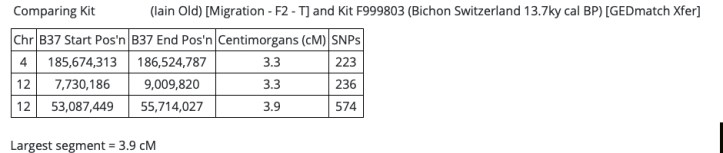
Kit F999841 El Mirador, Spain 5,000 years ago

Kit F999805 Ballynahatty Ireland 5,200 years ago
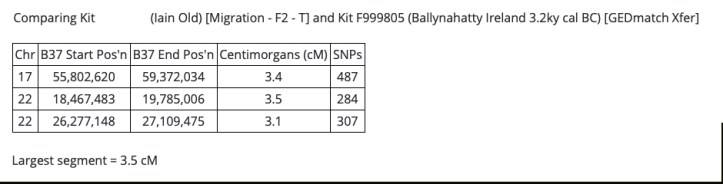
Sample: Ballynahatty / BA64 (Cassidy et al. 2016)
Sex: Female
Location:Ballynahatty, Down, Northern Ireland
Age: Middle to Late Neolithic 3343-3020 cal BC
mtDNA:HV0-T195C!
Kit F999840 Lopatino Russia, 5,000 years ago

Kit F999804 Kotias Georgia, 9,700 years ago

Kit F999865 Barcin, Turkey, 8,300 years ago

Kit F999842 Barcin, Turkey, 8,300 years ago

Kit 999811 HAL36C Germany 3,100 Germany 1,100 years ago

Kit 999824 ESP16 Esperstedt Germany 4,500 years ago

The Rathlin and Ballynahatty samples
I was familiar with the name Rathlin as Robert the Bruce allegedly took refuge on Rathlin in November 1306 just a few months after he was crowned King of Scots by Bishop William de Lamberton at Scone, near Perth, on Palm Sunday, 25 March 1306. (The next day, Bruce had a second coronation by Isabella MacDuff, Countess of Buchan and wife of John Comyn, 3rd Earl of Buchan (a cousin of the murdered John Comyn) who had arrived too late for the coronation. She claimed the right of her family, the MacDuff Earl of Fife, to crown the Scottish king for her brother, Donnchadh IV, Earl of Fife, who was not yet of age, and in English hands.)
Roberta Estes wrote an excellent blog on 3rd November 2020 entitled Ancient Ireland’s Y and Mitochondrial DNA – Do You Match??? There she explains:
“Ancient Ireland – the land of Tara and Knowth and the passage tombs of New Grange. Land of legend, romance, and perchance of King Arthur, or at least some ancient king who became Arthur in legend.
“The island of Ireland, today Ireland and Northern Ireland, was a destination location, it seems, the westernmost island in the British Isles, and therefore the western shore of Europe. Anyone who sailed further west had better have weeks of food, water, and a great deal of good luck.
“But who settled Ireland, when, and where did they come from? How many times was Ireland settled, and did the new settlers simply mingle with those already in residence, or did they displace the original settlers? Oral history recorded in the most ancient texts speaks of waves of settlement and conquest.
“According to two papers, discussed below, which analyze ancient DNA, there were two horizon events that changed life dramatically in Europe, the arrival of agriculture about 3750 BC, or about 5770 years ago, and the arrival of metallurgy about 2300 BC, or 4320 years ago.
“The people who lived in Ireland originally are classified as the Mesolithic people, generally referred to as hunter-gatherers. The second wave was known as Neolithic or the people who arrived as farmers. The third wave heralded the arrival of the Bronze Age when humans began to work with metals.
“Our answers about Irish settlers come from the skeletons of the people who lived in Ireland at one time and whose bones remain in various types of burials and tombs.
“The first remains to be processed with high coverage whole genome sequencing were those of 3 males whose remains were found in a cist burial on volcanic Rathlin Island, located in the channel between Ireland and Scotland.“
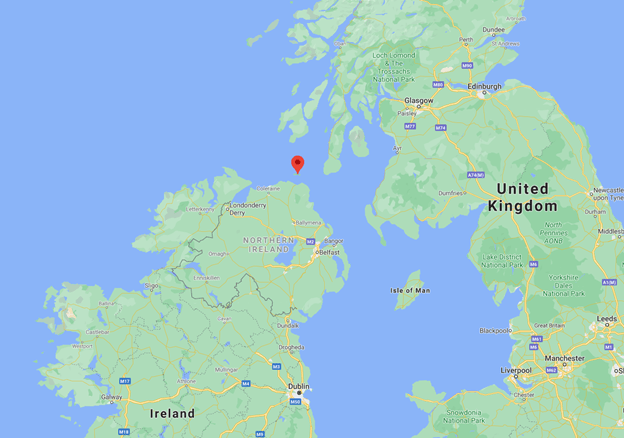
“In 795, Rathlin had the dubious honour of being the first target of Viking raiding and pillaging.
Rathlin Island is but a spit of land, with a total population of about 150 people, 4 miles east to west and 2.5 miles north to south. Conflict on the island didn’t stop there, with the Campbell and McDonald clan, among others, having bloody clashes on this tiny piece of land, with losers being tossed from the cliffs.
The island is believed to have been settled during the Mesolithic period, according to O’Sullivan in Maritime Ireland, An Archaeology of Coastal Communities (2007). The original language of Rathlin was Gaelic. Having been a half-way point between Ireland and Scotland, it’s believed that Rathlin served as an important cog in the Dalriada diaspora with Dalriada people taking their language, through Rathlin, into Scotland from about 300 AD, or 1700 years ago.
The first Irish remains whose DNA was sequenced at the whole genome level are from those three men and a much earlier Neolithic woman.
Three men from a cist burial in Rathlin Island, Co. Antrim (2026-1534 BC) with associated food vessel pottery.
A Neolithic woman (3343-3030 BC) from Ballynahatty, County, Down, south of Belfast, found in an early megalithic passage-like grave.
The female is clearly older than the three Rathlin males. According to Cassidy, et al, 2016, she clusters with 5 other Middle Neolithic individuals from Germany, Spain, and Scandinavia, while the males cluster with early Bronze Age genomes from central and northern Europe, reflecting a division between hunter-gatherer and early farmer individuals.
The males reflect genetic components of the Yamnaya, early Bronze Age herders from the Pontic Steppe, along with an equal level of Caucasus admixture.
The threshold between the Neolithic and Bronze Age fell at about 3750 BC in western Europe and Ireland, right between these two burials.
Even Earlier Burials
In 2020, Cassidy et al sequenced another 44 individuals from Irish passage grave burials ranging in age from 4793 to 2910 BC, or about 3000 to 7000 years ago. All of the men are members of haplogroup I, except two who are Y haplogroup H.
The Rathlin males, all haplogroup R1b, combined with evidence provided by later genetic analysis of passage grave remains point decisively towards a population replacement – with haplogroup R males replacing the previous inhabitants of both Europe and the British Isles.
In far western Ireland, haplogroup R and subgroups reach nearly 100% today.
I would encourage you to read the two papers, linked below, along with supplemental information. They are absolutely fascinating and include surprises involving both the history between Ireland and continental Europe, along with the relationships between the people buried at Newgrange.
Not only that, but the oral history regarding an elite sibling relationship involving the sun was passed down through millenia and seems to be corroborated by the genetics revealed today.
Take a look at these fascinating papers and then, see if you match any of the ancient samples.
Papers
Neolithic and Bronze Age migration to Ireland and establishment of the insular
Atlantic genome by Cassidy et al 2016. with supplemental data.
This paper included the Ballynahatty female and the three Rathlin Island males.
Significance
Modern Europe has been shaped by two episodes in prehistory, the advent of agriculture and later metallurgy. These innovations brought not only massive cultural change but also, in certain parts of the continent, a change in genetic structure. The manner in which these transitions affected the islands of Ireland and Britain on the northwestern edge of the continent remains the subject of debate. The first ancient whole genomes from Ireland, including two at high coverage, demonstrate that large-scale genetic shifts accompanied both transitions. We also observe a strong signal of continuity between modern-day Irish populations and the Bronze Age individuals, one of whom is a carrier for the C282Y hemochromatosis mutation, which has its highest frequencies in Ireland today.
Abstract
The Neolithic and Bronze Age transitions were profound cultural shifts catalyzed in parts of Europe by migrations, first of early farmers from the Near East and then Bronze Age herders from the Pontic Steppe. However, a decades-long, unresolved controversy is whether population change or cultural adoption occurred at the Atlantic edge, within the British Isles. We address this issue by using the first whole genome data from prehistoric Irish individuals. A Neolithic woman (3343–3020 cal BC) from a megalithic burial (10.3× coverage) possessed a genome of predominantly Near Eastern origin. She had some hunter–gatherer ancestry but belonged to a population of large effective size, suggesting a substantial influx of early farmers to the island. Three Bronze Age individuals from Rathlin Island (2026– 1534 cal BC), including one high coverage (10.5×) genome, showed substantial Steppe genetic heritage indicating that the European population upheavals of the third millennium manifested all of the way from southern Siberia to the western ocean. This turnover invites the possibility of accompanying introduction of Indo- European, perhaps early Celtic, language. Irish Bronze Age haplotypic similarity is strongest within modern Irish, Scottish, and Welsh populations, and several important genetic variants that today show maximal or very high frequencies in Ireland appear at this horizon. These include those coding for lactase persistence, blue eye color, Y chromosome R1b haplotypes, and the hemochromatosis C282Y allele; to our knowledge, the first detection of a known Mendelian disease variant in prehistory. These findings together suggest the establishment of central attributes of the Irish genome 4,000 y ago.
Do You Share Ancient Irish DNA
I also found and excellent article on Do You Share Ancient Irish DNA? Find Out With GEDmatch published on 6th November 2020 by Margaret O’Brien which states:
“If you have low cm matches, then this can be due to chance nature of inheritance. Also, many modern Irish people will have low connections to thes ancient samples. We are looking at periods of migration of peoples across continents.”
One person had a relatively large area of homology of 8.1cM (with Ballynahatty not Rathin) on chromosome 22. Margaret O’Brien commented:
“Its one of the highest reported here. Most people are seeing 3-4 cm. At 8 cM, you’re still well within the range of inheritance by chance but less so than the lower numbers.“
She also notes that “The ancient Irish samples are not part of the Archaic DNA collection.The Irish samples were prepared by Matt Kitching using the same techniques and uploaded as individual DNA kits to GEDmatch.“
The Rathlin Island Bronze Age Males
These three male specimens date back to the Bronze age. They are dated from three to four thousand years old.
Rathlin Island is further north, off the coast of Antrim, Northern Ireland. People still live there, which makes it the most northern inhabited island off the coast of the island of Ireland.
Unlike the Ballynahatty female, these men had genetic variants for blue eyes. They also have the most common Y type found in the modern Irish population. The DNA point to ancestors from the Pontic Steppes.
Evidence for Mass Migration Into Ireland
Dr Lara Cassidy of Trinity College Dublin says that modern Celts are closer to the Rathlin Island men than the Ballynahatty woman.
Genetic affinity is strongest between the Bronze Age genomes and modern Irish, Scottish and Welsh.
Dr Laura Cassidy
Professor Dan Bradley of Trinity points out that these genomes show evidence of a wave of migration into the island of Ireland.
There was a great wave of genome change that swept into Europe from above the Black Sea into Bronze Age Europe and we now know it washed all the way to the shores of its most westerly island.
Professor Dan Bradly.
Guides For Comparing Your DNA With Ancient Samples
 Vecchio