

Birth and Marriage
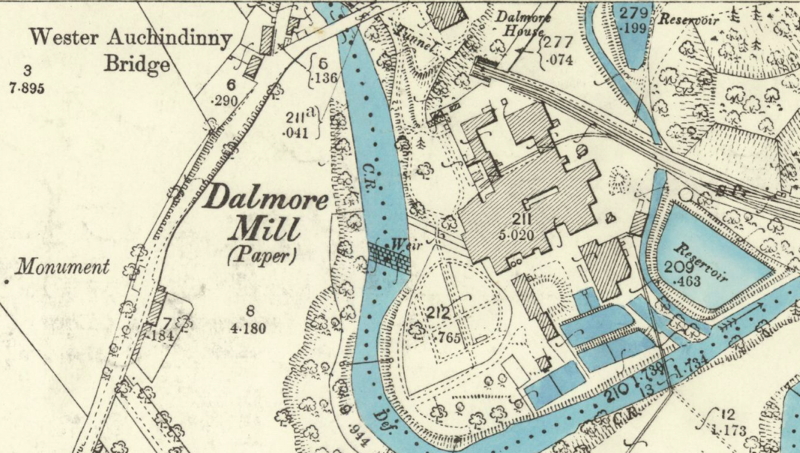
James David Tod Old was born on 17 January 1917 at Westerlea, Westerbridge, Auchindinny in Penicuik parish in Midlothian. He was the son of James Tod Old, a clerk in a paper mill (which can be seen on the map above) and his wife, Mary Turner Hardie Forrest Brown.
He had an elder sister, Janet Marshall Hardie Forrest Old, who was born on 17 November 1913, also at Westerlea, Westerbridge, Auchindinny in Penicuik parish in Midlothian.
On 23 December 1939, three months after the outbreak of the Second World War, James Old married Mabel Stoddart. The ceremony was performed by the Rev. Stewart Cooper after Banns According to the Forms of the Church of Scotland at Saint Mungo’s Church in Penicuik. At the time of the wedding, his occupation was given as Lance Sergeant, 1st Lothians & Borders Yeomanry and his normal place of residence was Bhurtpore Barracks at Tidmore in Wiltshire, in England. The barracks at Tidmore had been named for battles in India and Afghanistan.
The Dunkirk Evacuation
The story of Dunkirk is well known, from popular history, propaganda, and films. On 26th May 1940, the British Expeditionary Force (BEF) was ordered to withdraw to the coast for evacuation: the following day the exhausted Belgian Army, on the left flank, was compelled to surrender and in a series of hard-fought actions the whole of the BEF and part of French First Army withdrew within a perimeter initially running from Dunkirk to Nieuport but thereafter contracting daily. This withdrawal was greatly aided by the stand of part of the French First Army cut off near Lille. The harbour basins having been destroyed by bombing the evacuation, over a calm sea and under Royal Air Force protection, took place from piers, breakwaters and open beaches. From England 800 vessels were assembled to work under Royal Navy direction, many of them small craft manned by their civilian crews. By 4th June 1940, 338,000 Allied troops (198,000 British) had been evacuated.
The Battle of Saint Valery
However, there was another story that was not publicised. On that same date, 4th June 1940, south of the German wedge, there were still 140,000 British troops stranded in France. The 1st Regiment of Lothians and Border Yeomanry had embarked from Southhampton on 11 January 1940 as part of the 51st Highland Division, which had been sent to reinforce the French Maginot Line and was serving there when the Germans started their offensive.

Together with the rest of the Division, the regiment attempted to rejoin the British Expeditionary Force (BEF). In June 1940, the 51st (Highland) Infantry Division, under the command of Major-General Victor Fortune, was attached to French 10th Army. Moving around the south of Paris, the regiment engaged the German Army south of the River Somme near Abbeville. Outnumbered, it fought a retreat of sixty miles in six days to the fishing port of Saint Valery-en-Caux. There, having run out of food, ammunition and other supplies, and the town having been partly destroyed in the fighting, they were forced to surrender on 12 June 1940 to Major-General Erwin Rommel:

The history of the 1st Lothians and Borders Yeomanry notes:
“Unable to fight or retreat, the only choice was capitulation. On the morning of June 12, the white flag was raised from the church steeple. The order to cease fire given by the French general was hard to obey for those who had fought valiantly for several days and had seen their companions in arms fall alongside them. German tanks moved down from the cliffs, took the Le Havre road and entered Saint Valery to accept the Allies’ surrender. More than 40,000 men were taken prisoner and a substantial stock of equipment was confiscated. So began the occupation, that was to last for over four years.”
Prisoner of War at Stalag 383
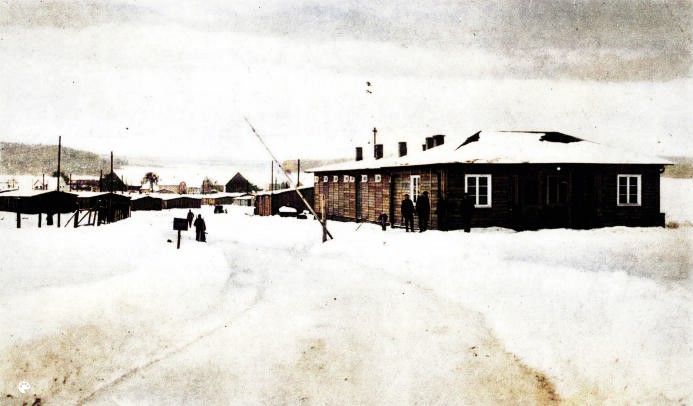
James Old was taken prisoner and interned at Stalag 383, a German World War II Prisoner of War camp located in Hohenfels, Bavaria. The German Army had founded a training area near Hohenfels, Bavaria in 1938. A troop camp for trainees, located in a high valley surrounded by dense woodland and hills at a homestead called ‘Polnrich’, it was commandeered for use as a Prisoner of War camp in 1939. At first it was used for Allied NCOs and named Oflag IIIC but was later renamed Stalag 383 as it expanded with other ranks. The camp comprised 400 detached accommodation huts, 30 feet (9.1 m) x 14 feet (4.3 m), each typically housing 14 men. More were built towards the end of the war as prisoners were moved in from other camps as the Russian front advanced from the east. The name, Oflag III-C, was re-assigned to a camp at Lübben (Spreewald) and operated between August 1940 and June 1942.
Amazingly, photos of James Old as a Prisoner of War exist, but we might have missed them as his name was not recorded as James Old but as “Jimmy Auld”.

STALAG: 383 Hohenfels with – back row: Ian McDougall; ?; Bert Christie; Jimmy McKenna; Tam Bowie; Freddie Laws; Bill Miller; Hughie Cairncross. Middle row: ?; Tommy Kerr; Dick Kerr; Paddy Leckie; Bill Brydon. Front row: Arthur Symington; ?; Jimmy Auld; Sandy Fairley. Photo credit: Lothians and Borders Yeomanry.

383 on 12 June 1943: The Lothian 4th right in the second row is Jimmy Auld. Picture credit: Lothian and Borders Yeomanry.
Liberation
On 24 April 1945, Major General Stanley Eric Reinhart‘s 65th Infantry Division captured Hohenfels. Major General Gustav Geiger, staff and guards surrendered. The POW camp with numerous British inmates, including James Old, was liberated.

Death
It seems possible that James Old’s military service and years in a prison camp may have shortened his life as he died on 18 April 1959 at 69 Bonnyrig Road in Dalkeith at the relatively young age of 42. His occupation was Carpet Designer and the cause of death was a (third) coronary occlusion. He had no children and his death was recorded by his niece’s husband.
They shall grow not old, as we that are left grow old:
From: For the Fallen
Age shall not weary them, nor the years condemn.
At the going down of the sun and in the morning
We will remember them.
Poem by Robert Laurence Binyon (1869-1943), published in The Times newspaper on 21 September 1914

Further Reading
Normandy Then And Now: The Other Dunkirk: “History we learn in school, or from films and occasional newspaper articles, hails the courage of rescuers and the rescued from Dunkirk between 27 May and 4 June 1940. A tidy story that often fails to mention the thousands of British troops left behind in France. Or the appalling weeks they faced, brave but vastly outnumbered by the German war machine.”
 Vecchio